
The Monkey’s Paw: Markets And Misaligned Proxies

by Jochen Szangolies
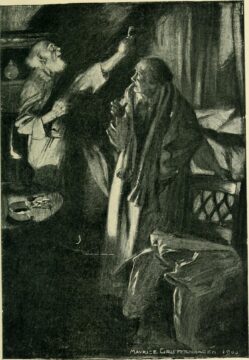
Illustration for W. W. Jacobs’ short story The Monkeys Paw, by Maurice Greiffenhagen. Image Credit: Public domain.

It was while watching the unveiling video of 1X Technologies’ home robot assistant Neo that I was hit with a revelation of a fundamental truth of our current moment in time: the world is a lot as if my ten year old sci-fi nerd self had had many of his wishes fulfilled, but by a cursed monkey’s paw. You want robots? You got it, but they’re creepy, kind of useless, probably spying on you and nevertheless will displace human workers from their jobs. You want AI? You got it, but it frequently makes stuff up, traps people in parasocial relationships while isolating them from the real world, floods the social sphere with misinformation and bad art, threatens the environment and funnels power to the people least fit to wield it.

A widespread narrative is that today, we have it better than at any previous time in human history: we live longer, are healthier and wealthier, better educated, have access to more and better nutrition, and are less likely to die from war or through homicide than ever. At the same time, however, we are faced with widespread ecosystem collapse, having just blown past the first catastrophic climate tipping point leading to near-certain die-off of coral reefs around the planet, the 1.5°C-goal may already have been eclipsed with global warming hitting a possible inflection point, depression and other mental health issues are on the rise even in the richest countries, income inequality is increasing as the richest snatch up an ever bigger piece of the pie, and wildlife populations have declined by a staggering 73% in the past 50 years. As a result, we seem to have very wildly divergent perceptions of our current reality: in one, we’re essentially living better than kings in the past; while in the other, we’re about to drive off a cliff with the wholesale destruction of our living environment.

So what gives? Who’s right—the Pinkerish peddlers of Panglossian optimism or the Monbiotesque negative Nancies decrying the despoliations of the neoliberal order? And how can there be two so vastly contradictory narratives, each of which claims a mountain of charts, data, and analysis in its favor? Read more »

Tuesday, August 12, 2025

Why I’m Quitting Substack

by Mark R. DeLong

An orange background and the Substack logo, jittered in vertical segments.
Based on Castro, Jinilson. Logo of Substack. March 1, 2025. Wikimedia Commons. Rights: CC BY-SA 4.0

This month, I’m closing up the years-long run of my Substack newsletter. I’ve decided to stand up my own newsletter site, despite the hassle, the modest expense, and the loss of what Substack touts as its “network.” The decision revealed to me some of the usually enshrouded assumptions that writers make about their work and the media they choose to release it. The relationship is hardly linear; it’s not just writers cooking up work that media mechanically release to a readership. Over the years, Substack’s evolution unveiled assumptions that complicate and shift the simple linear creation-to-publication process.

I decided Substack’s emerging assumptions about writing and publishing weren’t really mine. The simple model of writers writing and then somehow publishing is too simple; it ignores useful signals that shape a writer’s creation as a piece moves toward a readership (or, as often is the case, toward the desk drawer or wastebasket), and it ignores the targeting or even creation of a readership—the key to “making a living” as a writer. Substack’s evolution as a “publishing service” is an example of how media—and particularly social media—nurture or contort writers and, in the process, shape them to fit publication processes and the readerships that those processes conjure up.

After four years, Substack and I grew apart, so I’m ending the relationship.

My initial choice to set up a “stack” was in no small measure just a way to solve an email problem. In 2022, I had few designs on literary quality, much less delusions of pursuing a life of writing. Through the Covid pandemic, it was my habit to send an email to my students every morning, a message they eventually named the “morning missive.” When I wasn’t nagging at them, which was infrequent, students found them useful and even entertaining, and for me it was a means to start a weekday in a summary of an interesting item I read, some quick take on happenings, a musing quite broadly defined, or sometimes a crabby snap at students slacking off in seminar readings. Most missives related to the theme and content of the course. Read more »