
Three Takeaways, Number Two: We’ve Screwed The Pooch, Apparently

by Mike Bendzela

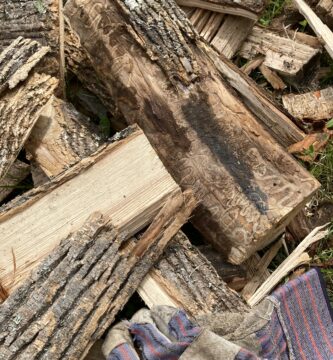
Debarked white ash logs showing “galleries” caused by the feeding of emerald ash borer larvae. Photo by the author.

From preface of Number One last month: Anytime is a good time to take stock of what you think you know, or what you think you have actually learned, but once you have seen two-thirds to three-quarters of your life pass, it would seem rather high time to do so. For all I know, the full measure has actually passed, as I could drop dead tomorrow while digging a grave at my summer job, so I had better hurry with this. [. . .] What would I say if, launched into the firmament and finding myself at Heaven’s Gate, St. Peter said to me, “What have you learned, sinner?” So, a few things I think I actually do know, in descending order of certitude, over the course of three articles: evolution, overshoot, determinism.

The human species likely exists in a state of ecological overshoot. The question is, how much longer can we exist in such a state? Can we prop up our behemoth of an existence for much longer?

That “apparently” in the title has to do a lot of work: I cannot actually say that I know this is true, the way I can say that evolution is true, but it sure looks that way to me (and I must thank sociologist William Catton and human ecologist Bill Rees for their work and insight).

In some ways the two ideas pull in opposite directions. The certainty of evolution is apparent in the abundance of Earth’s archives of evidence, which consists of traces of evolution’s past meanderings over a billion years, sussed out through 200 years or so of hard scientific labor. Overshoot, on the other hand, is about the weight of the present human “ecological footprint” and its bearing on an uncertain future. But they both have in common the idea of the inevitability of mass die-0ffs.

Is it possible for an issue or problem to be so large as to be invisible? I’ve already expressed how evolution by natural selection lay unseen all throughout human history until about 170 years ago, even though it is responsible for all life on the planet. Darwin states succinctly that it is the “laws existing around us” that have brought forth, well, everything. But we were blind to this for two chief reasons:

The mind cannot possibly grasp the full meaning of the term of even a million years; it cannot add up and perceive the full effects of many slight variations, accumulated during an almost infinite number of generations.

We will tend to notice the immediate effects of a condition even while being blind to it as the ultimate cause. A patient experiences chronic numbness in the legs and goes into treatment for neuropathy. Later, the patient experiences loss of vision and seeks treatment for retinopathy. There was a time when the chief cause of these signs, Type 1 diabetes, was unknown. The patient had been treating symptoms all along, not the disease.

Currently, we are obsessed with “solving” a plethora of “problems”: climate change, ocean acidification, soil erosion and loss of arable land, PFAS and microplastics contamination, resource depletion, etcetera. But these are mere symptoms of a larger, untreated disease. Read more »
Friday, April 10, 2026

This Is What Happens

by Mike Bendzela

This is what happens when you revere the fancies of Iron Age sheep:

This is what happens when you christen a parcel of dust Holy Land:

This is what happens when you refuse to give up worship for Lent:

This is what happens when you litter North, South, East, West with prayers:


This is what happens when you ignore 3.8 billion years of organic evolution:

This is what happens when you fail to dismember the Great Chain of Being:

This is what happens when you think the word “ape” is an insult:

This is what happens when you no longer pine for a tail:


This is what happens when you try to burn your way to prosperity:

This is what happens when you can’t stop inhaling the exhaust fumes:

This is what happens when you become addicted to hypersonic speed:

This is what happens when you replace eyes with satellites, flesh with plastics, legs with wheels:


This is what happens when you deify the neoplasm:

This is what happens when you parse survival into fractions of billions:

This is what happens when your cornucopia takes root in the earth’s crust:

This is what happens when leverage, interest, derivatives become shibboleths: Read more »

Sunday, November 16, 2025

The Monkey’s Paw: Markets And Misaligned Proxies

by Jochen Szangolies

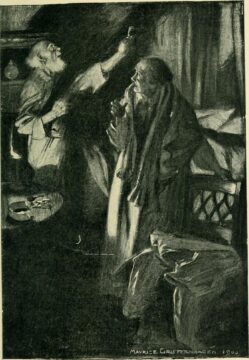
Illustration for W. W. Jacobs’ short story The Monkeys Paw, by Maurice Greiffenhagen. Image Credit: Public domain.

It was while watching the unveiling video of 1X Technologies’ home robot assistant Neo that I was hit with a revelation of a fundamental truth of our current moment in time: the world is a lot as if my ten year old sci-fi nerd self had had many of his wishes fulfilled, but by a cursed monkey’s paw. You want robots? You got it, but they’re creepy, kind of useless, probably spying on you and nevertheless will displace human workers from their jobs. You want AI? You got it, but it frequently makes stuff up, traps people in parasocial relationships while isolating them from the real world, floods the social sphere with misinformation and bad art, threatens the environment and funnels power to the people least fit to wield it.

A widespread narrative is that today, we have it better than at any previous time in human history: we live longer, are healthier and wealthier, better educated, have access to more and better nutrition, and are less likely to die from war or through homicide than ever. At the same time, however, we are faced with widespread ecosystem collapse, having just blown past the first catastrophic climate tipping point leading to near-certain die-off of coral reefs around the planet, the 1.5°C-goal may already have been eclipsed with global warming hitting a possible inflection point, depression and other mental health issues are on the rise even in the richest countries, income inequality is increasing as the richest snatch up an ever bigger piece of the pie, and wildlife populations have declined by a staggering 73% in the past 50 years. As a result, we seem to have very wildly divergent perceptions of our current reality: in one, we’re essentially living better than kings in the past; while in the other, we’re about to drive off a cliff with the wholesale destruction of our living environment.

So what gives? Who’s right—the Pinkerish peddlers of Panglossian optimism or the Monbiotesque negative Nancies decrying the despoliations of the neoliberal order? And how can there be two so vastly contradictory narratives, each of which claims a mountain of charts, data, and analysis in its favor? Read more »