Uff Da! Yeah, You Betcha.

by Mark R. DeLong

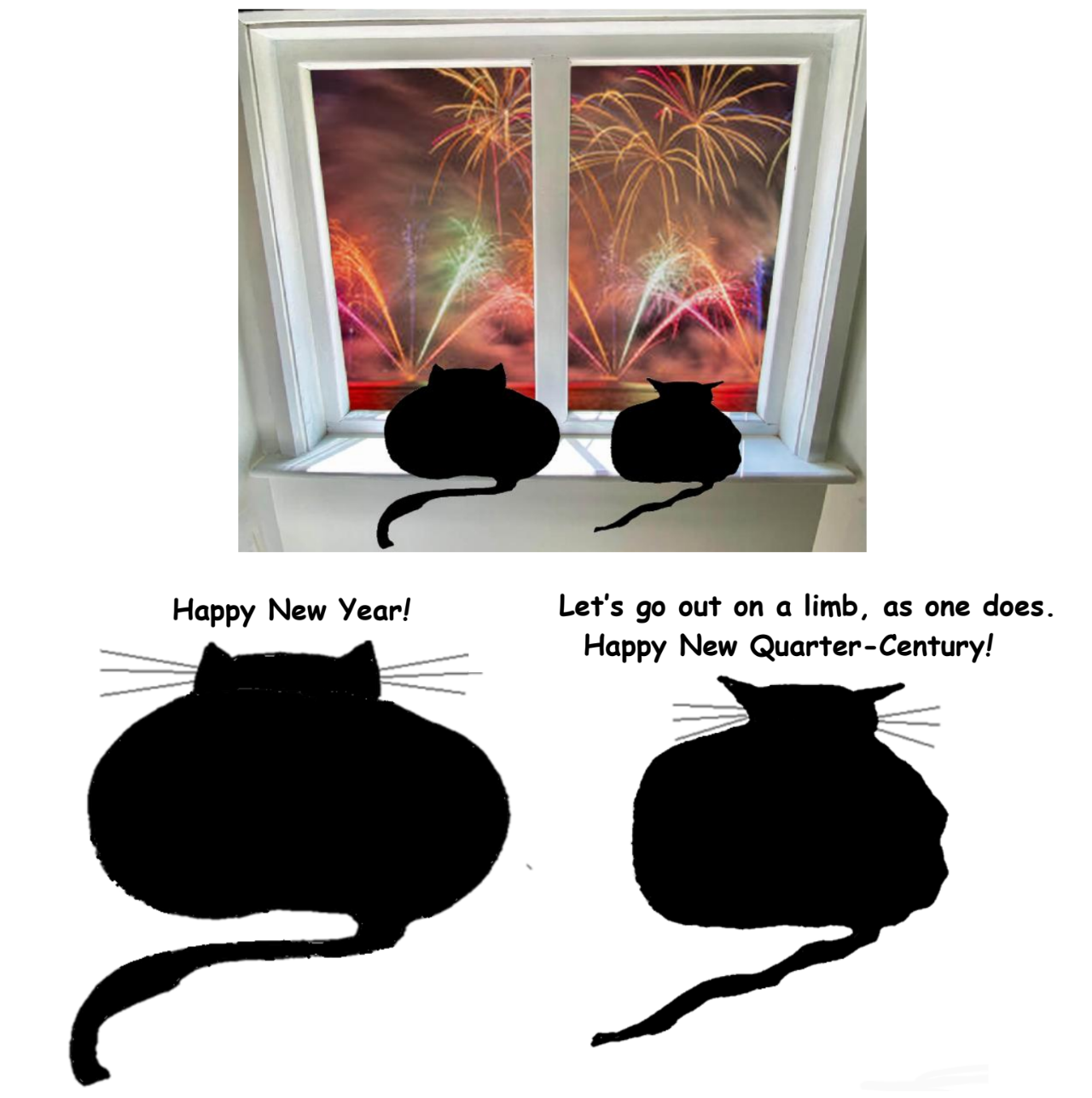
A colorful ocean fish (cod?) with its tail curled as if swimming wears a Viking helmet with two horns.
Ingebretsen’s Nordic Marketplace, “Maybe Lutefisk Isn’t What You Think It Is”

My mother ordered the annual parcel of lutefisk from Olsen Fish Company in Minneapolis, Minnesota. Determined to bring some of her Minnesota Norwegian Christmas tradition to our home in Oklahoma, where our family moved when I was in high school, she phoned in the order in November or even earlier. The package appeared a few days later, fish solidly frozen in dry ice—probably the only package of lutefisk to arrive in the state. When she nestled the butcher-paper wrapped lump into the freezer, I knew we were doomed.

She was trying to invoke Christmases she had lived in Minnesota, and a big part of that had to do with smell, the sense especially tied with memory.

Lutefisk dinners were common in Lutheran church basements in the upper Midwest US, and still happen even though some never recovered from the disruption of the Covid pandemic. Nationally, lutefisk sales slumped then and only recovered to about 300,000 pounds in 2022, significantly lower than the 800,000-or-so pounds made in the early 1990s. In small towns like the one I grew up in, the feasts always took place around Christmas, and the rumor in my home village was that churches, despite their doctrinal differences, would coordinate schedules such that it was possible to have a lutefisk dinner several times during the season. The fish, I guess, drove a true ecumenical movement and drew together the large community of families whose ancestors had immigrated from Scandinavia. Generations knew the odd pleasures of lutefisk first-hand, though, no doubt, the draw of the Christmas dinner fish puzzles many of them (including me).

Lutefisk, to put it bluntly, stinks. And that, ironically, might be part of its charm. Read more »

Towers in a Park Revisited

by Angela Starita

Aerial view of Co-Op City, Bronx, NY

Large-scale housing projects have been the subject of the public’s wrath and ardor for at least the last 70 years. Considering the extraordinary housing crises in cities across the country, it’s not surprising that Herman Jessor, the engineer-turned-architect behind the best-known cooperative developments in NY, is the subject of two studies and exhibitions, both coming out of The Cooper Union, Jessor’s alma mater. I work as a writer at Cooper, so perhaps my Jessor-looms-large-in-the-zeitgeist notion is skewed in his favor, but I can’t help but think that his work, which so promoted community bonds, is ripe for a reassessment exactly because we seem suddenly aware of the dangers of solitude. It’s also a moment when most everyone wants to beat a fast exit from civilization. Magazine and newspaper articles describe women starting their own small-house community, LGBTQ collectives built around farms, and MAHA families embracing back-to-the-land philosophies reminiscent of the Whole Earth Catalog.

What makes Jessor all the more intriguing, though, is that his solutions were decidedly urban, on a very large scale, and highly successful by any number of metrics—he is estimated to have built more than 40,000 residences most of which are still occupied and have low turnover. The March 2025 exhibition at Cooper included a map of the five boroughs with all of the Jessor-designed projects, including Penn South in Chelsea, Seward Park Houses on the Lower East Side, Co-op City in the Bronx, and Rochdale Village in Queens, the largest Black-majority housing co-op in the world. Most were built for unions like the International Ladies Garment Workers Union and the United Housing Foundation which was run by Abraham Kazan, an organizer and frequent Jessor partner.

The buildings, variations on the towers in the park scheme popularized by the modernist architect Le Corbusier, prioritized ventilation, eat-in kitchens, and numerous shared spaces. Co-op City, for instance, includes gardens, playing fields, a cooperative grocery store, and schools. Jessor and Kazan developed streamlined construction systems that made for more affordable buildings. Most of them remain affordable thanks to programs like the Mitchell-Lama program in New York State that subsidizes housing for middle-class residents.

What Jessor’s work doesn’t provide is anything akin to low-rise neighborhoods like Greenwich Village and the aesthetics associated with them. Read more »

Thursday, January 1, 2026

The UFO Disclosure Trap

by David Kordahl

Government secrecy makes UFO claims impossible to verify—or disprove.

When I lived in Arizona, my next-door neighbor once told me that he had seen a time machine. These types of anecdotes are not uncommon in Arizona, out on the edge of the world. At the time, I was in graduate school for physics at Arizona State, and I presumed my neighbor was either lying or confused. He had seen the time machine, he told me, behind the door of a restricted area of his former employer, a defense contractor in Tucson. I nodded politely and let it slide, much as I would for the claims from our neighborhood Mormon missionaries or the 9/11 Truthers whose stand I passed daily on my walk to the cafeteria.

I was thinking about my old neighbor when I recently came across a clip of Joe Rogan speaking with Dan Farah, the director of a new documentary, The Age of Disclosure. If Farah is to be believed, my neighbor might indeed have seen something behind that door. The Age of Disclosure claims that crashed Unidentified Aerial Phenomena—and, yes, UAPs are just UFOs by another name—have been studied by defense contractors for some eight decades, and that failing to take them seriously poses a risk to national security.

Regular readers will know that UFOs and US government secrecy are both part of my beat here at 3QD, so I grabbed my tinfoil hat and pressed play.

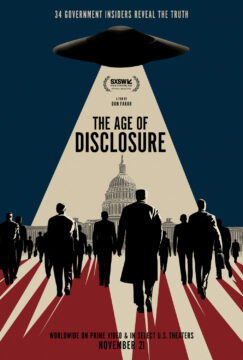
The Age of Disclosure tells a story that, as many critics have noted, is by now pretty familiar, which doesn’t stop it from being pretty crazy. The vibe of the film owes much to conspiracy thrillers like The Parallax View or JFK, with frequent solemn shots of national monuments thrumming to a continuous soundtrack. A good deal of the runtime is filled by montages of dark-suited men saying things like “UAPs are real, they’re here, and they’re not human.” The movie’s poster tagline, “34 Government Insiders Reveal the Truth,” gives a good idea about what it offers: clips of military, intelligence, and congressional officials affirming, on the record and under their own names, that they think UFOs are a real concern. Read more »

Wednesday, December 31, 2026

The Year of the Whale: Re-Reading Moby Dick

by Leanne Ogasawara

1.

Maybe this is something that happens when you reach a certain age?

But lately, I’ve found myself yearning to revisit things like paintings and books. Ones I loved when I was young. Like standing before Raphael’s Madonna del Cardellino in the Uffizi again. I was nineteen when I first saw the picture. Viewing it again thirty years later, I asked myself: How has the painting changed? How has the viewer changed? Am I even the same woman now? Or maybe it is the world that has moved on….

It was not long after seeing the Raphael that I first read Moby Dick. A philosophy major at Berkeley, I read Melville’s novel in a class taught by world-renown Heidegger scholar Hubert Dreyfus. The class, was called “Man, God, and Society in Western Literature” and Moby Dick was the last work on the syllabus, after reading Homer, Virgil, and Dante. Indeed, it was the culmination of the class.

The greatest book of American literature ever written, Professor Dreyfus told us this again and again.

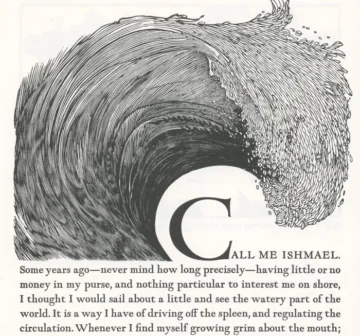
Call me Ishmael.

God, I loved that first sentence… But it was the rest of that opening paragraph that really grabbed and shook me.  That same one about which Ta-Nehisi Coates judged to be “the greatest paragraph in any work of fiction at any point, in all of history. And not just human history, but galactic and extraterrestrial history too…” Here it is:

Some years ago—never mind how long precisely—having little or no money in my purse, and nothing particular to interest me on shore, I thought I would sail about a little and see the watery part of the world. It is a way I have of driving off the spleen, and regulating the circulation. Whenever I find myself growing grim about the mouth; whenever it is a damp, drizzly November in my soul; whenever I find myself involuntarily pausing before coffin warehouses, and bringing up the rear of every funeral I meet; and especially whenever my hypos get such an upper hand of me, that it requires a strong moral principle to prevent me from deliberately stepping into the street, and methodically knocking people’s hats off—then, I account it high time to get to sea as soon as I can.

The words exert the same power over my imagination now as they did back then when I was nineteen. Re-reading the novel this year, as I am also consulting several other books about Moby Dick, I learned that nowadays people consider that Ishmael was depressed and maybe even suicidal during that dark and drizzly November of his soul.

But back when I was nineteen, I didn’t think of it like that.  Read more »

If the Poor Die, the Rich Die Too: A Review of “The Insider” by Teater Katapult in Hong Kong

by Daniel Gauss

Credit: Mathias Bender

The whistleblower in The Insider is introduced to us in a glass booth, evocative of the type defendants sit in at trial in some European countries. We wait for the theater piece to begin by listening through headphones to someone singing Money (That’s What I Want). We will hear everything through headphones. The only character in front of the audience will be the whistleblower/insider and all the voices he recalls and responds to, as well as anything he says, and any other sounds, will be piped into our ears.

The insider is trapped with his own recollections, which we are privy to. How he got trapped with these painful memories, and his way out, are the purpose of this theater piece. He is in the process of remembering and reliving his interrogation by a prosecutor, and other aspects of his life relevant to the Cum-Ex financial scandal he came forward to expose to the German authorities.

Cum‑Ex was a European‑wide tax fraud scheme, carried out from the early 2000s until its exposure in the late 2010s, in which bankers and investors exploited dividend tax loopholes to siphon off billions of euros. Some investigative journalists and researchers estimate that the scheme cost European treasuries up to €55 billion in total, with losses to Germany alone estimated at more than €30 billion.

The headphones mostly bring us voices – often the voice of the prosecutor. Many of the voices are intrusive memories that the insider cannot stop because he cannot answer them adequately due to his moral shame, struggle with denial and ambiguity concerning his own motives: his motives to first object to fraud at his bank, then to participate in the fraud and then to turn the bank in. This inner turmoil may mirror the internal trial, doubt and pain that many whistleblowers endure. Read more »

Tuesday, December 30, 2026

A Painful Paradox: Hoover And The Bonus March

by Michael Liss

We had reached a place in Virginia. It was a very hot day. In this jungle, there was a man, a very tall man. He had with him his wife and several small children. We invited them over to have something to eat with us, and they refused. Then I brought something over to them on an old pie plate. They still refused. It was the husband who told me he didn’t care for anything to eat. But see, the baby was crying from hunger. —Jim Sheridan, Bonus Marcher, quoted in Studs Terkel’s Hard Times

Bonus Army veterans heading to Washington, D.C., on the outside of a freight train, 1932.

There is a mood, a color, to the Great Depression. It’s a shade of gray, sooty and ominous, without sun, almost without hope. Wherever its victims stopped—on city streets and farms, on a muster line or on one for bread, outside tents or structures made of bits and pieces of packing boxes and cardboard, on trussed-up jalopies headed West, or on boxcars with hoboes like Jim Sheridan—there were chroniclers of images and words, all gray. Gray and ominous as well were the faces of those who were leaders in business and politics. Dark suits, white shirts, muted ties, emitting seriousness of purpose, and consciousness of class. Those men were Authorities—vested with power, but often remote from those who would be impacted by their actions, or non-action. They shared with their peers a fervent belief in their own self-worth, earned through moral superiority.

Herbert Hoover was in this second group. He had fought for and secured it through intensely hard work and great talent. He was the “Great Engineer,” the perfect man to be heir to a pro-business philosophy that had, in the Harding-Coolidge years, brought abundance. His landslide victory in November 1928 promised more of the same—more jobs, more innovation, more wealth, an appreciably raised standard of living, and the possibility of moving up in class, as he had. A better statesman for Capitalism, for the American Dream, for the American Promise was hard to imagine.

It blew up, of course, most spectacularly in the stock-market crash, but also as a result of secular forces both in the United States and abroad that made seemingly healthy economies reel. That these problems pre-dated Hoover’s taking office did not grant absolution for their existence. You don’t get a honeymoon in a crisis. Nor did successive governments in other Western countries get one. Democracy tottered because its stewards seemed inadequate to the task. Should they continue to prove to be inadequate, then more authoritarian forms of government might be the answer. Italy was already under the fist of Mussolini, Japan was eyeing China as a resource-filled morsel, and Germany was considering an angry man with a funny mustache who seemed a bit bellicose, but maybe could put people back to work.

What of the United States? In what direction would it go? Read more »

The Pluribus Utopia

by Marie Snyder

The recent show Pluribus has got me thinking differently about the kind of ideal state that might be a laudable direction and how to get there. The show is overtly about a hive mind interconnection, that started with a lab-leaked experiment, which affects almost all of the world except for 13 people who have natural immunity. We follow the trajectory of one of these anomalies, Carol, who gives them their titular name, not for “many,” a direct translation, but as her own invention: “the plural of succubus.” 

There will be no significant spoilers here; this isn’t about the show specifically, but about its depiction of a perfectly efficient and seemingly happy and altruistic society. Is Carol the last one left in the cave, or is she the only one who’s on the outside? 

The hive all works together effortlessly as one, with a prime directive to do no harm, as they distribute food worldwide with the utmost equity. They don’t step on bugs or swat flies. They will eat meat if it’s already dead, but they won’t kill it themselves. They also won’t pluck an apple from a tree. They don’t interfere with life. They can’t lie overtly. It’s all very pleasant. The hive won’t harm a living body; however, they didn’t mind obliterating the human spirit of 8 billion people without explicit consent, rendering their ethics questionable.

Connections to the show have been made with AI and Covid, so it may be useful to keep in mind that the show was originally written over ten years ago. If looking for authorial intent, those aren’t necessarily parallels. At that link, the lead of the show, Rhea Seehorn said she originally asked if it’s about addiction, and it’s not that either. There’s an element of just exploring human nature and what brings us happiness, and she likes journalists who “want to talk about philosophical questions about what this is bringing up for them. And we’re hearing all these different things. It’s wonderful.” I’m game! Read more »

Monday, December 29, 2026

Joy to the World, I Insist

by Akim Reinhardt

https://upload.wikimedia.org/wikipedia/commons/thumb/0/0f/Miracle_on_34th_Street_%281947_film_poster%29.jpg/960px-Miracle_on_34th_Street_%281947_film_poster%29.jpg
Released: 1947

I have never been Christian. Christianity then is at once very familiar and rather foreign to me, rather distant yet omnipresent. Although I’m now atheistic, I was raised Jewish and have a reasonable understanding of Christianity ‘s founding document: the Hebrew Bible. As a Historian who has periodically had to grapple with the role of religion, especially Christianity, in the European, colonial, U.S., and Indigenous pasts, I have a sense of how the religion has changed and been used over time. But mostly, as someone who has lived his whole life in a large nation thoroughly dominated by Christians, who has some Christian family, and who has been in relationships with women who were raised Christian even if they no longer practiced it, I am very used to the annual rhythms and rituals of Christianity, as well as the public stances and goals of various Christians.

This time of year tends to bring out the best, and occasionally the worst, in American Christians. While the materialistic orgy is a bit dismaying, it does not generally concern me. However, the emphasis on good will and generosity can genuinely warm American society. Indeed, even a lot of the ass holes start behaving a little better. Yet at the same time, there is always a small quotient of people, for whom genuine happiness seems to be forever elusive, and they will invariably begin whining about a supposed War on Christmas. Even during this festive season, in this very Christian country, that old Christian persecution complex never really goes away.

They’re not entirely wrong, you know. But boy are they not right. Christ has, to a large degree, been taken out of Christmas in the United States. But what some are apt to see as a sinister Liberal plot to de-Christianize Christmas is actually the largely passive secularization of Christmas that has been ongoing for at least a century in the U.S. The whole Santa Claus schtick and even Christmas sales at stores, date all the way back to the mid-19th century. The New York City department stores Macy’s and Gimbel’s came up with the odious Black Friday in the 1920s. It’s not a sinister conspiracy, and certainly not the doing of non-Christians. It’s just millions of people, most of them Christian, actually, embracing aspects of the Christmas holiday they enjoy (getting and giving gifts, putting up and decorating a tree, eating big family meals, watching football, not going to work, etc.) and forsaking overtly religious aspects of the holiday by not going to church and generally not giving too much thought to the birth of Jesus.

Yes, Christmas has secularized to an amazing degree, first here in the United States, and increasingly, because of America’s vast pop culture influence, around the world. Simlar to how the American-style wedding has also become a prominent part of many cultures around the globe. When you’re the wealthiest empire in the history of the world, and invent blue jeans, Hollywood movies, and modern pop music, you end up with a lot of copycats. Read more »

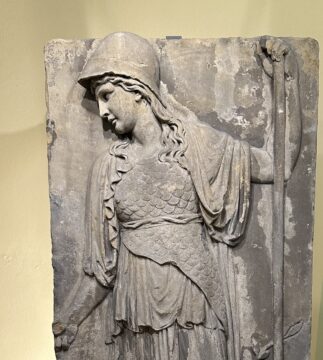
Invita Minerva

by Rafaël Newman

At the end of each of the past twelve years I have written a long rhyming ballad, reviewing the period coming to a close, giving thanks for some events and lamenting others. I began in December 2013, while I was recovering from a lengthy illness; and I recited what would be the first of a series at a family New Year’s Eve party, among some of those whose support had been indispensable to the recrudescence of my health, and to whom I therefore wished to express my gratitude.

My poem began that year with these lines:

Let’s raise a glass this festive day,
On Saint-Sylvestre or Hogmanay,
And toast to all both far and near
Who graced the now departing year:
To cracksource Cook, who nearly gotcha,
To Edward Snowden in his dacha;
To Granta, Guardian and Gawker,
To David Denby, and Tom Scocca;
To Pauline Marois, our own Grand Mufti,
As well as Josh and Benny Safdie;
To Edie Windsor, Stephen Fry,
And Malala Yousafzai;
Barack Hussein—“Make Drones, Not War!”
Dan Savage, and the myriad score
Who hailed with glee, or rising gorge,
The birth of Once and Future George.

This initial ode to a year gone by, following its “public” proem, then went on to become more private in substance—with cryptic tributes to the various attainments of my assembled kinfolk—for all that it borrowed its tone and humor from “Greetings, Friends!”, the Christmas poem written every year for many decades by Roger Angell and published annually in The New Yorker. Angell, better known as a baseball reporter, would compose his retrospectives as jokey commentaries on notable happenings in the public sphere; they featured sometimes quite ingenious (if often groan-worthy) rhymes on topical celebrity names, for which he evidently required increasing guidance from younger advisers as he grew more venerable (he died in 2022 at over a hundred) and less plugged in. Read more »

Poem by Jim Culleny

A Simple Ontology

maybe flower petals are held to stems by thought
and the wind’s a counter-thought that plucks
and sets them elsewhere in the grass
to grow in contemplative resolution
beside the notion of a grub-pulling crow

maybe the wind itself’s a palpable bright idea,
something about motion and the abhorrence of vacuums
something about coming and going,
about ferocity and stillness
about war and its absence

maybe the moon’s the concept of fullness,
loss, abatement, regeneration from slivers,
hope at the hour of the wolf, the opposite of
darkness at the break of noon, the
upside of shadow

maybe Descartes had it right
and this, from horizon to horizon, is
a simple ontology,
an inherent daisy chain of ideas chasing its tale
regardless—

one
…….. idea
hatched in this synapse nest
is to harvest
…….. thought
from thought
under a
….      perception
of blue
while the
….      conception
of breeze
riffles the
 ,,,,,     hint
of hair
and I place them
like
….       dreams
of plums
into the
  ….      essence
of basket
and give them
with the
  ,,,,      intention
of love
to my
c….      belief
in the natural being
of….
………. you

by Jim Culleny

Enjoying the content on 3QD? Help keep us going by donating now.

Sunday, December 28, 2025

Bribes, Pardons, and Presidential Immunity

by Ken MacVey

Donald Trump has creatively explored ways to monetize the presidency. These include launching the $TRUMP crypto business a few days before resuming office on January 20, 2025 or using Truth Social–a private business venture he helped start– to platform his presidential and personal pronouncements.

Monetization began early in the first Trump administration with the Trump International Hotel in Washington DC, which  became, according to an October 18, 2024 House Committee on Oversight staff report, a hotel of choice  for foreign and domestic influencers and would-be appointees to government positions, such as judgeships and  ambassadorships.  According to the  report,  it was also the hotel of choice for  various presidential pardon recipients. This report alleged that at least five such recipients stayed at the hotel spending thousands of dollars in 2017 and 2018.  The report went on: “[T]hese expenditures are particularly troubling in light of allegations that former President Trump’s former personal attorney, Rudy Giuliani, was involved in efforts to sell presidential pardons for $2 million apiece—an amount Mr. Giuliani reportedly planned to split with President Trump.” (These allegations stem from a lawsuit against Giuliani by someone who used to work for him– Giuliani denies the allegations.) Since this report, Trump has pardoned Giuliani for his role in attempting to overturn the 2020 election.

A number of Trump pardons in the last few months have caught the public’s eye. For example, in October Trump pardoned billionaire crypto entrepreneur and convicted  felon, Changpeng Zhao. Zhao and his company pled guilty to failing to stop money laundering, which according to the Department of Justice aided  terrorist groups like Isis. Forbes reported that Zhao’s company had made a deal in May 2025  with a Trump family  affiliated company that helped boost Trump’s net worth by  hundreds of millions of dollars. Liz Oyler, head pardon attorney for the Department of Justice until last March, is quoted by Forbes as saying:  “Trump has created a pay-for-play pardon system.” Read more »

Why Ghosting Feels More Violent Than Direct Cruelty

by Priya Malhotra

Cruelty, at least the old-fashioned kind, has a shape. It announces itself. It arrives with words you can quote later, replay, contest, reject. Even when it stings, it offers a surface against which the self can brace. Ghosting, by contrast, has no edges. It leaves no fingerprints. It is not an act so much as a disappearance, and it wounds precisely because it refuses to declare itself as one.

To be ghosted is not merely to be rejected. It is to be rendered uncertain about the status of reality itself—about what happened, what was meant, whether the past you shared was ever mutually understood. The pain does not come only from loss, but from ambiguity. And ambiguity, it turns out, can be more violent than an explicit no.

There is a reason direct cruelty, however unpleasant, often feels cleaner. A rejection, an insult, even a harsh goodbye acknowledges a shared frame. It says: We are in the same room. I see you. This is my position. Ghosting refuses that acknowledgment. It leaves you alone in a room you didn’t know you were exiting, wondering whether the lights will come back on.

At its core, ghosting is an injury to recognition.

Philosophers have long argued that being recognized—seen, addressed, responded to—is not a luxury but a basic human need. Recognition confers reality. To be recognized is to be confirmed as someone whose presence registers, whose existence calls for response. Ghosting withdraws that confirmation retroactively. It doesn’t just end the relationship; it quietly calls into question whether the relationship existed in the way you thought it did.

This is why ghosting can feel like erasure rather than rejection. Rejection says, I choose not to be with you. Ghosting says nothing at all, and in doing so, suggests something more corrosive: You do not require an answer. Read more »

Friday, December 26, 2025

Taste Values Craft

by Kyle Munkittrick

Silicon Valley has rediscovered ‘taste.’ Maybe it was Jony Ive at Stripe Sessions. Maybe it’s Substack aesthetes like Henry Oliver and David Hoang. Maybe it’s everyone trying to figure out if AI can have taste. But taste is, in every case, either ill or incorrectly defined, if at all. Let’s fix that.

Taste is the valuing of craft.

That is, taste is the ability to assess and appreciate a work based on deep understanding of techniques and skills used in the work’s creation, whether it’s a car, a novel, an app, a song, or an outfit.

In Jasmine Sun and Robin Sloan’s Utopia Debate “Can AI have taste?”, Sun argued  that if the YouTube or Spotify algorithm ever gave you a good recommendation, then yes AI has taste, because it understood and recreated your taste.

No. Algorithms understand your preferences. Taste is not your preferences. Preferences are, however, the thing most commonly conflated with taste.

Your preferences are intuitive taste—a starting point. Preferences rarely ever fully match with taste. That is what a guilty pleasure is! You like it even though you know it’s not good (Stranger Things), or hate it even though it is (Hemingway). Paying close attention to what you like is an excellent way of building taste. Preferences are a great signal that something might be good.

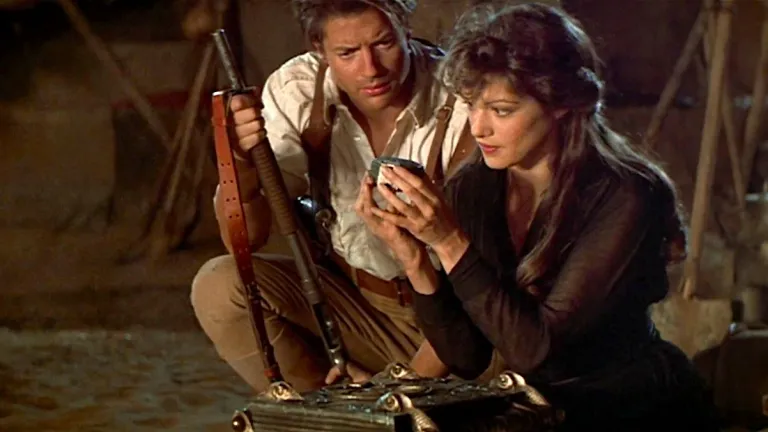
Rick and Evie appreciate something as well-crafted as they are.

The opening paragraph of Roger Ebert’s review of the Mummy is a perfect demonstration of his exceptional taste being in seeming conflict with his preferences:

There is within me an unslaked hunger for preposterous adventure movies. I resist the bad ones, but when a “Congo” or an “Anaconda” comes along, my heart leaps up and I cave in. “The Mummy” is a movie like that. There is hardly a thing I can say in its favor, except that I was cheered by nearly every minute of it. I cannot argue for the script, the direction, the acting or even the mummy, but I can say that I was not bored and sometimes I was unreasonably pleased. There is a little immaturity stuck away in the crannies of even the most judicious of us, and we should treasure it.

Ebert contrasts his judgement of the craft (script, direction, acting, effects) with his visceral delight. His pleasure was, by his own admission, unreasonable. That is, unlike many movies he loved, he cannot entirely explain or justify his delight.

There are a few ways to interpret this vis-a-vis taste. One is that taste isn’t objective or based on craft, it’s ineffable. Another is that Ebert didn’t have good enough taste to explain and justify why he liked The Mummy. Both of these are obvious nonsense. Read more »

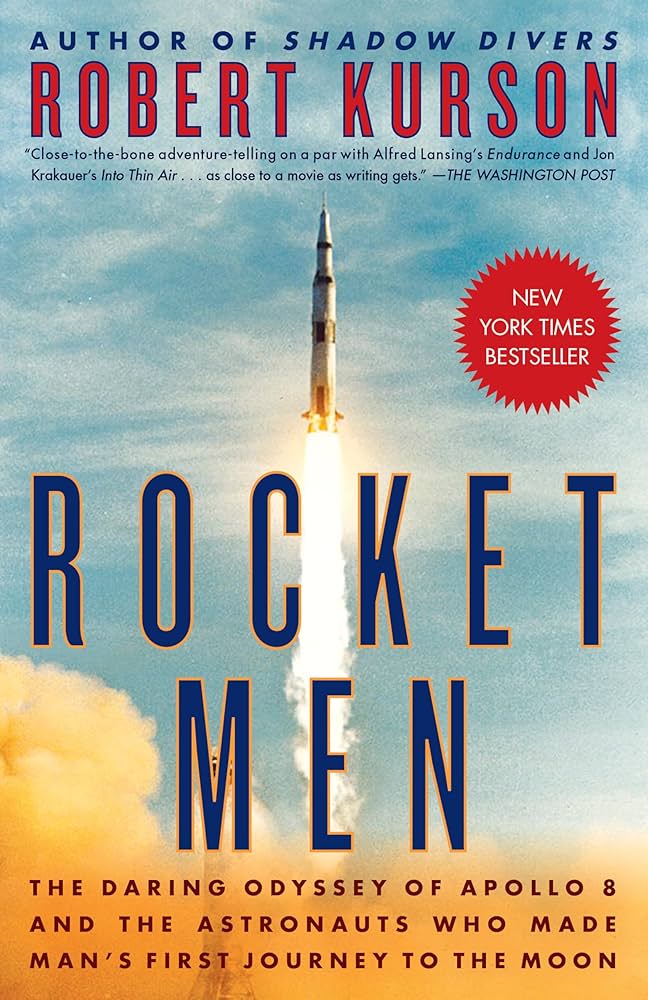
Earthrise Before Footprints: Review of Robert Kurson’s “Rocket Men”

by Ashutosh Jogalekar

We shall not cease from exploration.
And the end of all our exploring
Will be to arrive where we started
And know the place for the first time. —T. S. Eliot

Robert Kurson closes Rocket Men: The Daring Odyssey of Apollo 8 with a deceptively simple scene. Decades into the twenty-first century, he takes his teenage son, armed with an iPhone, an Xbox, and all the distractions of modern technology, to see a Saturn V laid on its side, bursting out of its building. The boy doesn’t check his phone. He doesn’t take a picture. He just stands there, staring at the five enormous F-1 engine nozzles, each taller than a person, and after several silent minutes asks if they can stay longer. The Saturn V guarantees turning every person, no matter how young or old, into that boy.

I had just returned from a visit to NASA myself, standing beneath the behemoth and feeling something close to vertigo. You can know the numbers – 363 feet long, millions of pounds of thrust, nearly a million gallons of propellant – and still be unprepared for the physical reality of it. The rocket overwhelms abstraction. Like Kurson’s son, I found myself wordless, pulled into a long stare, asking the same unspoken question: how did anyone dare build this thing? Rocket Men provides part of the answer.

What the book does better than almost any account of Apollo is make the case that Apollo 8, usually treated as a dress rehearsal for Apollo 11, may have been the most consequential spaceflight of them all. Apollo 11 was about arriving. Apollo 8 was about leaving, about the first time human beings severed the umbilical cord to Earth and committed themselves to a quarter-million-mile journey with no rescue, no precedent, and no margin for error. Apollo 11 astronaut Michael Collins’s later remark, quoted near the end of the book – that a century from now Apollo 8 might be judged more significant than Apollo 11 – sounds provocative until Kurson patiently shows why it may simply be accurate. Read more »

The Magic Ponies of AI Advocacy

by Dwight Furrow

Let’s grant, for the sake of argument, the relatively short-range ambition that organizes much of rhetoric about artificial intelligence. That ambition is called artificial general intelligence (AGI), understood as the point at which machines can perform most economically productive cognitive tasks better than most humans. The exact timeline when we will reach AGI is contested, and some serious researchers think AGI is improperly defined. But these debates are not all that relevant because we don’t need full-blown AGI for the social consequences to arrive. You need only technology that is good enough, cheap enough, and widely deployable across the activities we currently pay people to do.

On that narrower and more concrete point, there is a lot of disturbing data. The global management firm McKinsey estimates that current generative AI plus existing automation technologies have the potential to automate work tasks that absorb 60–70% of employees’ time today. The International Monetary Fund, addressing the world economy, predicts that AI is likely to affect around 40% of jobs globally, with advanced economies being more exposed. MIT’s Iceberg project reports that “AI technical capability extends to cognitive and administrative tasks spanning 11.7% of the labor market—approximately $1.2 trillion in wage value across finance, healthcare, and professional services.”

So the question is not whether job disruption is likely. The question is what kind of thinking is smuggled in when pro-AI commentators describe that disruption as painless, self-correcting, and—this is the favorite word—“inevitable.” The pattern I want to diagnose is magical thinking, the tendency to treat a desired outcome as if it follows automatically from the introduction of a powerful tool, as if social coordination, political conflict, and institutional design were minor implementation details. Each instance of magical thinking I designate as a magic pony because the confidence with which they are asserted often has the character of a bedtime story: comforting, frictionless, and uninterested in real world constraints. Read more »

Thursday, December 25, 2025

Congratulations to 3QD’s Own Rachel Robison-Greene!

Rachel is one of the winners of the American Philosophical Association’s 2025 Public Philosophy Op-Ed Contest for one of her essays here at 3QD. There is more information about that and other APA prizes at their website:

The APA committee on public philosophy sponsors the Public Philosophy Op-Ed Contest for the best opinion-editorials published by philosophers. The goal is to honor up to five standout pieces that successfully blend philosophical argumentation with an op-ed writing style. Winning submissions will call public attention, either directly or indirectly, to the value of philosophical thinking. The pieces will be judged in terms of their success as examples of public philosophy, and should be accessible to the general public, focused on important topics of public concern, and characterized by sound reasoning.

Rachel Robison-Greene (Utah State)

“The Temptations of Nostalgia” (3 Quarks Daily)

Rachel Robison-Greene earned her PhD from the University of Massachusetts, Amherst in 2017. Her research interests are largely in meta-ethics, epistemology, and applied ethics (with particular interests in animals, the environment, and technology). She is the author of the book Edibility and in Vitro Meat: Ethical Considerations. She is a regular contributor to the popular blog 3 Quarks Daily. Rachel serves as the Secretary of the Culture and Animals Foundation and is the Chair Elect of the Intercollegiate Ethics Bowl.

More information about the APA prizes here.

Congratulations, Rachel!

And Happy Newton’s Day to All!

A Child’s Christmas in New Jersey

A Remembering by Nils Peterson

Christmas Eve began with a carol sing at the big Presbyterian Church on Crescent Avenue which many of the rich town people attended. More cathedral than church. My brother and I went to Sunday school there when we were old enough because the small Lutheran church of our parents was not large enough to have one. My father was a chauffeur for one of the rich families.

The caroling was held in a large, handsome meeting room where, in the spring, the flower show would be held. A lot of chairs were set out and there’d be a big tree beautifully decorated and boxes of candy for the children to suck on when it was all over. I remember a particularly revolting lime-green ball sour enough and bitter enough to make even the greediest child spit it out. Some of the gathered Presbyterians had begun their celebrating before the sing, because after about the third carol, some wag would start calling for the “Hallelujah Chorus,” the last song in the songbook, and the calls, catcalls almost for the calls for it increased as the carols went on, grew until at last the leader with a sigh gave up and we hallelujahed our way out of there.

At home, the chauffeur’s apartment above the garage, there would be a supper of Swedish meatballs and boiled potatoes and lingonberry and sardines and cheeses and cookies. At the right moment, we’d go down the stairs and, across the driveway to the path leading to the big house – crunch of gravel, full moon shining between tree branches, feel of tended grass – to the kitchen door where Marie, the cook, my father’s cousin and my godmother, waited to let us in. Anet is there, the downstairs maid, and Martha, the upstairs maid. They are “the girls,” the three live-in Swedish servants. Marie, the cook, was my father’s cousin, my godmother, and the one responsible for getting my father the chauffeur job in 1932 in the heart of the depression. He had been out of work since he and mother came back from visiting their parents in Sweden to show off how well they were doing in America. Shortly before their return, the stock market crashed. The year, of course, 1929.

Anet was the one who served the Deforests the dinner Marie had cooked. She had her own pantry next to the kitchen where she kept jars of cookies to serve with the lady’s tea. Martha, the upstairs maid, was looked on as being a little racy because she smoked. She quit her job one time and went back to Sweden, but returned in a few months. The rich people never quite forgave her desertion. Read more »