by David Kordahl
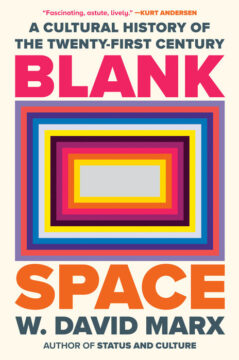 No one sells out anymore. The first pages of Blank Space: A Cultural History of the Twenty-First Century, W. David Marx’s overview of the past quarter-century of popular culture, give a striking example of this cultural shift. In 1992, the Seattle-based grunge band Pearl Jam elected to stop making music videos because they were worried about becoming too commercial. Marx writes, “Pearl Jam’s principled stand resonated with their fans: If rock bands were so desperate for money, they might as well be bankers.” This contrasts with the Lollapalooza festival in 2022, thirty years later, where David Solomon, the CEO of Goldman Sachs, performed as “DJ D-Sol,” playing electronic dance music for party-goers at the Tito’s Handmade Vodka stage after arriving in Chicago on his corporate jet.
How did this shift occur? One thing that makes Marx’s analysis bracing is that the figures he picks as being most significant in our broader cultural history are not the usual musicians or writers. Much more time is spent on Pharrell Williams and Kim Kardashian than, say, Arvo Pärt or Elena Ferrante. This is not a failure of taste, but a decision to focus on figures who managed to understand, before the rest of us, how fundamentally the Internet had altered the logic of cultural change.
Blank Space further develops the model that Marx described in his 2022 book Status and Culture: How Our Desire for Social Rank Creates Taste, Identity, Art, Fashion, and Constant Change. Cultural change in earlier eras, from high culture to low, ran something like this. Small groups of innovators would try new things in relative obscurity. Popularizers would notice them, and would streamline and repackage their ideas to be fed to a mass audience. The public might never experience the original source of such ideas, but the kitsch they consumed might still be directional, moving culture forward, even if at a lag.
Subcultural scarcity was important to such changes. Knowing about trends before others did gave one social capital, and that capital rewarded risk. It made sense for Pearl Jam to stop making music videos, since overexposure was a form of contamination. The gesture worked because the market was suspect, underground knowledge was elevated, and selling out was a real category with real stakes.
Enter the Internet. Read more »