Trump Tower, NY and Bauhaus School, Dessau (Photo: Romy Picht)
1. Reality isn’t what it used to be. Neither is fiction.
Years ago, someone who worked for a daily soap opera production company told me that if a storyline included a wedding, the TV network and its stations would be inundated with wedding gifts for the fictional newlyweds—from fans unable to distinguish fact from fiction, reality from TV. Hard to believe.
But this is more or less what happened in 2016: A man who had played a successful boss on TV won the Presidential election. He wasn’t such a successful businessman, but he played one on TV. (He wasn’t really a president, but he played one in the White House.) Eight years on, that cosplayed success is still branded on the minds of Trump supporters. No facts, scandals, or criminal convictions can shake their faith in the tenacious fictions of a reality show.
With so much knowledge and information at our fingertips, why haven’t we gotten smarter? Even now, when we can see with our own eyes how it happened in 1933, we are still in danger of becoming history’s recidivists. Read more »
There’s that list of religions from which we’re offered a choice. If none of them quite fit, at the bottom there’s None. Well that’s not for me either so I’ve taken to calling myself a Non-None. My religious feeling is not defined by any of the above, but it certainly is not defined by None. Some thoughts.
While knotting my shoes, which gets harder as I get older, I realized that if I were Catholic I would prefer to go to a church, well, cathedral really, in which the mass was sung in Latin. I’ve sung many of the great mass settings which are in Latin, and I know enough Latin to understand what I’m singing and conductors always insist on singers having a sense of what the sounds coming out of their mouths mean, but while tying my shoes I realized that I didn’t care about understanding. What I wanted was the incantatory sound, the glorious AH of Ave, the dark EH of Requiem, the round OH of Gloria. It was the sound that penetrated me, of what has sometimes been called “the holy vowels,” – think of the OM sound that some feel is the heartbeat of the universe. How rich it is to say, richer even in a chant. Some would say, and I for the moment agree, it is an all-encompassing sound. So maybe understanding the words of the mass gets in the way of the mass. I don’t insist on this, but wonder.
Remember the ending of Hopkins’ “God’s Grandeur?”
And for all this, nature is never spent; There lives the dearest freshness deep down things; And though the last lights off the black West went Oh, morning, at the brown brink eastward, springs — Because the Holy Ghost over the bent World broods with warm breast and with ah! bright wings.
How great that ah! is. It is an Ah of Awe, and we feel the awe deep down, and the exhalation of our saying is prayer. (I admit that it’s good to understand the words of Hopkins that bring us to that great sound then releases us from it.)
I think we have lost the feeling of awe and so the universe we live in has grown smaller except for the astrophysicists who seem to understand the universe as a vast cathedral. Once here on earth we found the language of awe. That language was the cathedral. It spoke our feeling of awe and also recreated it in us. (Yes, there are smaller spaces that offer their version of that experience and if we use eyes and ears, nature too enjoys building cathedrals. Maybe there’s nothing that’s not.) Read more »
An excerpt from the book can be found here. The book is published by Deep Vellum. It is a kind of horror story about academics in Germany and also about movies and about the supernatural, sort of, and also is just an excellent and sometimes scary and also quite hilarious book. Extremely well written. Great. J.M. Tyree and I (Morgan Meis) have an extremely silly but also kind of fun and lovely conversation about the book that some people could really enjoy. Not everyone. But some people, surely.
Enjoying the content on 3QD? Help keep us going by donating now.
Jean-Jacques Rousseau believed that the “most ancient of all societies and the only natural one is that of the family.”[1] Similarly, Rousseau’s great antagonist, Thomas Hobbes, claims that “family is a small commonwealth.”[2] But what if the most natural and ancient of all societies is confronted with war? According to a survey by the International Rescue Committee, 74% of Ukrainians report being separated from a close family member because of the war.[3]
Maria (32) and Ivan (42) are such a family. Ivan was drafted in April 2022. Since then, he has been stationed in Donetsk, in the region of Kramatorsk. In the beginning, Maria and Ivan saw each other every four months for about ten days. Now, in 2024, he is allowed to come home twice a year for two weeks. “But you also have to count two days for travel.” The frontline is far away from where Maria lives, Chernivtsi, on the border to Romania.
On the 13th of April 2024, when Ivan came home for his two-week leave, Maria had just given birth to their daughter, Sophia, the previous day. Two weeks later, Ivan left heartbroken for the frontline. “I cried every day until the end of May,” Maria says. “Then, I realized that I must live for my daughter, for my husband. I did not want my husband to see me crying every day, because he was worried as well.” Maria and Ivan always planned on having a family, but Maria’s pregnancy was an accident. “I don’t regret it,” she says smiling at Sophia. “She is perfect.”
Maria grew up in Greece, with her Ukrainian mother and Greek father. She went to Chernivtsi to study medicine to become a dermatologist. In March 2024, shortly before Sophia was born, Maria’s mother came to visit and help her. But just as Ivan, she left at the end of April. Still today, she is waiting in Greece for her daughter, but Maria does not want to leave her husband. She wants Ivan to see his daughter.
“It’s very difficult to be a single mother. It’s just myself and my daughter.” Maria’s mother, her father, her brothers, are all in Greece. Ivan’s grandparents from Ukraine are long gone. His father has passed away, and his mother lives in Italy. “I am all alone.” Read more »
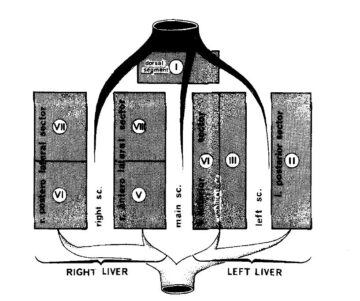
Functional Liver Anatomy with the eight liver segments as published by Bismuth H, World J Surg, 1982 (5)
Colorectal cancer is the third most common cancer with an estimate of more than 150,000 new cases in 2024 in the United States (1, 2). In approximately one third of patients, colorectal cancer is metastatic at the time of diagnosis, meaning that cancer cells have already spread from the colon or rectum to other organs in the body (2). One of the most frequent metastatic sites of colorectal cancer is the liver (50% of patients). In case the metastases are localized only in the liver, the optimal treatment is to remove them surgically in combination with chemotherapy (3). Of note, resection of liver metastases is only beneficial if all macroscopically visible lesions can be removed. Unfortunately, a complete resection of liver metastases is only possible in up to 35% of patients, owing to anatomical limits imposed upon the surgeon (3).
What are the limits of liver surgery?
In order to understand the limits of surgical resection of liver metastases, one has to focus on liver anatomy. French anatomist Claude Couinaud published the first complete description of the functional anatomy of the liver in 1957 (4). The liver consists of two functional entities, the left and the right hemiliver, which are both supplied by three main structures: a vein, an artery and a bile duct (5). These three structures are referred to as the portal pedicle. There is a right portal pedicle for the right hemiliver and a left portal pedicle for the left hemiliver. The hemiliver can be further divided into individual segments, defined by the bifurcation of the respective portal pedicle into smaller branches (6). One can image the functional liver anatomy as a tree, with the left and right pedicles originating directly from the main trunk before further dividing into smaller branches as we approach the periphery of the tree. In total, there are eight liver segments with a dedicated portal pedicle (6). Read more »
A box containing an assortment of Pakistani sweets given to me by the owner of a shop in Brixen, South Tyrol, in celebration of the birth of his first grandchild.
Enjoying the content on 3QD? Help keep us going by donating now.
In daily life we get along okay without what we call thinking. Indeed, most of the time we do our daily round without anything coming to our conscious mind – muscle memory and routines get us through the morning rituals of washing and making coffee. And when we do need to bring something to mind, to think about it, it’s often not felt to cause a lot of friction: where did I put my glasses? When does the train leave? and so on.
So, we get on well in the world of medium sized dry goods, where things can be dropped on your foot and the train leaves at 7.00 AM. Common sense carries us a long way here. For common sense is what we know already, what we can assume and the things we know how to do because we know what they are.
There are limits, though. We begin to run into difficulties when we apply the categories of the understanding – the normal way we think of things – into areas which look as if they are same kind of thing, but are not. I’m thinking of anything to do with long term change, of the way in which structures underlie what we see, of the complex interactions of the economy and politics. The kind of thinking that we might call common sense is the ‘spontaneous ideology of everyday life’, and it has problems with the larger and longer-range things that both run through our lives and have a history that we should try to grasp.
If we fail to make that effort, we typically find ourselves falling back on the notion that these are just things that we can assume to be the case. This can lead to quite problematic positions. So, a friend of mine – intelligent, well educated – announced to me, apropos of Trump et al ‘half of America is just sick’. Perhaps on reflection he’d think that a bit inadequate, but it does represent the baffled contempt many have for the people who support a party and a politician who they see, rightly, as a threat to whatever democracy remains in the USA. Read more »
Demonstrating the utility of a critical practice that’s sometimes obscured more than its venerable history would warrant, my 3 Quarks Daily column will be partially devoted to the practice of traditional close readings of poems, passages, dialogue, and even art. If you’re interested in seeing close readings on particular works of literature or pop culture, please email me at [email protected]
A good poem can do many things – be clever, edifying, provocative, or moving – but a truly great poem (which is to say a successful one), need only be concerned with one additional attribute, and that is an arresting turn of phrase. By that criterion, Ukrainian-American poet Ilya Kaminsky’s “We Lived Happily During the War,” originally published in Poetry in 2013 and later appearing in the 2019 collection Deaf Republic, is among the greatest English-language verses of this abbreviated century. Within the context of Deaf Republic, Kaminsky’s lyric takes part in a larger allegorical narrative, but that broader story in the collection aside, “We Lived Happily During the War” is arrestingly prescient of both the 2014 Russian invasion of Crimea and Vladimir Putin’s brutal and ongoing assault on the broader country of Kaminsky’s birth since 2022, including bombardment of the poet’s home city of Odessa. Yet even stripped of this context, “We Lived Happily During the War” concerns itself with the general tumult of modern warfare, both its horror and prosaicness, its sanitation and its tragedy. More than just about Ukraine, or Syria, or Gaza, Kaminsky’s lyric is about us, those comfortable Western observers of warfare who have the privilege to be happy and content at the exact moment that others are being slaughtered.
To return to my initial argument, the line which lodges in the head from Kaminsky’s poem is one that isn’t exactly or actually in the lyric itself but is rather the title – “We Lived Happily During the War.” Six words, only two multisyllabic, each one hits with the definitiveness of a bullet shot or an incendiary explosion. There is an initial ambiguity to the tile – who does the pronoun refer to? What war are we speaking of? If the “We” is those who are suffering through this undefined assault, then the poem becomes a testament to human endurance through atrocity. If the “We” is someone else, maybe those contemporaneous with the war but not witness to it, then the poem becomes a condemnation of inaction. Kaminsky’s lyric is largely interpreted in the second way, and for good reason, because the only instance of the title appearing as a line within the poem itself, albeit altered by a parenthetical which makes all the difference, in the penultimate stanza which is enjambed into a one-line final stanza so that it reads “we (forgive us)/lived happily during the war.” That parenthetical seemingly makes all the difference, though there is also always the possibility that there is a need for forgiveness from those who successfully survive a war, with all of the negotiations and betrayals that implies, as well. Read more »
The philosophy of one century is the common sense of the next. –Henry Ward Beecher
There are several long-running attempts to give AIs common sense. Or, at least, to build a useable database of “common sense” for AIs. MIT’s Media Lab shut down its “Open Mind Common Sense” project in 2016 after 17 years of collecting common sense, but Wordnet has been up and running in Princeton’s cognitive science lab since 1985 and is still going strong. It is now an independent, noncommercial database run by The Global WordNet Association and, purportedly, contains 12+ megabytes of common sense. The always scary sounding Defense Advanced Research Project Agency (DARPA) has its own Machine Common Sense project – and then there’s Delphi which focuses on “ethical” common sense. There’s probably more.
But common sense is a slippery notion. “A stabbing ‘with’ a cheeseburger,” Delphi has said, “is morally preferable to a stabbing ‘over’ a cheeseburger.” Which seems right, but common sensical? I don’t know. Cows say “Moo” is another example of Delphi’s AI common sense. But isn’t that just ordinary knowledge based on wide-spread (if sometimes second-hand) experience? If you stick a pin into a carrot, another nugget goes, it makes a hole in the carrot not the pin. Is that really what we mean by common sense?
G.E. Moore, along with Russel and Wittgenstein one of founders of analytic philosophy, famously proved the existence of an external world – which does seem common sensical – just by waving his hands about. “I can prove now,” he says, “that two human hands exist…[just] by holding up my two hands, and saying, as I make a certain gesture with the right hand, ‘Here is one hand’, and adding, as I make a certain gesture with the left, ‘and here is another’. How absurd it would be to suggest that I did not know it, but only believed it, and that perhaps it was not the case!”
I assume his appeal is ultimately to common sense – and not just his hands.
Which brings me to a paradox that occurred me when I first began studying philosophy that I still can’t quite shake. It’s this.
A philosophical theory can either go against common sense or it can support or justify common sense. Supporting common sense seems pointless. After all, what you are trying to prove is, by definition, already commonly recognized as the sensible view. But if you, instead, challenge or attack common sense what resources or knowledge can philosophy bring to bear powerful enough to overturn or undermine common sense – that which, again, everyone already knows to be the case? Read more »
It’s a warm June day in 1976. I am 17 years old and standing with my family and my 30-year-old husband’s family at the airport In Tehran. My mother, grandmother, and mother-in-law have red eyes and red nose tips from crying and trying hard not to cry in public. My mother-in-law is seeing her firstborn leave again to go overseas, but this time with a new wife instead of going alone. My mother is seeing her daughter start a new life far away from her, and years later she told me a part of her was always not sure she had made the right decision to marry me off so young. In the picture we took at the airport, I am standing by my younger sisters, carrying a very cool beige Samsonite makeup case and from the look of my sisters and me, I doubt we could have known that it would be the last time we were in Iran together as a family, ever. My sisters and I are looking at the camera, I am scared, excited, and sad; my sisters are standing there, wondering probably what will happen next. When I say goodbye to my grandmother who had raised me for the first five years of my life, she discreetly puts a folded one-hundred-dollar bill in my hand and closes her fingers on it. She whispers to me that she wants me to buy something for myself when I get to my destination.
The flight that brought me to America had a stop in the UK and my husband, whom I had met three months earlier, bought himself a white wool Irish sweater at the long layover at the airport, as did the young Iranian woman who sat on the aisle seat next to me. She spoke Persian with an American accent even though she was Iranian, and had come to visit her family and was returning to the States. I disliked her right away for no good reason except that she had bought her Irish sweater and I hadn’t bought anything. I also envied the fact that she was traveling on her own. She and my husband were speaking to each other mostly in English, because it was easier for her, and she was telling him about her college in Boston, how far Philadelphia, our final destination was from the airport in New York, and other things that must have not been worth translating for me, as I didn’t speak English. With their new matching sweaters, smoking Dunhill cigarettes, and speaking to each other, I felt a complicity between them that excluded me.
We landed at JFK airport, a place my grandmother had warned us about because according to her, it was the largest airport in the world. She had asked him to hold my hand there and not let go the whole time, worried I might get lost in the size of that place. Quickly after landing, my husband bought a Popular Mechanics magazine at the newsstand and his colleague who was on the same flight, bought a Playboy magazine. As he was looking at the centerfold picture, he said to my husband, “My magazine’s pictures are better than yours,” making both of them laugh and making me extremely uncomfortable, feeling naked and exposed. The Boston girl got picked up by her boyfriend who lifted her in his arms and I disliked her even more because she could have a boyfriend who loved her and whom she loved, something I wasn’t allowed to have. Read more »
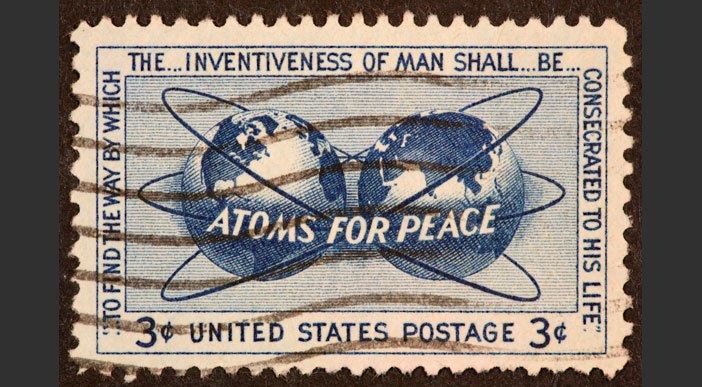
A stamp commemorating the Atoms for Peace program inaugurated by President Dwight Eisenhower. An AI For Peace program awaits (Image credit: International Peace Institute)
The visionary physicist and statesman Niels Bohr once succinctly distilled the essence of science as “the gradual removal of prejudices”. Among these prejudices, few are more prominent than the belief that nation-states can strengthen their security by keeping critical, futuristic technology secret. This belief was dispelled quickly in the Cold War, as nine nuclear states with competent scientists and engineers and adequate resources acquired nuclear weapons, leading to the nuclear proliferation that Bohr, Robert Oppenheimer, Leo Szilard and other far-seeing scientists had warned political leaders would ensue if the United States and other countries insisted on security through secrecy. Secrecy, instead of keeping destructive nuclear technology confined, had instead led to mutual distrust and an arms race that, octopus-like, had enveloped the globe in a suicide belt of bombs which at its peak numbered almost sixty thousand.
But if not secrecy, then how would countries achieve the security they craved? The answer, as it counterintuitively turned out, was by making the world a more open place, by allowing inspections and crafting treaties that reduced the threat of nuclear war. Through hard-won wisdom and sustained action, politicians, military personnel and ordinary citizens and activists realized that the way to safety and security was through mutual conversation and cooperation. That international cooperation, most notably between the United States and the Soviet Union, achieved the extraordinary reduction of the global nuclear stockpile from tens of thousands to about twelve thousand, with the United States and Russia still accounting for more than ninety percent.
A similar potential future of promise on one hand and destruction on the other awaits us through the recent development of another groundbreaking technology: artificial intelligence. Since 2022, AI has shown striking progress, especially through the development of large language models (LLMs) which have demonstrated the ability to distill large volumes of knowledge and reasoning and interact in natural language. Accompanied by their reliance on mountains of computing power, these and other AI models are posing serious questions about the possibility of disrupting entire industries, from scientific research to the creative arts. More troubling is the breathless interest from governments across the world in harnessing AI for military applications, from smarter drone targeting to improved surveillance to better military hardware supply chain optimization.
Commentators fear that massive interest in AI from the Chinese and American governments in particular, shored up by unprecedented defense budgets and geopolitical gamesmanship, could lead to a new AI arms race akin to the nuclear arms race. Like the nuclear arms race, the AI arms race would involve the steady escalation of each country’s AI capabilities for offense and defense until the world reaches an unstable quasi-equilibrium that would enable each country to erode or take out critical parts of their adversary’s infrastructure and risk their own.Read more »
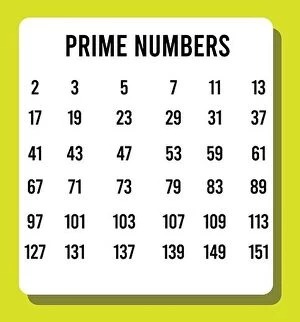
Prime numbers are the atoms of arithmetic. Just as a water molecule can be broken into two hydrogen and one oxygen atoms, 12 can be broken into two 2s and a 3. Indeed, the defining feature of a prime number is that it cannot be factored into a nontrivial product of two smaller numbers. Two primes that are easy to remember are
12345678910987654321
and
131211109876543212345678910111213.
Prime numbers are not only fundamental in mathematics, they are a key ingredient in the cryptography that secures your bank account, email, and everything else online. We can quickly and easily multiply numbers to get things like
but it is incredibly slow and difficult to factor a number like this into its constituent primes. The primes give us a mathematical lock that is easy to close and impossible to open unless you know how it was made.
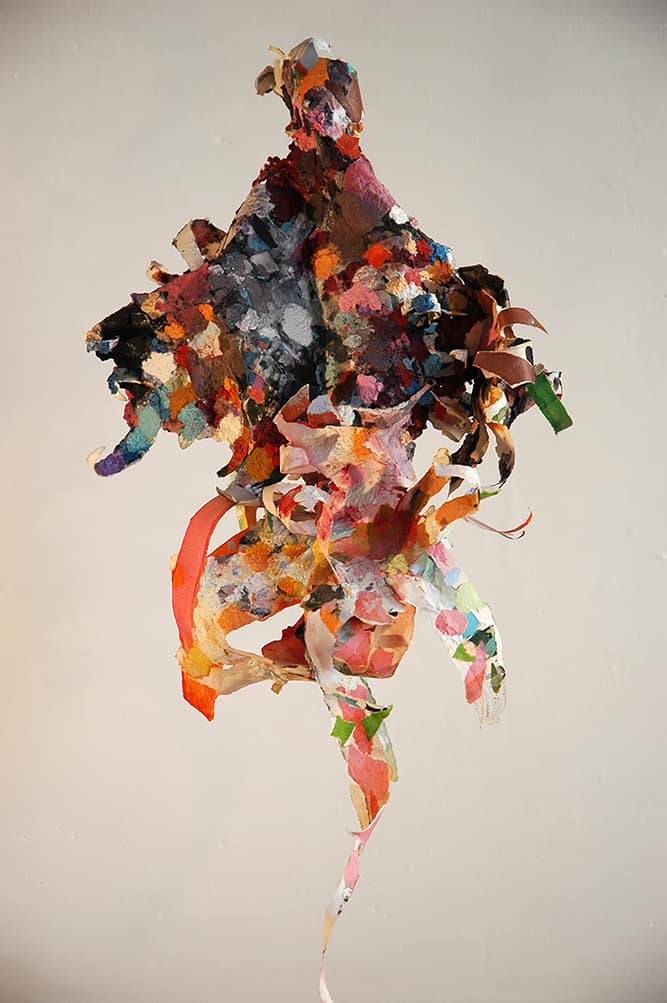
Factoring numbers into monsters by Richard Schwartz [0].As numbers get larger and larger, they are less and less likely to be prime. You might think this means that a new prime number would be incredibly valuable. After all, they are rare, and if you have one that nobody else has, you can make locks that are nearly unbreakable.
Sadly, once again, the earthly rewards of mathematics elude us. For the purposes of cryptography, pseudoprime numbers are close enough. These non-prime numbers act like prime numbers in all the important ways for cryptography, and they are much easier to find.
Nevertheless, in math and computer science circles there was a flurry of excitement this week at the discovery of a new prime. Last week, the Great Internet Mersenne Prime Search announced that
2136279841 – 1 = 881694 … 86871551
is a prime number. The … is a yada yada of an awfully large number of digits. This new prime has 41,024,320 digits. That’s 16 million more digits than the second-largest known prime.
By comparison, AES-256 encryption is widely considered to be very secure, and it uses a key that is approximately 78 digits long. This prime is way too large to be of practical use. The goal is simply to find new prime numbers.
Why? George Mallory climbed Everest for the same reason: “because it’s there.” Unlike, say, the creators of livermorium, you don’t get to name a new prime number. But how can you not want to be one of the rare few who finds a new mathematical atom? Read more »
imagine the atomic affinities of the world these clinging particles of stuff that look like chairs or moons, that look like things that laugh and love, this vast, maybe infinite web of motions, these packets of energy that mutter and reflect upon their own protons spinning electrons off in breaths and sweat distributing themselves in scents and sense, who think themselves into being, who imagine boundaries so concrete they defy laws of physics and grace, deny the electric pull of particles, their magnetic attractions, their nano network of thoughts and dreams, their atomic affiliations that spin-off murderers and mystics their inclination to combine, their passion to enter or receive other yet their odd insistence that they could, despite those universal gravities, ever be alone
Jim Culleny, 4/5/22
Enjoying the content on 3QD? Help keep us going by donating now.
This image came from this flickr account: https://www.flickr.com/photos/dolescum/3130894185
As I start this essay, early voting just began in my state of Georgia which is a critical swing state. Our secretary of state announced record turn out on the first day of early voting. By the time this is posted, I will have already voted, and perhaps that might be true of many Americans who frequent this website. Others might reject voting all together, as they might feel voting has become a pointless act. While true that voting is not the only act of democratic participation, in this case avoiding a worse-case scenario with a second Trump presidency who has a well-organized fascist movement behind him is critical for any positive change in the near future.
The roadmap for a second Trump term (Project 2025) ignores the many challenges we face as a society in favor of blaming the “other” and criminalizing dissent from Christian nationalism. Some try to argue that Harris, who seems to be pivoting to a centrist position on at least some issues, might not be much better. I am advocating embracing the lesser of two evils here and casting your vote for Harris. Let’s highlight some very good reasons why avoiding the nuclear option of fascism is always the right move.
One of the biggest sticking points for voters on the left (and rightly so) is the ongoing genocide in Gaza. Even for many staunch supporters of the Zionist project, the war is becoming harder to justify as it expands to Lebanon. Frustrated Arab American voters in Michigan have been angered by the lack of traction on ending the war by the Biden administration. As a result, some are claiming they’ll cast a vote for Trump, which seems wild, considering he refuses to acknowledge that Palestinians even exist. Others are leaning towards Stein, who espouses an anti-war stance. She did gain the endorsement of David Duke which she rejected, but one wonders why. Foreign policy is one area that the voters have little direct input on and historically, the majority of the public vote on domestic issues.
At times, wars and the threat of wars shaped our choices of president, such as during the Vietnam war. The choice is rarely stark, as US wielding power abroad is a bi-partisan issue. Many Democrats tend to be more hawkish at times, such as when Kennedy and Johnson expanded US involvement in the Vietnam war. Electing Nixon in 1968 proved to be a disaster, as his “plan” to get us out involved widening the US bombing campaign, trying to do so in secret, and setting neighboring Cambodia down the path of genocide. As bad as what’s happening right now in Gaza is (and it’s really, really bad), another term of Trump would mean the full liquidation of Gaza, an expansion into Lebanon, and even a major strike on the Iranian nuclear infrastructure. Read more »
When I was growing up, my mother and I would sometimes read or recite poetry to each other. Ours was not a poetic household, and my father would occasionally complain: “If poets have something to say, why don’t they just say it?” But we thought they did say it, albeit indirectly sometimes, and we continued with our Longfellow, a bit more quietly.
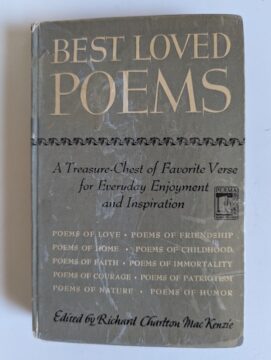
My mother had a collection of Longfellow’s works (he was probably her favorite poet). Another book we frequently read from was an anthology called Best Loved Poems: A Treasure-Chest of Favorite Verse for Everyday Enjoyment and Inspiration (edited by Richard Charlton MacKenzie, copyright 1946). Everyday enjoyment, that’s what we were after.
Mom was opposed to what she called moping, and she especially loved Longfellow’s “A Psalm of Life” (“Let us then be up and doing / With a heart for any fate”) and “The Rainy Day” (“Be still, sad heart! and cease repining; / Behind the clouds is the sun still shining.”). We also found Excelsior very satisfying to read aloud. It was one of the poems that taught me that you don’t need to understand everything about a poem to get the message or to enjoy it. I suspect this was also one of the poems my father found most annoying, because you really want to belt out the repeated word Excelsior, and perhaps raise a fist skyward as you do.
We often read other poems written in a similar spirit of inspiration—for example, “Invictus,” by William Ernest Henley and “Say Not the Struggle Naught Availeth,” by Arthur Hugh Clough. I was comforted by Clough’s words of encouragement to the doubtful and worried; even as a child I was often apprehensive. I can’t remember how I felt about “Invictus,” except that, like “Excelsior,” it was satisfying to recite with great gusto. “In the fell clutch of circumstance / I have not winced nor cried aloud,” we exclaimed. The language seems all out of proportion to the life we lived, but I liked the archaic phrasing (who talks about the fell clutch of anything these days?). Looking back, I see that my struggles became more difficult when I tried to meet them with silent, tearless stoicism. Perhaps I was trying to borrow bravado. Read more »
Most people don’t want to hear your sob stories, even if they pretend to be caring listeners. Even a good friend listening to your personal version of Orpheus and Eurydice—and making all the right noises—is probably focused on whether to put snow tires on their car Thursday or Friday.
Some of us turn to music to ease our mortal wounds and it’s a bit of a mystery as to why sad music is actually helpful. I turn to either classical or country music when I need to feel better about a loss or when things just won’t go my way. There is a vast distance between the ultra-cultured notes of, say, the Berlin Philharmonic Orchestra and the decidedly baseborn lyrics of the country songsters I like. But lo and behold, each can have its healing powers, and a little of each might be the key to a good diet.
You can hear the grand wounds and the bending of the Weltgeist in classical music and it often involves losing a village or watching Napoleon fail at taking Russia. The great composers endeavor to capture tidal movements and tidal emotions. They have a whole orchestra with bizarre instruments such as glockenspiels and contrabassoons, to accompany the more common violins and pianos. To play in a great orchestra takes merely 15 years of daily practice from the age of four along with some otherworldly talent. So if you wake up feeling sad about the fall of democracy in Europe, by all means, reach for your Schubert or your Brahms. That’s what it takes to handle the bigger themes.
Country music is less ambitious and more concerned with things like, “Whose bed have your boots been under? And whose heart did you steal I wonder?”. But when you’re in the throes of a tawdry breakup, the clever, brassy lyrics of a Shania Twain or a Jamie Richards might offer the fast, powerful relief you need and can’t get from the refined classical music.
Good country music has the boomy-bassy-twangy sound made by simple instruments such as slide guitars, fiddles, and banjos. It can be plaintive and crooning but part of what makes it successful are clever, ironic lyrics. Read more »
My friend Ian worked hard all his life. In his seventies, he bought a big house and moved his son’s family in with him. It’s the classic multigenerational setup, and it seems to be working out. Only one thing bothers him—the zombies.
“My son and his kids love the whole zombie thing,” he says. “They watch The Walking Dead and play video games where thousands of zombies come right at ’em, and get blasted to smithereens.”
“Those games can be violent,” I say, as the young waitress pours our coffee.
“It’s not the violence. It’s the zombies. You ever watch a zombie movie?”
“Sure,” I say. “Shaun of the Dead. I love those Edgar Wright-Simon Pegg movies.”
“Did you like it?”
“Nah, I hated it.”
“Why?”
“Zombies,” I shrug. “They’re old people. They’re us.”
The secret message. Ian nods sadly. Ian knows old people. His retirement job is managing a nonprofit apartment complex for the elderly poor. He and I sometimes disagree, but on the subject of zombies, we’re on the same page.
What is a zombie? A stiff-limbed, shuffling figure in out-of-date clothes. They have thin lips, yellow teeth, staring eyes, and gaping mouths.
Sitting a booth at the diner where Ian and I have lunched for many years, I look around and see dozens of people just like that—seated around us or struggling to make their way to the toilet. Read more »



 In daily life we get along okay without what we call thinking. Indeed, most of the time we do our daily round without anything coming to our conscious mind – muscle memory and routines get us through the morning rituals of washing and making coffee. And when we do need to bring something to mind, to think about it, it’s often not felt to cause a lot of friction: where did I put my glasses? When does the train leave? and so on.
 A good poem can do many things – be clever, edifying, provocative, or moving – but a truly great poem (which is to say a successful one), need only be concerned with one additional attribute, and that is an arresting turn of phrase. By that criterion, Ukrainian-American poet Ilya Kaminsky’s “We Lived Happily During the War,” originally published in Poetry in 2013 and later appearing in the 2019 collection Deaf Republic, is among the greatest English-language verses of this abbreviated century. Within the context of Deaf Republic, Kaminsky’s lyric takes part in a larger allegorical narrative, but that broader story in the collection aside, “We Lived Happily During the War” is arrestingly prescient of both the 2014 Russian invasion of Crimea and Vladimir Putin’s brutal and ongoing assault on the broader country of Kaminsky’s birth since 2022, including bombardment of the poet’s home city of Odessa. Yet even stripped of this context, “We Lived Happily During the War” concerns itself with the general tumult of modern warfare, both its horror and prosaicness, its sanitation and its tragedy. More than just about Ukraine, or Syria, or Gaza, Kaminsky’s lyric is about us, those comfortable Western observers of warfare who have the privilege to be happy and content at the exact moment that others are being slaughtered.

 Prime numbers are the atoms of arithmetic. Just as a water molecule can be broken into two hydrogen and one oxygen atoms, 12 can be broken into two 2s and a 3. Indeed, the defining feature of a prime number is that it cannot be factored into a nontrivial product of two smaller numbers. Two primes that are easy to remember are

 When I was growing up, my mother and I would sometimes read or recite poetry to each other. Ours was not a poetic household, and my father would occasionally complain: “If poets have something to say, why don’t they just say it?” But we thought they did say it, albeit indirectly sometimes, and we continued with our Longfellow, a bit more quietly.