My mind’s a purse in which I keep my stash if its purse strings are loose I might add to its load when new coin comes to town but if I tighten down the purse strings of my mind they’ll garrote its capaciousness and all that God might have me be may be hopelessly consigned to dangle from their noose
Jim Culleny, 2014
Enjoying the content on 3QD? Help keep us going by donating now.
My friend R is a man who takes his simple pleasures seriously, so I asked him to name one for me. Boathouses, he said, without hesitation.
To the best of my knowledge, R has never owned a boat. No canoe or coracle, not a dinghy or dory, nor even a yacht. His abiding passion has always been small planes, especially the four-seat Beech Bonanza he likes to fly to tiny airstrips scattered about the continent, which serve in turn as starting points for terrestrial excursions (folding bicycle) to the back of beyond with his lady love, B.
So why boathouses?
“Well,” said R, “I love the light of the water reflecting on the walls and ceiling of the boathouse. And it’s hard to imagine a more relaxing sound than the gentle lapping of waves against a boathouse slip. It’s a sound that accentuates the pleasure of writing or reading or simple conversation. If you’re inclined to nap, as one does on holiday, there’s nothing more conducive to drifting off to sleep, and then you have the pleasure of a gentle awakening to a charming view of lake or ocean. All nicely framed by the boathouse doors.”
All of which explains why R and B, on their forthcoming trip to Austria to ride motorcycles on winding mountain roads, plan to rent a lake boathouse (mod cons included) as their base. It will be a peaceful counterpoint to the frenetic ecstasy of navigating the “twisties”, as they call the alpine hairpin turns.
Once upon a time, boathouses were simple affairs, erected for the sole purpose of providing safe haven to boats, the kind operated by sweep of arm and sweat of brow. As with all things simple, times changed. Complexities ensued. The two-stroke engine was invented, so boathouses expanded to accommodate motorboats. Motorboats got bigger, and boathouses got larger still. That gave someone the notion to take advantage of the swelling footprint and add a second storey with a bedroom or two, maybe throw in a bathroom, above the boat slips, to the point that many lakeshore boathouses today are more guesthouse than boathouse. Read more »
A pen between God-fingers, a walking stick dragon, my blind mind taps along its cane of thought. Rumi (trans. Barks)
Saturday morning. Not quite ready for coffee from the espresso machine. Eyes closed. Brooding over the thises and thats. Remembering the start of a thread of thought that wove forward and backwards over the last couple of days. Now trying to remember and writing some of it down.
Here’s the poem which started it.
Map of the New World
Archipelagoes
At the end of this sentence, rain will begin. At the rain’s edge, a sail.
Slowly the sail will lose sight of the islands; into a mist will go the belief in harbors of an entire race.
The ten-years war is finished. Helen’s hair, a grey cloud. Troy a white ashpit by the drizzling sea.
The drizzle tightens like the strings of a harp. A man with clouded eyes picks up the rain and plucks the first line of the Odyssey. Derek Walcott
Reading it touched something that’s been on my mind. I found myself wondering how long it would be before the Homer in the last lines would go unrecognized by everyone except scholars. I fear the loss of the mythologies of Greece and Rome that provided a binding field of imagery and felt-meaning to centuries of poets of the West. Yes, it is part of the general down grading of the humanities but also an understanding that one can no longer be well-educated and eurocentric. And we are finite. We do not have “world enough and time,” memory enough and time. So much must be lost, replaced, Forgotten.Read more »
Editor’s Synopsis – As the narrative of Homer’s epic poem The Iliad begins, the Trojan War whose violence it recounts is nearly at an end. Agamemnon, Achilles, Hector, and the rest of the invading Greeks had already been arrayed about the besieged city for a decade at the point where Homer invokes the muses. Homer’s other great epic, The Odyssey, similarly begins in the middle of things; not with brave Ulysses having left Troy to return home to Ithaca, but rather with the hero imprisoned on the idyllic isle of the nymph Calypso. Because Milton was a keen reader of the Greek and Latin classics, he too begins his epic in the middle – in media res – not with the epic War in Heaven whereby Lucifer and a third of the angels who had chosen to rebel against God were caste out, but instead after they’ve already been exiled into the inferno, regrouping following their defeat by the divine host. As a rhetorical gambit, in media res engages the reader by rearranging the chronological expectations of the epic, understanding that implication can often be more effective than straightforward recounting. Arguably the most eminently quotable books of Paradise Lost, with some of Milton’s most familiar turns of phrase, the beginning of the epic lays out its authors purpose – to tell tale of humanity’s initial disobedience and the nature of our fall, to justify the ways of God to man, and to do all of this in a language that had never before been accomplished. What follows is Satan’s rallying of his demonic troops, his justifications for their coming assault on God’s new creation of humans, and his self-serving philosophy of greatness. – E.S. Read more »
The gym I was trying to like last year had a manic male trainer who wore tight shorts and had a microphone attached to his head. He ran around on a firm mattress-like floor giving members high-fives like the good participants we were supposed to be, and even telling us to high-five each other or clap for ourselves after each section. I introduced myself to him before the session started and told him about my knee issues. He looked at me and then looked away, and said “Only do what feels comfortable because you don’t want to get hurt.” Then he added with enthusiasm ”You will rock this”, giving me a high five. I was secretly worried that I wasn’t going to rock much, given that I was one of the older participants. I felt overwhelmed by the loud music pumping through the big open space, but as I usually do with gyms in general, I thought I had found a place where I could attend the least number of times and get the most amount of benefit, so I signed up for one month to give it a try. This is a gym that offers free childcare and is geared towards women, most of them moms who really like the day care option. The club advertised itself as a place where you give them a week and you will fall in love with the process. When asked if I loved the place during my second visit, I replied “I am trying to figure out if I like it” but the over-enthusiastic receptionist didn’t care for my answer. She asked what I wasn’t sure about and I told her the noise level was too high for me. She had an even louder laugh than the music and the trainer on the microphone combined, and said “Hahaha, you will get used to it. It motivates people to work out longer”.
Another gym I tried for a few months was a high intensity place that was run by very kind people; for most of them, this was their second job and for some, it was their religion. I felt seen and accepted, and the trainers made a lot of accommodations for me. I didn’t have to jump over high black boxes, or climb the wall, or run. For the warm up, I was allowed to walk or use the stationary bike. It was all too good to be true, and everyone would call me by my name, as in “Azi, you are doing great” or “Azi, you are strong today.” Soon enough though, about five weeks in, I hurt my right knee and couldn’t participate anymore. Someone there told me there is no shame in getting hurt and I could still participate in the Murph, even if I don’t complete it. I shook my head in agreement and when I got home, I googled The Murph to see what she was saying. Read more »
Continuing my previous 3QD post about Pamela Sneed’s Funeral Diva, and an earlier piece contextualizing literary representations of the HIV/AIDS pandemic, today I want to discuss the work of Sindiwe Magona. She is one of South Africa’s most renowned Black women writers, and her autobiography To My Children’s Children (1990) is required reading about apartheid in the 1950s and 1960s. Magona went on to publish Beauty’s Gift in 2008, a novel dealing with the devastation of AIDS in South Africa during the early twenty-first century. The protagonist is called Beauty and she lives up to that name, being beautiful inside and out. But she exists off-stage, so to speak, since the novel narrates in a non-linear manner some events from August to December 2002.
These are recounted from the perspectives of Beauty’s four closest friends, Amanda, Edith, Cordelia, and Doris, all women in their early to mid-thirties. The novel opens on Beauty’s funeral, described in free indirect discourse through her oldest friend Amanda’s focalization. We find out quickly that Amanda hates Beauty’s surviving husband, Hamilton, as ‘a silent message of loathing’ is exchanged by the two. The reason for this hatred, readers discover, is that the suave ‘man of substance’ Hamilton had conducted multiple love affairs. As a consequence he had infected his wife with HIV, which in her case leads to rapid physical deterioration and death from AIDS soon afterwards. In her ‘Introduction’ to the ten-year anniversary edition of the novel, Magona writes of ‘the raging fire in the country of my birth – a veritable catastrophe that was laying waste to all life – especially young life. Absolute devastation’. She also explores the initial assumption that this was a plague affecting gay men, and her horror on realizing that hardly a home in South Africa would be unaffected by the disease. Accordingly, even as they mourn her, Beauty’s friends start looking at their own marriages, discovering husbands’ infidelities, and worrying about tests and HIV status.
Early on, Magona presents readers of Beauty’s Gift with a startling image: the beautiful and ‘beloved’ Beauty laid to rest in an opulent casket, which is then fixed in the earth with cement to prevent theft. Her friends’ memories of Beauty’s charisma and kindness are concretized by the weight of her death from AIDS. From the outset, funerals emerge not merely as a plot point but a structuring device for understanding the social and political implications of the AIDS crisis in South Africa. After opening her novel with Beauty’s funeral, Magona continues with vignettes about various stages of illness, death, and grief. These include a wake, the mourning period, Beauty’s posthumous ceremony of drinking water and the spade-washing rite, followed by other people’s funerals. Through this framework, Magona creates a narrative of gendered suffering and resilience. Read more »
Humans are beings of staggering complexity. We don’t just consist of ourselves: billions of bacteria in our gut help with everything from digestion to immune response.
In recent years, scientists have started to uncover how this ‘gut microbiome’ shapes a variety of health outcomes including obesity and depression. For instance, when researchers transplanted fecal matter from depressed humans to rats, those rats started showing signs of depression themselves. We’re still unsure why this happens—it could have to do with the production of neurotransmitters, which depends on how food is processed—but the gut microbiome forms a promising horizon of health science.
This has raised the obvious question why the biome in your belly looks the way it does. Where did it come from? We normally assume that the microbiome is mostly shaped by the food we eat. But a new Nature study provides a radical refinement of this story: our social interactions can shape the microbial communities living inside us.
The study involved mapping the social networks and sequencing the microbiomes of 1,787 adults in 18 isolated villages in Honduras. Participants were asked to self-collect stool samples, which were stored in liquid nitrogen and shipped to the USA for analysis. A detailed survey and photographic census helped participants identify their social connections, including their friends and family.
Analyzing the data, the research team found that the gut microbiome looked the most similar between members of the same household: they shared up to 14% of the microbial strains in their guts. However, even friends who see each other regularly shared about 8% of strains, while strangers from the same village shared only 4%. Microbiome similarity even extended to friends of friends, forming potential transmission chains that spread strains within communities. Read more »
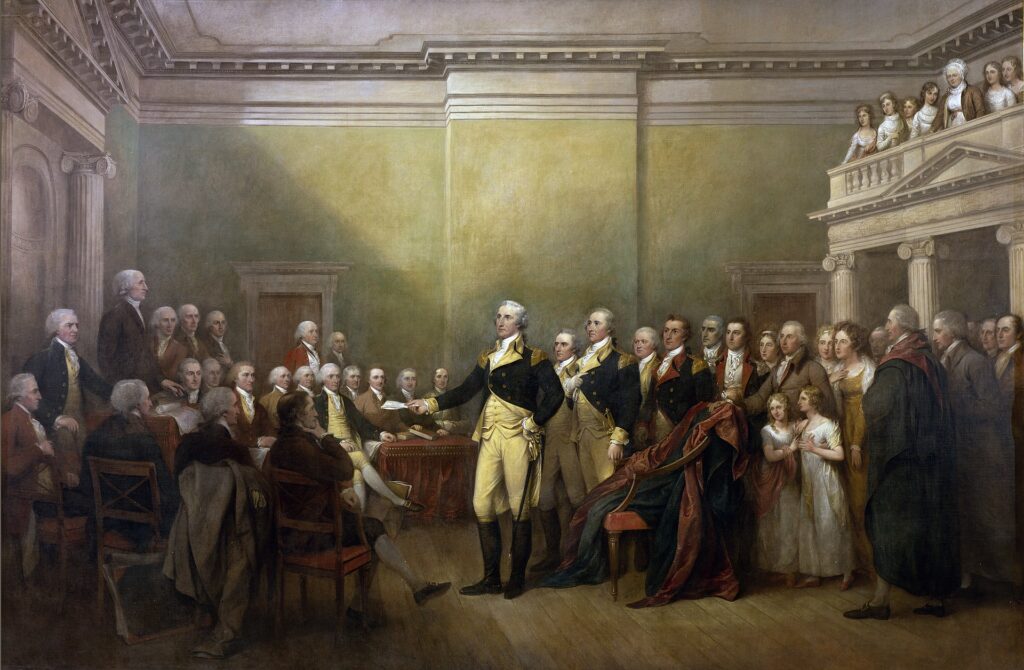
Washington resigning his commission. Even George III thought this act made him one of the greatest of all men.
The Founding Fathers aren’t much in fashion among liberals these days. A good friend of mine has been trying to get a novel about Thomas Jefferson published for three years. He has approached more publishers than he can care to name, publishers of all sizes, reputations and political persuasions. He tells me that while most mainstream, as well as niche publishers, have turned his manuscript down, a small number of right-wing houses that typically publish conservative polemic are deeply interested.
My friend’s problems with publishing Jefferson mirror the liberals’ problem with the Founding Fathers in general. At best they are dismissed as outdated dead white men, and at worst as evil slaveholders. But as an immigrant who came to this country inspired by the vision these men laid down, I don’t feel that way. Neither does my 4-year-old who proudly dressed up as George Washington, of her own accord, for Halloween last year. She stood proudly in her little tricorne hat and blue colonial coat, her face full of determination, as if she too was leading an army (she was particularly inspired by the stories I told her of Valley Forge and Washington’s crossing of the Delaware). Both she and I believe that while these men’s flaws were pronounced, and vastly so in some cases, the good they did far outlives the bad, and they were great men whose ideals should keep guiding us. More importantly, I believe that a liberal resurrection of the Founding Fathers is in order today if we want to fight the kind of faux patriotism foisted on us by the Party of Trump (“POT”. We can no longer call his party the Republican Party — that party of Dwight Eisenhower, of Ronald Reagan, of respect for intelligence, fiscal responsibility, international stewardship and opposition to real and not perceived evil, is gone, kaput, pushing up the daisies, as the memorable sketch would say: it is an ex-party).
First, let’s acknowledge the bad. There’s no denying why some liberals feel hesitant about embracing the Founding Fathers. These men who laid out ideals of equality and justice also owned human beings, a glaring contradiction that’s impossible to ignore. They were patronizing toward women and scoffed at their intellect. They would almost certainly have thought that people who looked like me or my daughter could not be equal citizens of the Republic. Washington and Jefferson, in particular, were deeply enmeshed in this brutal institution – Jefferson far more so than Washington, who freed his slaves in his will – and it’s fair to question how they could write about liberty while denying it to others. As early as 1775, Samuel Johnson was asking, “How is it that we hear the loudest yelps for liberty among the drivers of negroes?”; the hypocrisy was obvious on both sides of the Atlantic. For those of us who call themselves liberals and believe in human rights, this hypocrisy is hard to reconcile.
But we must remember the times in which they lived if we want to free ourselves of the disease of presentism. As wealthy Virginia planters, it would be virtually impossible to imagine Washington or Jefferson not owning slaves. Their acceptance of slavery was, however evil and anachronistic it seems to us, common among people of their era. However, their ideas about free speech, religious tolerance, separation of powers, and individual rights were not. In other words, as Gibbon said about Belisarius, “His imperfections flowed from the contagion of the times; his virtues were his own.” In addition, it is important to not bin “The Founders” in one homogenous, catch-all bin. Washington freed his slaves and was a relatively beneficent and enlightened master for his times, loathe to participating in the wrenching practice of separating families, for instance; Adams and twenty-two of the signers of the Declaration of Independence did not own any at all; Franklin later became an abolitionist; Jefferson was probably the biggest culprit – not so much because he owned many slaves but because the gap between his soaring rhetoric and the reality at Monticello, not to mention his relationship with Sally Hemings, is glaring. To recognize these differences between the Founding Fathers is to not excuse their practices; it is to recognize the possibility of human improvement and the fact that in every age there is a spectrum of men and morality.
Why have a democracy? Because democracy is always right.
There are two kinds of arguments in favor of democracy: intrinsic and instrumental. Intrinsic arguments try to show that democracy is good in-and-of-itself – and not as simply a means to some other end or ends. Instrumental arguments try to show that democracy is good because it leads to some good.
There are two main kinds of intrinsic arguments: those based on liberty and those based on equality. The most straight-forward kind of liberty argument says that we should be free, but to be free means not only to govern ourselves, but to have some control of our larger social and material environment. Democracy gives us that control. The trouble is that in actually existing democracies very, very few people are able to exert any real influence on society or their material conditions via the political process. Democracy does not make most of us free, at least in this way.
Here’s a different kind of liberty argument. We all have certain basic rights. Among the basic rights, liberties, and freedoms we possess in a liberal democracy – freedom of religion, free speech, the right to the rule of law, etc. – there are also rights of political participation – political speech, a right to free assembly, etc. What does this kind of pro forma right to some kind of political participation really amount to, though?
There’s no right to vote in the US Constitution. And Arrow’s Impossibility Theorem shows there is no way of counting votes that can satisfy all of the seemingly simple and reasonable conditions voting must bear. To oversimplify a bit, there is no way of voting that always gives us an answer, always depends on the input of more than one person, gives a way of deciding between candidates based on voting (and nothing else), and insures that the choice between any two candidates is independent of how the voter feels about other candidates.
Fortunately, there are also equality-based arguments for democracy. Manypoliticalphilosophers have argued that democracy is a way of treating people equally. But lotteries treat people equally too. Read more »
Much philosophical writing about food has included discussions of whether and why food can be a serious aesthetic object, in some cases aspiring to the level of art. These questions often turn on whether we create mental representations of flavors and textures that are as orderly and precise as the representations we form of visual objects.
The claim that we do not form such ordered, mental representations is central to the view that food and drink cannot be serious aesthetic objects or works of art. The reason is that genuine aesthetic experience requires the apprehension of form or structure. In the absence of structured representations there is no form to apprehend. (See Part 1 of this essay for a more detailed account of mental representations of aroma.)
I want to argue that the skeptics have a point although they draw the wrong inference from it. Our flavor experiences do, in fact, rest on weak representations. They lack the stable, detailed, clearly identifiable objects that vision typically yields. However, these weak representations allow for the apprehension of a different kind of structure, what I shall call a nomadic distribution (or continuously changing structure), and it is in fact this nomadic distribution of flavor that enables the aesthetic experiences characteristic of our engagement with food. The main point to draw from this is that cuisine is about transformation, one thing becoming another, and it is ill served by theoretical perspectives that rely on mental representations with firm identity conditions.
The explanations for why flavor and aroma are weakly representational fall into three categories—flavors are ephemeral, ambiguous, and difficult to remember with precision. Read more »
In perilous times we join the otherworld, the one that’s outside our bubble
who’s driving this bus? who’s at the helm? who jiggles the joystick?
we man our posts we soothe ourselves but one day must come to terms:
I saw a cormorant, wings spread drying herself in the wind after lunch oblivious to the dilemma of our recklessness but snared nevertheless in its reach
but time itself is oblivious, and space
so, who?
Jim Culleny 7/10/19
Enjoying the content on 3QD? Help keep us going by donating now.
I lie on a futon in a little room tucked in a turret of an old funeral home-turned-apartment building in Binghamton, New York, listening to election returns coming in over my clock radio. It is a Tuesday night in 1984, the year of Orwell’s never-ending fever dream. Madonna and Prince and Michael and Bruce play incessantly on the radio between election reports. The unfolding AIDS epidemic is a thing no one wants to talk about: A friend, a PhD candidate in poetry, is sick in faraway Florida, but none of us in the department even knows about it yet. He will be dead in six months.
I am a year into my stint in graduate school. (Two years will be more than enough for me.) The path to my master’s degree in English has been a circuitous one, even tortuous: As an undergraduate, I started out in geology with a little climatology, detoured into art and design for two years, then ended up studying American literature. But I have never lost my love of the Earth sciences.
Ronald Reagan, at 73, is the oldest candidate ever to run for election — or, in this case, re-election — as President of the United States, against . . . What’s his name again? This election marks (I firmly believe) our last chance as a civilization to change course and sail towards a Green Future, an inkling of which we saw with President Jimmy Carter. I do not know if What’s-his-name is the answer, but we all know Reagan ain’t. One term could be a fluke. A second, collective suicide.
Several months hence, the great science communicator, Carl Sagan, will say to the United States Senate, “If you don’t worry about it now, it will be too late later on.”* His talk is a plea to those in power to start controlling carbon dioxide emissions from burning fossil fuels. The concentration of atmospheric CO2 in 1984 is 344 parts per million and the global temperature anomaly a barely noticeable +0.40° Celsius.* Carbon dioxide concentration MUST be kept below 350 ppm, or the planet will heat up, creating havoc. And there are other pollutants to worry about. And also oil depletion, deforestation, ocean acidification, wildlife habitat loss, over-population. A collapsing civilization does not seem far-fetched.
False alarm! It is Morning in America.*Read more »
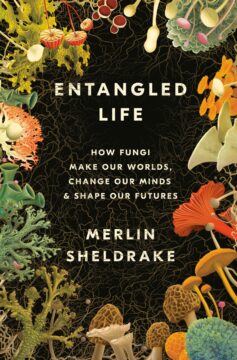
Recently I stepped into the underworld of fungi in Merlin Sheldrake’s Entangled Life: How Fungi Make our Worlds, Change our Minds and Shape our Futures. His book took me to an ancient world, tirelessly and inconspicuously working away and doing its vital job of literally interlacing the planet and holding it together to make life sustainable. The entry into this curious world was through the rather unassuming life form that most of us are more accustomed to eating than we are to learning about its existence: the mushroom.
Mushrooms are, for most of us, just another source of food, or indeed choose the wrong kind to consume and the adverse effects are likely to be more dangerous than delicious. They are though, fruiting bodies of fungi whose appearance on the surface is aimed at the reproductive role of dispersing millions of spores into the atmosphere to secure their existence.
Colourful mushrooms of all sizes and shapes poking their heads up from the leafy undergrowth of a woodland or forming colonies of various architectural designs on dead trees, have never failed to draw my attention during my wanderings through wooded areas. Fascinated by these humble looking elegant protuberances that decorate the forests, on some occasions I have taken the time to count the varieties I have seen and found several different types on any one day. But as I learned from Sheldrake, my enthusiasm for the diversity of the mushrooms I observed was quite trivial in comparison with the numbers of fungi on the planet: there are, literally, millions of species throughout the world. Read more »
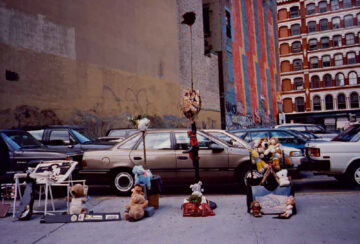
Photo from the publication “Curtis Cuffie.” Scot Portnoy, Robert Snowden, Ciarán Finlayson (eds.); Katy Able, Carol Thompson, Curtis Cuffie, Michael Galinsky, Margaret Morton, and Tom Warren (photos), 2023.
I recognized the corner immediately: it was right next to Cooper Union, on Lafayette Street in downtown Manhattan. There used to be a large parking lot on the other side of the street, where passers-by occasionally happened upon a colorful bricolage cobbled together from stuffed animals and clothes, discarded household items, deformed umbrellas, and battered car parts. These strange and playful conglomerations looked as though the bric-a-brac and refuse had been plucked together by some invisible furious force to house a spirit or daemon. They were, of course, carefully composed works by the late African-American artist Curtis Cuffie, one of the many ephemeral assemblages he created in the streets of downtown New York in the 1980s and 1990s.
Photo from the publication “Curtis Cuffie.” Scot Portnoy, Robert Snowden, Ciarán Finlayson (eds.); Katy Able, Carol Thompson, Curtis Cuffie, Michael Galinsky, Margaret Morton, and Tom Warren (photos), 2023.
Cuffie installed his improvised ensembles of found objects on fences, window grilles, sidewalks, and traffic signs in Cooper Square, the Bowery, and elsewhere; they were always temporary, and only a few of his works have survived. Cuffie periodically lived on the streets around Cooper Square and his homelessness must have made his emotional tie to the treasures he found and wheeled around in shopping carts all the more urgent. Most of the works he created from this repertoire of materials were abstract, shrines that seemed to grow out of the flotsam and jetsam of a city in constant transformation; seen from a passing car, they flashed in the sideview mirror like otherworldly apparitions. But there were also figurative sculptures: ragged garments strung on wire and string and adorned with hats or wigs became animated spirits on a secret mission. Today, the few remaining works by Cuffie that were not taken down and destroyed by the police or street cleaners are shown and sold in the pristine white spaces of uptown Manhattan galleries, stripped of their context and also, perhaps, a good deal of their meaning. Read more »
My favorite place on Earth is Niagara Falls. I refresh my spirit there. Standing on the very brink, my chest pummeled by the roar of millions of gallons of fresh water plunging into the abyss, I feel at one with figures like Margaret Fuller, Charles Dickens, and Mark Twain, each of whom recorded their humbled awe at the spectacle. I throw my mind into the past and imagine countless generations of Native Americans standing on the brink of the Falls and wondering, as many do today: where is all this water going?
Well, I’ll tell you where it goes: down the Niagara Gorge, into Lake Ontario, into the St. Lawrence Seaway, and finally to the Atlantic Ocean, where it mixes with the saltwater and is, for all practical purposes, wasted.
Now I’ll tell you where it isn’t going: it isn’t going to the showerhead in my luxury Niagara Falls hotel room. Even though I can look through my window and see 44,500 gallons of fresh water tumbling over the brink every minute, when I step into my marbled bathroom and turn on the shower, I stand under the same strangled trickle I’d get in a cheap motel outside Salinas, California, or another city with severe water use restrictions.
Primal pleasure denied. I don’t need to sell anyone on the satisfaction of a good, strong shower—hot, but not too hot, slightly stinging, and thoroughly cleansing of both body and soul. Yet this primal pleasure has not been widely available since 1992, when the U.S. Energy Policy Act mandated that new showerheads sold in the country not exceed 2.5 gallons per minute.
The Energy Policy Act makes sense for places like the American West, where the combination of climate change, cattle farming, and almond growing has created a dire water situation. But Niagara Falls? Read more »
This book is a delight. Drawing on a deep love of her subject matter, the author interweaves descriptions of a sequence of rock types with the story of her own personal and professional life. An extremely difficult feat to bring off, but Marcia Bjornerud (M) manages to do this without artificiality or mawkishness, drawing on historical and philosophical insights whose origins are hinted at throughout the text, and explaining complex concepts in lucid and enjoyable language. The only thing I did not like about the book is its appearance, which for me fails to suggest the hard-won insights that it is so successful in conveying.
M began her training in the early 1980s, at an interesting time, when the community of geologists was still absorbing the implications of plate tectonics, and geology was changing from a descriptive to an explanatory science. This was also when, despite the best efforts of the fossil fuel companies, predictions of global warming were beginning to seep into public awareness. A difficult situation for a socially aware geologist, since these same companies are going to be the main employers of her students.
She was established in what most people would regard as a successful academic career, having earned tenure at an unnamed but easily identified major Midwestern research university. But she was not happy, either with the location (in the middle of a vast expanse of one of the few kinds of rock that she really seems to find boring) or with the atmosphere of the place. And so, despite having got away with such subversive activities as smuggling a mention of Gaia into a lab manual chapter on biogeochemistry, and devising undergraduate classes that actually taught students something, she decided that she needed to move. Easier said than done. She was too far along in her career for ordinary entry-level positions, but not yet advanced enough for senior appointments. So she made the extraordinary decision to apply for a teaching job at Lawrence University, a tiny private liberal arts college in Wisconsin, and we must be glad that she did so.
Lawrence is clearly a very special kind of place. It educates not only its students (all 1500 of them), but its faculty, by involving all of them in its “great books” programme. And there, released from the treadmill of writing papers to gain grants to fund students to collect data to write papers, she has been able to explore at will and meditate on her findings, in the occasional specialist publication but also other outlets such as newspaper articles, and in a series of books including Timefulness, which I reviewed here earlier, and the present volume. (All this despite an unusually demanding family situation, and the responsibilities of rebuilding her department.) Read more »
The tree was immense even by local standards: a western red cedar that might have been a thousand years old. A botanist would want to measure it; I only wanted to touch its wrinkled face, or kneel among the roots and capture a dramatic snapshot looking up along the trunk. But it was fifty paces away and I couldn’t get there.
We were 300 miles northwest of Vancouver, as the raven flies, on one of the countless islands of the Great Bear Rainforest. The Great Bear covers 25,000 square miles of British Columbia’s Central Coast, which makes it about the size of Sri Lanka. You can get into it by road, sort of, if you take a long, long detour around the back of the coastal mountains to the Bella Coola valley. But water has always been the real road in this maze of islands and inlets, so instead we drove our kayaks to Port Hardy, on the northern tip of Vancouver Island, rolled them onto the ferry, and rolled them off five hours later at the geographical and spiritual heart of British Columbia’s Central Coast, the Heiltsuk community of Bella Bella.
We paddled for twelve days. From the water we saw cormorants and sea otters beyond counting; porpoises; humpbacks. But the land seemed eerily empty, aside from a mink the color of salted chocolate that scampered past my feet one evening. Clawed prints in the sand. A few distant howls in the night. But the bears and wolves, and no doubt many other creatures, were perfectly hidden by the most dominant form of life, tens of millions of trees.
They cover almost everything. On most of the islands, whether fifty square miles or the size of a room, the forest approaches the water like a shoulder-to-shoulder army marching over a cliff, the edge marked by a constant slow-motion falling. The only shore is a yellowish ring of hand-shredding, barnacle-encrusted boulders, fortifications so uniform that it can be hard to finding even the sketchiest place to land. Camping is possible only because some islands have pockets of white sand beach.
Here, for me anyway, was a strange and arresting new experience of wilderness. Read more »

 My friend R is a man who takes his simple pleasures seriously, so I asked him to name one for me. Boathouses, he said, without hesitation.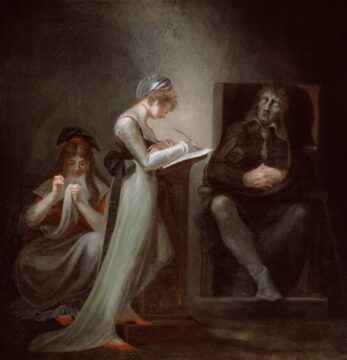

 Early on, Magona presents readers of Beauty’s Gift with a startling image: the beautiful and ‘beloved’ Beauty laid to rest in an opulent casket, which is then fixed in the earth with cement to prevent theft. Her friends’ memories of Beauty’s charisma and kindness are concretized by the weight of her death from AIDS. From the outset, funerals emerge not merely as a plot point but a structuring device for understanding the social and political implications of the AIDS crisis in South Africa. After opening her novel with Beauty’s funeral, Magona continues with vignettes about various stages of illness, death, and grief. These include a wake, the mourning period, Beauty’s posthumous
 Humans are beings of staggering complexity. We don’t just consist of ourselves: billions of bacteria in our gut help with everything from digestion to immune response.
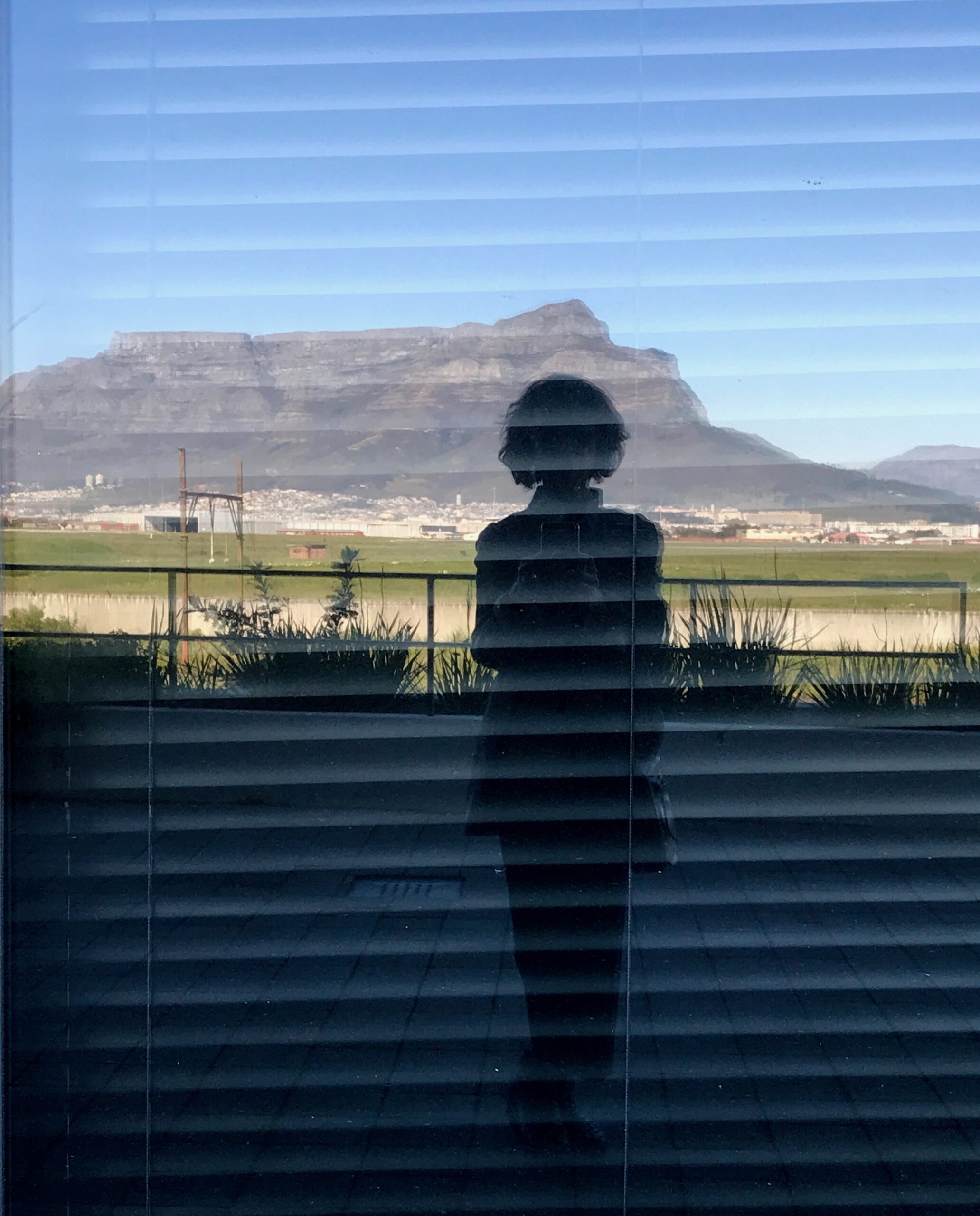 Sughra Raza. Self Portrait Against Table Mountain. August, 2019.
 Much philosophical writing about food has included discussions of whether and why food can be a serious aesthetic object, in some cases aspiring to the level of art. These questions often turn on whether we create mental representations of flavors and textures that are as orderly and precise as the representations we form of visual objects.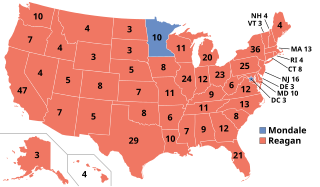



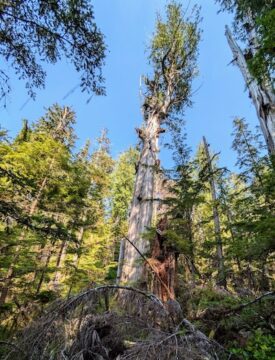 The tree was immense even by local standards: a western red cedar that might have been a thousand years old. A botanist would want to measure it; I only wanted to touch its wrinkled face, or kneel among the roots and capture a dramatic snapshot looking up along the trunk. But it was fifty paces away and I couldn’t get there.