 I read a great deal of Bertrand Russell when I was in my teens. I read various collections of essays, such as Why I Am Not A Christian, In Praise of Idleness and Other Essays, and Marriage and Morals, some of which my father had stored in a box in the basement, along with Orwell’s 1984, Huxley’s Brave New World, a book or two by this guy named Freud, though I forget which one, and some others. I also Russell’s – dare I say it? – magisterial A History of Western Philosophy And Its Connection with Political and Social Circumstances from the Earliest Times to the Present Day, which I purchase myself, a big thick paperback with a white cover. It was cited when he received the Nobel Prize for Literature in 1950.
It was from Russell more than anyone else that I got the idea that philosophy was a grand synthetic discipline, which I liked. Putting things together, seeing how all the parts interacted, that had immense appeal to me. And so I became a philosopher major when I enrolled in The Johns Hopkins University in 1965. I enjoyed an introductory course called, I believe, Types of Philosophy. Edward Lee’s course in Plato and the Pre-Socratics was wonderful as well; Lee was young, charismatic, and loved Mahler, as I did.
Then there was a two-semester sequence in the history of modern philosophy, from Descartes up through Kant. Maurice Mandelbaum taught the first semester, outlining each lecture on the board and then delivering on the outline. The lectures were so clear that you almost didn’t have to read the primary texts. The second semester was taught by a visitor from Chicago, Alan Gewirth. A different experience, like pulling teeth. Gewirth did the pulling and we students offered up our teeth. Ouch! But perhaps more pedagogically effective than Mandelbaum’s clarity, more Socratic, if you will.
By my junior year, however, I had come to realize that philosophy, as it is practiced in the academic world, is not what I had imagined it to be from reading Russell’s essay. It was another specialized discipline that had long ago abandoned any attempt at a broad synthesis. Fortunately, I had discovered literature, and Dr. Richard Macksey, whom I’ll discuss in more detail later. I’d always loved to read, and Macksey’s free-wheeling and broad ranging intellect appealed to me. I took four courses with him, plus an independent study on I forget what, and did a master’s thesis on “Kubla Khan” under his supervision. Literary criticism became the rubric under which I put things together. And why not? Literature expresses the world, and so couldn’t one study the world under the rubric of studying literature?
Well, no, if you must ask. By the time I’d figured that out – it didn’t take but a year or three – I was committed to an impossible intellectual project. I remain so committed. I will end this essay by arguing – it’s more of an earnest suggestion, really – that perhaps, if we do it right – of which there is no guarantee, and many signs that we’re botching it – we can harness these marvelous new machines to the job of synthesizing (human) knowledge. If we succeed, we’ll find ourselves in a whole new world, perhaps one where it is not at all obvious who is harnessed to what and to what end. I will, however, proceed indirectly. Read more »

 Sughra Raza. Let Me Just Absorb Today.
 There is no genuinely effective lyric poem unless there is a line which lodges itself in the brain like a bullet. Often – though not always – these lines are the first in a poem, the better to abruptly propel the reader into the lyric. William Wordsworth’s “I wandered lonely as a cloud,” Walt Whitman’s “I celebrate myself, and sing myself,” or Langston Hughes’ “I’ve known rivers.” For example, John Donne and Emily Dickinson are sterling architects of not just the memorable turn-of-phrase, but the radiant introductory line as well. Think “Batter my heart, three-person’d God” or “I heard a Fly buzz – when I died.”


 In
In 

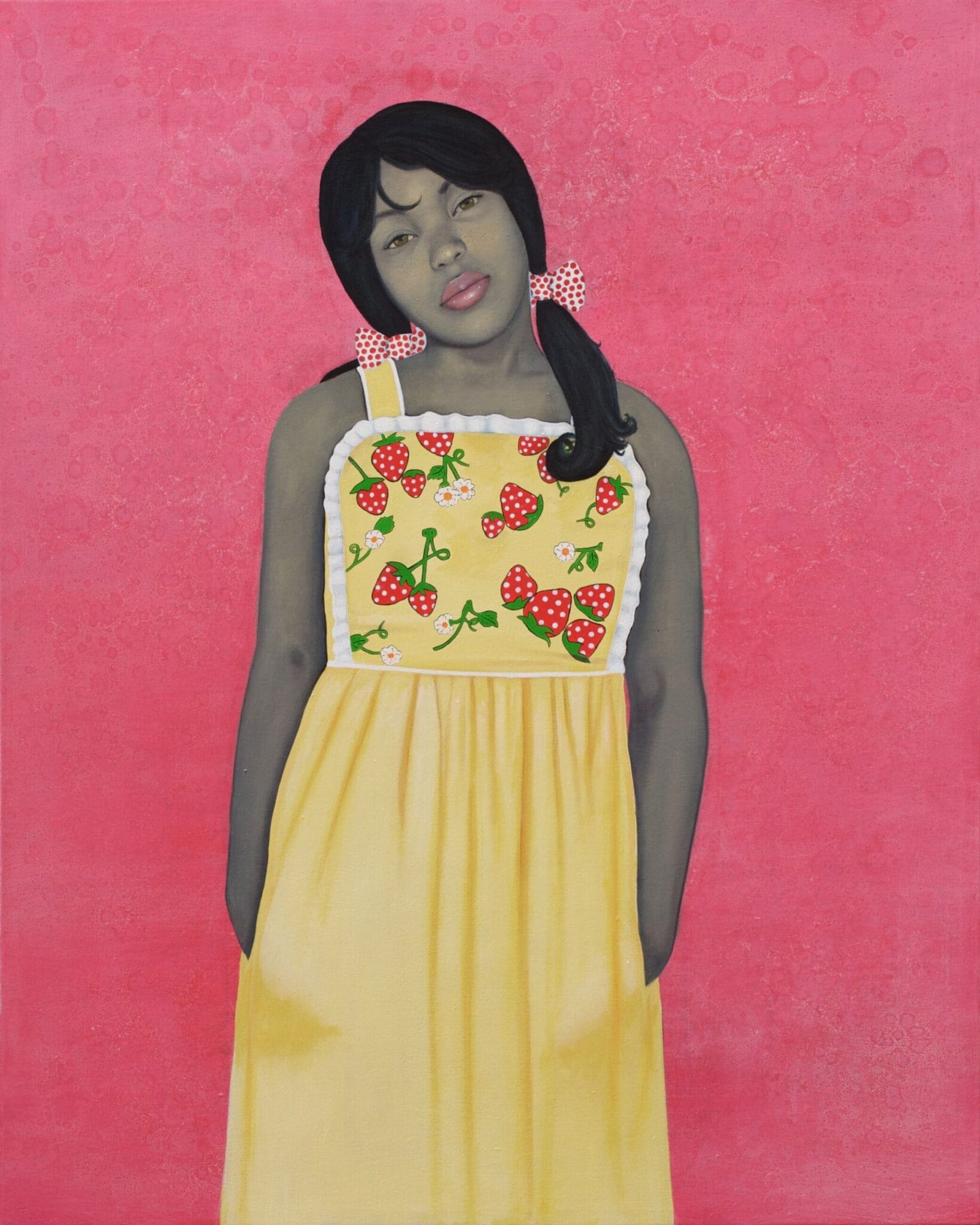 Amy Sherald. They Call me Redbone but I’d Rather Be Strawberry Shortcake, 2009.
 In November 2023, in an essay for the German national newspaper die taz, I wrote that Germany’s Jews were once again afraid for their lives. It was—and is—a shameful state of affairs, considering that the country has invested heavily in coming to terms with its fascist past and has made anti-antisemitism and the unconditional support of Israel part of its “Staatsräson,” or national interest—or, as others have come to define it, the reason for the country’s very existence. The Jews I’m referring to here, however, were not reacting to a widely deplored lack of empathy following the brutal attacks of October 7. In an open letter initiated by award-winning American journalist Ben Mauk and others, more than 100 Jewish writers, journalists, scientists, and artists living in Germany described a political climate where any form of compassion with Palestinian civilians was (and continues to be) equated with support for Hamas and criminalized. Assaults on the democratic right to dissent in peaceful demonstrations; cancellations of publications, fellowships, professorships, and awards; police brutality against the country’s immigrant population, liberal-minded Jews, and other protesting citizens—the effects have been widely documented, but what matters most now is now: the fact that the German press is still, four months later, nearly monovocal in its support of Israel and that over 28,000 civilians, two-thirds of them women and children, have died.