by Jerry Cayford
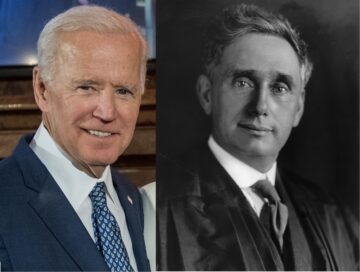
Biden matters because he is taking on the real problems that are wrecking America, the deep structural problems, created over decades, that benefit powerful people who will do anything to prevent change (the way fossil fuel companies do anything to block climate solutions that hurt profits). He is the first president since LBJ to take on problems that big.
“How can that be?” you ask. “Joe Biden hasn’t transformed the Middle East into peaceful democracies like George W. Bush did. Nor has he ended racial and partisan animosity in America like Barack Obama did, or drained the swamp like Donald Trump did. What has Biden done?” He has taken on a challenge as big as his three predecessors’ ambitions: breaking corporate monopoly power and restoring healthy competition.
“Competition policy” is the innocuous name for this program. It’s big because it seeks to cure the root malady ailing America. Obviously, I was being sarcastic about the successes of Biden’s predecessors: they got nowhere on their signature ambitions, because they did not even try. Bush’s program for the Iraq transition was an arrogant experiment in free-market fantasy, uninterested in democracy. Obama announced in an apology letter to supporters after winning the nomination that he was not going to change our corrupt and toxic politics. (I wrote a Daily Kos piece about it in July 2008.) And Trump, as the very embodiment of the swamp, would no more drain the swamp than a bullfrog would. But Biden is serious. Read more »
 Sughra Raza. Let Me Just Absorb Today.
 There is no genuinely effective lyric poem unless there is a line which lodges itself in the brain like a bullet. Often – though not always – these lines are the first in a poem, the better to abruptly propel the reader into the lyric. William Wordsworth’s “I wandered lonely as a cloud,” Walt Whitman’s “I celebrate myself, and sing myself,” or Langston Hughes’ “I’ve known rivers.” For example, John Donne and Emily Dickinson are sterling architects of not just the memorable turn-of-phrase, but the radiant introductory line as well. Think “Batter my heart, three-person’d God” or “I heard a Fly buzz – when I died.”



 In
In 

 Amy Sherald. They Call me Redbone but I’d Rather Be Strawberry Shortcake, 2009.
 In November 2023, in an essay for the German national newspaper die taz, I wrote that Germany’s Jews were once again afraid for their lives. It was—and is—a shameful state of affairs, considering that the country has invested heavily in coming to terms with its fascist past and has made anti-antisemitism and the unconditional support of Israel part of its “Staatsräson,” or national interest—or, as others have come to define it, the reason for the country’s very existence. The Jews I’m referring to here, however, were not reacting to a widely deplored lack of empathy following the brutal attacks of October 7. In an open letter initiated by award-winning American journalist Ben Mauk and others, more than 100 Jewish writers, journalists, scientists, and artists living in Germany described a political climate where any form of compassion with Palestinian civilians was (and continues to be) equated with support for Hamas and criminalized. Assaults on the democratic right to dissent in peaceful demonstrations; cancellations of publications, fellowships, professorships, and awards; police brutality against the country’s immigrant population, liberal-minded Jews, and other protesting citizens—the effects have been widely documented, but what matters most now is now: the fact that the German press is still, four months later, nearly monovocal in its support of Israel and that over 28,000 civilians, two-thirds of them women and children, have died.

 by David J. Lobina