Rowan tree, also known as the mountain ash and its bright treasure of berries. With its yellow-orange leaves, it looks particularly striking at this time of year. Photo taken during a walk last week through Franzensfeste, South Tyrol, on a sunny day with beautiful light.
Enjoying the content on 3QD? Help keep us going by donating now.
The Stepped Reckoner, a calculating machine invented by philosopher and mathematician Gottfried Wilhelm Leibniz in 1674
Is mathematics created or discovered? For over two thousand years, that question has puzzled philosophers and mathematicians alike. In Plato’s Meno, Socrates encourages an uneducated boy to “discover” a geometrical truth simply by answering a series of guided questions. To Plato, this demonstrated that mathematical knowledge is innate, that the soul recalls truths it has always known. The intuitionists of the early twentieth century, however, rejected this idea of eternal forms. For thinkers like Poincaré and Brouwer, mathematics was not revelation but construction: an activity of the human mind unfolding in time.
The debate continues today in an unexpected new arena. As artificial intelligences start to generate proofs, conjectures, and even entire branches of formal reasoning, we are prompted to ask again: what does it mean to do mathematics? Current systems excel at symbol manipulation and pattern matching, but are they truly thinking in any meaningful way, or just rearranging signs? The deeper question is how humans do mathematics. What happens in the brain when a mathematician recognizes a pattern, intuitively sees a relation, or invents a new kind of number?
In what follows, I’ll trace that question from ancient philosophy to modern neuroscience and then to the newest foundations of mathematics. We’ll see that mathematical invention may be the natural expression of the brain’s recursive, embodied intelligence, and that this perspective could transform how we think about both mathematics and AI. Read more »
Throughout most of the UK (Northern Ireland is a partial exception) evolution is regarded as established science, and no politician would make belief in separate creation part of their platform, for fear of ridicule. In the US, this is far from being the case. Although evolution has become more widely accepted over time, one third of Americans still believe that God created humans in their present form. Here I discuss the enormous influence of creationism in US politics and analyse the arguments put forward in its favour, as set out for example by Charlie Kirk, the recently slain leader of Turning Point USA.
Mike Pence, Vice President during Trump’s first term in office, had argued in Congress for creationism, while creationists have been prominent in the various faith councils supporting Trump. At least three members of his present cabinet (Pete Hegseth, Scott Turner at HUD, pastor at Prestonwood Baptist Church, Doug Collins at the VA, one-time pastor at Chicopee Baptist Church) are committed creationists, as is Mike Huckabee, another former Southern Baptist pastor, now ambassador to Israel. So is Mike Johnson, Speaker of the US House of Representatives, who has done pro bono work for Answers in Genesis, now the leading creationist organization. Russell Vought, co-author of Project 2025, whose role at the Office of Management and Budget is pivotal role in the distribution of federal funds, is an elder of a church that explicitly rejects evolution, and sees Satan as “the unholy god of this age.” Vought is also acting director of the Consumer Financial Protection Bureau, and on 28 October 2025, in this capacity, rescinded the rule that, in some States, prevents medical debt from showing up on credit reports.
We can understand the link between creationism and US right-wing politics in terms of the appeal to US conservatives of loyalty, respect for authority, and sanctity. These all favour absolutist theology, which demands submission to divine authority, loyalty to the community of believers, and the preservation of pure doctrine. With this in mind, we can understand the appeal of Christian Nationalism and Trumpism to creationists. Thus as early as 2015, Answers in Genesis praised Trump, not for any specific policies, but because he spoke, just as Jesus spoke to the Pharisees, as one with authority. Read more »
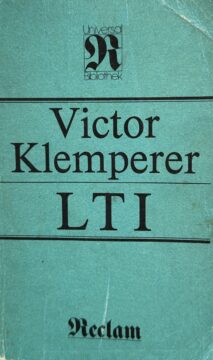
In June 1932, half a year before Adolf Hitler was sworn in as German Chancellor, Victor Klemperer watched Nazis on a newsreel marching through the Brandenburg Gate in Berlin. A professor of Romance languages at the Technical University of Dresden, whose area of specialization was the 18th century and the French Enlightenment, Klemperer (1881-1960) was unpleasantly gripped by this first encounter with what he termed “fanaticism in its specifically National Socialist form,” and by the “expression of religious ecstasy” he discerned in the eyes of a young spectator as the drum major passed by, balanced precariously on goose-stepping legs while he robotically beat time.
This initial morbid fascination—with National Socialist martial aesthetics, and eventually with Nazi ideology as expressed linguistically—was to prove a lifesaver after 1933 when Klemperer, although a convert to Christianity, was systematically deprived of his academic privileges, and then of his civil rights, by the Nazis now in power, who regarded him as an unalterably “biological” Jew. Klemperer’s marriage to an “Aryan” woman saved him from the deadly fate reserved for millions of others, but he nevertheless suffered as a form of torture his exclusion from libraries, his confinement with his wife to a Judenhaus, and the mindless industrial work he was forced to perform:
In my hours of revulsion and hopelessness, during the endless drudgery of sheerly mechanical factory labor, by the side of the sick and dying, at gravesites, when I myself was in distress, at moments of the greatest agony, as my heart was failing in my body—the demand I made of myself came faithfully to my aid: to observe, to study, to remember what has occurred—tomorrow things will look different again, tomorrow you will feel different again; set down the way this moment announces itself, record its impact. And very soon, this call to elevate myself above the situation and to preserve my inner liberty had been condensed into a secret formula, one with reliable effect: LTI, LTI!
“LTI,” Klemperer’s “secret formula,” was his shorthand for the project that sustained him: documenting the language used by the National Socialists as they gradually exerted totalitarian control over German minds (and “non-German” bodies). “LTI” stands for Lingua Tertii Imperii, Klemperer’s own taxonomy for “The Language of the Third Reich”. Read more »
When my mother was a teenager in the early 1940s, a NY-area radio station ran a weekly contest, asking listeners to vote for their favorite singer among two: Crosby or Sinatra? How people made this preference known remains unclear to me: did you need a phone in your house to make a call to the station or was sending a postcard enough? Whatever the method, the winner would be announced each Sunday afternoon. While Sinatra often took the prize, Crosby occasionally outpaced the Jersey boy who grew up two towns south of Cliffside Park, my mother’s hometown. On those occasions, she told me, she’d stamp around my grandparents’ railroad apartment, enraged at the abject stupidity of her fellow listeners. When she’d tell this story, my mother would marvel at her parents’ forbearance, the way they’d accept these outbursts without comment, though they were highly disciplined, gloomy people for whom the idea of having an “idol,” or caring about his fate on a weekly radio show was surely alien. I like this insight into them, a softer side that I myself had only witnessed a few times.
What I like even more about the story is what it says about my mother’s taste—excellent—and that her knowledge and passion for the American songbook went way back. I suppose you could say that last statement was true for almost anyone young in those years, but I doubt there were many casual listeners who, years later, could pick out the pop standard undergirding the inventive tangents of Cecil Taylor or Milt Jackson recordings. But none of this was an identity for my mother or something she talked about or was even aware of as somehow unusual: she liked the music, knew it deeply, and there was no more to it. Her tastes were definite and clean, like the beautiful seams of well-made clothing that don’t depend on distracting accessories or patterns. She dismissed the likes of Judy Garland and Sammy Davis Jr.—too needy—and championed Johnny Mathis, Jo Stafford, and Sinatra for their understated elegance. Despite her own performance as an irate teenager, she was her parents’ daughter in prizing reserve on stage. No big gestures or frenetic moves across the stage. Read more »
“…eventually he regained his balance and dismissed all thought of resistance from his mind, and concentrated on accepting the dizzy state of the world that was spinning round him as a perfectly natural state of affairs…” —László Krasznahorkai, The Melancholy of Resistance (trans. George Szirtes)
I grew up in communist Hungary, the country that is the original source of the bitterness of Krasznahorkai, winner of this year’s Nobel prize in literature. During my upbringing there, and before, for generations, politics had been a constant presence in everyday life, and history, too, with still fresh memories of fascism all around. I am not saying that politics dominated everything; there was life beyond it, but still, it was unavoidable. It provided the oppressive, at times humiliating, at times ridiculous mise en scène of our lives. During my youth spent in dissolute opposition to the tired version of communism in the 1980s, I knew that there was an alternative: the democracies of the West, which struck me, on my visits as an impoverished tourist from Eastern Europe, as obviously, vastly, and exhilaratingly superior to the places on my side of the Iron Curtain.
When I moved to New York in 1989, illusory as some of my expectations turned out to be, I reasonably concluded that I escaped history’s clutches. Like a good enough mother, guarding inconspicuously the safety of her children, American democracy turned out to be, from my vantage point in any case, the constantly humming background of a normal life unmarred by the intrusions of a power-hungry political regime. The newspapers, by and large, reported the facts instead of the tendentious, strangely formulated distortions and outright lies I grew up on, and there seemed to be a certain, minimal level of decorum in public affairs. I didn’t feel the need to be constantly on alert; I didn’t even need to know much about politics at all.
But now it looks like history has caught up with me again. So I started wondering if the Eastern European experience can shed any light on the present predicament of the US. If it can teach something about the meaning of resistance. Read more »
Jersey City is a medium-size city on the West bank of the Hudson River across from Lower Manhattan. Up through the middle of the 20th century it was a port and a railroad hub but that disappeared when containerized freighter became too deep to travel that far up New York Bay. Without any freighters the railroads were no longer needed. Light industry disappeared as well. Jersey City became back-offices and bedrooms to Manhattan-based business.
In the 19th century the Morris Canal carried coal from Eastern Pennsylvania to the Hudson River at Jersey City. Most of the canal has been filled in, but the eastern-most bit remains. You can see it in the photo to the upper right. The small building to the left of center is an abandoned industrial building of some kind. As you can see various walls have collapsed, as has part of the roof.
When you get closer you can will that the walls are marked with graffiti, which I saw when I first approached the building in the middle of 2011. The graffiti changed from week to week and month to month. It is for that reason that I took to thinking of it as the ‘urban design studio.’ This is the south wall; the Morris Canal is behind us and the Hudson River is about a quarter mile to the right. Read more »
I need a good poem lifespan-short, one I can shoe-horn between instants which in that pinch says so much I’ll understand long and short by the depth of calluses built upon my brain—
but it’s not happening I’m already up to nine lines so it’s too late for brevity—
what I want is one that says something without rolling on forever, Amazon-like swaying to topographical switches and twists in rivers and streams or cul-de-sacs of human error,
but now I see this won’t end here in brute summation like a dead fish wrapped mafia-like in newsprint warning of impending but once-avoidable consequence,
no, it’ll go on until all nouns, verbs, conjugations, & absolute clauses have been spent,
until this mine of memory and metaphor is no more complete than the store of meanings dragged inside-out by the flow of pregnant clauses rendered in blood & bone which lead to others and others and others like cups filled & spilled into the flow of sea-bound floods of multitudes of sisters and brothers and cousins, uncles and aunts and fathers and mothers; …………………………….—what if “brevity” is just one more thing that seems?
Jim Culleny 7/1/18
Enjoying the content on 3QD? Help keep us going by donating now.
At my senior center we have a Shakespeare class led by marvelous young woman, actor, playwright, professional clown. Her main method is to assign us parts and have us read the text out loud. I taught Shakespeare for a bunch of years and did some of this. But this class makes me wish I had done more of having students read out loud. I kept most of the good lines for myself. Selfish. Speaking well-ordered words is one of the great physical pleasures. Yes, physical pleasure. The body responds to good words in the right order (when you say them out loud with appropriate energy) in the way it does to a sip of good wine at evening,
We’ve been doing A Midsummer Night’s Dream and I got the part of Bottom. Here’s what I got a chance to read and rediscover in the reading:
Bottom: When my cue comes, call me, and I will answer. My next is “Most fair Pyramus.” Heigh-ho! Peter Quince? Flute the bellows-mender? Snout the tinker? Starveling? God’s my life, stol’n hence, and left me asleep?
I have had a most rare vision. I have had a dream—past the wit of man to say what dream it was. Man is but an ass if he go about to expound this dream. Methought I was—there is no man can tell what. Methought I was, and methought I had—but man is but a patched fool if he will offer to say what methought I had. The eye of man hath not heard, the ear of man hath not seen, man’s hand is not able to taste, his tongue to conceive, nor his heart to report what my dream was. I will get Peter Quince to write a ballad of this dream. It shall be called “Bottom’s Dream” because it hath no bottom. And I will sing it in the latter end of a play before the duke. Peradventure, to make it the more gracious, I shall sing it at her death.
I had thought to call this piece “The Poetry of Of Incoherence,” but when I thought about it, that title is exactly wrong. Bottom is the most coherent of poets. What is the poet’s job but to find language to explain and share his experience. At this, Bottom is wonderfully successful. His experience is – to be loved by the queen of fairies while wearing an ass’s head. I know enough about wearing an ass’s head in romance to have the publisher of my first book of poems insist that the name of it be The Comedy of Desire. Read more »
We have slid almost imperceptibly and, to be honest, gratefully, into a world that offers to think, plan, and decide on our behalf. Calendars propose our meetings; feeds anticipate our moods; large language models can summarize our desires before we’ve fully articulated them. Agency is the human capacity to initiate, to be the author of one’s actions rather than their stenographer. The age of AI is forcing us to answer a peculiar question: what forms of life still require us to begin something, rather than merely to confirm it? The best answer I’ve been able to come up with is that we preserve agency by carving out zones of what the philosopher Albert Borgmann called focal practices—activities whose meaning lies in their doing, that integrate thought and action, that resist the drift toward frictionless consumption. Cooking and eating, when pursued as focal practices, are exemplary test cases. They can be (and increasingly are) colonized by devices and algorithms. Yet they also contain native antibodies to that colonization—rhythms, resistances, irreducible sensuous details—that make them stubbornly human. The task is to protect and cultivate those antibodies.
“Agency” is often misdescribed as the mere ability to choose among options. That definition flatters the marketplace and leaves us docile, turning us into consumers of choices rather than authors of ends. The more precise mark of agency is the power to set ends and learn through doing—to craft a trajectory, absorb the world’s feedback, adjust, and continue. This is what the crafts teach: not only that we can do things, but that the things we do can teach us back.
By contrast, the contemporary “device paradigm” (to borrow once again a concept from Borgmann) seeks to deliver goods while obscuring the world of engagement that once produced them. Central heating without a hearth; playlists without musicianship; complete dinners in boxes with QR codes. AI intensifies that device paradigm: it can now plan an entire week of meals, generate a shopping list, adapt to your nutrition targets, propose substitutes for your missing fennel, and teach you knife skills—without you ever acquiring a hand’s memory for the knife or a nose’s discernment for fennel. You can “cook” by executing the plan’s plan, outsourcing the learning that makes cooking more than caloric logistics. Read more »
Some time ago – I can’t remember if it was before, during, or after the pandemic – I read Michael Finkel’s The Stranger in the Woods: The Extraordinary Story of the Last True Hermit, which is an account of Christopher Knight, a man who, in 1986, drove his car as far as he could into the Maine wilderness, adandoned it, and then proceeded to live in the woods without human contact for 27 years. My first reaction, and I sure I’m not alone in this, was to say “Ah, wouldn’t that be nice, to get completely free from everyone!” followed very swiftly by the realization that I wouldn’t last a day in such circumstances, not just due to my total incompetence as an outdoorsman, but also that I have a limited tolerance for isolation. I live what’s likely a more solitary life than most, but I still need contact with people, at least on occasion. Nevertheless, I remain impressed with Knight; like a person who has complete immunity to some serious disease, Knight seems to have been completely invulnerable to loneliness.
A Google search will provide you with a raft of recent articles which informs us of the deleterious social, mental and even physical effects of loneliness, and their increasing pervasiveness. In January of this year, the Atlantic published an article entitled “The Anti-Social Century” about our tendency to isolate even in settings where we used to commune with others; we go to the bar, take out our phones, and drink in a solitude nearly as complete as if we just stayed home. Now, not three weeks after the Atlantic published the above article, it published another one questioning the existence of a loneliness epidemic, so perhaps we can rest a little easy – but the potential seriousness of the issue ought also to concern us. Loneliness is not just a private or purely social concern; there are, as Hannah Arnedt told us, serious political concerns here. Lonely people lose their connection to others and, Arendt thought, to reality itself. These people become deeply manipulable and subject to the predations of those who would unite them into groups bent on destruction; loneliness is a precondition for totalitarianism. A common quality of contemporary warnings against the dangers of loneliness is that we all must “reconnect;” stop looking at your phone at the bar and talk to somebody – the bartender’s always there, right? Read more »
Demonstrating the utility of a critical practice that’s sometimes obscured more than its venerable history would warrant, my 3 Quarks Daily column will be partially devoted to the practice of traditional close readings of poems, passages, dialogue, and even art. If you’re interested in seeing close readings on particular works of literature or pop culture, please email me at [email protected]
On Valentine’s Day in 1990, the Voyager space-probe reoriented its camera in the direction of its origin, and was able to capture the furthest image of the Earth ever taken, from almost four billion miles away. Smaller than a single pixel, our world is suspended in a ribbon of luminescence, with Earth appearing as nothing so much as a solitary dust fragment captured in a ray of morning light. The picture was taken at the urging of astrophysicist and science popularizer Carl Sagan, who had worked on the original Voyager mission (and was famously involved with the compilation of its “Golden Record”). Acknowledging that there was little concrete scientific benefit to the image, Sagan had argued that reorienting the space probe’s camera so as to record Earth from such a distance would provide a perspective that would be culturally, philosophically, and spiritually beneficial. He considered the implications of that picture four years after it taken, in his celebrated work of science popularization Pale Blue Dot: A Vision of the Human Future in Space. A passage from that book, often informally referred to as “Reflections on a Mote of Dust,” asks the reader to “Look again at that dot.” What follows are five concise paragraphs wherein Sagan does just that, producing one of the most popular passages from a work of scientific journalism written in the past several decades.
Writing in The Atlantic, Marina Koren says that thirty years later, the Voyager image should be understood as a “display, however fuzzy, of humankind’s capacity to catapult away from our planet in an attempt to understand everything else.” Science correspondent for the BBC, Jonathan Amos, declares that the aqua sliver in a field of black is “unquestionably one of the greatest space images ever.” Meanwhile, Carolyn Porco at Scientific American exclaims that the picture “capped a groundbreaking era in the coming of age of our species.” Many peoples’ reactions to the picture, which if a viewer is unaware of what they’re looking at happens not to look like much of all, is understandably filtered through the experience of reading Sagan’s “Reflections on a Mote of Dust.” Perhaps the most talented and widely read popular science writer of the last quarter of the twentieth-century, Sagan was able to avoid the acerbic mean-spiritedness of a Richard Dawkins or the naïve scientificity of a Neil DeGrasse Tyson, writing rather in a poetic idiom that sacrificed nothing in the way of accuracy. Sagan rather belonged to an earlier grouping of scientist-explainers, figures like Stephen Jay Gould, Lewis Thomas, and Rachel Carson, who drew upon a rich vein of humanistic expression to use science as a means of contemplation and not just technocratic apologetics, making him a figure as reminiscent of the eighteenth or nineteenth-centuries as much as of the twentieth (in the best way). Read more »
If Wolfgang Porsche, 82, chairman of the supervisory board of Porsche AG, is able to live in a historic landmark villa on the Kapuzinerberg, a forested mountain in Salzburg, he owes a debt to Stefan Zweig, the popular and prolific Austrian writer who bought the rundown 17th century structure in 1917, at a time when it had no electricity, no telephone, little heating and a treacherous path down the mountain to the city.
“I did most of my work in bed, writing with fingers blue with cold, and after each sheet of paper that I filled I had to put my hands back under the covers to warm them.” (The World of Yesterday: Memoirs of a European)
The villa, first conceived as a hunting lodge for Prince-Archbishop Paris von Lodron in the 17th century, was expanded over the following centuries by new owners who gave it new names. Mozart and his sister are said to have performed at the villa. Kaiser Franz Josef bowled there as a boy.
Zweig completely renovated the Paschinger Schlössl, as it is now called, and lived there until 1934, when a fascist police department raided his home on a false pretense. Zweig, who was Jewish, and the best-selling German-language author of that period, read the writing on the wall and moved to London. In 1938, after the Anschluss, his books were burned on Salzburg’s Residenzplatz. Four Stolpersteine serve as reminders of Zweig’s involuntary exit from a city that he loved.
View of the Kapuzinerberg from my balcony
I lived in the cozy shadow of the Kapuzinerberg near the Stefan Zweig villa for four years in the early nineties. At the time, it was still owned by the family who had bought it for a song from Zweig in 1937, but I liked to imagine the cultured author still at home above me—in near solitary splendor—enjoying the best view in town, his only neighbors the novitiates at a nearby Capuchin monastery. Zweig maintained a vast library in his home, and had been a regular at the Café Bazar, which was also my favorite place to soak up the atmosphere over a mélange. Read more »
When promoting her new book in September, Supreme Court Justice Amy Coney Barrett stated in an interview as quoted in Politico : “I think the Constitution is alive and well.” She went on – “I don’t know what a constitutional crisis would look like. I think that our country remains committed to the rule of law. I think we have functioning courts.”
Contrast that with what conservative icon, one time Supreme Court justice contender, and retired federal appellate court Judge J. Michael Luttig wrote for Constitution Day – less than two weeks after Justice Barrett’s interview – about Trump’s current presidential term: “He has ruled as if he were a king who is above the law, when in America there are no kings, the law is king and no man is above the law. He has corrupted our democracy and asserted control over our elections in violation of our Constitution. He has refused to faithfully execute the laws, and he has waged war on our Constitution, our Rule of Law, and our Federal Courts . . . . He has sought absolute power, unchecked and unbalanced by other branches of our government, by the several states, by the free press, or by us. He has enthralled our Supreme Court, spellbinding it into submission to him and his will rather than to the Constitution and its will, and our Supreme Court has favored him with its affirmation and its acquiescence in his lawlessness.”
The Dred Scott Decision: What a Constitutional Crisis Can Look Like
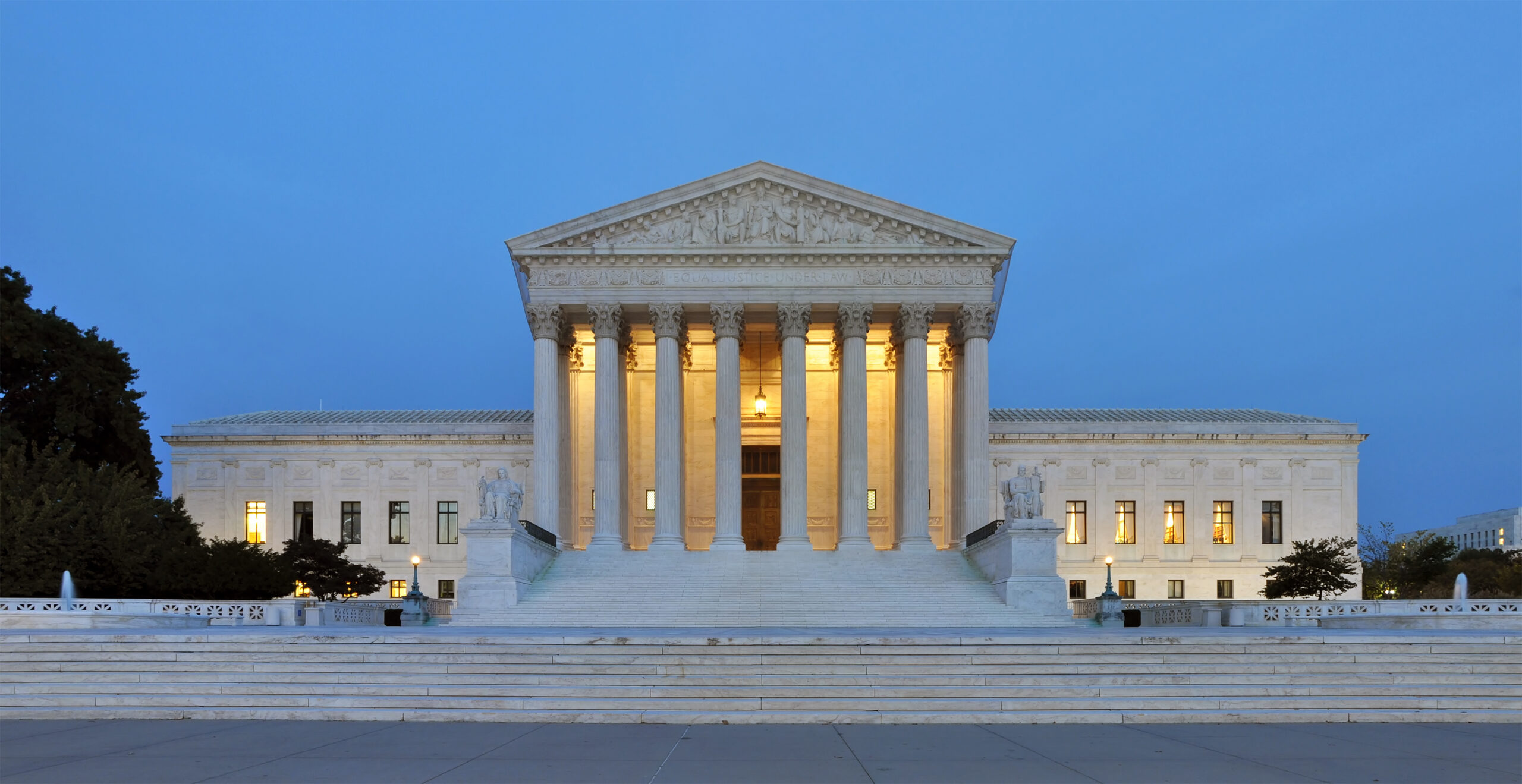
The Supreme Court started its new term in October, which may prove to be one of the most consequential in its history in what it does or doesn’t do in protecting democracy and the rule of law. If Justice Barrett would like to know what a constitutional crisis can look like all she has to do is go back in time to another consequential Supreme Court term. In 1857 the Supreme Court helped to set the stage for a constitutional crisis with its infamous decision, Dred Scott v. Sanford, authored by Chief Justice Roger B. Taney.
Dred Scott was a slave whose owners took him from Missouri to US territory where slavery was banned. Afterwards as a resident of New York, Scott brought a lawsuit in federal court claiming his status as a slave terminated by entering jurisdictions where slavery was prohibited. Taney teed up the case this way: “The question is simply this: Can a negro whose ancestors were imported into this country, and sold as slaves, become a member of the political community formed and brought into existence by the Constitution of the United States, and as such become entitled to all of the rights, and privileges, and immunities, guaranteed by that instrument to the citizen?”
The answer was no. Taney and the Court found that when the Constitution was ratified slaves were considered “a subordinate and inferior class of beings, who had been subjugated to the dominant race, and whether emancipated or not, yet remained subject to their authority.” Read more »
During covid, amid the maelstrom that was American healthcare, a miracle happened. State medical boards suspended their cross-state licensure restrictions.
No special legislation required, no political capital spent. Overnight, every state declared they would recognize medical licenses from any other state. One day you needed 50 licenses to practice nationwide—an expensive, tedious, slow process. The next day, you needed only the license you already had. The nation’s entire health system stayed this way for nearly two years.
As a patient, this was an incredible boon. If you had a primary care doctor you liked in New York and moved to Vermont, Texas, or anywhere in the US, you could keep seeing them over Zoom.
Moving did not mean losing your doctor. You could keep seeing someone you knew and trusted, even across state lines. Telehealth boomed. Whole new ways to deliver and build healthcare businesses emerged.
And then, at the end of the pandemic, all that freedom was quietly destroyed. Why? Because State Medical Boards don’t trust each other. Read more »
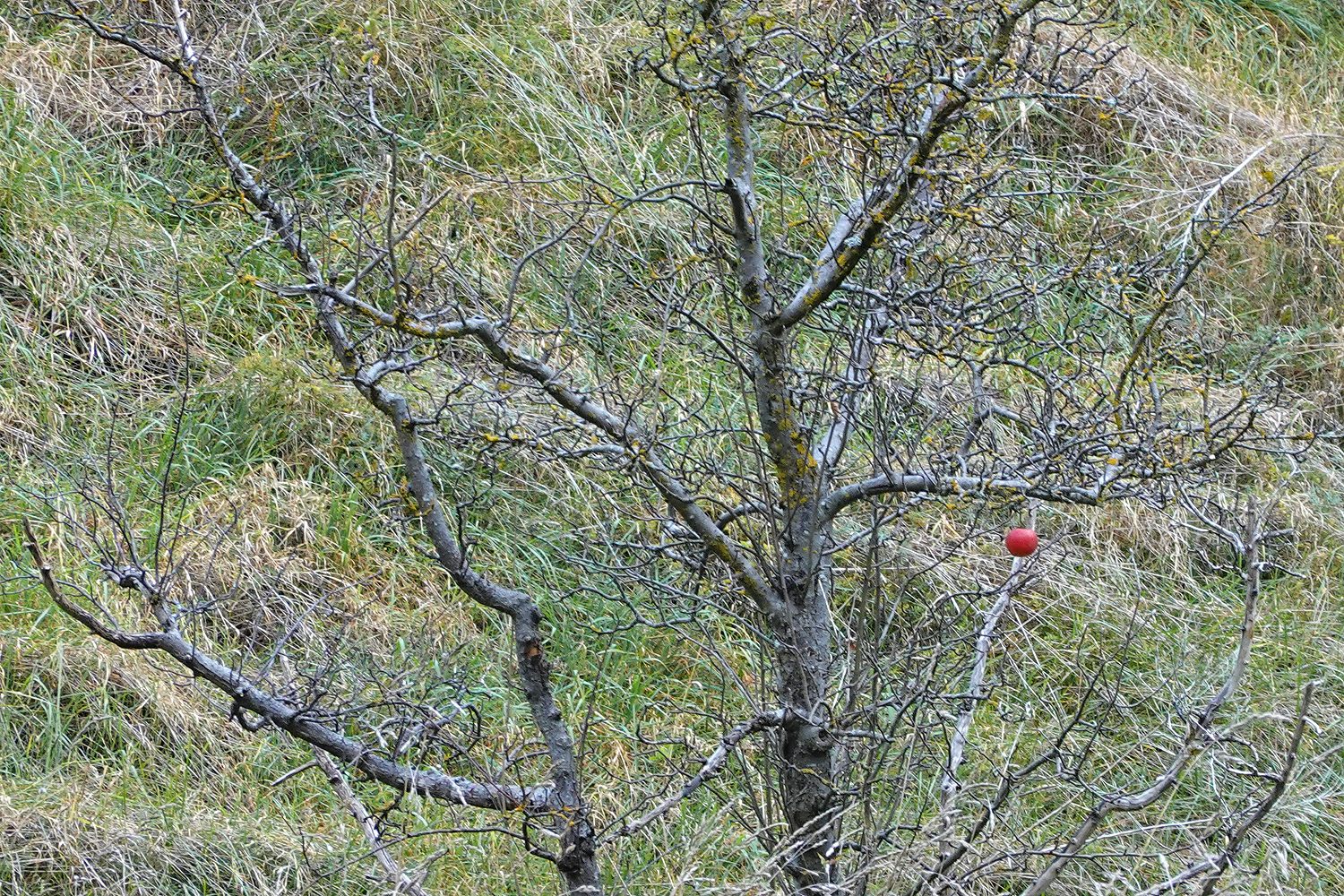
This wild apple tree in Franzensfeste, South Tyrol, had scores of apples on its leafy branches a month ago but now has just this one last apple still hanging on.
Enjoying the content on 3QD? Help keep us going by donating now.
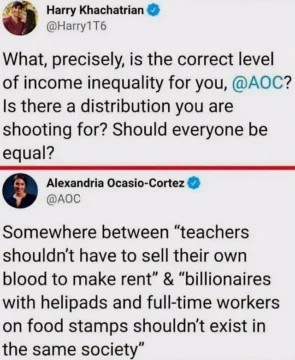
The economy is not a force of nature. We have some control over it. Granted, it’s also not like a machine controlled directly by levers, switches, and buttons either. But when the state acts, intentionally or not, it often influences the distribution of income and wealth. More often than not, it influences the distribution of wealth and income in reasonably predictable ways. It seems to me that, for this reason alone, we should care what the ideal distribution of wealth should be. The ideal distribution is, at a minimum, one factor we have an ethical obligation to take into account in governing.
Some people say that any ideal distribution is unrealistic, impossible to achieve. That’s alright though. Ideals – perfectionism, utilitarianism, the Ten Commandments – are, as they say, honored as much in their breach. We should still have ideals to follow.
Others say that trying to enforce any particular distribution – equality, first and foremost – leads to coercion and political oppression. I think they say this mostly because they have frightening real-world cases in mind. But people also do terrible things in pursuit of freedom, justice, or whatever.
You certainly can pursue equality in a repressive way. Say, seize everyone’s property, redistribute it, and redo that every so often to maintain equality. But you could also, as I implied above, mostly regard equality (or whatever the correct principle is) as a kind of tie-breaker. For example, the point of health care is not the distribution or redistribution of wealth per se, but when you must decide between two approaches one of which takes you closer, the other further away, from the ideal distribution, there’s nothing repressive about going with the one that also has a positive effect on the distribution of wealth and income. In other words, there is nothing inherently oppressive about pursuing more distributive equality. It just depends on how you do it. Read more »
There’s a strange vulnerability in realizing that no one is coming to comfort you—and a stranger kind of strength in learning that maybe, just maybe, you can do it yourself.
Lately, I’ve been thinking about the child I was. Not in some wistful, soft-focus way, but with the fierce clarity of someone trying to understand what was missing—not to assign blame, but to give name to the hunger. At seven, I needed safety. At fourteen, I needed space to be messy, dramatic, unsure. At twenty-seven, I needed someone to tell me I didn’t have to be so hard all the time. And now, I’m learning to become that someone for myself.
There’s a quiet revolution in that sentence—“I’m learning to become that someone for myself.” It sounds gentle, but it’s anything but. It has meant dismantling a scaffolding built over decades, composed of all the coping strategies that once helped me survive: perfectionism, people-pleasing, self-erasure, chronic competence. It has meant walking backwards through the house of my own memory, opening locked rooms, and saying to the younger selves still sitting there: I see you. I’m sorry. I’ve got you now.
No one teaches you how to do this. There’s no roadmap for re-parenting, no syllabus handed out at the start of adulthood that says: “Here is how you’ll hold the child inside you.” Instead, you notice the signs. The way you crumble after criticism. The way you contort yourself to avoid disapproval. The way you ache after certain holidays or scroll through photos of other people’s mothers and feel an inexplicable, wordless longing. The clues are scattered, like breadcrumbs leading back to the places where you first learned your worth was conditional.
What I’ve come to understand is that you can have loving parents and still be emotionally undernourished. Read more »



 Throughout most of the UK (Northern Ireland is
 In June 1932, half a year before Adolf Hitler was sworn in as German Chancellor, Victor Klemperer watched Nazis on a newsreel marching through the Brandenburg Gate in Berlin. A professor of Romance languages at the Technical University of Dresden, whose area of specialization was the 18th century and the French Enlightenment, Klemperer (1881-1960) was unpleasantly gripped by this first encounter with what he termed “fanaticism in its specifically National Socialist form,” and by the “expression of religious ecstasy” he discerned in the eyes of a young spectator as the drum major passed by, balanced precariously on goose-stepping legs while he robotically beat time.
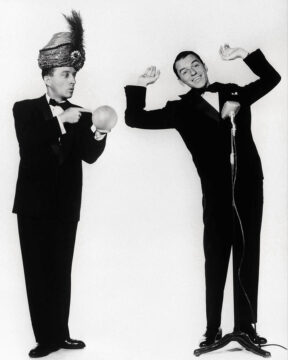 When my mother was a teenager in the early 1940s, a NY-area radio station ran a weekly contest, asking listeners to vote for their favorite singer among two: Crosby or Sinatra? How people made this preference known remains unclear to me: did you need a phone in your house to make a call to the station or was sending a postcard enough? Whatever the method, the winner would be announced each Sunday afternoon. While Sinatra often took the prize, Crosby occasionally outpaced the Jersey boy who grew up two towns south of Cliffside Park, my mother’s hometown. On those occasions, she told me, she’d stamp around my grandparents’ railroad apartment, enraged at the abject stupidity of her fellow listeners. When she’d tell this story, my mother would marvel at her parents’ forbearance, the way they’d accept these outbursts without comment, though they were highly disciplined, gloomy people for whom the idea of having an “idol,” or caring about his fate on a weekly radio show was surely alien. I like this insight into them, a softer side that I myself had only witnessed a few times.
 Anushka Rostomji. Waq Waq Tree, 2023, of the Flesh and Foliage Series.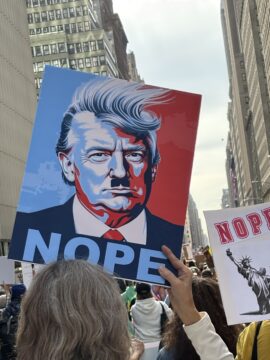
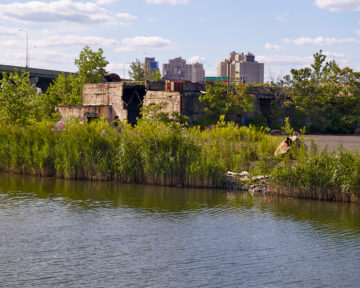 Jersey City is a medium-size city on the West bank of the Hudson River across from Lower Manhattan. Up through the middle of the 20th century it was a port and a railroad hub but that disappeared when containerized freighter became too deep to travel that far up New York Bay. Without any freighters the railroads were no longer needed. Light industry disappeared as well. Jersey City became back-offices and bedrooms to Manhattan-based business.
 We have slid almost imperceptibly and, to be honest, gratefully, into a world that offers to think, plan, and decide on our behalf. Calendars propose our meetings; feeds anticipate our moods; large language models can summarize our desires before we’ve fully articulated them. Agency is the human capacity to initiate, to be the author of one’s actions rather than their stenographer. The age of AI is forcing us to answer a peculiar question: what forms of life still require us to begin something, rather than merely to confirm it? The best answer I’ve been able to come up with is that we preserve agency by carving out zones of what the philosopher

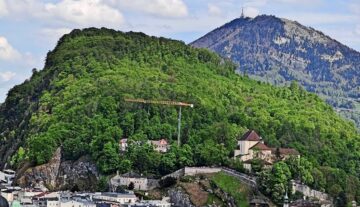

 When promoting her new book in September, Supreme Court Justice Amy Coney Barrett stated in an interview as quoted in Politico : “I think the Constitution is alive and well.” She went on – “I don’t know what a constitutional crisis would look like. I think that our country remains committed to the rule of law. I think we have functioning courts.”
 During covid, amid the maelstrom that was American healthcare, a miracle happened. State medical boards suspended their cross-state licensure restrictions.