
 Jersey City is a medium-size city on the West bank of the Hudson River across from Lower Manhattan. Up through the middle of the 20th century it was a port and a railroad hub but that disappeared when containerized freighter became too deep to travel that far up New York Bay. Without any freighters the railroads were no longer needed. Light industry disappeared as well. Jersey City became back-offices and bedrooms to Manhattan-based business.
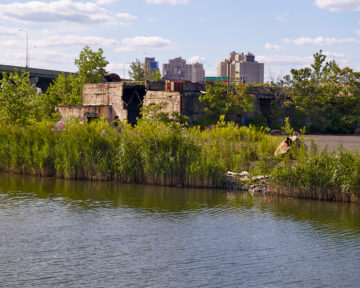
In the 19th century the Morris Canal carried coal from Eastern Pennsylvania to the Hudson River at Jersey City. Most of the canal has been filled in, but the eastern-most bit remains. You can see it in the photo to the upper right. The small building to the left of center is an abandoned industrial building of some kind. As you can see various walls have collapsed, as has part of the roof.
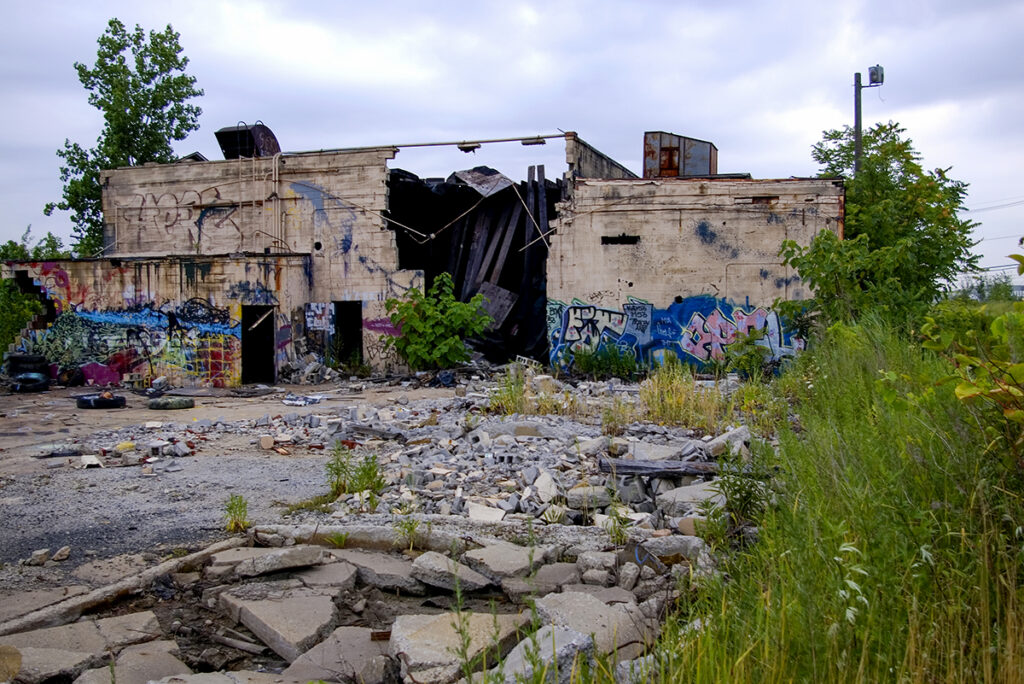
When you get closer you can will that the walls are marked with graffiti, which I saw when I first approached the building in the middle of 2011. The graffiti changed from week to week and month to month. It is for that reason that I took to thinking of it as the ‘urban design studio.’ This is the south wall; the Morris Canal is behind us and the Hudson River is about a quarter mile to the right.
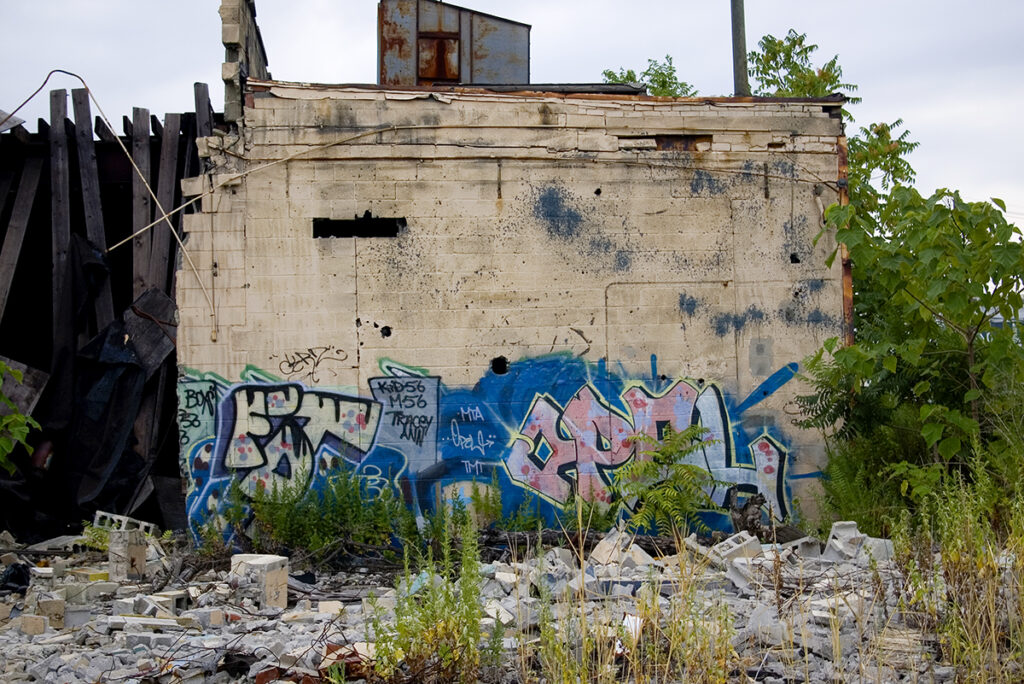
Next up, a closer look at the wall to the right. We see a bunch of tags – e.g. KoD56, M56, TRACY ANN to the left of center – and a rudimentary ‘piece’ (for ‘masterpiece’) to the right. Just who these people are, I don’t know, but most of them are probably local.
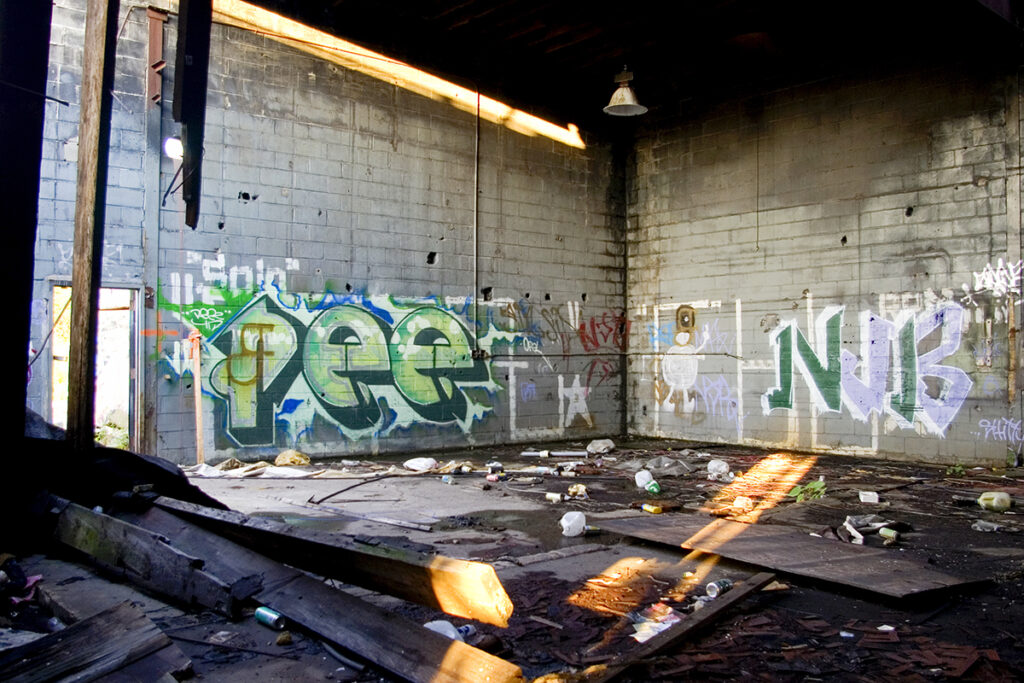
Here’s a look at the interior of the largest room. The boards at the bottom left are from collapsed walls and the roof. Sunlight streams in through breaks in what remains of the roof and the floor is littered with plastic bottles, cans, and boxes of various kinds. There is a bit of water lying around as well; this photo was probably taken shortly after some rain.
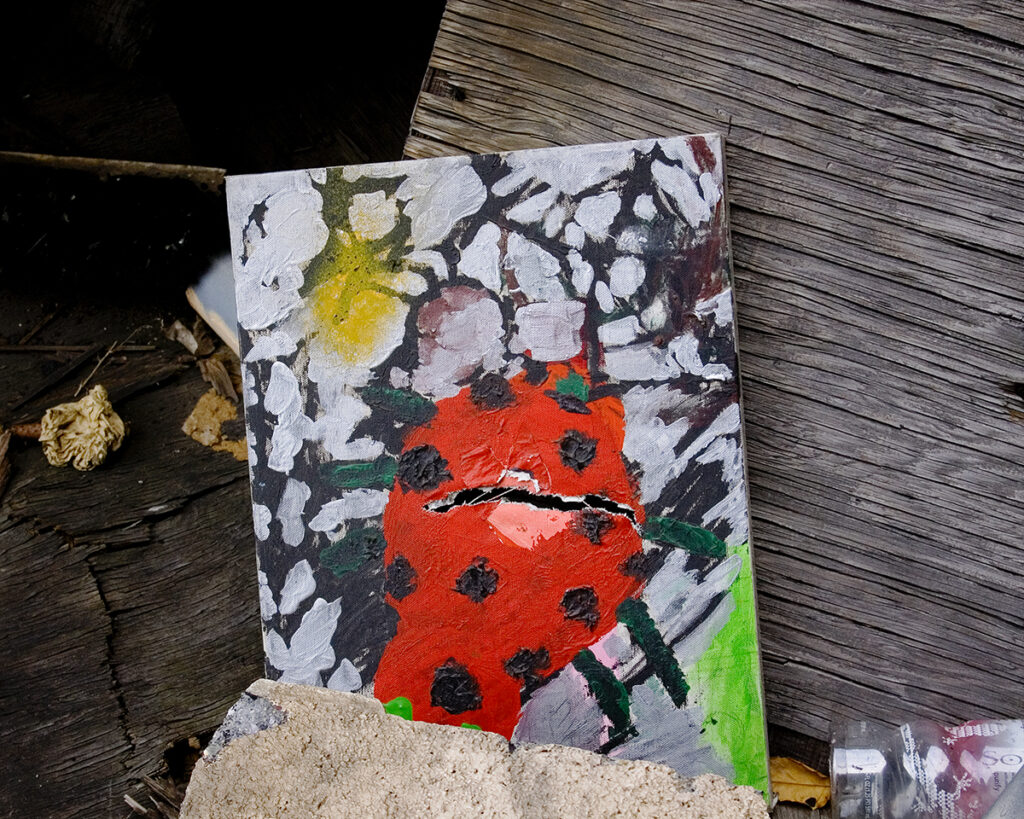
There were a number of these painted panels lying scattered about the floor. This one appears to be some kind of bug, a ladybug? I have no idea whether or not the panels were painted in the building or painted elsewhere and dumped. Who knows?
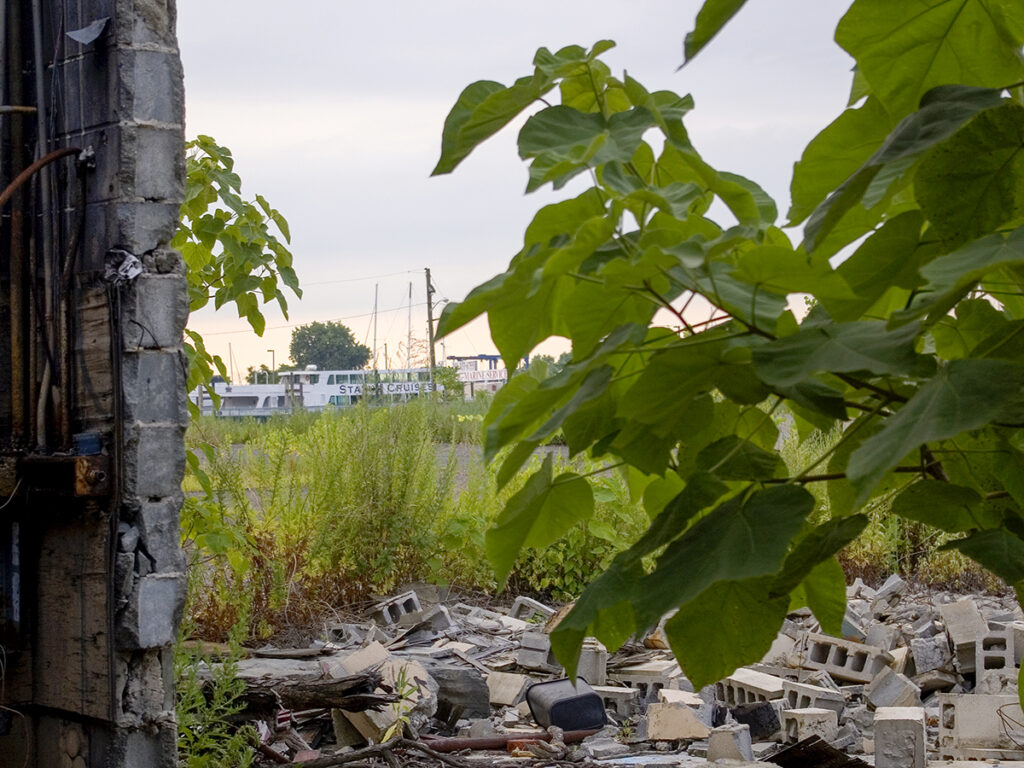
Now we’re looking southeast out a whole in the wall. Across the center we boats docked at the marina along what remains of the Morris Canal. Wall Street in Manhattan is off to the right about a mile and a half to two miles away.
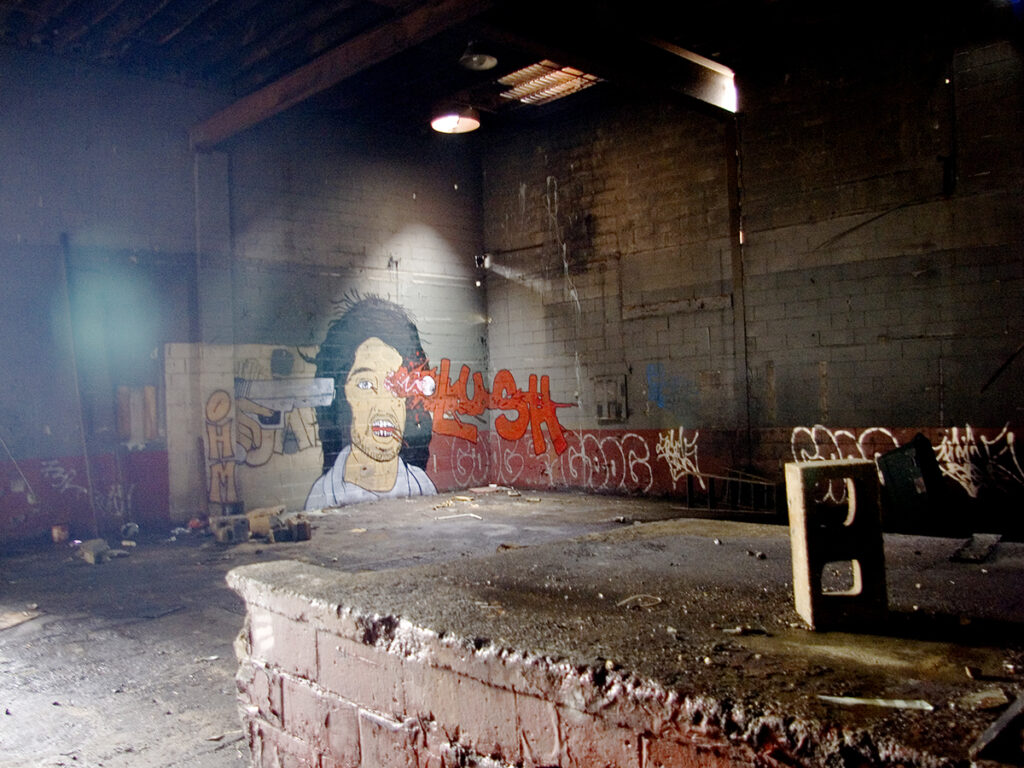
Here we are as deep in the interior as one can get in such a small building. We’re looking at a grim mural that LUSH spread over a corner. Someone is shooting himself through the right ear and his left eye is flying out of the socket as blood spatters on the wall, spelling out “LUSH,” the writer’s nom de guerre. Lush/Lushsux is not local at all. He’s from Melbourne, Australia, and has an international reputation. Graffiti culture is like that. Most writers are local, or regional at best. But a small number travel internationally. Some of these shown up in Jersey City from time to time, most likely as a result of the proximity of New York City.
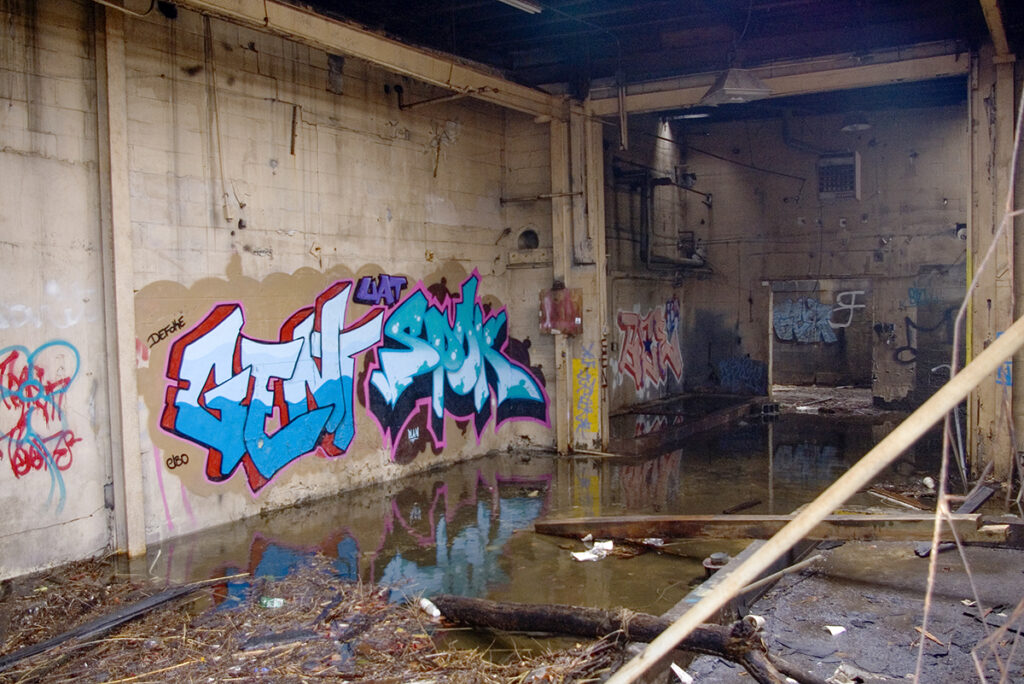
I took the next photo on November 5, 2012, five days after Hurricane Sanday blew through. The area is low enough that the building would have been flooded. Perhaps the trash at the lower left was deposited by Sandy. The two pieces on the left wall appear to be fresh. Notice that they share a common light brown background, that and composition through the center line suggest that the two writers were working at the same time.
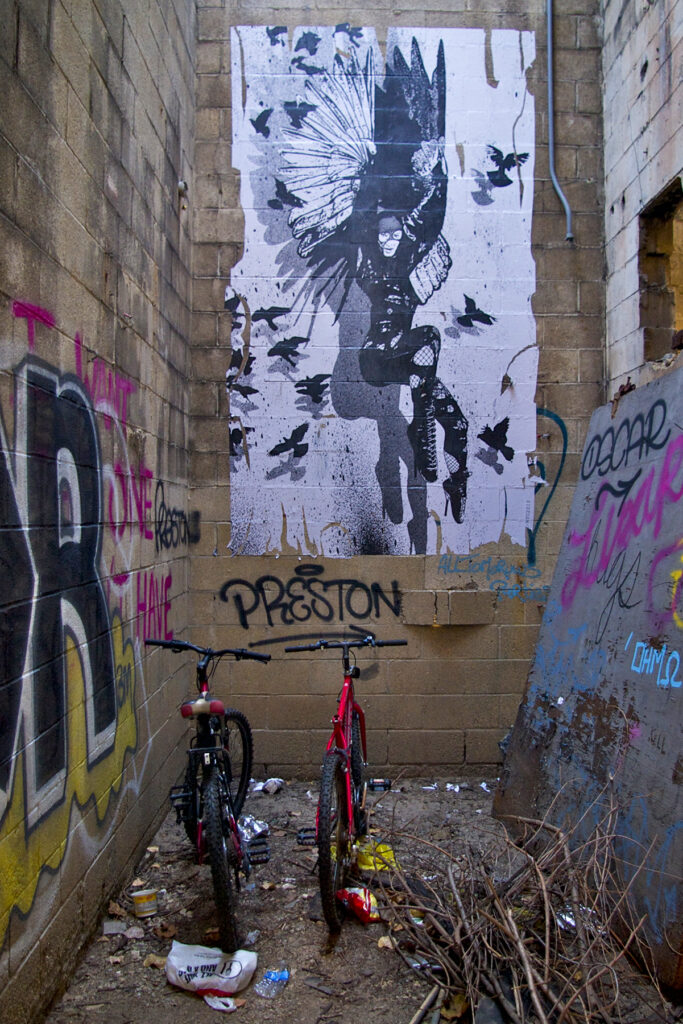
We’re now looking at a wheat-paste, as it’s called, on an exterior wall, though it may have been an interior wall when the building was intact. It’s a large poster affixed to the wall with paste, hence the term “wheat paste.” I have no idea who did it or where they’re from, but they placed three or four of these in the building. I know nothing about those bicycles. If their owners were around when I was photographing the building, they didn’t reveal themselves.
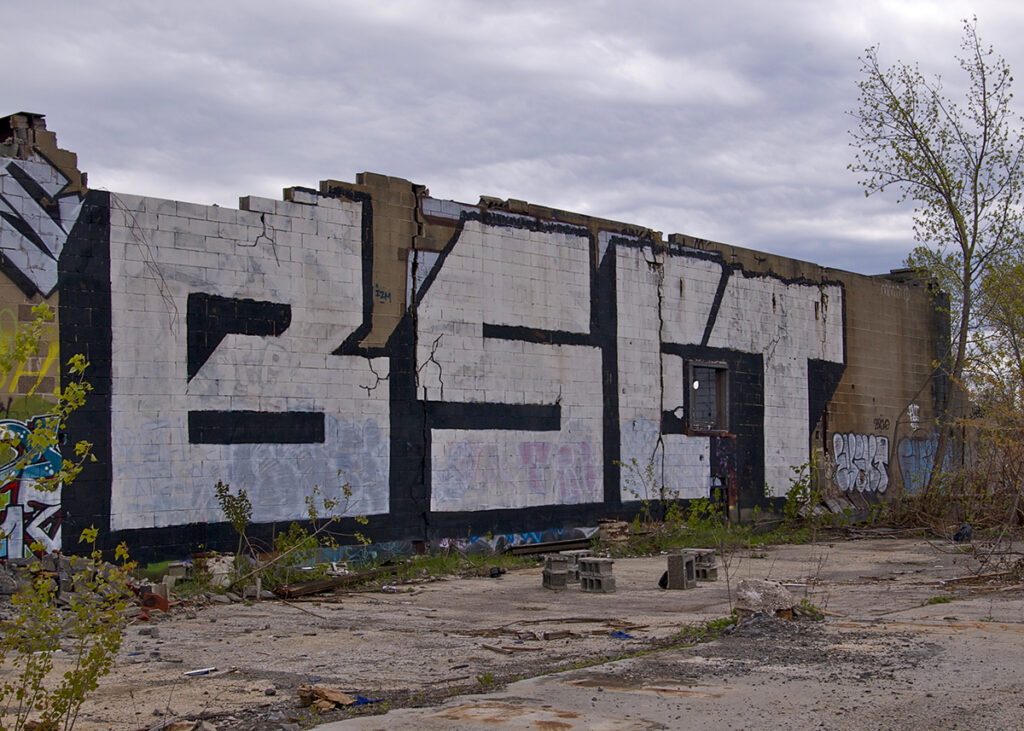
This large wall-high ‘roller’– so-called because it’s painted with a paint roller – is on a West facing wall. BSET I believe is local; he has a number of rollers in the immediate area. Though you can’t see it in those photo, what’s left of this building is in the process of being demolished.
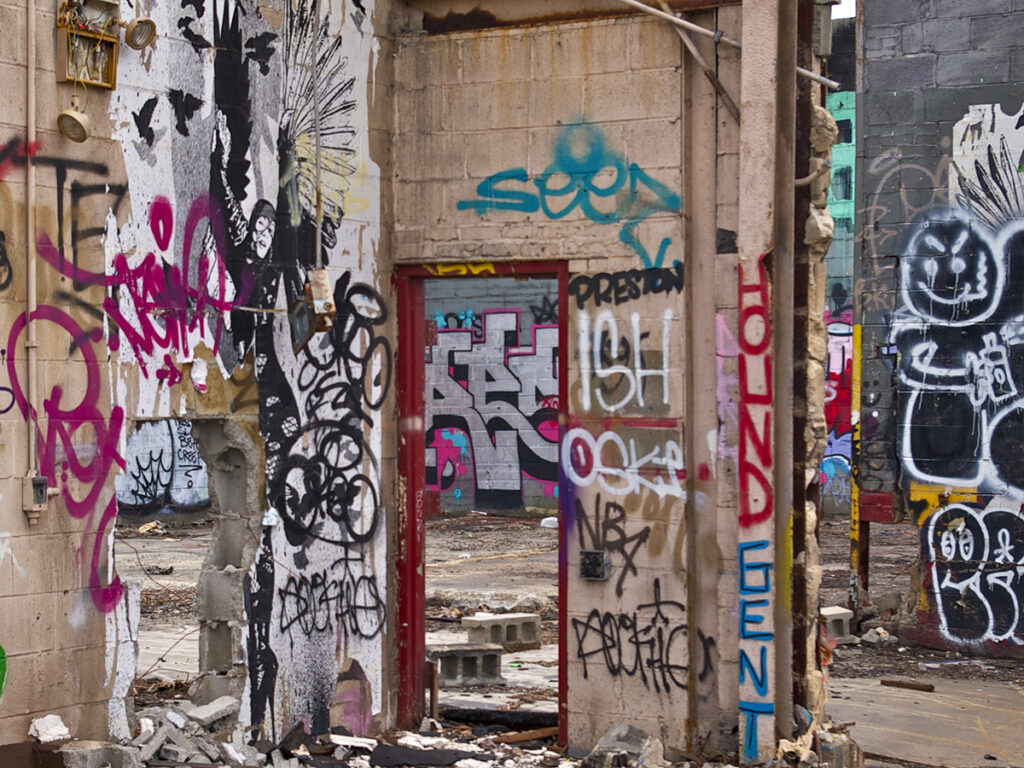
That should be obvious from this interior shot. Though it’s not obvious from this photo, the roof is now completely gone. Chunks of the walls have been knocked out and tags are are everywhere. Notice the remnants of a bird-woman wheat-paste to the left of center.
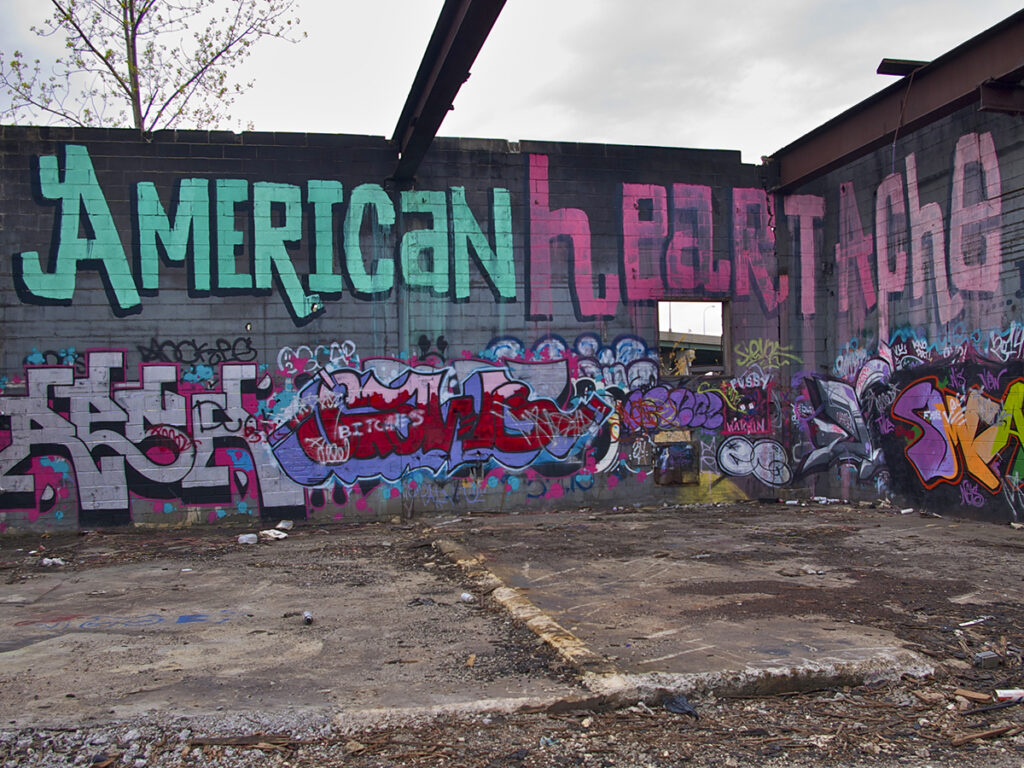
My heart stopped when I saw this roller in May of 2014: “American Heartache.” The acid green and washed-out magenta, the way it moves around the corner, the cloudy sky, it captures a vibe that’s been creeping up on the country for a few decades now. As I indicate in this blog post from September 16, 2014, it was done by Droid907.
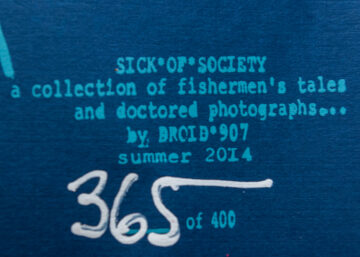
I was able to get in touch with him through friends and he sent me copy 367 of a zine in which he featured it, Sick of Society, a collection of fisherman’s tales and doctored photographs.
Here’s a photo from the zine:
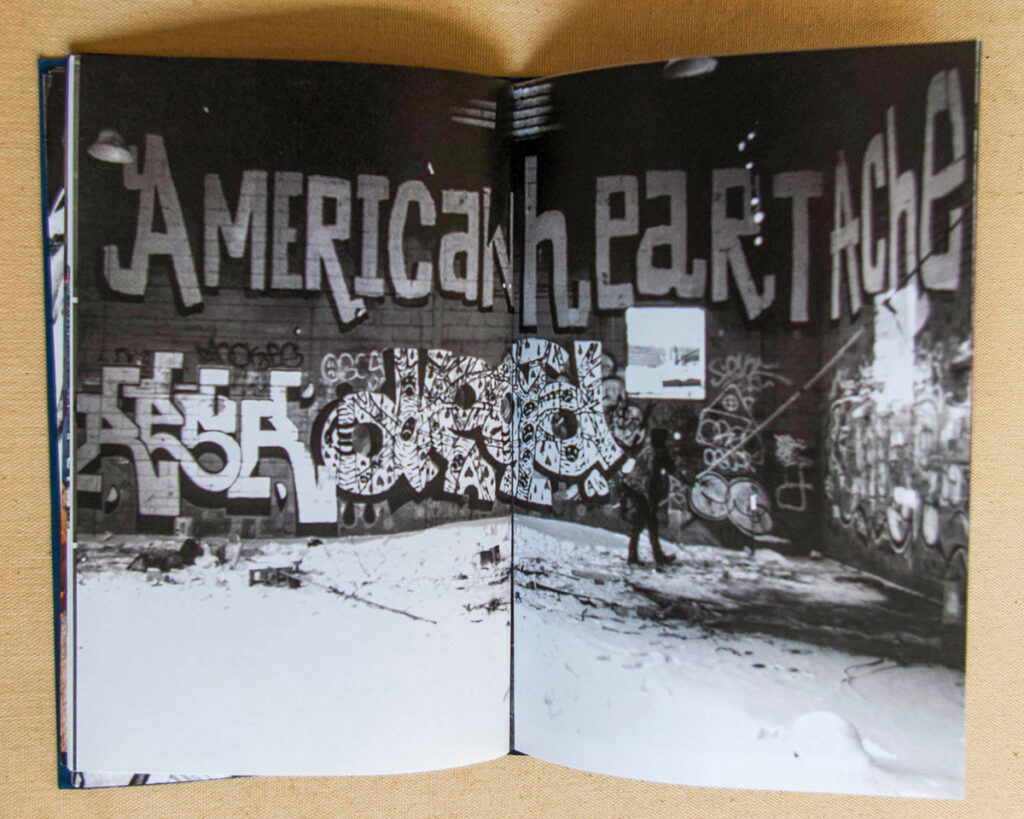
And here’s what I say about it in the blog post:
Notice the snow on the floor, so we know it’s winter and, if I didn’t know the building was falling down because I’ve been there, well then, you could infer that because how else would there be snow on the inside? And it’s late afternoon, too. See that bright square below the “ea” right of center? That’s a window. If you look immediately to the right you’ll see where light streams through that window and hits the wall under the “ch.” the sun has to be low in the sky for the light to stream through and that window’s on the west side of the building so it’s got to be afternoon, not morning.
Technically, it’s not much of a photograph. But that’s surely deliberate. Maybe it’s one of those doctored photographs. Truth in labeling.
I took those photos in July of 2014. The urban design center has was finally reduced to a pile of rubble a month or two later. Notice the rusted steel beams snaking through the center of the photo amid the cinder blocks.
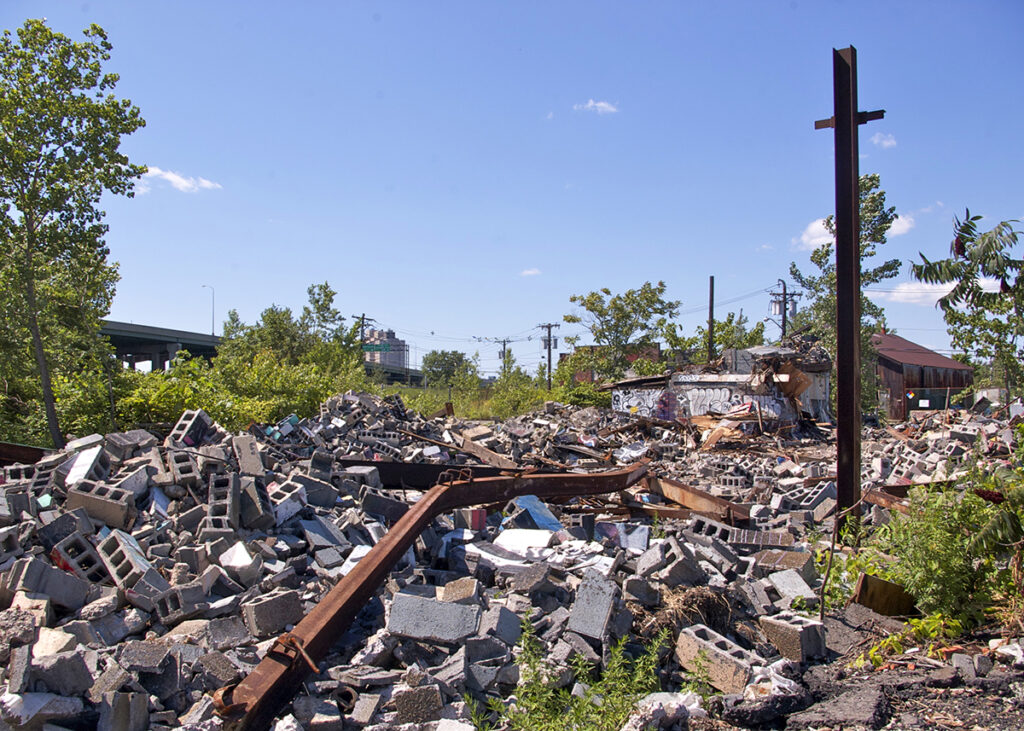
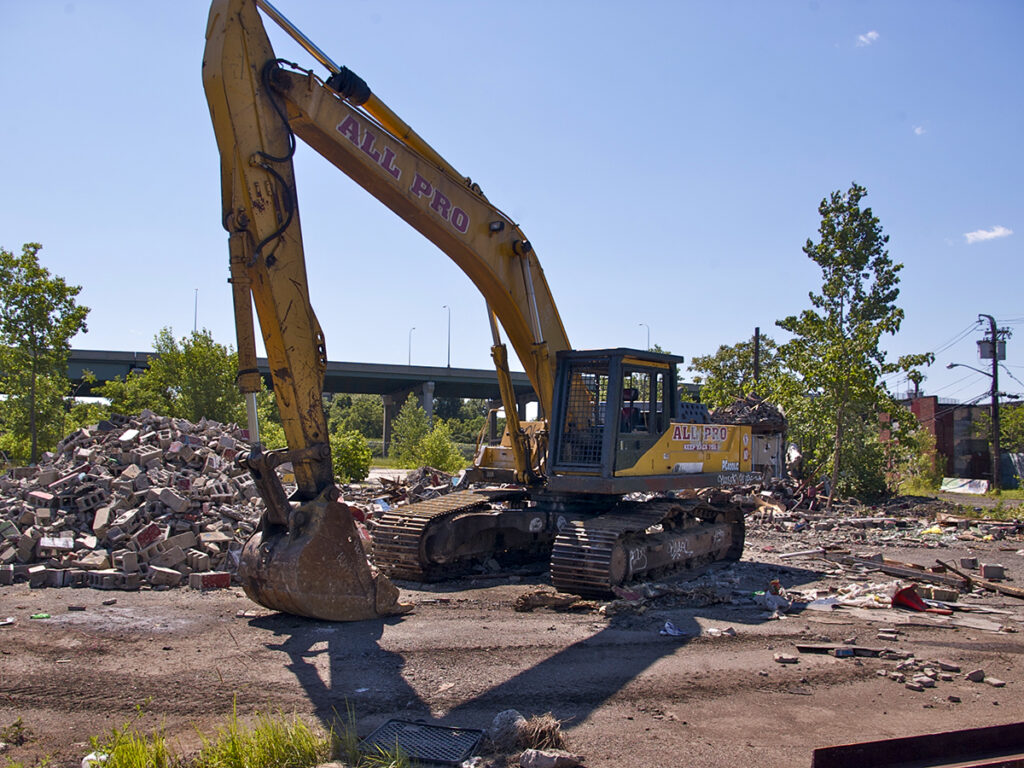
Exit 14 of the New Jersey Turnpike runs across the photo in the background. It appears that the demolition was completed by All Pro (on the excavator). And so it goes.
***
Enjoying the content on 3QD? Help keep us going by donating now.