 Rania Matar. Samira, Jnah, Beirut, Lebanon, 2021.
Archival pigment print.
From the portrait collection of the ICA, Boston.
Enjoying the content on 3QD? Help keep us going by donating now.

Rania Matar. Samira, Jnah, Beirut, Lebanon, 2021.
Archival pigment print.
From the portrait collection of the ICA, Boston.
Enjoying the content on 3QD? Help keep us going by donating now.
by Tim Sommers
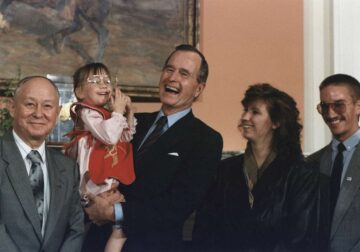
In October of 1987, 18-month-old Jessica McClure Morales – forever after to be known as “Baby Jessica” – fell into a well in her aunt’s backyard in Midland Texas. She was lodged 22 feet down in the 8 inch well casing with one leg bent above her head. Over the next 58 hours an ever-expanding crew of rescuers worked to free her, eventually deciding to drill an entirely new, parallel shaft with a cross-cut into the well where Jessica was jammed.
Unfortunately, they soon realized that the well was surrounded on all sides by solid rock. Jack hammers barely dented it. If they could drill at all, it would not be quickly. A mining engineer showed up on the scene with a solution in the form of a new technology: waterjet cutting. Throughout the process of creating a parallel shaft, the rescuers could hear Baby Jessica singing the “Winne-the-Poo” song.
When the shaft and cross-tunnel were complete, the rescuers considered sending in a roofer, Ron Short, who had been born without a collarbone and could collapse his shoulders to get through tight spaces. But in the end, it was EMT Robert O’Donnell who crawled down and freed Jessica from her pinned position and then passed her back through the cross-cut to EMT Steve Forbes. Forbes then passed Baby Jessica to firefighters who carried her to an ambulance.
It’s basically impossible to discern, at this point, how much was spent on the rescue of Baby Jessica, but we do know that a trust fund was set up at the time that received 1.2 million dollars in donations, which is approximately equivalent to 3 million dollars today. At least on one estimate, 3 million dollars donated to fight malaria today would save 750 lives, 749 more than 1.
Was the rescue of Baby Jessica unique? Specific to a certain time or place? Read more »
by Jonathan Kujawa

A few hours’ drive north of my home is the Laser Interferometer Gravitational-Wave Observatory (LIGO) in Hanford, Washington. LIGO was designed and built to detect gravitational waves. When the LIGO project was started in the 1980s, gravitational waves were a purely theoretical phenomenon predicted by Einstein’s theory of general relativity.
General relativity says that gravity should be understood as the deformation of the geometry of spacetime. If, say, two massive objects, like a pair of black holes, should collide, then this should cause waves to ripple across the universe. With enough care, we just might be able to detect these waves.
This is just the sort of large-scale, curiosity-driven, speculative research that depends on the support of far-sighted government funding agencies [1]. Over the course of several decades, the United States’ National Science Foundation funded many hundreds of researchers to make the pipe dream of gravitational wave detection a reality. In 2015, they succeeded. In my lifetime, we’ve gone from gravitational waves being purely theoretical, to detecting them, to being able to listen to them on our home computer. All thanks to decades of work by numerous researchers funded by the NSF and their home universities.
It so happens that one of those researchers was a friend of mine, Rauha Rakola. We did our undergraduate and graduate degrees at the same universities, me in math and him in physics. Rauha’s PhD thesis developed some of the theoretical and computational physics needed for gravitational wave detection. It took more than a decade from his thesis until gravitational waves were first detected — research is not for the impatient!
If we stopped after detecting a gravitational wave, that would be an impressive feat of engineering and physics, and an important contribution to our understanding of general relativity and the fundamental nature of the universe. But human curiosity and ambition know no bounds. Just as you could imagine using the size and shape of waves lapping at your feet to learn about a large ship that passed by (or an earthquake on a distant continent), we should be able to use gravitational waves to learn something about distant objects. The success of LIGO spawned the new field of gravitational-wave astronomy. Read more »
What I need a good poem,
a poem lifespan-short, a poem
I can shoe-horn between instants,
a poem that, in a pinch, says so much
I’ll understand the long and short of it
by the depth of calluses building on my brain.
But that’s not happening —count ’em,
I’m already up to eight lines, so it’s
too late for brevity.
What I want is a poem that says something
without rolling on forever, Amazon-like,
swaying to rhythms of topographical switchbacks
and eddies of rivers and streams, or swirls into
another cul-de-sac of human error.
Yes, I can see now that this won’t end here
in brute summation like a dead fish
wrapped in newsprint plopped on the desk
of a collaborator, warning of impending,
but once-avoidable, consequence.
No, it’ll go on until all nouns, verbs, conjugations,
and (especially) absolute clauses, have been spent.
It’ll go on till this mine of memory and metaphor,
no more complete than the store of meanings
and explications dragged inside-out by ripping flows of
pregnant clauses scribbled in blood & bone that have
led to others, and others, and others and poured from buckets
into the tides of the sea-bound flood of recollecting multitudes
of sisters and brothers, and fathers and mothers as time
tips its hat and evaporates in the heat of life.
Jim Culleny
7/1/18 & 25
Enjoying the content on 3QD? Help keep us going by donating now.
by Hari Balasubramanian
In the long and evolving list of cognitive biases, the ‘frequency illusion’ feels most familiar: I’ve experienced it so many times that it seems almost ordinary. This is roughly how it works. First, you encounter something – an unusual word like ‘topology’, or the title of a new book or a movie – that makes you stop and notice. Then, in the days after, the same word or title crops up again and again in unrelated places, making it seem more frequent than it is (hence the name). A friend brings it up unprompted, or you unexpectedly see it at a museum exhibit. It’s not only about words or titles, of course: anything in your conscious experience – a sound, an image, a fragrance – that makes an impression can be a point of entry. Buy a new car and in the weeks that follow, you will likely start noticing others driving the same model.
The most wonderful thing about this illusion is that with each seemingly unplanned encounter there’s a thrill of recognition, a feeling that the universe is signaling to you. The rationalists among us, however, will point to a more mundane explanation: that our cognitive processes have simply been primed to notice or identify the word, image, or sound among all sensory experiences. The illusion works in concert with two other biases: selective attention, the act of focusing on certain things while excluding others; and confirmation bias, the tendency to seek evidence that supports one’s beliefs while overlooking evidence to the contrary.
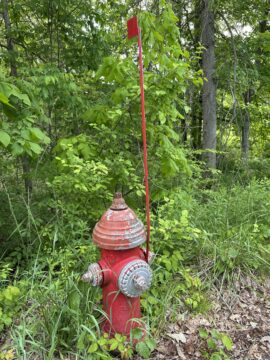
The recognition that these are only tricks of the mind can be somewhat deflating. But the processes that decide what we pay attention to and what we ignore remain mysterious. Something can be frequent in my everyday experience – say, a fire hydrant that I walk past each day – yet I may not notice it at all for years. Or I might be only vaguely aware of the hydrant’s presence, as if it lives in the background of my conscious experience. Then one day, I ‘stumble’ upon it, as if I am seeing it for the first time. Details such as its shape, color, and peeling paint register in a way they never had before. From that point on, I will naturally notice fire hydrants elsewhere. But I am seeing what was already commonplace; the frequency is not an illusion.
So the more intriguing question is: Why do things that we overlook all the time, things that are hiding in plain sight, suddenly catch our attention one fine day? And what is it about our cognitive processes that filters out certain stimuli and emphasizes others? Read more »
by Dilip D’Souza
Allow a columnist his anguish, because what follows is almost all I have been able to think about for several days now.
Years ago, a college mate jumped into a well.
Well, in truth that’s a little bit of an exaggeration. He and I knew each other because we were partners on some lab assignments in some early electronics course. But we were not really close friends. But then he jumped into that well, and for a long time afterward, he was on my mind far more than any of my much closer college buddies were.
Because, of course, that day he took his own life. He left an entire college campus simply devastated. Through my years on that campus, we had a few suicides – but for some reason, it was what this particular young man did that stayed on in my mind. I remember lying awake nights, sitting through lectures, nursing cups of coffee … agonizing over him through all that, through everything in my daily routine.
Had he been thinking of taking his life the last time we had met, in the lab? If so, were there signs I might have, could have, should have, picked up on? If so, what if I had just asked, quietly, “Wanna talk?” What were his thoughts in those moments before he jumped? Did he survive for any length of time? If so, what was he thinking, lying there alive at the bottom of the well?
Questions, questions. None came with any answers, of course. But for weeks that turned to months, I couldn’t stop asking them.
I realize I’m not saying anything particularly novel here. I know suicides leave us all with questions and extended bouts of agonizing. But several years later, another suicide got me thinking in different directions. Read more »
by Mary Hrovat
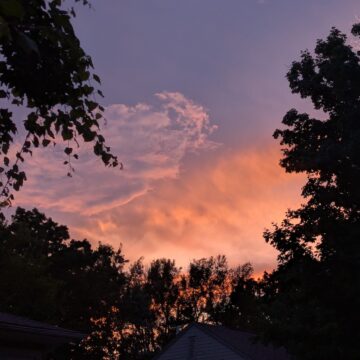
I’ve come to believe that any aspect of nature, large or small, will reward patient, open-ended attention. I’ve been photographing the sky for three years. Here I describe some of the things that I’ve come to appreciate about it.
The sky is full of color and light. It’s blue, of course, and children drawing the sky tend to leave it at that. When you look closely, though, you can see so many shades of blue, so many variations in the light. I could write at great length about the incredible colors of sunrise and sunset, or the marvels of light and shadow in the golden hour, or the varieties of lightning. But even in a clear sky at midday, the color varies across the sky. Twilight has its own shades of blue.
Clouds have innumerable colors, ranging from pure white through many subtle grays to almost black. They sometimes cast shadows on each other or on the sky. Water droplets and ice crystals in the sky can cause colorful or even startling effects such as rainbows, sun dogs, and sun pillars. And at night, in addition to the moon, there are planets, comets, meteors—less brilliant, more subtle, and infinitely engaging.
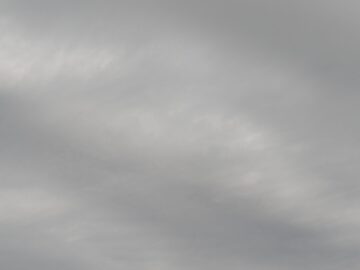
The sky is always in motion. One of the first things I noticed when I began to photograph the sky daily was that it changes hour by hour, if not moment by moment. I’ve known for a long time that clouds move, of course; I remember being thrilled by that fact as a child. But it wasn’t until I began photographing the sky daily that I finally began to notice how variable it is. If I see clouds that I’d like to photograph, I need to do it right now. On a stormy day, clouds may race through the sky. When the moon is above the horizon, it can be especially easy to see clouds as they alternately reveal and conceal the moon.
Certainly there are sunny days with few clouds. On other days, especially in winter, the clouds can seem like a heavy featureless blanket from dawn to dusk. Even then, in both cases, the sky’s appearance often shifts subtly throughout the day. Read more »
by Alizah Holstein
Once upon a time, summer meant windows thrown open, midnight breezes, the cooing of doves at dawn. Now, though, the panes have fallen. My family has at long last joined the approximately ninety percent of American households with access to air conditioning. Statistically speaking, it’s possible we had already joined that number: for the past four years, window units have cooled two of our three bedrooms when necessary. But the kitchen remained hot, the dining room sticky, the third-floor offices all but unusable for four or five months of the year.
I will not mince words: after years of resisting systemic cooling, I concede it’s a profound relief. I’m comfortable, sleeping well, and feeling productive. Just days into our new arrangement, I already regard my life as divided into two distinct eras: BCE (Before Conditioning Era) and CE (Conditioning Era). In the period from 50 BCE, when I was born, to approximately 20 BCE, summer temperatures in New England and the mid-Atlantic were often hot but rarely unbearable. But from 20 BCE on, summer days, and even autumn ones, have grown hotter and more humid. Now even nights can be tough to bear. When I sauntered out at 7:45 one morning last month to walk my dog, the temperature was 80 degrees Fahrenheit with 92% humidity—a combination one might resent even at the height of day. But of course, it was just the start of it.
And yet for all its pleasures, I partake in this new era with some misgivings. In part my hesitation is personal because some things I enjoy about summer are inevitably now less noticeable to me: a sudden gust of wind; the smell of grass; the sounds of children playing outside. As for my own kids, I don’t want them to grow up oblivious to the outside world as they move between one anodyne climate-controlled indoor space and another. Nor do I believe it’s in their best interest to come to expect comfort at all times. But I worry that I, too, might come to expect it. Read more »
by Steve Szilagyi

The suburban lawn. It’s as loaded with symbolism as it is with chemicals. That perfect green expanse stands for everything people hate about people like me: the smug squire in his tony ranch house.
I wasn’t always this way. Back in the 1980s, I was an Upper West Sider who laughed with the outrageous comedian Sam Kinison, as he screamed what I considered the last word on yard care:
“Once my life was so boring, I actually worried about my yard. Hey, do me a favor—if you see me outside painting the house, working in the yard… kill me! Shoot me in the head, run me over with the car—I live in hell, I live in hell, AUUUGH!”
Today, I live happily in Sam Kinison’s inferno. Okay, not exactly. I pay a guy to paint and do yard work. But even if I don’t personally care for my lawn, I do care about it. So do my neighbors.
We all observe the unwritten rules of lawn care to reassure ourselves—and each other—that we’re not the kind of people we moved here to get away from. Few things in suburbia are scrutinized more narrowly than a neighbor’s lawn gone to seed. And few souls are more pitied than the damned fool who thinks he can escape a lifetime of mowing by replacing his grass with gravel, stones, and ornamental grasses. His efforts to evade his responsibilities are contemptible and he knows it.
Drive down our long and lovely street and you’ll see near-total consensus on the basics of suburban land management: lawns mowed, shrubs trimmed, mulch refreshed annually. But this tidy uniformity covers a caldera of hot contention—a profound disagreement that threatens to shred the very sod beneath our feet.
The issue? Roundup.
A discovery on a par with penicillin. Developed by Monsanto Corporation and now owned by Bayer AG, Roundup is a ruthlessly efficient weed killer. When it was first introduced in the early 1970s, its chief ingredient was hailed by the USDA as the “virtually ideal” herbicide. As recently as 2010, weed scientist Stephen Powles called it “a one-in-a-100-year discovery that is as important for reliable global food production as penicillin is for battling disease.”
But for many modern suburbanites, Roundup is nothing more or less than the distillation of pure evil. Read more »
by Azadeh Amirsadri
 A South Asian person I dated for a year complained to me one day that I was too Iranian. He said a lot of things I did had that tint and flavor to them. We were eating lunch that I had prepared, which consisted of rice and chicken, and I had a plate of fresh herbs that accompanies most meals in Iran. As he was enjoying his meal, he continued that he had never met someone as still ingrained in their own culture as I was. When I pressed for details, he said things like having pistachios and sweets at home to go with tea, or serving fruit for dessert. The irony of it all is that he loved it when I cooked Persian dishes and enjoyed them when I sent him home with leftovers, and really appreciated the snacks I had in my house to accompany his 5 pm scotch.
He, on the other hand, was adamant about his detachment from his own country, distancing himself from his childhood and background. He primarily discussed the Irish Catholic school he attended in Lahore, the university he studied at in Russia, and his work and life in Moscow. When I asked about his parents or family, he would tell me more about their positions as physicians in the military, their proper table manners, taking tea in the afternoon, and what behaviors were not acceptable in his family. They were not the type who showed emotions and kept things very formal, an oddity in that culture. I found it very interesting, when I wasn’t confused by his comments, that he played Indian songs that his mother loved in the car during a trip we took to Arizona, as we were driving to the Grand Canyon. When he wasn’t paying attention, he too would revert to his Pakistani self, instead of the British-Russian person he made himself to be, looking down at his own people. When he did spend time with his relatives, he acted as the outrageous boundary-pushing person who would not abide by his cultural rules. Making fun of his culture and himself was somehow his way of pushing it away and asserting the new self he had created a long time ago.
My Iranian friends tell me I have become too American, that I am too direct and don’t tarof (a social system of politeness and etiquette) enough. I was also told that I was too direct as a teenager by my school friends in Iran, and for being honest back home. I was called naive, simple, and easily fooled. It may be true, since I do take people at face value, and also try to distance myself from formalities that can become a labyrinth of deceptions and conflicting messages. I lacked the street smarts that so many of my friends had and paid the consequences a few times. Read more »
by Richard Farr
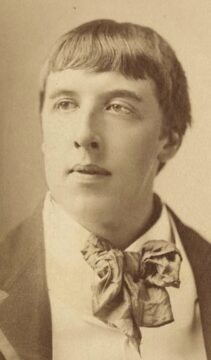
On February 14 1895, The Importance of Being Earnest opened at London’s St. James’s Theatre. There was mild consternation over the lack of a moral, but most people let this pass — as well they might, having been treated to a first view of the funniest play ever written. Only four days later, Oscar Wilde’s feud with the Marquess of Queensberry came to a boil and his epic fall began. Wilde made the fateful decision to sue Queensberry for libel; what followed was public humiliation, criminal prosecution, prison, ill-health and exile. I was reminded of this story recently while listening to David Runciman’s excellent podcast Present Past Future. It’s always a Proustian experience for me. I am immediately taken back to being ten years old. And sixteen.
Ten because of my mother. A passionate lover of theatre all her life, she helped found a local company that put on Importance. She was cast as Algernon’s terrifyingly formidable aunt, Lady Bracknell; as a result I can hear those famous pronouncements only in her voice:
Well, I must say, Algernon, that I think it is high time that Mr. Bunbury made up his mind whether he was going to live or to die. This shilly-shallying with the question is absurd.
JACK: I have lost both my parents. LADY BRACKNELL: To lose one parent, Mr. Worthing, may be regarded as a misfortune; to lose both looks like carelessness.
I’m reminded of being sixteen because Tom Stoppard collated some scraps of historical fact into an absurd idea for an Absurdist play. In 1917 James Joyce, Lenin, and the Dadaist artist Tristan Tzara could all be found working in the Zürich public library — Joyce on Ulysses, Lenin on Imperialism, and Tzara on, for example, cutting up other people’s poems and then rearranging the words by picking them out of a hat. Joyce had also become the business manager of an amateur theatrical company, The English Players, whose first production was to be Importance. Joyce had a nasty, petty financial run-in with the man cast as Algernon, a British consular official named Henry Carr.
It took a writer of Stoppard’s talent to present these facts through Old Carr’s garbled memory, and to do so in part by lifting many of the best lines and plot elements directly from Importance. The garbled memory and the purloined drama are only two of many reasons the play is called Travesties. Read more »
by Peter Topolewski
 The 2020 documentary Gunda captures a stage in the life of a barnyard sow and her brood. The director, Viktor Kossakovsky, embarked on this mission to at least in part remind “us of the inherent value of life and the mystery of all animal consciousness, including our own.” It would be foolhardy to expect a real-life version of Wilbur from Charlotte’s Web, and anything resembling Babe would be a stretch. As we do have a tendency to humanize our animals, maybe there was a chance the film would come out like an extended video from The Dodo, where animals cooperate with warm hearts and easily recognized intentionality.
Wrong.
Like most wildlife documentaries, Gunda doesn’t show humans. Unlike most wildlife documentaries, it also lacks a narrator. Interestingly, however, at points throughout you can almost hear the voice of Werner Herzog from his own documentary Grizzly Man. That film tells the story of Tim Treadwell, a man who dealt with his life’s problems by spending summers among Alaska’s grizzlies. Where in the movements and faces of grizzlies Treadwell saw personality and intent, Herzog saw “no kinship, no understanding, no mercy. I see only the overwhelming indifference of nature.”
Why do Herzog’s words hover over Gunda? Isn’t all life connected, as the synopsis to Gunda implies? Yes, it is. All of life on our dear planet is linked and interdependent. If the web breaks, none of us, from the smallest to the largest, will find salvation moving to another planet.
But connection is not the message that came out of Gunda. At least not when viewed in 2025.
The film is less a following of the titular character and her piglets, and more a detached observation. You get the impression Kossakovsky often planted the camera and left it. There are many extended shots. One scene fixed on chickens confronting a fence made them appear completely other-worldly. And the feeling that lingered was how strange and different these animals are from us humans. How boring their lives are. How repetitive and how barren of meaning.
There is drama, though it’s difficult to imagine Gunda appreciated it, or had any sense of it, even when it was of her own making. Early on, Gunda kills—accidentally or intentionally, it’s impossible to say—a piglet. It was a straggler, maybe the runt. That’s a reminder to us viewers: the world is merciless. Read more »
by Mindy Clegg
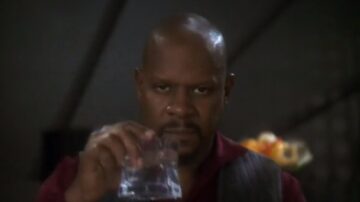
As a long-time trekkie, I admit that I am worried about the future of the Star Trek franchise. It might seem strange to be pearl-clutching over a piece of sci-fi intellectual property with… you know… EVERYTHING happening (war, genocide, starving children, ICE raids, colonial/imperial boomerang, gutting of the social safety net, etc). But hear me out. Our future imaginary that feels approachable and possible (as long as you ignore the impossibility of faster-than-light space travel) could face a conservative makeover. But why should that matter? Isn’t it just mass produced culture, that maybe has some liberalish politics, but ultimately just reinforces a particular imperialist ideology? That ultimately depends on how you look at it. While sometime functioning as an apologia for American empire, the show could also ask some hard questions about that empire, even as it ultimately embraced the supposed idealism of the US experiment. More importantly, the show imagines a better, more progressive future where everyone belongs. In times like these, we absolutely need these kinds of hopeful story associated with Star Trek. Changing it into a generic space action series would strip it of what made it special. Many focus on the way it champions science, but ultimately, Roddenberry sought to illustrate a humanist future where technology serves humanity, rather than controls us. We need this vision now more than ever, as everything that so many people have fought for seems to be violently being erased.
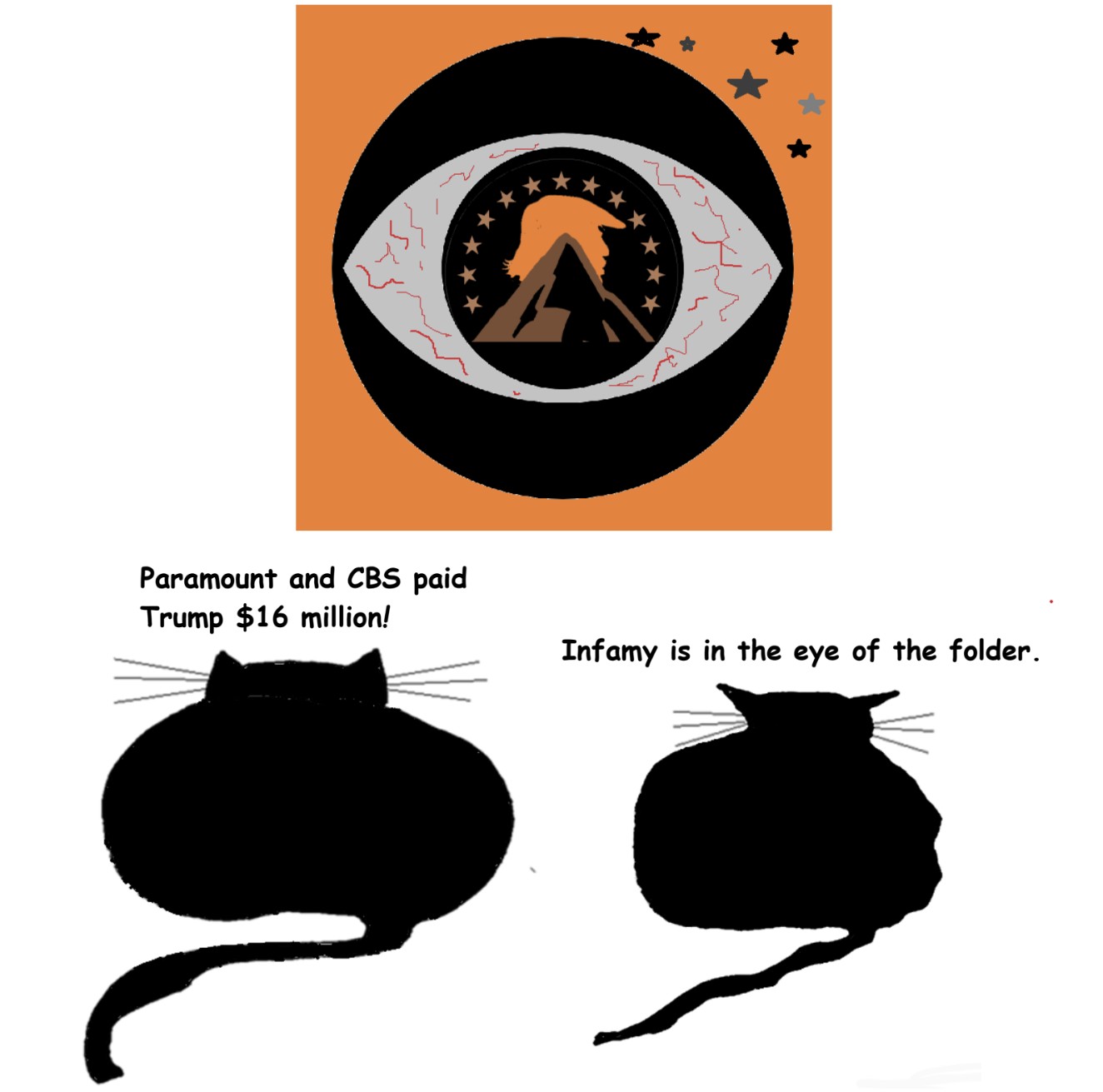
The merger between Paramount and Skydance has already had one major casualty, The Late Show. Now hosted by Stephen Colbert, the show began in the 1990s when David Letterman was passed over for the “safer” option of Jay Leno to replace Johnny Carson. Under Letterman, The Late Show had a tendency to the weird and countercultural, though less pointedly political. His tone was deeply ironic and cynical of societal norms, while taking a deep pleasure in highlighting the odder corners of American life. Gen Xers idolized him. Colbert ran a slightly more traditional program even as Letterman’s influence shines through. Colbert brought his own signatures to The Late Night, highlighing his geeky bonefides, but regularly commenting on current political events. But after a scathing take on the recent settlement between the current POTUS and Paramount, Colbert’s contract was not renewed. The show will end in May of 2026. Paramount claims the decision was due to “financial reasons.” But no one believes them. Other figures such as Jon Stewart of The Daily Show have weighed in on the settlement with the President in solidarity with Colbert’s view that it was essentially a bribe to ensure the Paramount/Skydance merger to a Trump ally’s son goes through. Many believe that under Ellison, CBS and Paramount will veer to the right, mimicking Fox News. Skydance has already announced a DEI review after the firing of Colbert. It is hard not to see that the ultimate outcome, as David Ellison has promised content favored by Trump and his movement. Read more »
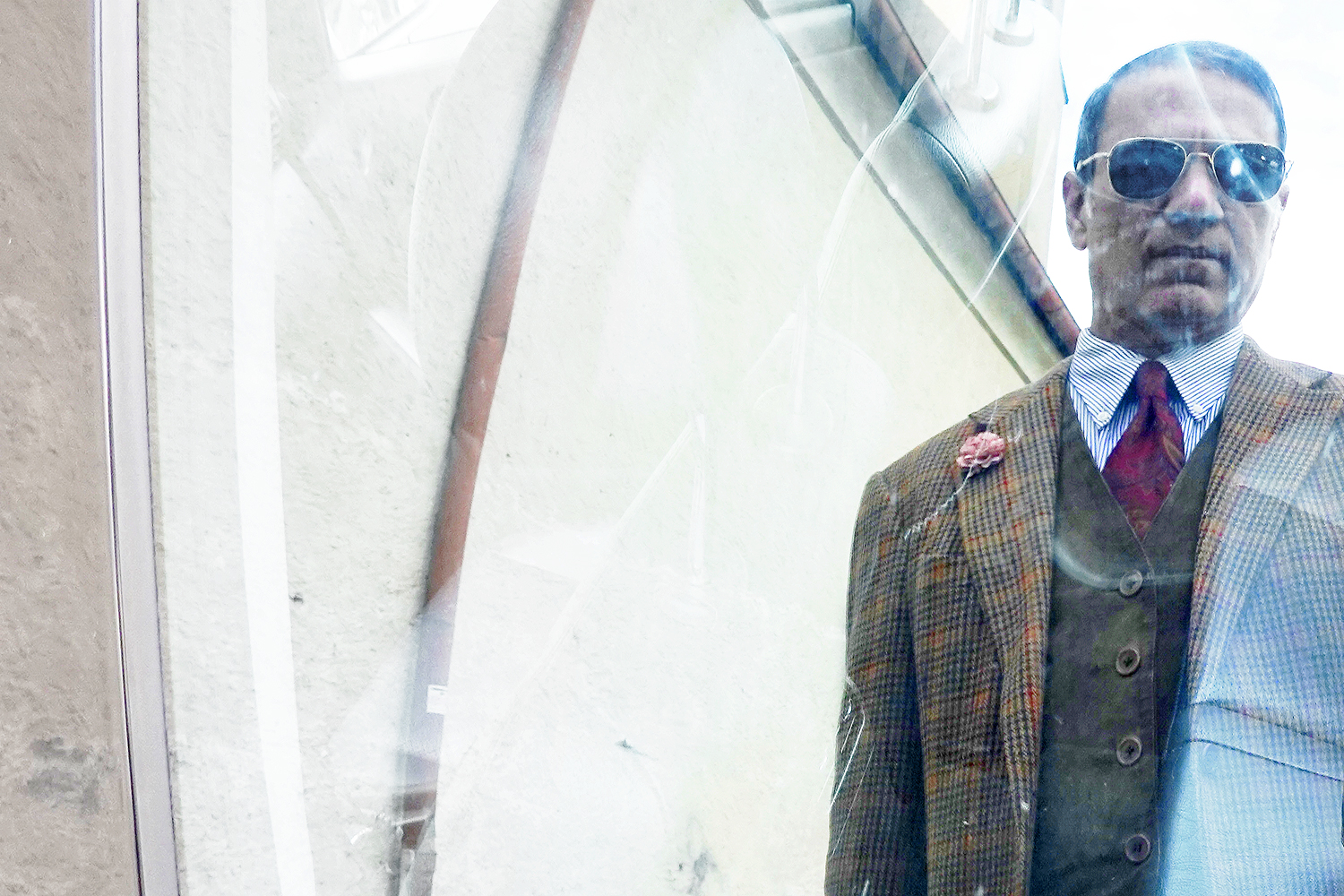
Self-portrait by reflection in car window.
Enjoying the content on 3QD? Help keep us going by donating now.
by TJ Price
In high school, algebra class was fraught with peril. I’ve never been good at math—in fact, I suffer from mild dyscalculia (not “number dyslexia,” as so many people quip), wherein integers squirm and shimmy on the page, mischievously transposing themselves with the others in a sequence. This was danger enough, yet also there was Cheryl, who sat in front of me in class—or, more specifically, Cheryl’s notebook. It was not, as one might have expected, filled with theorems and diagrams but rather words. It was striking, too—in front of her, resting on her desktop, was a row of pens, each one a different color. Some paragraphs in the notebook were entirely in green; some in blue; others in red, or pink. Sometimes there’d even be a single line in a different color.
To the casual observer—and indeed, the teacher—it had the appearance of investment, even application, to the subject at hand. (I was always told that I was “a bright kid,” that if I just “applied myself”… ) Cheryl never did well on tests or quizzes, either. I know this because I saw her grades, inked in red pen at the top of the papers handed back to us. I know this because she had a sad, hopeless look every time she had to pass back whatever pile of dittoes had been handed to her, for me to take one and continue the chain. There was always a flash of recognition, even camaraderie, in that instant. Maybe I knew she was unhappy, even frustrated, with the concepts we had to learn. Maybe it was something else.
Cheryl was not a popular girl, nor did she seem particularly attractive—for reasons that would not become clear to me for a long time—she wasn’t even from one of the three towns whose children made up the population of the school. She’d come in on some kind of extension from a different town, one far more rural, through the “Vocational Agriculture” program. We called it VoAg for short, like some kind of planet in a novel by Vonnegut. Cheryl loved horses, I think. Wanted to be a veterinarian. Read more »
by Thomas Fernandes
Interest often begins in surprise. It may arise from the encounter of something new or the clarity of insight, when a complex thing finds a simple resolution. We may also be blind in two ways. The first lies in what we fail to notice, and thus cannot be surprised by. The other lies in what we take for granted, missing the complexity.
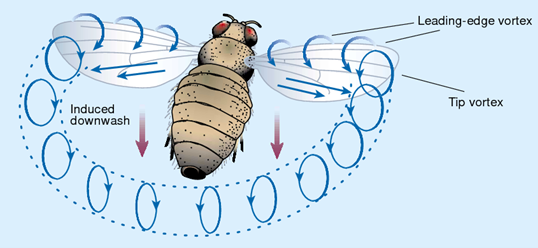
Consider something you’ve likely seen all your life and are possibly afraid of: the honeybee. Honeybees represent but a few species of the 20 000 species of bees, most of which are solitary bees laying their eggs in tunnels or dead wood. Yet they are the most notorious. But how well do we see them?
We notice them flying, but are we surprised? Until the 2000s, scientists could not explain how bees fly. As the story goes, in the 1930s, engineers considered bee flight aerodynamically impossible. It was found that, by all accounts, their wings shouldn’t be able to lift their bodies. Yet the answer was found in a very different mechanism of controlled turbulence. Specifically, it was found that bees rely on leading edge vortices. Insects in general do not rely on steady flow of air but create controlled turbulence called a vortex at the top of their wings. By sweeping their wings at a sharp angle bees generate “horizontal mini-tornadoes” that are then pinned on top of the wing. The low-pressure zones of the “eyes” of those mini tornadoes carries them aloft. This is very similar to staying aloft in water by sculling: moving your hand back and forth at an angle in a figure-eight movement. In this pattern both directions create lift, contrary to bird flight. Slow-motion footage reveals bees “swimming through the air” more vividly.
This discovery only brings about a new deeper mystery that might fail to surprise us. To keep those vortices anchored to the wings, bees must beat their wings fast, 230 beats per second on average. Read more »
by Paul Braterman
 When Representative (now House Speaker) Mike Johnson told us that the cause of school shootings was the study of Darwinism, he did so from the platform of Shreveport Christian Center, on which there were no religious symbols, but two flags equally prominent, that of the United States, and that of Israel. This symbolizes the political position of the Christian Right in the US, now and for many years past Israel’s main source of external political support.
It is not my intent here to discuss the situation in Gaza. I have already done this elsewhere, and information is freely available, for example from Médecins Sans Frontières, whose reports are based on the evidence of medical personnel on the spot, 1Disclosure; Médecins Sans Frontières is one of the causes to which I donateand Sky News, one of whose notable reports describes the operation of the current aid distribution system. Reuters issues regular reports (e.g. this, from mid-July, giving a UN estimate of 875 for total number of Palestinians killed in six weeks while trying to collect food), while for distinguished comment from within Israel, see e.g. here and here and here.
Here, I have set myself the more modest task of describing how US biblical Christianity uses support of Israel as a plank in its alliance with the American Right. Their success in doing so does much to explain the otherwise mysterious inability of US politicians to influence Israeli policy, despite Israel receiving almost $18 billion in the year following the October 7, 2023 attack. I will also point out that while this support is unconditional politically, it is not so theologically, may prove a broken reed (to invoke a biblical expression) when it comes to resolving any major crisis that it helps create, and has already, at a crucial juncture, sabotaged Israel’s own peace initiative. Read more »
by Scott Samuelson

Studying in Leipzig back in 1993, I took the train down to Dresden and visited the Old Masters Picture Gallery. As I meandered among the masterpieces, I was stopped in my tracks by Johannes Vermeer’s Young Woman Reading a Letter by an Open Window. The droplets of light on her braids. Her ringlets of loose hair. The almost-touchable texture of the tapestry. The almost-smellable bowl of fruit. The mysterious green curtain. Her face engrossed in the end of the letter. Her blurred reflection on the windowpane. I ended up gawking at the painting so long I missed my train back.
Right now, at the Frick Collection in New York, people the world over are crowding into an exhibit called “Vermeer’s Love Letters,” featuring three exquisite portraits by the master on his favorite theme (I first wrote “only three”—but that’s nearly ten percent of his work!). Vermeer shows are always a sensation. I still remember the excitement I shared in early 1996 with the line of museumgoers waiting in the cold to see the once-in-a-lifetime exhibit at the National Gallery in Washington D.C., which gathered twenty-one of his thirty-five paintings.
How have Vermeer’s paintings come to entrance the world? Why is that painting in Dresden—alas, not in the Frick show—still my absolute favorite over thirty years later? What are Vermeer’s love letters trying to tell us?
A couple of years ago, I had an experience that revealed to me the secret of our fascination with his paintings. It took place at Terminal One in O’Hare—at Stefani’s Tuscany Café. But before I unveil the mystery (at least as far as I’ve been given to understand it), let me say a quick word about light. Read more »
by Mike Bendzela
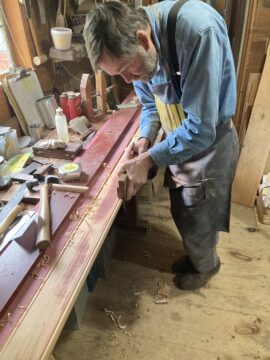
This concludes the story from last month about the ongoing restoration of a Maine farmhouse by woodworker Don Essman, who is also my spouse. Over the years, Don had built up enough trust with the southern states descendents of the historic property to be permitted to live on the farm rent-free, in exchange for his completing yearly construction and restoration projects. Before I arrived on the scene in 1985, he had re-sided parts of the kitchen ell with clapboards; installed a hand-pumped cistern in the attic to supply running water to the kitchen; and bought a wood-fired Glenwood cook stove from a neighbor with a piped-in water front to heat hot water as needed. A calf waterer set up in the kitchen and filled with hot water was suitable enough for him as a bathtub. He also put new sill timbers under the front of the main house; he reframed walls, insulating with fiberglass as he went; and he began replacing the large windows installed in the late 19th century to “Victorianize” the place with smaller, more period appropriate nine-over-six window sashes.
For years he used the old privy or “four-holer” (an outhouse connected to the barn), which never bothered him. The one time his parents visited Maine in those early years, his mother understandably wouldn’t use the privy and asked to be driven to a gas station to use the restroom. Only at the urgings of the owner and a future roommate did Don install an electric water pump and a modern bathroom. The facilities were completed by the time I moved in with him in 1986. Read more »