by Shawn Crawford

In 1987, Anderson University, an Evangelical school in Indiana, acquired 140 works by the artist Warner Sallman, including Head of Christ. You may have never heard of Sallman, but in terms of sheer sales and presence, his Head of Christ makes him the most popular 20th Century artist in America. Exponentially more popular than Warhol or Wyeth. If you are a Boomer or Gen X Evangelical, Head of Christ provided the definitive image of Jesus, in a way that you can never shake.
At my house, this was the only “art” hanging on the wall. Many of my friends could say the same. One of the wealthier families in our church also had a copy of Sallman’s Christ at Heart’s Door, with a heavy gilt frame and one of those fancy lights attached at the top to better illuminate Jesus trying to get in. The painting has obvious echoes to William Holman Hunt’s The Light of the World without thePre-Raphaelite theatrics. Our Jesus did not wear a cape. And that beard needs a trim. As a freshman in college I learned Hunt had also painted The Awakening Conscience, a painting so erotic to my sheltered sensibilities I could not reconcile the two. I also stared at the reproduction in my British literature anthology for hours on end.
If you are wondering just how ubiquitous Sallman’s picture is, over 500 million copies have been sold since he painted it in 1940. That’s enough for every man, woman, and child in the U.S. with plenty left for Justin Trudeau to pass out to his disillusioned base. Oh pretty, pretty Justin. Read more »

 It is fashionable to say that great wine is made in the vineyard. There is a lot of truth to that slogan but in fact wine is made by a complex assemblage with various factors influencing the final product. Last month
  From aviation to zoo-keeping, there’s a simple rule for safety in potentially hazardous pursuits. Always keep an eye on the ways that things could go badly wrong, even if they seem unlikely. The more disastrous a potential failure, the more improbable it needs to be before we can safely ignore it. Think icebergs and
  The man for whom the word “Emergency” must have been invented (“serious, unexpected, and often dangerous situation requiring immediate action”) pulled the pin out of yet another hand grenade.
 I’d been living in Tokyo about ten years, when a friend’s father decided to perform a little experiment on me. Arriving one cool autumn evening at their home in suburban Mejirodai, he waved my friend away, telling her: “I want to have a little chat with Leanne.” Sitting down on the sofa across from him, he poured me a cup of tea. In truth, I can’t recall what we chatted about, but about twenty minutes into the conversation, he suddenly clasped his hand together in delight–with what could only be described as a childlike gleam in his eyes– and said, “Don’t you hear something?”
 Just about everyone who visits the famous

 My seventy-something year old uncle, who still uses a flip phone, was talking to me a while ago about self-driving cars. He was adamant that he didn’t want to put his fate in the hands of a computer, he didn’t trust them. My question to him was “but you trust other people in cars?” Because self-driving cars don’t have to be 100% accurate, they just have to be better than people, and they already are. People get drunk, they get tired, they’re distracted, they’re looking down at their phones. Computers won’t do any of those things. And yet my uncle couldn’t be persuaded. He fundamentally doesn’t trust computers. And of course, he’s not alone. More and more of our lives have highly automated elements to them,
  The Anna Karenina Fix
 In the Third Essay of On the Genealogy of Morality, Nietzsche levels a powerful attack on the modern Platonistic conception of mind and nature, urging us to reject such “contradictory concepts” as “knowledge in itself,” or the idea of “an eye turned in no particular direction, in which the active and interpreting forces, through which alone seeing becomes seeing something, are supposed to be lacking.” More recently, Donald Davidson’s attack on the dualism of conceptual scheme and empirical content, and thus of belief and meaning, requires us to see inquiry into how things are as essentially interpretative.
 Andrea Scrima: As a visual artist, I worked in the area of text installation for many years, in other words, I filled entire rooms with lines of text that carried across walls and corners and wrapped around windows and doors. In the beginning, for the exhibitions Through the Bullethole (Bemis Center for Contemporary Arts, Omaha), I walk along a narrow path (American Academy in Rome) and it’s as though, you see, it’s as though I no longer knew… (Künstlerhaus Bethanien Berlin in cooperation with the Galerie Mittelstrasse, Potsdam), I painted the letters by hand, not in the form of handwriting, but in Times Italic. Over time, as the texts grew longer and the setup periods shorter, I began using adhesive letters, for instance at the Neuer Berliner Kunstverein, Kunsthaus Dresden, the museumsakademie berlin, and the Museum für Neue Kunst Freiburg. Many of the texts were site-specific, that is, written for existing spaces, and often in conjunction with objects or photographs. Sometimes it was important that a certain sentence end at a light switch on a wall, that the knob itself concluded the sentence, like a kind of period. I was interested in the architecture of a space and in choreographing the viewer’s movements within it: what happens when a wall of text is too long and the letters too pale to read the entire text block from the distance it would require to encompass it as a whole—what if the viewer had to stride up and down the wall? And if this back and forth, this pacing found its thematic equivalent in the text?
 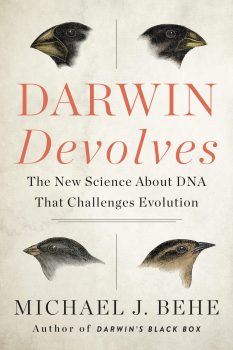 “[T]here is in fact nothing that can alleviate that fatal flaw in Darwinism” says Professor Behe,
  rapture, claiming that “Michael Behe’s Darwin Devolves Topples Foundational Claim of Evolutionary Theory” and that “Anyone interested in knowing the truth about the design/evolution debate will find Darwin Devolves a must read.”
 I wonder whether Behe’s most vociferous supporters actually understand his position. Unlike them, he