Is There a Word for Reverse Anthropomorphism?

by Richard Passov

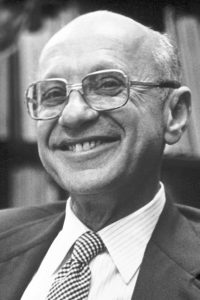
Milton Friedman

Milton Friedman, in his essay The Methodology of Positive Economics[1]first published in 1953, often reprinted, by arguing against burdening models with the need for realistic assumptions helped lay the foundation for mathematical economics. The virtue of a model, the essay argues, is a function of how much of reality it can ignore and still be predictive:

The reason is simple. A [model] is important if it explains much by little, that is, if it abstracts the common and crucial elements from the mass of complex and detailed circumstances surrounding the phenomena to be explained and permits valid predictions on the basis of them alone.

Agreement on how to allow predictive models into the canon of Economics, Friedman believed, would allow Positive Economics to become “… an Objective science, in precisely the same sense as any of the physical sciences.” What Friedman coveted can be found in a footnote:

The … prestige … of physical scientists … derives … from the success of their predictions … When economics seemed to provide such evidence of its worth, in Great Britain in the first half of the nineteenth century, the prestige … of … economics rivaled the physical sciences.

Friedman appreciated the implications of the subject as the investigator, to a degree. “Of course,” he wrote, “the fact that economics deals with the interrelations of human beings, and that the investigator is himself part of the subject matter being investigated…raises special difficulties…

But he loses the value of his observation to a spate of intellectual showboating:

The interaction between the observer and the process observed … [in] the social sciences … has a more subtle counterpart in the indeterminacy principle … And both have a counterpart in pure logic in Gödel’s theorem, asserting the impossibility of a comprehensive self-contained logic …

The absence of an ability to conduct controlled experiments, according to Friedman, was not a burden holding back progress or unique to the social sciences. “No experiment can be completely controlled,” he wrote and offered astronomers as an example of scientists denied the opportunity of controlled experiments while still enjoying the prestige he coveted.

But though moving economics forward as a positive science – one where predictions are formulated through math and then tested against alternative formulations – he did not want to see mathematics supplant economics. “Economic theory,” he wrote, “must be more than a structure of tautologies … if it is to be something different from disguised mathematics.”

When Friedman penned his article, the simplest mathematical formulations exhausted computational capacity. Read more »

On the Trail of Leonardo– Confusion, Collusion, and Connoisseurship

by Leanne Ogasawara

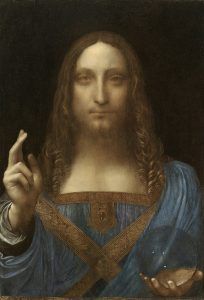
Salvator Mundi (Leonardo da Vinci)

It was mid-summer 2011 when the news broke that a long-lost Leonardo da Vinci painting had been found. Apparently, a New York City art dealer noticed the picture at an estate sale in Louisiana and purchased it for around $10,000. This occurred back in 2005, and the following six years were spent in painstaking work to research and restore the painting. Now in 2011, it was making its public debut in a high profile blockbuster exhibition at the National Gallery in London.

My first thought was: “This is the greatest art historical discovery of my lifetime!”

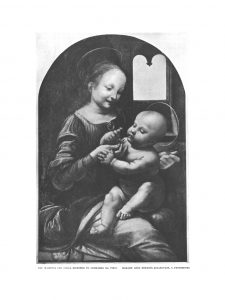
After all, it has been over a hundred years since the last Leonardo was officially “discovered.” This happened when the Benois Madonna was triumphantly trotted onto the world stage in Saint Petersburg, in 1909. Considered to be one of two very early Madonna paintings that the master himself mentioned working on in his notebooks in 1478, the painting was bought by the Hermitage Museum in 1918 and has remained in that collection ever since. This purchase being much to the chagrin of the American industrialist and art patron Henry Clay Frick, who had plunked down a hefty deposit for the picture– only to lose out in the end, when the Russian czar swooped down to exercise his right to purchase.

Benois Madonna

Not a prolific artist, it is hard to say which was worse: Leonardo’s chronic procrastination and inability to finish projects or the highly experimental methods in technique and materials that he favored. The result being that not many paintings remain in what is broadly agreed upon by experts to have been done in his hand. Prior to the new 2005 discovery, there were fewer than twenty pictures. So the new discovery was immediately –and not surprisingly– met with a deluge of doubts. First of all, how does one lose something this valuable in the first place? Shouldn’t there by a seamless trail of the work from its conception and initial purchase by a king or duke down through history, as it changes hands for greater and greater sums of money? Leonardo was, after all, legendary even during his own lifetime, with kings and queens clamoring to obtain paintings from the great master. And unlike with my favorite artist, Piero della Francesca, his work never fell out of favor. Read more »

Improper Nouns

by Akim Reinhardt

I’ve met
Montanas, Dakotas, and Asias
Brooklyns, Chinas, and Indias
Roses and Irises, Lilys and Daisys
Porsches and Lexuses and Mercedes,
Persons turned to Places and Things

I’ve met
Mayas, Gypsys, and Cheyennes
People who were people they’ve never been

I’ve met
Aprils, Mays, and Junes
People defined and consigned to sunny times

I’ve met
Robins, Ravens, and Fawns
Summers, Autumns, and Dawns
People plucked unnaturally from nature

I’ve met
Jubilees and Joys
Faiths and Hopes
Charitys, Serenitys, and Flelicitys
People who were prayed upon

I’ve met
Hazels, Ebonys and Violets
Sapphires, Siennas, and Scarlets
People spilled upon pallets

I’ve met
Olives, Abrosias, and Bries
Candy and Cherrys
Gingers and Sherrys
Clementines, Cocos, Honeys
People gobbled and chewed up

I’ve met
Rubys and Pearls
Crystals and Jewels,
Jades and Goldies
Ambers and Pennys
People pocketed and paid for

No wonder they’re so easily called
Red Heads, Brunettes, and Blondes
Curvy, Skinny, and Fat
Big Titted, Fake Titted, and Flat
Ugly, Hot, and Okay
Bitch and Cunt
Whore and Slut

Instead of
Mother or Daughter
Sister or Wife
or Friend

So many women
labeled as exotic
tasty or erotic
So many women
told not to be women
told to be
calendars, colors, or stones
animals, flowers, or strangers
told to be something
Eaten or visited or tamed
Bought and sold as they’re named
For other people’s emotions
Dreams and devotions
Trinkets and Toys

But boys, it seems, will be boys

Akim Reinhardt’s website is ThePublicProfessor.com

Facts Become the Enemy: Art and Archives. A Conversation with Joy Garnett on “The Bee Kingdom”

by Andrea Scrima

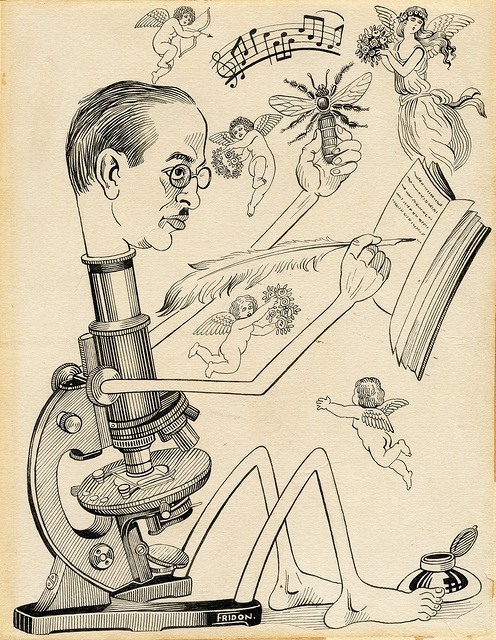
Caricature of A.Z. Abushady by the Persian/Alexandrian cartoonist, Mohamed Fridon (ca. 1928)

Joy Amina Garnett is an Egyptian American artist and writer living in New York. Her work, which spans creative writing, painting, installation art, and social media-based projects, reflects how past, present, and future narratives can co-exist through ‘the archive’ in its various forms. Her work has been included in exhibitions at New York’s FLAG Art Foundation, MoMA–PS1, the James Gallery, the Milwaukee Art Museum, Museum of Contemporary Craft Portland, Boston University Art Gallery, and the Witte Zaal in Ghent, Belgium, and she has been awarded grants from Anonymous Was a Woman, the Lower Manhattan Cultural Council, Wellcome Trust, and the Chipstone Foundation. Joy’s paintings and writings have appeared, sometimes side-by-side, in an eclectic array of publications, including the Evergreen Review, Ibraaz, edible Brooklyn, C Magazine, Ping Pong, and The Artists’ and Writers’ Cookbook. She has been working on a memoir and several other projects around the life and work of her late grandfather, the Egyptian Romantic poet and bee scientist A.Z. Abushady (1892–1955). Her chapter on Abushady will appear in Cultural Entanglement in the Pre-Independence Arab World: Arts, Thought, and Literature, edited by Anthony Gorman and Sarah Irving, forthcoming from I.B. Tauris. An excerpt from her memoir-in-progress appears in the January 2019 issue of FULL BLEDE, edited by Sacha Baumann.

Andrea Scrima: Joy, you’re the sole steward of the effects of your famous grandfather—the Egyptian Romantic poet and bee scientist Ahmed Zaki Abushady [Abu Shadi]—and have been compiling an archive for several years. First of all, however, I’d like to ask you about your artistic approach to the material and the ways in which history and storytelling interweave in the work. You showed an earlier version of this work-in-progress at Smack Mellon around four years ago, and now, recently, I’ve seen a number of new installments of The Bee Kingdom on Facebook. It makes me think of a kind of novel of layered fragments.

Abushady in the back garden of his home and research laboratory ‘Rameses Villa,’ Ealing, London. September, 1917

Joy Garnett: I like that description, The Bee Kingdom as a novel of layered fragments, though sometimes it feels like I’m chasing a moving target. It’s been challenging to parlay so many fragments into an artwork or a sustained piece of creative writing, but that is what I’m doing. The source material is not only historically relevant, it’s close and personal, and this affects how I work. And while I want to know the history of what actually happened to my grandfather and my family, and so on, I’m aware of many co-existing unofficial and even secret histories that appear and disappear as I try to make sense of things.

There are other questions, such as what types of media I want to work with. I’ve been a painter all my life, but painting isn’t right for this project. Is The Bee Kingdom mostly writing? Yes and no. I’ve subordinated the visual to writing, but the writing depends heavily on images. Read more »

Finnegans Wake & Dreaming of the ‘Everything Novel’

by Robert Fay

In the winter of 1927 James Joyce was in desperate need of a kind word. It didn’t seem to matter that he was a genius, the man who’d published Ulysses five years earlier, an artist of such magnitude that another Irish genius—a young Samuel Beckett—worshipped him and acted as his personal secretary. Joyce was completing a new novel under the working name, Work in Progress (Finnegans Wake), and nearly everyone who had read drafts hated it.

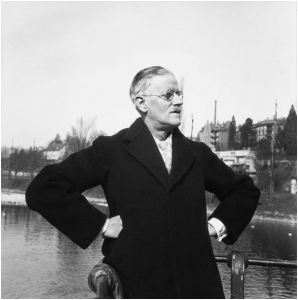
James Joyce in Paris.

His wife, Nora Joyce, badgered him: “Why don’t you write sensible books that people can understand?” while his longtime patron, the sophisticated Harriet Shaw Weaver, wrote him scathing letters. She found the work nearly indecipherable. “I am made in such a way that I do not care much for the output from your Wholesale Safety Pun Factory nor for the darkness and unintelligibilities of your deliberately-entangled language system,” she wrote. Joyce biographer Richard Ellmann in his definitive chronicle James Joyce (1959), tells us that Joyce was so upset by this letter he “took to his bed.”

In Joyce’s three previous books he had explored and mastered the limits of the short story and the autobiographical novel, and then proceeded to write a maximalist “avant-garde” novel,  Ulysses (1922), that was arguably three-to-four decades ahead of its time. In baseball terms, Ulysses remains the equivalent of Joe DiMaggio’s 56-game hitting streak in 1941. A record of human achievement that is unassailable and will forever remain a sacred Mount Sanai for writers across the globe.

Yet this great book burdened Joyce too. Like DiMaggio, he had to know his achievement was not repeatable. “In Dubliners he had explored the waking consciousness from outside, in A Portrait and Ulysses from inside,” Ellmann wrote. “He had begun to impinge, but gingerly, upon the mind of sleep…that the great psychological discovery of the century was the night world he was, of course, aware.”

Ellmann, we can’t forget, is referring to the writings and work of Sigmund Freud and his psychoanalytic theory, which was an intellectual bombshell of the early 20th Century that was only rivaled by Einstein’s Theory of General Relativity. In Finnegans Wake Joyce was looking to create an entirely new language for the new territory of the unconscious, of sleep, of the dream world. Read more »

Hanging Up My Ruby Red Slippers: Confessions and failures of an internet dater

by Sue Hubbard

Okay. I’m done. I’m through. I’m hanging up my ruby red slippers, my fuck-me shoes. I’m not going down that yellow brick road no more, no more. I’m giving up internet dating. I may have run a successful antique business in Portobello Road for many years which kept my three children in fish fingers, the three little children I was left with in the middle of Somerset – where I kept chickens, made bread and grew my own veg – when I was 31 and they were all under 6. I may have dragged myself off as a mature student up to the University of East Anglia, after I’d moved us like Ms Whittington to London, to do an MA in Creative Writing with the crème de la crème, whilst juggling child care as the other students hung out talking postmodernism in the bar. I may have written for Time Out, The Independent and The New Statesman as an art critic, published three collections of poetry, one of short stories and three novels but none of this is as anything compared to my failure with internet dating.

I have been at it since before they even had internet dating. When my ex left me for an older women while I was in my early 30s I was desperate to find someone new. To rekindle love and touch and remind myself I wasn’t the mad bad person he was trying to make me out to be. So I put a tiny ad in the personal column at the back of Time Out. It felt incredibly transgressive. The replies came in a big brown envelope at the end of the week. Some had photos of men in woolly jumpers. Some were 20 stone. Some looked nice. There were accountants and students, film buffs and some just in the buff. And I began dating. How naive and serious I was then, wearing my heart on my sleeve, hoping to find an attractive, kind man who’d share my interests and wanted to fall in love. Read more »

Neural Weather, An Informal Defense of Psychoanalytic Ideas

by Bill Benzon

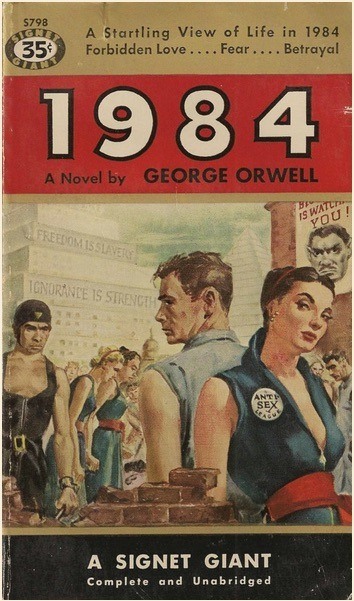
I first found Freud in the basement of the house on Luther Road. There was a small closet in the corner and my father had a box or two of paperback books in it. I don’t remember but a few titles; in fact, I’m only sure of two: Wodehouse on Golf, which I never read, and 1984, which I most certainly did read, as it had a pulpy cover that promised sex – a buxom brunette in a tight blue jumpsuit emblazoned with “Women’s Anti-Sex League” – in THAT costume! Of course, the book wasn’t quite what the cover advertised, but that was OK. I may also have found Brave New World there, I’m not sure. Come to think of it though, that probably IS where I found War of the Worlds. So that’s three titles I’m pretty sure of.

I probably found some Bertrand Russell, too, though just exactly what, I can’t recall. I went on to buy a bunch of Russell, including his history of Western philosophy. I also found something by Theodore Reik (Listening with the Third Ear?), and went on to buy more of THAT. And I found Freud, perhaps Three Essays on the Theory of Sexuality; after all, it has that magic word in the title: S E X.

In the summer between my freshman and sophomore years at Johns Hopkins I read The Interpretation of Dreams. Somewhere in there I picked up a five-volume set of The Collected Papers from a book club. I’ve still got them, though they’re in storage along with some other Freud. But I’ve still got Totem and Taboo, Civilization and It’s Discontents, and The Future of an Illusion on the shelves in my apartment. They’re slender volumes and so don’t take up much space and Civilization plays to my interest in cultural evolution. Read more »

Monday, January 28, 2019

A Puzzle about Ancient Cynicism

by Scott F. Aikin and Robert B. Talisse

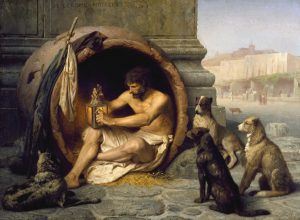
Diogenes of Sinope famously walked the streets of Athens searching for an anthropos. The tale is regularly rendered as him looking for an honest man, but this is too restrictive a translation. Rather, he was looking for a human, in the thick sense of the word. It is like a coach of a soccer team, challenging the squad of players, asking them if they are soccer players. In this regard, the thick sense of the term bears a normative weight, as a success term. And so, when one points to Lionel Messi and says, “Now, that’s a soccer player,” one is not merely saying that Messi plays the game. Rather, one is saying that he plays excellently, that he is exemplary. And so, when Diogenes, with his lit lamp in the daylight, asks people he meets if they are human beings, he is using the term in the thick sense. And given that his search seems to be ongoing, he implicates that everyone is failing to live up to the standard.

The standard that Diogenes — and with him, the ancient Cynic tradition — had in mind is not clear. However, one value at the center of this thick notion of humanity is not in question: that of autarkeia, roughly, independence, self-sufficiency, freedom. The genuine human is free; but, again, Diogenes finds no one fulfilling that standard. Instead, he finds people who are who have lost or given away their independence. Hence a famous Cynic paradox: only the practicing Cynic is free, only the Cynic is rich. How to make sense of these claims? Read more »

A Love Poem

by Amanda Beth Peery

Ms Green isn’t any good with
love poems or tokens, doesn’t like
small, easily lost objects. So she wants
to give him her visions—for example
the wedge of park & slim streetlights
shattering in shallow rainwater
like swarms of bottled fireflies
or clusters of leaping stars.
She wants to give him her gratitude
for life itself: darkness broken by light
days broken by night. The pattern of
dark leaves pressed against the sky.

Here Goes Everything

by Tim Sommers

I know you’ve heard this before. But it’s just too relevant to avoid, so, please, bear with me. It may, or may not, be a garbled version of something Bertrand Russell wrote in Why I am not a Christian, but it has become the equivalent of an urban legend in philosophy. It goes like this. Some famous philosopher or another, maybe Russell, maybe William James, is traveling in some non-Western country, probably India, because of the elephants, and they ask a local informant about their cosmology. The local says, “We believe that the world is a vast sphere resting on the back of four great elephants.”
The philosophy professor says, “But what are the elephants standing on?”

“The elephants are standing on the back of an enormous turtle.”

“What’s the turtle standing on?”

“An even larger turtle.

“But what is that turtle standing on?”

“You are very clever, sir, but I’m afraid it’s turtles all the way down.”

What is that so relevant to? Maybe, the cosmological argument for the existence of God, for one thing, but certainly this. Either the universe has existed in some form or another forever or the universe came into existence out of nothing at some point. That’s not physics or even cosmology. That’s logic. P or not P. Either some turtle is standing on nothing or it’s turtles all the way down. Read more »

I am attempting to Come to Terms with this Big Failure

by Niall Chithelen

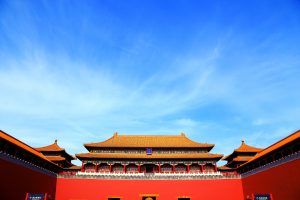
1) I got to see a different side of the Forbidden City when I brought visitors to there on a Monday and learned that the Forbidden City is not open to the public on Mondays. The side of the city that I saw was the outside, because Plan B (improvised) was to walk around the Forbidden City to the park behind it, which amounts largely to walking alongside a large, wide gray wall. Truly remarkable, you know, the immaculate geomancy, the imperial wonders and golden roofs. And then the wall and then us on the other side, strolling around as though I did not just commit a grave and truly ignominious error—strolling in pained, weak silence.

2) On any informal tour I lead, I like to show people the real China, you know, not just the tourist spots. Some people might like to see the inside of the Forbidden City, but for most of its existence, common people could not see the Forbidden City, and so it is more appropriate, I think, to walk around it, as a person would have two or three hundred years ago in order to do whatever business or activity people did at that time in this city—perhaps involving carts, or administration, or workplace conflict resolution. I am not sure about this. This is a more legitimate experience—no ticket required—just a channel into Beijing, feet on the ground in this old city, eyes on those old buildings that have seen so many years of change, an injection of pure Beijing right into your goddamn veins, really. And I try to be informative and even-handed as I dole out history and explain contemporary developments. Is China perfect? No. Is the US perfect? Also no. It is so difficult to judge these things. Read more »

In the Agora of Socrates

by Shadab Zeest Hashmi

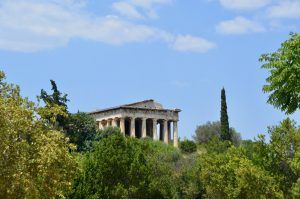
No one knows if it was really in the state prison, the ruins of which are visible today outside the ancient Agora of Athens, that Socrates was kept during the final days before his execution, so many times has the area been destroyed and reconstructed— walking past it sends a chill down my spine. Ancient Greece is visceral and vivid because it entered my imagination early in life; some of the most cherished tales of my childhood came from the crossovers of Hellenistic history and legend, such as the one in which Sikander (Alexander the Great) is accompanied by the Quranic Saint Khizr, in pursuit of “aab e hayat,” the elixir of immortality, or the one about the elephantry in the battle between Sikander and the Indian king Porus, or of the loss of Sikander’s beloved horse Bucephalus on a riverbank not far from Lahore, the city where I was born. I became familiar with ancient Greece through classical Urdu poetry and lore as well as through my study of English literature in Pakistan, but I would read Greek philosophers in depth many years later, as a student at Reed college; I would subsequently discover Greek influence on scholars in the golden age of Muslim civilization while working on a book on al-Andalus— the overlooked, key contribution of Arabic which served as a link between Greek and Latin, and its later offshoots that came to define the cultural and intellectual history of Europe.

Visiting the Agora in the sweltering heat of July, I am amazed by how comfortably these ruins from over two thousand years are nestled in the modern landscaping, park benches and pavements, how familiar the patchy, intensely green grass is, the deep, somnolent shade of oaks— the ancient is home once again, brought down to a child’s scale, at once snug and phantasmagoric, historic and pulsating with new life. Read more »

More Death

by Nickolas Calabrese

1. “…And I, who timidly hate life, fascinatedly fear death.” Fernando Pessoa, The Book of Disquiet.
2. I didn’t ask to be born, yet I’ve been condemned to death. Early on in Plato’s Phaedra, Socrates declares that it’s the job of the philosopher to prepare for death. Addressing Simmias and Cebes he states, “I am afraid that other people do not realize that the one aim of those who practice philosophy in the proper manner is to practice for dying and death.” There is something vulgarly sunny in the way he suggests it, but it also rings clearly true. What philosophers talk about when they talk about ‘the good life’ is a life not regretted when it comes time to exit it. Theirs is the pursuit of truth and understanding, and our own mortality could not be a more present topic to pursue.

3. Quite a few artists are engaged in a similar investigation. Although theirs is not as pure as the philosophers’, the good ones have a strong tendency to make work that both eviscerates vanity and frames mortality. By its very nature, the subject becomes the object. The countless examples of musicians, artists, poets, etc., examining the finitude of their own lives constitutes a vast list. Those who have spent time producing work in this vein are legion: from Bob Dylan to Future, from John Donne to Amiri Baraka, from Cady Noland to Andy Warhol. It comes as no surprise that one’s own death is an attractive topic. After all it’s something that every person ever has either done or will do in their lives. Death is more common than emotions. Not all people are capable of, say, love, but everyone must die. But what artists try to do with their work is antithetical to what Socrates was defining: artists are trying to cheat death. I’ll say more about this further down. Read more »

Monday, January 21, 2019

The Chinese Governance System: Impressive Strengths and Appalling Flaws

by Pranab Bardhan

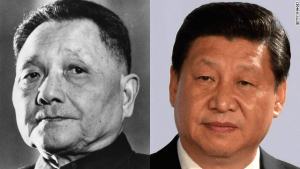
This is the 40th anniversary of the onset of economic ‘reform and opening-up’ (gaige kaifang) in China under the leadership of Deng Xiaoping, which eventually led to a dramatic transformation of its economy and global status. It is, however, remarkable that China’s current supreme leader, Xi Jinping, marked the anniversary in a speech in the Great Hall of People in Beijing mainly emphasizing the Party’s pervasive control. It is also remarkable that in recent years this leadership seems to have forsaken Deng’s earlier advice of tao guang yang hui (“keep a low profile”). In the flush of Chinese nationalist glory, Xi explicitly stated in the 19th Party Congress that China has now entered a “new era”, when its model “offers a new option for other countries and nations who want to speed up their development while preserving their independence”. Many people both in rich and poor countries seem to be already awe-struck by this model.
What are the special characteristics of the Chinese development model? Briefly, it’s a model of essentially capitalist development under authoritarian leadership and purposive governance, with a vertical production structure where basic capital goods are produced in monopoly state-owned enterprises and the much-larger rest of the economy is under private ownership, with a state-guided nationalist industrial policy and finance, with subsidized access to land and credit for state-favored business and repression of labor rights, massive investments in infrastructure funded by a very high national savings rate (particularly on account of large undistributed profits of companies), with rural industrialization in a decentralized framework of jurisdictional competition, and openness to foreign trade and acquisition and learning of foreign technology.  It has produced a rapid pace of economic growth over the last three decades and lifted hundreds of millions of people above the poverty line—undoubtedly a spectacular historic feat for any developing country. The recent slowing of the growth rate does not tarnish the long-term shining performance so far.

I have discussed some of these features of Chinese development, particularly in a comparative assessment with Indian development, in my book Awakening Giants, Feet of Clay (Princeton, 2013)—incidentally, I should mention here that when a Chinese translation of this book came out in Beijing, the translator thought it fit or prudential to take out, without my permission, some of the passages in the book that criticized Chinese policy, while those critical of Indian policy remained.

I believe the Chinese governance system is a crucial part of the China development model, and in this article I shall concentrate on its special features, both positive and negative, which tend to be overlooked in the simplistic discussion on authoritarianism vs. democracy that tends to dominate the usual observations on the system. Authoritarianism is neither necessary nor sufficient for some of those special features. In many ways these features undergirding the Chinese polity and economy are quite distinctive, and their roots go long back in history. I shall focus here on the aspects of governance that affect economic development and less on their clearly repressive police-state aspects and gross abuse of basic human rights. Read more »

The Met Museum’s Scholarly Looter

by Thomas O’Dwyer

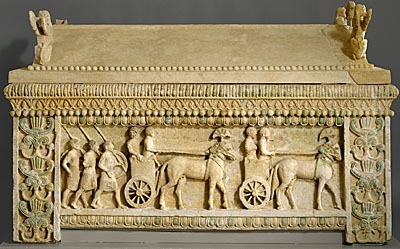
Limestone sarcophagus from the Met Cesnola Collection
The Amathus sarcophagus from the Met Cesnola Collection

French President Emmanuel Macron has set a very large cat among the pigeons of global antiquities trading and curating. The cat – catalogue – is a report he commissioned in March 2018 and it’s named The Restitution of African Cultural Heritage: Toward a New Relational Ethics. It identifies tens of thousands of cultural artifacts looted from Africa in French colonial days that could be repatriated. France’s national syndicate of antique dealers has already howled in protest at the report. In a letter to the culture minister, the Syndicat National des Antiquaires wrote: “The risks of extensions to other geographical areas and periods of history do not seem to have been anticipated.” In a separate statement, the syndicate expressed concern that the proposed repatriations would cover objects from the Americas, Asia, the Mediterranean and European countries.

A debate on Western theft from foreign cultures has been around since the nineteenth century. Only now is it gathering real momentum. It is a controversy which rumbles on in specialist magazines and art sections of various media. It erupts at times into open public rows over the most notorious cases – the theft of the Greek Parthenon Marbles by Britain’s Lord Eglin, for instance. There have been vocal demands from Greece, Egypt, Italy, Thailand and China for the return of treasures stolen by colonial marauders. Moral arguments abound over the sale of art pieces that Hitler’s Nazis plundered from European Jews. Such treasures now are often restored to surviving Jewish family members and their descendants. The moral case is that when buyers pay for art objects in good faith, it does not erase the original crime that makes such transactions possible. It is now being argued that this could apply to the millions of stolen artifacts laid out in the dusty cabinets of the world’s great museums. Read more »