by Gabrielle C. Durham
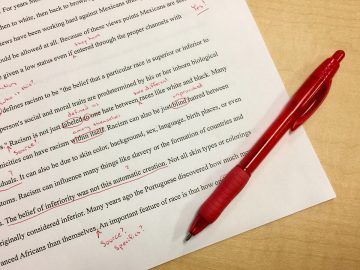
Have you ever been asked to donate to the worthy cause of sending the Lady Loins to the state semi-finals? I have, and I think I gave a couple bucks because of the doubtlessly unintentional prurience of the street fund-raising efforts of these aspiring young athletes and their lacking sign-makers.
As an editor, I think everyone needs an editor’s eye to pass over any written material, including my own. When we review our own writing, our brain fills in any lacunae in logic or syntax. This does not happen when we read other authors’ output, at least not as often. If you want to point the finger at why this occurs no matter how conscientious we are, go ahead and blame science.
You have likely seen the memes that dot social media about being able to read garbled words and sentences such as:
Tehse wrods may look lkie nosnesne, but yuo can raed tehm, cna’t yuo? [from mnn.com]
When relatively simple (one- to two-syllable words) words have their first and last letters in the correct place, our brains decipher them fairly quickly. Why does this happen? Because we rely on context to determine meaning. Whether we are counting the number of letters when we play Hangman, watching a show like “Wheel of Fortune,” or working on a crossword puzzle, our brains are analyzing the context to create solutions.
Your brain wants to fill in a pattern so that the jumble make sense. Measuring pattern recognition is one of the ways to test IQ, intelligence, and job fit (how you think being perhaps more important than what you think). According to this article from Frontiers of Neuroscience, “A major purpose of the present article is to forward the proposal that not only is pattern processing necessary for higher brain functions of humans, but [superior pattern processing] is sufficient to explain many such higher brain functions including creativity, imagination, language, and magical thinking.” Patterns and context matter tremendously.
So, what does this have to do with needing an editor forthwith? It comes down to this: You can’t be trusted. Read more »

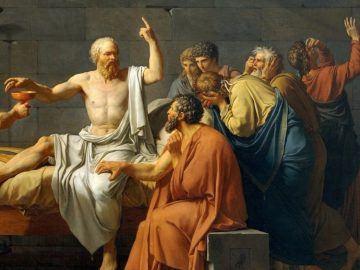 When Socrates’ students enter his cell, in subdued spirits, their mentor has just been released from his shackles. After having his wife and baby sent away, Socrates spends some time sitting up on the bed, rubbing his leg, cheerfully remarking on how it feels much better now, after the pain.

 I’ve always liked stories that depended on mistaken identity, a very old theme in general. Having a degree in mathematical logic, I was also drawn to the subject on a more theoretical level, on which lies Gettier’s Paradox.

 Movies, music and novels portray a particular ideal of romantic love almost relentlessly. Love is something that happens to you, something you fall into even against your will or better judgement. It is something to be experienced as good in itself and joyfully submitted to, not something that should be questioned.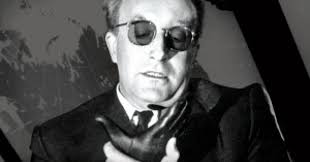

 Just as Anteus in Greek mythology renewed his strength by touching the earth, so emigrés who live abroad often draw some sort of cultural or spiritual nourishment from returning to their roots. In my case this means returning to Britain, and specifically to the countryside that remains, for the most part, green and pleasant. Usually I do this in the summer, so it made a nice change this year to be in Britain at the beginning of Spring. The trees not yet being in leaf left more of the landscape open and visible. There were fewer flowers, of course, but there were also fewer holiday makers clogging up the roads and the honey pot tourist sites.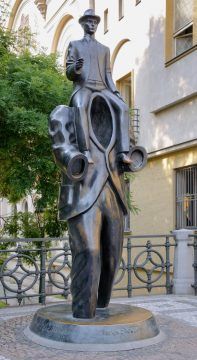

 The wine world thrives on variation. Wine grapes are notoriously sensitive to differences in climate, weather and soil. If care is taken to plant grapes in the right locations and preserve those differences, each region, each vintage, and indeed each vineyard can produce differences that wine lovers crave. If the thousands of bottles on wine shop shelves all taste the same, there is no justification for the vast number of brands and their price differentials. Yet the modern wine world is built on processes that can dampen variation and increase homogeneity. If these processes were to gain power and prominence the culture of wine would be under threat. The wine world is a battleground in which forces that promote homogeneity compete with forces that encourage variation with the aesthetics of wine as the stakes. In order to understand the nature of the threat homogeneity poses to the wine world and the reasons why thus far we’ve avoided the worst consequences of that threat we need to understand these forces. I will be telling this story from the perspective of the U.S. although the themes will resonate within wine regions throughout much of the world.
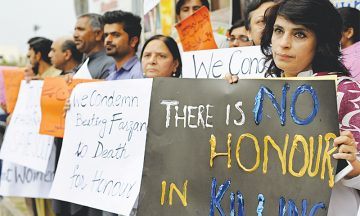 In May 2014, a young man beat his twenty-year-old sister, Farzana, to death by hitting her head with a brick. He did this in broad daylight just outside the High Court building in Lahore, the cultural, artistic and academic capital of Pakistan. He did it as local policemen and passersby looked on, lawyers in their black flowing robes went in and out of their offices and barely fifty yards away, inside the building, the bewigged and begowned Chief Justice sat with his hand on the polished gavel.




 You shouldn’t curse. People will take you less seriously. Cursing also reveals a certain laziness on your part, suggesting that you can’t be bothered to come up with more descriptive language. In the end, when you curse, you short change both yourself and your audience. Instead, take the time to use the language more fully, more carefully, and more artfully. In so doing, your message will be clearer, more forceful, and better received.