Other Selves

by Leanne Ogasawara

1.

Shortlisted for the Women’s Prize for fiction this year, Sanam Mahloudji’s The Persians is a multi-generational novel about a wealthy Persian family, told from the points-of-view of five of the family’s women.  Starting the novel, I was expecting a fun romp with a group of extremely glamorous Persian ladies. You know, Chanel suits and amazing shoes. And the novel did open with a wild night: the American branch of the family is partying on vacation in Aspen (where else?), when Aunt Shirin is arrested for prostitution, accused of soliciting an undercover cop in a bar.

A ridiculous idea that Shirin is struggling to take seriously even after she spends the night in jail. After all, she is rich beyond belief, the descendant of a great Persian war hero, if you believe all those old stories, plus the family are hereditary landowners.

This wealth being the center of everything.

The story starts with the matriarch of the story Elizabeth, who falls in love with the chauffeur’s son, not something done back in the day. And then when things get iffy with the Shah and revolution seems possible, Elizabeth’s daughters, including Shirin and family decide to take a short trip to Paris, to wait it out. Fully expecting to return to Iran, Shirin agree when Grandma Elizabeth informs Shirin that her daughter Niaz wants to stay behind in Iran with grandma. That Paris holiday turns into twenty-seven years with Shirin and family eventually settling in Houston and Niaz staying behind with her grandma in Tehran.

Because the family is separated into the bilinguals in America and the Persians who stayed behind, Shirin’s words at the start of the novel have real impact.

“We didn’t come here for a better life. We left a better life.”

It is a startling comment since at one point her daughter Niaz has been jailed by the Revolutionary Guards and has had to lead a life much more circumscribed than Shirin’s drug-fueled wildly extravagant lifestyle. But the more you read, the more you wonder about happiness. First of all, Shirin has basically been profiled and racially targeted by the white policeman in Aspen. That is what her lawyer says. But Shirin dismisses this since because she says, she doesn’t even have dark skin and also because she is convinced that the cop desired her for real and that –just like everywhere else in the world—he was a man struggling with how to contain and control a strong woman. In fact, she was just playing along with him, because she was bored and drunk.

They still have all their money and live like royalty so why does she feel she had a better life in Iran? Read more »
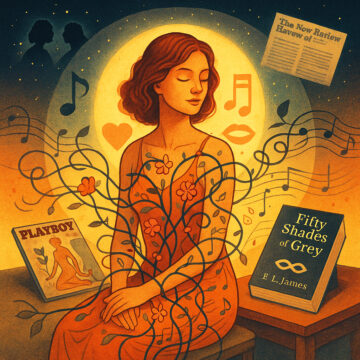

Redeeming Pleasure: Women Lead A Second Sexual Revolution

by William Benzon

Image by ChatGPT

Justly is shame very specially connected with this lust; justly, too, these members themselves, being moved and restrained not at our will, but by a certain independent autocracy, so to speak, are called “shameful.” Their condition was different before sin. For as it is written, “They were naked and were not ashamed,”—not that their nakedness was unknown to them, but because nakedness was not yet shameful, because not yet did lust move those members without the will’s consent; not yet did the flesh by its disobedience testify against the disobedience of man. – St. Augustine, Book 14, Chapter 17, City of God

I came of age during the 1960s. I saw the wind-down of the Civil Rights Movement, even as the War in Vietnam was ramping up. I marched against that war, became a conscientious objector to war, discovered “Kubla Khan,” smoked pot, joined a rock and roll band, and witnessed the so-called Sexual Revolution. I even made an ever-so small contribution to that revolution. I contributed a letter the Playboy Forum in the June 1966 issue of Playboy. For those of you who don’t know, those were the pages where readers got to discuss Hugh Heffner’s “playboy philosophy.” I wrote in defense of casual sex, of which I had had very little at the time. My friends tell me it was a good letter.

Don’t laugh.

Whatever Playboy is now, it was substantial back then, something that’s hard to appreciate if you haven’t had direct experience of those ancient days. Yes, it had pictures of naked women, tasteful nudes, no public hair – not until Penthouse and Hustler upped the ante. Did it objectify women? Sure did. But it also had substantial journalism. That same June 1966 issue had an article by Jimmy Breslin, a story by Arthur C. Clarke and an interview with Mike Nichols. The March 1963 issue had an interview with the great Bertrand Russell, logician, philosopher, Nobel Laureate in literature, and tireless peace activist. And, yes, I know, Gloria Steinem went undercover as a bunny in a Playboy Club and wrote about how women were mistreated and exploited.

It’s complex.

Women’s birth control pill became available in 1960. California passed the first no-fault divorce law in 1969 and other states followed. With its decision on Roe v. Wade, the Supreme Court legalized abortion in 1973. During the 1970s women increasingly flowed into the workforce. The net effect of these events is that women were no longer so dependent on men.

Mary McCarthy published The Group in 1963 and it became a best-seller, then was made into a movie. It was about the sex lives of “good” girls, eight recent Vassar graduates. Betty Friedan published The Feminine Mystique in the same year and went on to form the National Organization for Women (NOW) in 1966. Thus second-wave feminism was born. The civil rights and anti-war movements led younger women to form their own organizations.

Thus the sexual revolution was born. Read more »

Friday, July 18, 2025

The Border: A Comic Tale Of Terror

by David Winner

I’m the comic relief here, not much else is funny.

After the inauguration, I began to feel the siren call of the southern border: so mystified, so lied about, so central to our recent political troubles. And despite all the real horrors (the deportations and detainments) and invented horrors (undocumented people wreaking havoc), I had no sense of what going there would be like. My only experiences at the southern border happened when I was in in grad school in Tucson in the early nineties, and it is to Tucson that I have decided to return. Thirty years ago, Greyhound buses, replete with norteños and multiple stops at random-seeming street corners, would make the hour-long journey to the border. There was nothing stressful, nothing fraught about either going to Mexico or returning to the United States, but the acceleration of cartel violence and the Trump administration and its horrors may have turned everything upside down.

April 3, 2025, spring break from my college teaching job, I’m in an Airbnb in Tucson, fretting about my international journey the next day.

During the relatively benign Trump One, I found myself going through customs at Kennedy Airport with a group of Warsaw passengers. Homeland Security aggressively searched their bags for contraband kielbasa. “We didn’t bring any,” said one of them, “we can get it in Brooklyn.”

Recently, during the first several months of Trump 2.0, an Australian living in the U.S. on a work visa got detained and deported after a brief trip home to bury his mother’s ashes. A German on a tourist visa went with a friend and their dog over to Tijuana for cheaper veterinary care only to get detained on the way back, weeks in an ICE facility before finally getting deported. Even when a judge saw the legal birth certificate of an American citizen of Latino origin detained in Florida, he could not release him from ICE custody. Worst of all, obviously dystopic, are the El Salvadorans and Venezuelans (most of whom appear to have been non-gang members living legally in the United States) being kept in barbaric conditions in a concentration camp in El Salvador where Trump has threatened to send American citizens who he calls “homegrown” terrorists.  Other prisoners, some with green cards, are being kept in subhuman conditions in Alligator Alcatraz in the Everglades.

As a white citizen, I will probably be okay, but I’m sixty years old and rather a delicate flower. I wouldn’t last a minute in ICE custody. But after all the rhetoric of the election and all that has happened since Trump took office, I wanted to visit the place that compelled so many to vote for him and glimpse his “big beautiful” wall for myself. Read more »

Mentalizing, Mindfulness, and the Drive for Evidence

by Marie Snyder

In reading about attachment theory, David Wallin‘s description of Peter Fonagy’s work was intriguing, so I went down that rabbit hole. Fonagy developed Mentalization-Based Treatment (MBT) to improve emotional regulation, as distinct from Jon Kabat-Zinn’s Mindfulness-Based Stress Reduction (MBSR). Fonagy sees our mental development as relational, but in order to have empathy for others, we need awareness of our own feelings, which can be helped with mindfulness work. However, in looking at the evidence of efficacy of these separate modalities, I question the attempt, since Freud, to make psychology into a natural science. Each of the various ways to help are useful, but there’s an element of the unknowable in the way when we treat them scientifically. 

According to Wallin, Fonagy’s focus was on developing the understanding of the mental states of others, which he calls mentalizing, to let us understand the depths of ourselves and others. For instance, it can help heal old wounds if we understand that dad’s rejection of us might be due to his depression and not our behaviour as a child. Other people’s reactions to us aren’t just caused by us, but there are always multiple factors at play affecting how people behave. It seems very similar to Theory of Mind. He met Bowby in the 1980s, and studied adults’ behaviour relative to their own descriptions of childhood attachment, and found, when comparing severely deprived to well-connected adults, that a weak attachment was correlated with a weak “reflective functioning” (the ability to understand behaviours in terms of their thoughts, feelings, and mental states). From this, he says psychotherapy should be the “effort to restore or kindle patients’ capacity to mentalize,” to simultaneously feel our feelings and reflect on their meaning. To help people develop mentalizing requires a relationship that mirrors and guides emotional responses. 

His description of mirroring is specific: it must be “contingent and marked.” The reaction has to be accurate and not our own reaction to the other person’s upset, but an empathetic reaction with them. Read more »

Lessons From Singapore: Breaking Free Of The Impossible Trinity

by Eric Feigenbaum

“Peaches are $8.99 a pound!” my friend texted me yesterday.

“This is the valuable package,” a very nice man named TJ who works at Trader Joe’s but disavows any personal connection said to me as he packed my grocery bag, “It has the eggs!”  $5.49 a dozen for jumbo organic free-range eggs was the best deal around.

Despite the recent eight percent drop in oil prices, a gallon of gas in my area still costs almost $5.00 per gallon.

Inflation is not only real, but has been one of the defining issues of our decade. The Consumer Price Index for my region of the country (Western United States) was increasing by as much as 8.3 percent in May of 2022 and still hovers at monthly increases on roughly 2.8 percent. Food costs are still increasing at 5.1 percent per month and most forms of housing in excess of 3.1 percent. Americans have not just faced inflation, but have been hit hardest where it hurts – on necessities and everyday staples.

To their credit, the Board of Governors of the Federal Reserve have given inflation their full attention and have been working hard to curb it with their main and most accessible tool being interest rates. Raising the cost of capital and borrowing slows the flow of dollars in the economy causing people to spend less. In turn, the cost of goods can slow if not drop because of decreased demand. Raising interest rates is a way to hit the brakes on an overheated economy.

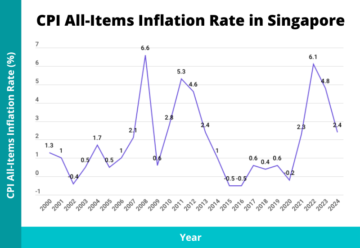
Singapore deals with inflation differently. In fact, it does so in a way completely unique in the world – by focusing first and foremost on consumer prices. Quite simply, the Monetary Authority of Singapore – their version of a central bank – uses consumer affordability as its Northstar.

But how? That’s kind of a crazy thing for a central bank to do. The Fed certainly doesn’t have the kind of power. How does the MAS (which cleverly means Gold in Malay)?

Singapore tries to break what in international economics is often called The Impossible Trinity or The Trillemma.

Read more »

Thursday, July 17, 2025

Oh, Happy Future!

by Rafaël Newman

On a sunny Saturday towards the end of last month we took a train to Moutier in the west of Switzerland, half an hour from the French border, to attend an opera in a shooting range. We had tickets to hear my friend Annina Haug sing the role of Fenena in Giuseppe Verdi’s Nabucco at Stand’été, an annual festival of the arts held in the local stand de tir, now decommissioned, a pleasantly eerie, Charles-Addams-like structure on a hill above the municipality. We were also keen to visit the little town itself, which had recently voted to secede from the canton of Bern and join the neighboring canton of Jura as an exclave.

The opening day of the Stand’été’s 2025 edition fell on June 21, the date of this year’s Summer Solstice—the longest day of the year, and a clement midsummer—; but the festival organizers, not taking any chances, had erected marquee tents over the picnic tables set up in the forecourt of the performance venue. And when it suddenly began to hail out of a clear blue sky as we munched fish and frites before the opera began, I was inclined to respect the locals’ perspicacity. We finished our dinner and hurried inside, to take our seats for a marvelous production by the Compagnie Opéra Obliqua, under the direction of Facundo Agudin.

Midsummer in the Swiss Jura

Verdi’s first great success, Nabucco is based on a combination of Biblical accounts. The libretto, by Temistocle Solera, pits Jerusalem against Babylon, Jehovah against Baal, Hebrew against Assyrian. The plot is convoluted: King Nabucco (short for Nabucodonosor, the Italian form of the name of the historical Nebuchadnezzar) is besieging the Jewish capital, where the Hebrews are holding his daughter Fenena hostage. When Nabucco enters the city and its inhabitants attempt to use their pawn to keep him at bay, the princess is instead released by the traitorous Ismaele, a Hebrew soldier with whom she has been having an affair. Read more »

Wednesday, July 16, 2025

GRA-A-A-AVY, Man

by Mark R. DeLong

Two women in black dresses lean toward each other as they show off three plates of biscuits and gravy. The plates are white and the gravy on the biscuits is white. The women are musician Megan Harris Brunious and singer Ingrid Lucia who are pictured at Buffa's Bar & Restaurant in New Orleans, Louisiana.
Infrogmation of New Orleans. Buffa’s Bar & Restaurant, New Orleans. Musician Megan Harris Brunious and Singer Ingrid Lucia Enjoy Some Biscuits & Gravy. May 16, 2016. Digital photograph. Rights: CC-BY 2.0 Generic.

“You may be an undigested bit of beef, a blot of mustard, a crumb of cheese, a fragment of underdone potato. There’s more of gravy than of grave about you, whatever you are!” The line from Charles Dickens’ A Christmas Carol came to mind as I scrolled through my Mastodon account. There was #gravy everywhere, with social media-rendered ladles holding warm, sometimes gelatinous wit, too. Initially, I thought it was a mere annoyance. You know, even self-righteous, open-sourced, “fediverse” digital citizens can junk up social media. The #gravy was a hashtag, which is a simple means of labeling a message so that it can be grouped easily.

Using the hashtag, you can get more #gravy (https://mastodon.world/tags/gravy) than you’ll ever need.

Eventually, it became more obvious to me that Mastodon’s #gravy oozed a strategy—the odd “toots” (once called “tweets”on a now defunct social media platform in an earlier and happier time) were merely lip-smacking morsels to deceive the palates of bot barbarians. At least that was my second thought. As it happened, that was ChatGPT’s second thought as well.1The first was that Canadians were celebrating poutine, a concoction of fries, cheese curds, and gravy that the chatbot called “a beloved Canadian comfort food.” Ol’ Chat enumerated its results. At number two: “Others believe #gravy is being used as a viral prank to clutter AI training datasets. The theory: if bots or AI systems scrape common hashtags, flooding one with nonsense posts could ‘pollute’ or mislead the data.” Here, I thought, the LLM “tone” was slightly skeptical, since it labeled its explanation “the theory.” It’s unlikely that AI companies were gravely worried about it; their bots “knew” about the stratagem, after all. Read more »

Footnotes

  • 1
    The first was that Canadians were celebrating poutine, a concoction of fries, cheese curds, and gravy that the chatbot called “a beloved Canadian comfort food.”

Abnegation of Powers – Part 1

by Charles Siegel

Americans learn about “checks and balances” from a young age. (Or at least they do to whatever extent civics is taught anymore.) We’re told that this doctrine is a corollary to the bedrock theory of “separation of powers.” Only through the former can the latter be preserved.  As John Adams put it in a letter to Richard Henry Lee of Virginia, later a delegate to the First Continental Congress, in 1775: “It is by balancing each of these powers against the other two, that the efforts in human nature toward tyranny can alone be checked and restrained, and any degree of freedom preserved in the constitution.” As Trump’s efforts toward tyranny move ahead with ever-greater speed, those checks and balances feel very creaky these days.

Why do we care?  What “balance” is to be preserved? “Separation of powers” is a defining concept of our government. But the phrase itself does not appear in the Constitution. What does it mean?

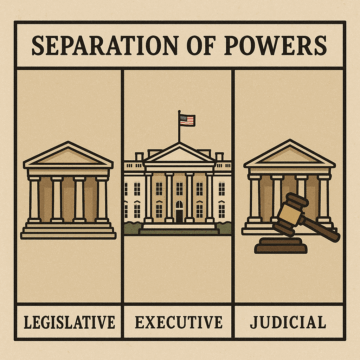
There is no official answer, of course. But Congress has provided a definition: at its direction, every ten years the Library of Congress publishes the “Constitution Annotated,” a “comprehensive, government-sanctioned record of the interpretations of the Constitution” that appears on Congress’ website. According to the Librarian of Congress, then, “separation of powers” is a “well-known concept derived from the text and structure of the Constitution. The Framers’ experience with the British monarchy informed their belief that concentrating distinct governmental powers in a single entity would subject the nation’s people to arbitrary and oppressive government action. Thus, in order to preserve individual liberty, the Framers sought to ensure that a separate and independent branch of the Federal Government would exercise each of government’s three basic functions: legislative, executive and judicial.” The Constitution sets those powers out in Articles I, II and III respectively. Read more »

Tuesday, July 15, 2025

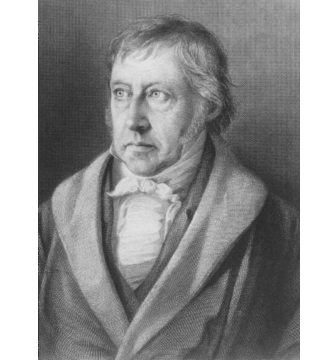
Self-Consciousness As A Team Sport: From Hegel To Predictive Neuroscience

by Herbert Harris

When we say, “I’m feeling self-conscious,” we usually mean we are uncomfortably aware of being the center of other people’s attention. We might worry about how we look, what we wear, or how we act. While we are, to some degree, concerned with aspects of ourselves, our main focus is on others and what they think about us. “Self-conscious” is an interesting choice of words that might reveal something deep about the nature of self and consciousness.

Two hundred years ago, the German philosopher G.W.F. Hegel introduced a groundbreaking idea: self-consciousness does not arise from introspection, but from mutual recognition. We become aware of ourselves as individuals not by looking inward, but by encountering another mind that perceives us as conscious, and by recognizing that mind in return. Hegel argued that this process of reciprocal recognition is the foundation of personhood. It is only through others that we truly understand ourselves. Hegel linked this movement from recognition to a broader concept of freedom. For him, freedom was not just the lack of constraints, but the achievement of autonomy through mutual recognition. According to Hegel, we become free not by turning inward, but by engaging in relationships that acknowledge and affirm our self-consciousness.

This insight has resonated across philosophy, psychology, and social theory. George Herbert Mead viewed the self as emerging from social roles and symbolic interaction. He emphasized how the self develops by internalizing others’ perspectives, especially through language and shared symbols, which create a ‘generalized other’ that shapes individual identity. Sartre described self-consciousness as an unavoidable confrontation with the gaze of the other. His concept of the ‘gaze’ illustrates how we feel exposed under someone else’s scrutiny and how their judgment influences our self-awareness. Frantz Fanon later developed these ideas, showing how the Black subject becomes aware of themselves through the racialized gaze of a white other, illustrating how power dynamics and social identity impact self-consciousness. Each of these thinkers extended Hegel’s idea of the self as socially constructed and relational rather than autonomous or private.

Although Hegel’s ideas have been highly influential, they would seem to have limited applicability to neuroscience-based explanations of consciousness. The primary explanatory frameworks in neuroscience are bottom-up, beginning with molecules and ending with complex neural network systems. But the Hegelian outside-in, top-down perspective might provide insights that both complement and inform neuroscience. Read more »

Reddit at 20: A Look Beyond the Upvotes

by Daniel Gauss

I waited until after Reddit’s 20th anniversary to post this article, hoping others might offer critical reflections on what the platform has become. Much of the “Reddit at 20” coverage, however, was somewhat fawning, as if many writers had received and worked from the same PR press kit.

In the interest of diversity of opinion and free, civil discourse, I’d like to offer a more critical assessment of a platform whose business model often amplifies impulsive reactions and group identity bias, rather than fostering the values that enable free expression or meaningful community engagement.

There are a number of criticisms of Reddit online already, yet I would like to focus more on the platform’s broader social consequences. I do not want to be contrarian or snide, but I want to trace how certain design choices and norms may be quietly cultivating values that undermine genuine discourse, empathy and moral engagement. I believe Reddit’s influence, however unintended, deserves a closer, more candid examination.

So, I’d like to contribute toward a more balanced view of this popular website and aspects of its design that hinder the kind of communication a democratic society depends on. It might seem overstated to suggest that Reddit carries democratic weight, but when millions rely on it to share news and opinions, and engage in civic discourse, it functions less like a website and more like a public square. Read more »

Perceptions

Gozo Yoshimasu. Fire Embroidery, 2017.
“Gozo Yoshimasu’s double-sided work on paper Fire Embroidery explores his response to the March 2011 Tohoku earthquake and tsunami. He embarked on the project out of a deep sense of sympathy and commitment, in pursuit of “poetry possible after March 2011”, without exactly knowing where he was heading. He started scribing lines and letters on exceptionally large manuscript paper that he handcrafted every day. The new routine resembled the way that Buddhist monks copy sutras; Yoshimasu prepared the materials, his groundwork, and ran a pen across them day after day, “as though tattooing” on his mind.

The series as a whole includes manuscripts on which are extensive enumerations of letters and words repeatedly dismantled and rearranged in response to the voices and shadows of the deceased, recovered by painted color layers. This series appropriates tragedy through the act of interfering with and destroying the process of language production, while creating existential dreamscapes offering new flux or a peculiar prayer.”

More here, here, and here.

Enjoying the content on 3QD? Help keep us going by donating now.

Monday, July 14, 2025

Presidential Appetites

by Michael Liss

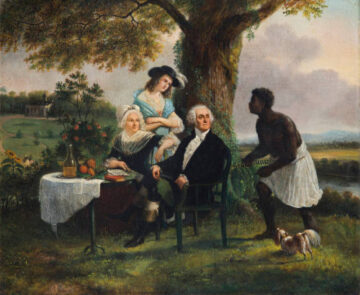
Palmy Days at Mount Vernon, by Thomas Prichard Rossiter, 1866. emuseum.mountvernon.org

George Washington and his wife Martha were committed eaters and generous hosts. A meal was a serious affair: fine China, glassware and cutlery, a variety of spirits, wines, and champagne, soups and souffles, trifles, crisps, tortes, any number of things pulled or plucked from the soil or vines, harvested from the bays and rivers, or trapped, shot, or simply domesticated and destined for the table.

The couple preferred English-style cooking and apparently were fond of meat pies. For a Christmas meal one year, their kitchen turned out a family favorite—a cover-the-bases delicacy that called for a bushel of flour for crust, stuffed with five different types of boiled fowl—pigeon, partridge, duck, goose, turkey—all baked on high heat for four hours. I’m not sure what that might be called—perhaps “pipparduckoosekey”?

Of course, none of these monumental affairs began with George and Martha doing any of that pulling, plucking, sowing, reaping, boiling, or broiling. Nor setting the table, clearing it afterwards, washing up, polishing the silver, drying the China, or putting it away. The Washingtons had “staff” for that, quite a large staff, in fact.

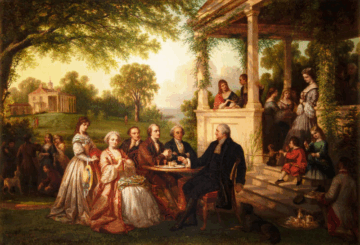
The Washington Family at Mount Vernon, by Christiaan Julius Lodewijk Portman, 1857. emuseum.mountvernon.org

George and Martha kept slaves—per the Mount Vernon website, at the time of George’s death, there were 317 on the plantation. There is nothing to indicate Washington was a particularly difficult master, and Mount Vernon was in temperate Virginia, not some swampy, snake-and-insect-ridden killing field in South Carolina, but the “Peculiar Institution” was certainly vibrant enough there. As one might expect, the staff didn’t enjoy quite the same creature comforts as the Washingtons did. Again, from the website:

The standard slave quarter on Mount Vernon’s five farms was a rough one-room log structure with a wooden chimney, measuring about 225 square feet. Some dwellings were slightly larger and divided into two rooms, each housing a different family. As many as eight people could be crowded into a single room. They slept on pallets or on the dirt floor.

History is complex and contradictory, isn’t it? Certainly, one that demands you put inconvenient parts aside so as to appreciate the more celebratory. Still, this is George Washington, so let’s talk about the Father of Our Country’s personal qualities. No doubt he was uncommonly brave, an oak for the thin reed of independence to lash onto. He was incorruptible, rigidly self-disciplined, and, as Parson Weems reminds us, even as a boy, honest in trees and axes. Read more »

A Quantum Correspondence

by David Kordahl

Peter Morgan has worked for decades to appreciate the underlying structures of physics. But can he convince others he is right?

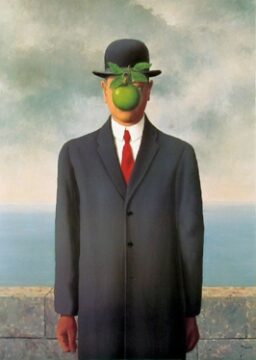
Magritte, Le fils de l’homme (1964).

When I receive unsolicited scientific communication, I bin writers into two crude categories: Possible Collaborators, and Probable Crackpots. Of course, these categories may overlap. Ted Kaczynski, after all, taught at Berkeley before he made those bombs.

When I first received a message from Peter Morgan, I wasn’t sure where to slot him. The fact that he was listed as a lab associate for the Yale University Physics Department pushed the needle of my prior judgment toward Collaborator. But the fact that he was cultivating journalists to promote his ideas about quantum theory…well, that swung my needle far the other way.

Morgan first contacted me on X.com (the website formerly known as Twitter) on December 9, 2024. I had posted the review of Escape From Shadow Physics: The Quest to End the Dark Ages of Quantum Theory that I had written for 3 Quarks Daily, and he posted a short comment in response. Seeing Morgan’s frequent physics posts, I followed him. Minutes later, he pitched me a column idea.

Morgan suggested that I write about his ideas:

I hope that if there are any of the ideas that deserve to go viral, they will do so sooner rather than later, then I can admire what better mathematicians and physicists than I am can do with whatever survives the winnowing. There are quite a few people who react positively to how different this is (for one thing it’s not a ToE, and the data and signal analysis aspect is met almost joyfully by some people), but I’m so far out in left field that nobody quite believes that I’m not making some obvious mistake. It’s always embarrassing to be the person who champions nonsense, right?

Right. I went to Morgan’s profile and watched one of the talks on his YouTube channel. After realizing I had no immediate way of assessing whether there was any there there, I sent him a polite but noncommittal reply, and placed a mental bookmark, thinking I might contact him again once I had time to spare. Read more »

Sunday, July 13, 2025

The Book of Theseus

by Kyle Munkittrick

A Song of Onyx (Storm) and AI

Distant dragons circle a mountain fortress in a Bierstadt landscape
Rocky Mountain Landscape by Albert Bierstadt with Empyrean dragons and fortress by ChatGPT

Ted Gioia recently highlighted that when it comes to media, abundance is the name of the game. He cited Rebecca Yarros’s Onyx Storm, a 544 page romantasy novel that is also the fastest selling book in twenty years, as an example. While Gioia sees Yarros’s latest entry in her Empyrean series as indicative of where art is heading in terms of scale, I see something else.

I see Onyx Storm as the first opportunity for AI and literature that might actually work. And this is because, for all of its enormous popularity, Onyx Storm is terrible.

My suspicion is Gioia may have hesitated to cite Onyx Storm had he, you know, read it. Reading Onyx Storm is, in terms of content, equivalent to a binge watch session of Love Island. Despite being technically ‘long-form’ content, one would hardly argue that binging reality TV is the stunning rebuke to TikTok culture he thinks it is. It’s a book comprised entirely of manufactured cliffhangers, sexual tension, and dragon-based drama, not deep thought.

While reading Onyx Storm, I found myself experiencing the anhedonia Gioia mentions—I just couldn’t bring myself to pay attention. I didn’t care. Those who read it and do care are not reading it as literature. They’re reading it as entertainment and to be titillated. That’s ok! But let’s not pretend it’s the same as the semi-virality of Middlemarch among the Silicon Valley cognoscenti and those in their milieu.

But Onyx Storm could have and should have been good. I know this because I’ve read the entire Empyrean series, including the banger of an initial entry, Fourth Wing. Read more »

The Contradiction at the Heart of All Conflict

by Daniel Shotkin

Conflict follows us everywhere. Terrible drivers, horrible friends, evil politicians—the list goes on and on. For me, most conflicts never really made much sense. I avoid clashing with people as much as possible. It feels self-righteous, almost cringey, to be in a state of dispute. Ironic, because my favorite club in high school was debate. Still, I know people who, far from avoiding conflict, thrive in argument. So why do we conflict?

On a basic level, almost every human can agree on a core set of moral principles. Thou shalt not kill, thou shalt not steal, do unto others as you would have them do unto you. These are fundamental truths present in every culture. The three Abrahamic faiths, Hinduism, and Confucianism all espouse that last point independently. Even cultural practices that are, to us, morally questionable (think human sacrifice, headhunting) can’t be chalked up to evil intentions. Can you really blame the Aztecs for wanting to appease Quetzalcoatl?

At the end of the day, you’d be hard-pressed to find anyone who acts without explicit good intentions. Look at a morally deplorable historical figure, and you’ll see that even they acted with “good” in mind. Regimes don’t declare war, restrict speech, or commit genocide for evil’s sake; they do so in the name of national security. Similarly, ask any two beefing high schoolers, and you’ll see that neither did anything, and even if they did, it wasn’t on purpose—and actually, it was the other one who wanted to start shit.

So, logically, we’re in agreement. Then why do we still conflict? Read more »

On Pleasure, Food, and the Moral Meaning of Flavor

by Dwight Furrow

In a culture oscillating between dietary asceticism and culinary spectacle—fasts followed by feasts, detox regimens bracketed by indulgent food porn—it is easy to miss the sensuous meaningfulness of ordinary, everyday eating. We are entranced by extremes in part because they distract us from the steady, ordinary pleasures that thread through our daily lives. This cultural fixation on either controlling or glamorizing food obscures its deeper role: food is not just fuel or fantasy, but a medium through which we experience the world, anchor our identities, and rehearse our values. The act of eating, so often reduced to a health metric or a social performance, is in fact saturated with philosophical significance. It binds pleasure to perception, flavor to feeling, and the mundane to the meaningful.

American culture harbors a long-standing discomfort with pleasure born of its Puritanical roots and sustained by the contradictions of consumer capitalism. Even as we chase pleasure through consumption, we cloak it in guilt or dismiss it as indulgence. This ambivalence has moral, psychological, and spiritual dimensions. The dominant message is clear: enjoy, but not too much; indulge, but repent.

But this suspicion of pleasure misunderstands its role in life. Pleasure is not a passive sensation, an add-on to more “serious” pursuits. Rather, pleasure is a mode of attention, a reinforcement mechanism fundamental to cognition, agency, and sustained activity. The human brain is wired to experience pleasure from a bewildering range of sources and for good reason: Pleasure is a fundamental motivation. We are much more likely to engage in beneficial behaviors if we enjoy them. (Or course the same is true of harmful behaviors but the point about pleasure as motivation still stands.)

Indeed, pleasure motivates and sustains the very activities that give life meaning. When we speak of “flow,” of deep absorption in physical, creative or intellectual tasks, we are describing a form of pleasure inseparable from the activity itself. The distinction between pleasure and happiness matters here. Happiness is a long-term orientation toward life, a disposition of coherence and fulfillment. Pleasure, by contrast, is episodic, but no less essential. A life bereft of pleasure may be, under some circumstances, productive and ethical as well, but it is likely to be empty. Thus, we ought not treat pleasure as a luxury. It is part of the infrastructure of a life well-lived. Read more »

Friday, July 11, 2025

Can Free Speech and the Federal Trade Commission Get Along?

by Ken MacVey

Since 1914, the Federal Trade Commission ‘s mission has been to enforce civil antitrust and unfair competition/consumer protection laws. The question is whether this mission has been supplanted—whether the FTC under Trump 2 .0 is becoming the Federal Political Truth Commission.

My Background: The FTC Investigates the Movie and Record Industries

Many years ago I started my legal career as a lawyer for the FTC. In that role, I proposed investigations into the motion picture and record industries which were opened by the FTC.

The  publicly announced FTC investigation of the movie industry focused on possible collusion in the US  between a handful of major motion picture companies that dominated the motion picture markets in the US  and abroad. Not too long afterwards I recommended and got approval to investigate a  proposed merger between two of the top six record companies in the US that would have resulted in the largest record company in the world.

While the motion picture investigation did not result in litigation, the record merger investigation did lead to litigation by a small team of  FTC lawyers (including myself) that blocked the merger.

Antitrust and the Value of  Media Diversity

In pursuing these investigations, I discussed traditional antitrust concerns about reduced competition and collusion. But I also pointed out that the products were unique—they just weren’t commodities like cement or steel.  These were products of expression and culture. Antitrust focuses on how consumer choice is reduced by anticompetitive conduct. Here we did not face just a reduction in choice regarding widgets, but in ideas and expression.

But there never was any discussion on content—never was it suggested that certain kinds of movies or records were better than others, that some should be promoted, others not. Never were ideological slants or views considered or discussed. The point was always about protecting or expanding the range of consumer choice.

This idea of the antitrust value of diversity in media was not new. In fact, the Supreme Court in 1943 underscored the value of diversity and quantity in radio broadcasting when it held that the Federal Communications Commission could consider antitrust  concerns in regulating radio broadcasting networks. Then NBC owned two radio networks, one called the “red network” and the other the “blue network.”  Per the Supreme Court decision, the FCC  ordered the divestiture of the blue network. This network became ABC, the American Broadcasting  Company. Although the Supreme Court endorsed consideration of antitrust values to widen the scope of  what was available to listeners, it drew the line on government going after the content of expression. Read more »

Pocket And The Archaeology Of Self

by Brooks Riley

RIP Pocket (aka Read It Later) 2007-July 8, 2025

The recent announcement of Mozilla’s shutdown of the Pocket app caught me by surprise. It felt as if the rug was being pulled out from under me—the rug being a motley weave of all the online articles and stories I’ve ever wanted to read later but never did. What would happen to all those pieces saved on impulse for a rainy day?

For those who don’t use it or even know of it, Pocket was a bookmarking service for links you wanted to save and come back to at a later time. Pocket saved it all for you with an easy click, in a pleasant layout and a user-friendly reading format that didn’t require returning to the original site.

Before Pocket, I bookmarked everything on the browser, hoarding unwieldy lists of links that turned the browser into a digital dumpster. Pocket came along to eliminate the constant need to manage browser bookmarks.

Using Pocket, I amassed thousands of saves, going back years—a bottomless bucket of ‘wanna reads’, most of which have remained wanna reads. Early on, I noticed that I rarely opened a Pocket save unless it had to do with whatever subject I was researching at that moment—leaving all the rest unread. Why? I always found an excuse to postpone a visit to my candy store of saves, and fought an eerie sense of guilt by always promising myself to take the time to do so—someday. The truth is, I was no longer interested in many of those stories. Some were too dated. Others simply lost their appeal.

Now, the thought of losing them feels like losing a part of oneself that had once existed. Read more »