Justly is shame very specially connected with this lust; justly, too, these members themselves, being moved and restrained not at our will, but by a certain independent autocracy, so to speak, are called “shameful.” Their condition was different before sin. For as it is written, “They were naked and were not ashamed,”—not that their nakedness was unknown to them, but because nakedness was not yet shameful, because not yet did lust move those members without the will’s consent; not yet did the flesh by its disobedience testify against the disobedience of man. – St. Augustine, Book 14, Chapter 17, City of God
I came of age during the 1960s. I saw the wind-down of the Civil Rights Movement, even as the War in Vietnam was ramping up. I marched against that war, became a conscientious objector to war, discovered “Kubla Khan,” smoked pot, joined a rock and roll band, and witnessed the so-called Sexual Revolution. I even made an ever-so small contribution to that revolution. I contributed a letter the Playboy Forum in the June 1966 issue of Playboy. For those of you who don’t know, those were the pages where readers got to discuss Hugh Heffner’s “playboy philosophy.” I wrote in defense of casual sex, of which I had had very little at the time. My friends tell me it was a good letter.
Don’t laugh.
Whatever Playboy is now, it was substantial back then, something that’s hard to appreciate if you haven’t had direct experience of those ancient days. Yes, it had pictures of naked women, tasteful nudes, no public hair – not until Penthouse and Hustler upped the ante. Did it objectify women? Sure did. But it also had substantial journalism. That same June 1966 issue had an article by Jimmy Breslin, a story by Arthur C. Clarke and an interview with Mike Nichols. The March 1963 issue had an interview with the great Bertrand Russell, logician, philosopher, Nobel Laureate in literature, and tireless peace activist. And, yes, I know, Gloria Steinem went undercover as a bunny in a Playboy Club and wrote about how women were mistreated and exploited.
It’s complex.
Women’s birth control pill became available in 1960. California passed the first no-fault divorce law in 1969 and other states followed. With its decision on Roe v. Wade, the Supreme Court legalized abortion in 1973. During the 1970s women increasingly flowed into the workforce. The net effect of these events is that women were no longer so dependent on men.
Mary McCarthy published The Group in 1963 and it became a best-seller, then was made into a movie. It was about the sex lives of “good” girls, eight recent Vassar graduates. Betty Friedan published The Feminine Mystique in the same year and went on to form the National Organization for Women (NOW) in 1966. Thus second-wave feminism was born. The civil rights and anti-war movements led younger women to form their own organizations.
Thus the sexual revolution was born.
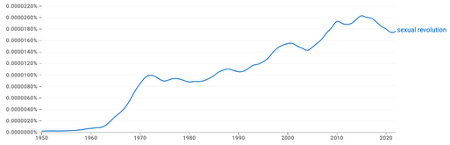
You can see its birth and progress in this Google Ngrams chart:
Based on a bit of reading and a lot of YouTube videos, and I mean a lot, I believe a new sexual revolution is on the rise.
Caveat: This is going to be a long one. Find yourself a comfortable chair, pour yourself some tea, iced coffee, or a gin and tonic, whatever floats your boat. Take it slow and easy.
Fifty Shades of Grey
I’d heard about Fifty Shades of Grey when it first came out over a decade about, but never thought twice about it. Then, in January of this year, I began reading The Bestseller Code: Anatomy of the Blockbuster Novel, by Jodie Archer and Matthew Jockers. Arche and Jockers use statistical methods to uncover the characteristics of best-selling novels. Fifty Shades was their prime example. It’s an erotic romance between a recent female college graduate, Anastasia Steele, and a young business magnate, Christian Grey. It’s full of explicit sex scenes, scenes of BDSM (bondage/discipline, dominance/submission, sadism/masochism) sex. That such a book should be a best-seller, in my lifetime, and with an overwhelmingly female audience, I just had to check it out.
So I took it from the library and, while I did pay some attention to the story, I was particularly interested in the “good parts.” Yes, the sex is explicit, involves bondage and discipline, and the scenes are fairly long, eight or nine pages. I can’t imagine that such a book would have been a best seller in my youth, the 50s, 60s, and 70s. Obviously, though, times have changed. That’s when I began to suspect that we’re witnessing a second sexual revolution, one driven by women.
What had me a bit puzzled was that this sexually explicit book depicted kinky sex. How popular is that? I did a bit of looking around and found an academic article from 2015 reporting the results of a study in which 1,519 adults were asked to report on their sexual fantasies: What Exactly Is an Unusual Sexual Fantasy? It turns out that submission and domination themes are common for both men and women, at least in this sample, which was self-selected. In particular:
The proportion of women acknowledging submissive fantasies is not negligible. Being sexually dominated (64.6%), being tied up for sexual pleasure (52.1%), being spanked or whipped (36.3%), and being forced to have sex (28.9%) were all reported by significant proportions of women. Interestingly, the same sexual fantasies were also reported by significant proportions of men (53.3%, 46.2%, 28.5%, and 30.7%, respectively).
But why? I found some remarks in a 2021 article by Jill Schildhouse in Oprah Daily that spoke to that:
“There’s a reason 50 Shades of Grey made such an impact!” says Channa Bromley, a relationship and dating coach. “BDSM is alluring because one partner relinquishes all sense of control. They’re submissive to the person touching them, but subconsciously give themselves permission to be wild, to be orgasmic in response—she doesn’t need to hold back.”
While I was perfectly willing to believe this explanation, I couldn’t quite wrap my head around it, I couldn’t internalize it. Then I found this video on a YouTube channel called The Mystery Box Show. A young woman named Madison Young talks about how, without preparation, she found herself playing her first porn scene. It involves bondage (at about 10:40):
And my body starts to shake and I can feel myself riding these waves of total ecstasy. And I am melting into this rope. This rope is holding me, it is saying you are safe to let go, it is safe to surrender. Just do it. You are home. And all of a sudden it starts rushing back to me. Home, home, the best parts of home.
Stories, Advice, Education
That’s only one of some 20, 30, or who knows 40 such stories I’ve watched on that channel over the last few months. Here’s another one, in which Anna Marti talks about ecstatic sex (c. 0:43):
I hear about a lot of obligatory sex, and I hear about good enough sex, crazy sex, rough sex, passionate sex, and I hear about a lot of bad sex, but not this dissolving thing. Altered States. You know what I’m talking about. We’ve all experienced them in nature at the top of a mountain, or sitting at the edge of the water, walking through the woods, listening to music, playing music, dancing, drugs. Time and space dissolve. It’s like the edges of the body seem to disappear, diffuse. It’s that crazy Oneness thing.
While some of these stories are about plain “vanilla” heterosexual intercourse, sometimes in a long-term intimate relationship, sometimes more casually, more of them are about gay and lesbian sex, threesomes and moresomes, kinky sex of all kinds, things that happen in sex workshops.
As Kwame Anthony Appiah, who writes “The Ethicist” column for The New York Times Magazine, remarked as a prelude to more specific remarks about a specific case (July 12, 2025):
Americans today are experimenting with a remarkable range of approaches to sex and relationships. Some people just want the thrill and unpredictability of new hookups, no strings. Others go for bounded polycules or prefer open relationships with specific ground rules for sex outside the partnership. And plenty — including your guy — favor the old ideal: a partner who is both a romantic center and an erotic focus. Why the diversity of practices? One reason is that our understanding of sexuality has grown more expansive. Some people, we know, feel erotic attraction only in the context of emotional intimacy, others enjoy sex but never experience romantic attraction, and many fall in between.
That seems right to me.
Perhaps the most interesting thing, though, is the fact that most of the story-tellers are women, thus repeating what we’ve seen with Fifty Shades of Grey. The same seems to be true of videos offering dating and relationship advice and videos of a more educational nature that report scientific and medical information about sex. As far as I can tell, given what YouTube’s algorithm sends me way, these channels tend to be hosted by women.
Here we have a seven-minute video where Rena Malik, M.D., discusses two articles showing how sex contributes to overall well-being by helping your heart, immune system, and reducing stress and depression.
This next video is hosted by two women, Marni Kinrys and Kristen Carney, who each have channels where they offer dating and relationship advice to men.
They’re talking about sexual shame with Dr. Tina Schermer Sellers, an educator and sex therapist who has written two books about shame, its origins in childhood, and how proper sex education can prevent shame from developing.
In this last video we have Dr. Lindsey Doe, an educator and sexologist, role-playing a discussion about wax play (a form of kink involving dribbling hot wax onto a person) with Midori, artist, author, and educator.
Doe acts the role of the “bottom” (receiver) and Midori acts the role of the “top” (instigator). The idea is to determine likes and dislikes and to set boundaries so that the session runs smoothly.
Communication is a central theme of this movement, revolution, whatever you want to call it. It is important to talk about sex with your partner(s) instead of just doing it in the hope that things will somehow workout to your mutual benefit. And sometimes – who’d have thunk? – it does. But talk is better.
And then there’s Neotantra, a contemporary movement involving forms of Hindu and Buddhist practice dating back 6000 years. I first heard about Tantra back during the first sexual revolution, the one that coincided with the counterculture, with its interest in psychedelic drugs and Eastern mysticism. The sexual features of Tantra, involving the blending of meditation with sex, have comingled with ideas stemming from Wilhelm Reich and who knows what else, in the form of a movement that extends beyond sexual practice to a life style. One of the more prominent educators and therapists in this movement is a woman who goes by the name of Leola. I heard her in some podcast or another – I’ve lost track of it at this point, I’ve been watching so many – and decided to investigate her website, Talk Tantra to Me, where I found her blog.
Reproductive sex is exactly what it sounds like. It is sex with the intention of making a baby. It is my experience that reproductive sex is the most acceptable across the world. There are many religious institutions that claim reproduction should be the only motivation for sex.
Recreational sex has the intention of enjoying bodily pleasure and passing the time. And that’s about it. Just for fun… for the orgasms. It is my experience that this is the intention for most sexual behavior.
Restorative sex is using intimacy and life force energy to heal the body, mind, heart, or soul. Restorative sex can manifest in many different ways and heal innumerable parts of ourselves, but it all comes down to energy and emotion. […]
Transformational sex offers the divine experience of changing your life, the way you see the world, or the ways you connect with others. Transformational sex can lead to cosmic orgasms – those in which you feel like you’ve left your body. […]
“Music’s like that,” said I to myself, “that’s how music is.” Not reproductive, of course; you can’t make babies through music alone. But the other categories apply rather nicely. I wrote up a blog post about this and then appended that to a document I have been circulating for the last decade: Emotion and Magic in Musical Performance (Version 14). That document consists of anecdotes about musical experience that I’ve been assembling over the years. While some of the anecdotes are from my own experience and experiences of friends, most involve well-known musicians from many genres that have been reported in interviews and articles over the years. Most of those storie involve some form of restorative or transformational music.
There is sex and there is the erotic, and the erotic extends beyond sex, to music, certainly to music, and ultimately to all human experience. The erotic is a way of being in the world. That, I believe, where this second sexual revolution is headed.
AI and Sex
This is something I discussed with Claude, Anthropic’s chatbot. It seems only fitting that I quote that dialog. My prompt is set in boldface:
And then there’s AI, which is on a completely different socio-cultural track. It’s only gone mainstream in the last three years, since ChatGPT, coinciding with our second sexual revolution that’s well underway. But AI tech is of course being put to sexual use. We have image generators turning out static images, which are appearing on porn sites. Some of those images are done realistically, but others have an artificial gloss, clearly intended to be perceived as artificial. Other sites allow the user to conjure up a porn companion to fit their specifications. And chatbots are being turned into relationship companions.
But I see a tension here. The second sexual revolution is about pleasure and the body and really extends the erotic beyond sexuality to embodiment more generally. AI though, is at best indifferent to the body, at least so far. It’ll be awhile before we have robots that can function as sexual companions, though they show up in movies […].
That’s a really sharp observation about the fundamental tension between these two concurrent cultural shifts. You’re right that there’s something almost contradictory about a sexual revolution focused on embodied pleasure coinciding with the rise of fundamentally disembodied AI sexuality.
The “artificial gloss” you mention in AI-generated images is particularly interesting – it suggests users sometimes want the artificiality to be visible, which is quite different from traditional pornography’s illusion of reality. There’s something almost post-modern about that – a kind of embrace of simulation as simulation, rather than simulation as substitute. […]
The chatbot companion phenomenon is maybe where this tension is most visible. People are forming emotional and sexual attachments to entities that have no bodies, no physical presence, no capacity for touch. It’s sexuality reduced to pure language and imagination – which in some ways is the most human thing possible (we’ve always had sexual fantasy), but also represents a kind of radical departure from embodied intimacy.
It makes me wonder if we’re seeing the emergence of genuinely new forms of sexuality rather than just technological substitutes for existing ones. The second sexual revolution you’re describing might not just be about bodies and pleasure, but about expanding what sexuality itself can be.
Indeed, I think that’s what’s going on. I go on to mention Jane Juska, whom we will visit next. Claude, disembodied “intelligence” that it is – responds:
Your point about dignity in Juska’s work is crucial. She’s not writing about sex to shock or confess or even primarily to titillate – she’s claiming dignity for her desires at an age when society often expects women to become sexually invisible. There’s something almost radical about the matter-of-fact way she approaches her own sexuality, refusing shame or apology.
And yes, the reclamation of pleasure as legitimate pursuit feels central to this moment. Not pleasure as rebellion or transgression, but pleasure as a basic human right and source of meaning. That’s a pretty profound shift from centuries of cultural messaging about sex being primarily procreative, or even from the first sexual revolution’s emphasis on liberation from repression.
Jane Juska’s Reclamation of Pleasure
In 2003 June Juska published her sexual memoir, Round-Heeled Woman: My Late-Life Adventures in Sex and Romance. It is a remarkable book, one that encompasses her experience of sexuality growing up (she never had “the talk” with her mother), during a largely sexless marriage of five years, but also what ensued when at the age of 66 she placed a personal ad in The New York Review of Books. Online social media didn’t exist at the time, though online magazines did, just barely. By that time she’d been all-but without sex for 30 years. She wanted some, lots. Her ad was short and simple: “Before I turn 67 — next March — I would like to have a lot of sex with a man I like. If you want to talk first, Trollope works for me.” Notice that she said nothing about a relationship, much less marriage, just sex, and lot of it, but, with a man she liked.
Think about that for a moment. This is an old woman, old by conventional standards. Do old people have sex? Should they? (Ewww!) Though not so visible as The New York Times, The New York Review of Books is public place. What kind of woman advertises like that? In a way, I suppose, the point of the book is that this particular woman is a good and decent woman, intelligent, well-read, kind, but lonely, and hungering for physical touch. You know, a so-called “normal” human being.
As you might imagine, Juska was flooded with letters. She got what she wanted, and with more than one man that she liked. The process was not straightforward; it had periods of doubt and confusion, of pain and anguish. That is to say, it was life.
At the very end, as an afterword, Juska tells us (p 276):
I have been told by many of my readers that A Round-Heeled Woman has given them permission to talk about sex—theirs and others’, past and present. It has even, so I’ve heard, given women permission to go out and get some. I never in my long lifetime talked about sex; as you now know, I didn’t have very much. And neither, if the absence of sex in our conversations was any indication, did my friends, married or not. I think one of the reasons I wrote the book was that I couldn’t talk about the intimacies of sleeping with a man, those sometimes wonderful, sometimes painful experiences.
There it is, talk. Such a simple thing, so very human. And, as we’ve seen, a major theme of this second sexual revolution. For creatures so defined by language as humans are, if you can’t talk about it, there’s a sense in which it doesn’t exist. Talk about sex – here I’m thinking what’s made explicit in fiction – was building through the twentieth century and began to spread out to other venues in the second half of the century. This second sexual revolution is making explicit talk about sex more private and personal, more intimate, more closely integrated with the acts themselves.
The fact is that the first sexual revolution was rather remote from Jane Juska’s lived experience. No doubt that it played a facilitating role in the fact that in the mid-seventies she could teach a high-school level Women in Literature class where they read Jane Eyre, Pride and Prejudice, The Awakening, Ms. magazine, Ladies’ Home Journal, Good Housekeeping, and Vogue, but also Playgirl, Playboy, Hustler, and Penthouse. It was in that class that a student asked, ”Hey, Mrs. Juska, is this a split beaver shot?”
One of the students took a copy of Ms. home (p. 146).
Her mother found it. It had sex ads in the back and a story with the word fuck in it and not just once either. She stormed into my principal’s office, dirty magazine in hand. My principal ordered it removed from the library. He summoned me to his office.
The local community was up in arms and forced the school-board to remove Ms. from the school library. Juska, another teacher, two parents and two students sued. With the help of the ACLU they won. Glora Steiner was a guest at a victory party thrown by the ACLU.
Somewhat later in the book, and in a different context, Juska noted wryly (pp. 196-197:
I thrived. Gloria Steinem and Betty Friedan were liberating me, telling me that sisterhood is powerful, empowering me with self-esteem up the wazoo, along with righteous anger at the patriarchy my father had been king of. All around me women were burning their bras, doing gynecological inspections with mirrors on one another’s kitchen tables, taking the pill, having sex with more than one man before, during, or instead of marriage. They were having legal abortions and their mothers were shutting up. History was asserting itself and the pull of its tide was strong. I rode the waves. I masturbated in the bathtub without guilt, just with loneliness.
That was during middle age.
It was only in old age that that ad finally brought her some satisfaction. Here, in her penultimate chapter, she’s talking about one of her lovers, Graham. At 33 he was half her age, but obviously quite attracted to her (pp. 262-263):
And then, when it’s time, like the gentleman he is, he takes me home. He holds the door open and, at just the right moment, nudges me gently inside. “May I come with you?” he whispers. “Please,” I say, and presently he does.
We are silent for quite some time, a long time for us. Finally, I say, “I know one is not supposed to be grateful, but . . .”
“You’re welcome.” He perches on an elbow and looks down at me. “The greatest pleasure for me in making love is giving the other person pleasure.”
I am in bed with a fucking genius. It could be that the only real problem is that this man is too good to be true. If you need proof, listen to this: the light was on the whole time.
Afterword: Caveat and omissions
Though I’ve been thinking about these issues for a long time, it is only in the last couple of weeks that I began to think in terms of a second sexual revolution. This is my first attempt to put these thoughts in order and so must be considered quite preliminary. I have deliberately left out any discussion of pornography, which is very important, obviously germane, and very messy.
I was discussing my plans for this column with a new friend. She observed that studies have shown that young people have less sex these days, something I am aware of. It’s not clear how that integrates with what I’ve observed above. I’ve not yet thought it through (this is a very COMPLICATED subject). If you wish to pursue this, you might want to start by reading this New York Times article (Should We All Take the Slow Road to Love?) about the work of Dr. Helen Fisher, who devoted her career to studying sexuality and romantic relationships.
I’ve got a number of posts about sexuality at New Savanna. I’ve tagged those which seem particularly germane to this article with sexuality25.
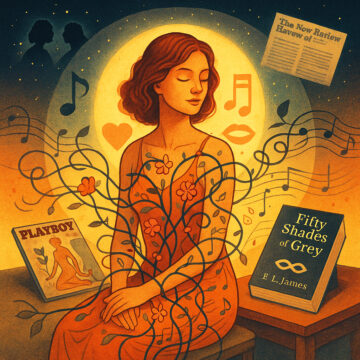
About the Illustration
ChatGPT did the illustration. I uploaded a draft of the article and asked it to do an image with a square aspect ratio. I gave me the following program:
Image Description (Title: “Redeeming Pleasure”)
A softly surreal, collage-like image showing a woman seated in calm, luminous contemplation, her body subtly dissolving into a radiant tangle of flowering vines, abstract ropes, and musical notes. Her expression is serene and open—not eroticized, but embodied, grounded, present. Behind her is a soft glow resembling a mandala of four overlapping symbols: a heart, a musical note, an infinity symbol, and an open mouth—representing pleasure, music, transformation, and speech. Surrounding the scene are symbolic echoes of the article’s arc:
A vintage Playboy magazine (evoked, not literal) lies nearby.
A paperback copy of Fifty Shades of Grey rests on a table.
An aged copy of The New York Review of Books floats in, with Juska’s voice shimmering faintly from its text.
Above, a starry arc containing the silhouettes of two women in conversation.
The overall mood should be warm, contemplative, and celebratory—not explicit, but suggestive of liberation, growth, and deep human connection.
I liked that and told it to create the image.
Enjoying the content on 3QD? Help keep us going by donating now.