by David Kordahl
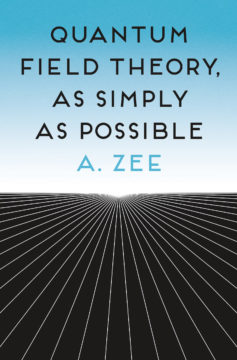
I began reading Anthony Zee’s most famous book, Quantum Field Theory in a Nutshell, at Muncher’s Bakery in Lawrence, Kansas, where, as a would-be quantum field theorist in 2010, Zee’s book taught me to evaluate Gaussian integrals. Zee made it all seem almost trivial, but his fast style belied the true expectation that his book would be read slowly, pen in hand, the reader studiously working their way from one line to the next. You couldn’t escape the sense that Zee was a very clever man, if not a very sympathetic teacher. This was a book whose readers would select it. If they couldn’t proceed, well, who was really to blame?
I never did become a quantum field theorist, though that’s hardly Zee’s fault. (At that point, I barely had the patience to sit and eat a donut.) Thankfully, Zee has now published an even swifter book, Quantum Field Theory, As Simply as Possible, which readers of this column will be happy to know I actually finished.
On the first page, Zee comments wryly that popular physics books jumped straight from quantum mechanics to string theory—so this book fills the quantum field theory gap. Now, if you are not a physicist, you may not know what quantum field theory is. This review is for you. Unfortunately, Zee’s new book probably isn’t. For whom then, is QFT, as Simply as Possible (henceforth: QFT, ASAP) written? My own answer is that it’s perfect for a past version of myself, just way too late for that bakery. Read more »
 Kevin Beasley. Reunion.

 My favorite bookstore closed this month. Well, my favorite bookstore in Zurich, where I live. Also it hasn’t actually closed, it’s only changing hands. But


 The season finale of
  Two weeks ago, outside a coffee shop near Los Angeles, I discovered a beautiful creature, a moth. It was lying still on the pavement and I was afraid someone might trample on it, so I gently picked it up and carried it to a clump of garden plants on the side. Before that I showed it to my 2-year-old daughter who let it walk slowly over her arm. The moth was brown and huge, almost about the size of my hand. It had the feathery antennae typical of a moth and two black eyes on the ends of its wings. It moved slowly and gradually disappeared into the protective shadow of the plants when I put it down.
 Philosopher Harry Frankfurt is best known for his article-turned-manuscript On Bullshit, in which he distinguishes between lying and bullshitting. Most of us are raised to condemn liars more than bullshit artists, but Frankfurt makes the claim that we’ve all got it backwards. His argument is philosophical, rather than scientific, which means observable evidence is hard to come by, but recent political events have filled the gap.
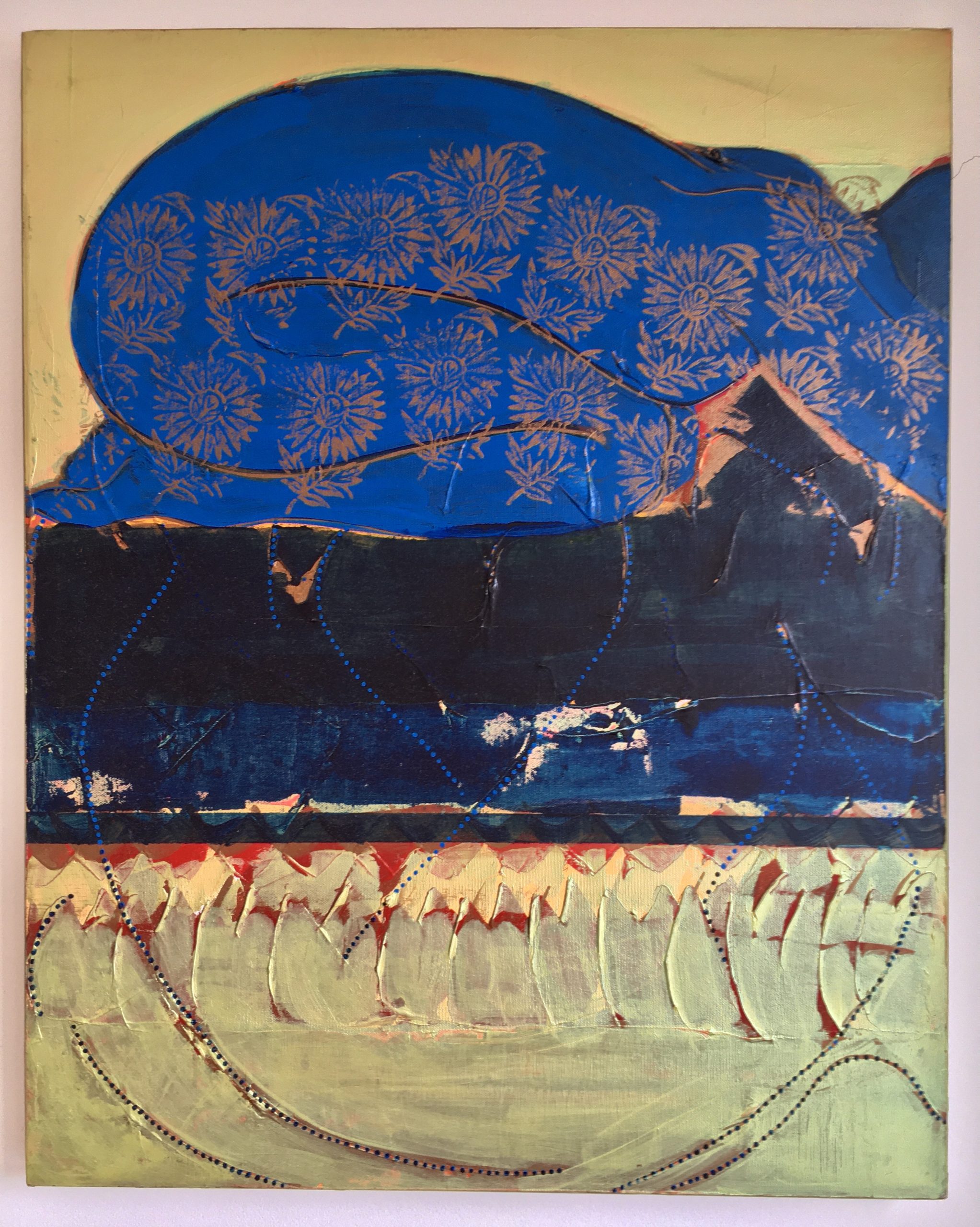 Sughra Raza. Untitled. Cambridge, 1999-2000.
 Having
 On the night of July 13, 1977, the old god Zeus roused from his slumber with a scratchy throat. Reaching drowsily for the glass by his bedside, his arm knocked a handful of thunderbolts from the nightstand. Swift and white, they rattled across the floor to the mountain’s, his home’s, precipitous edge: off they rolled and dropped to plummet through the dark. That night, great projectiles of angular light splashed against and extinguished New York City’s billion fluorescent eyes.