Perceptions

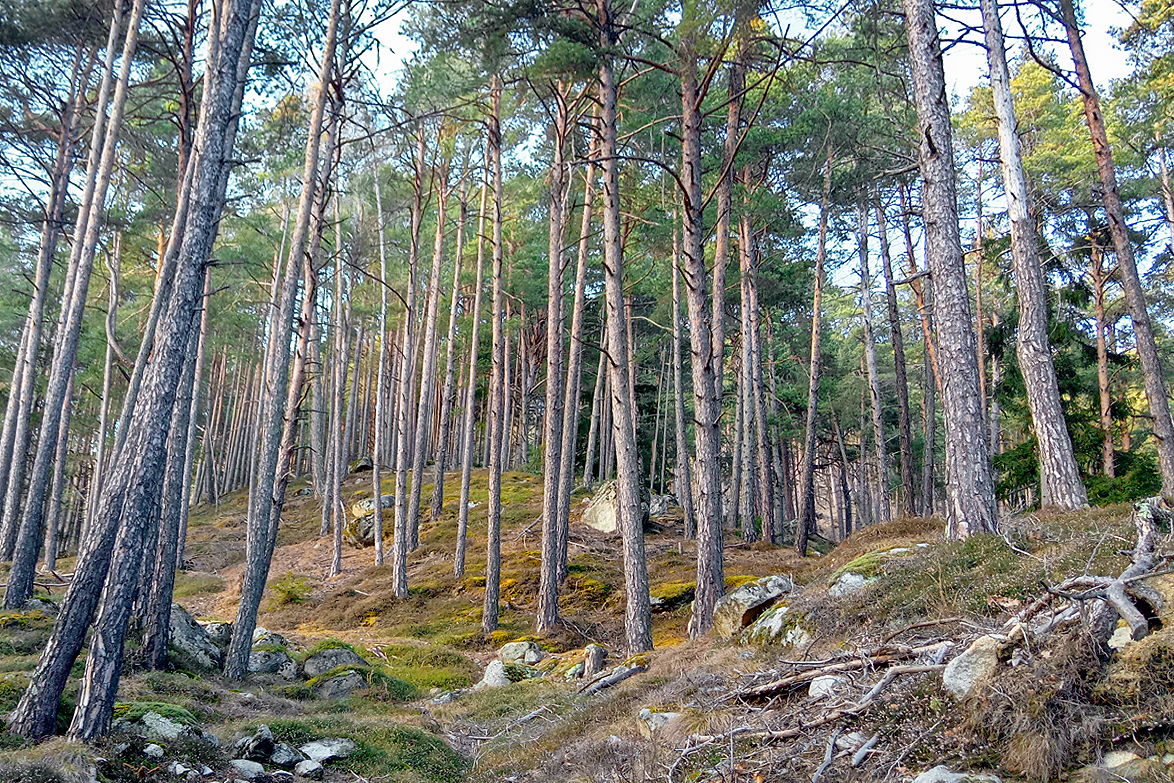
Amar Kanwar. The Sovereign Forest, 2011- …

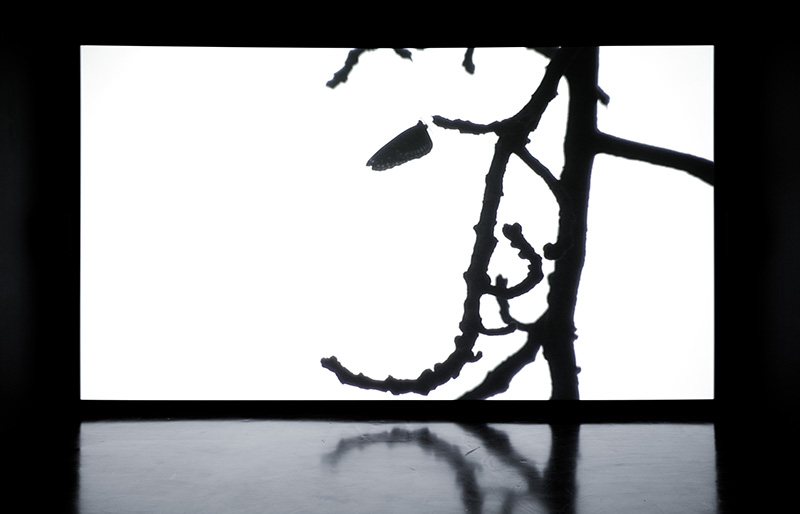
The Sovereign Forest is an ongoing multimedia installation that is a creative response to crime, politics, human rights, and ecological crisis. It evolved out of the political and environmental conflict in the resource-rich, and largely tribal Indian state of Odisha. Kanwar has been observing and documenting the industrial interventions that have irrevocably altered Odisha’s landscape for more than a decade.”

More here and here.

Current show here.

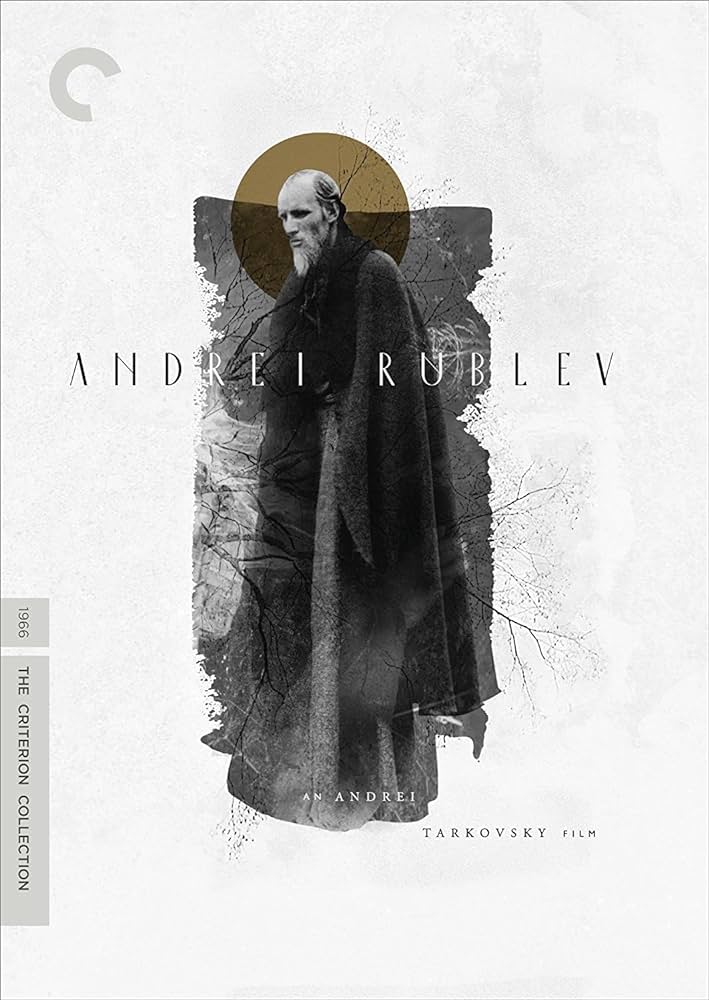
Pride and Envy in “Andrei Rublev”

by Derek Neal

1.

Three men walk across a desolate landscape. They are dressed in robes, but they might as well be rags. One is barefoot, and the ground is muddy. Who are they? Where are they going?

“There must be lots of painters in Moscow,” the one called Daniil says.

“No matter, we’ll find some work,” the one called Kirill replies.

They are monks, they paint icons. It is 1400. We understand that they have been together many years. It begins to rain, and the one called Andrei, the youngest one and the most talented, seeks shelter under a tree.

“Come on,” the others say, we’ll be alright. They move on into the storm. From this point on, their unity will begin to break.

2.

Some years later Kirill wanders into a workshop. He thinks he is alone, but he comes across another man reclining on a bench. This man is called Theophanes the Greek. Outside, a heretic is being tortured; inside, all is cool and calm. Kirill begins to admire the paintings he sees, and Theophanes realizes he is in the presence of a man of a certain intelligence. Read more »

Anatomy of a Girl

by Tamuira Reid

The last time I see Sam she’s sitting at the vanity in her bedroom, carefully examining her 16 year-old face in its lighted mirror.  

Ugh, she sighs, wiping away the lip pencil I just watched her carefully apply for over the better part of an hour. This color, what is it? Hot-rod red? More like hotdog orange. Fuck you, MAC.

Grabbing a lighter shade from her stash of pencils, Sam regroups, starts over. 

Music plays from an open laptop in the corner, haphazardly balanced on a milkcrate-turned-nightstand, The Weekend telling us to save our tears for another day. A beam of late afternoon sun finds its way through the cracked blinds, illuminating the side of Sam’s pale face. 

You’d think I’d be better at this by now, she laughs, shaking her head, chestnut curls bobbing up and down at her shoulders. 

The first lip pencil she used was stolen, straight out of mama’s make-up drawer, when Sam was just seven. She hurriedly ran into the bathroom and locked the door, giddy and nervous af. A small compact mirror in her lap. Cold tiled floor beneath her. There was a freedom in that moment for Sam, the kind of freedom that comes with spectacular acts of defiance. A girl doing girl things, because to the rest of the world, including her own family, Sam was very much a boy.

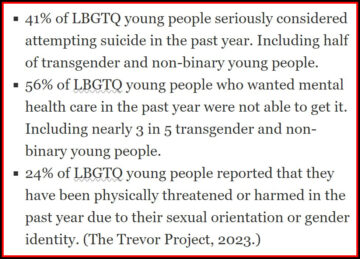
I was scared. Had a lot of shame back then. It was paralyzing. I knew my gender didn’t match my biological sex. I knew I was a girl. But I didn’t have the words to explain this to my mom and my brother. To anyone. It was a secret I held onto for a long time and it hurt. A lot. Read more »

The Right Thing For The Wrong Reasons

by Mike O’Brien

We are fast approaching that special day midway through February, when we are called to reflect upon the joys and sorrows of sharing our lives with certain special others. An occasion for celebration by some, and for lamentation by others. I am, of course, referring to the second anniversary of Justin Trudeau’s invocation of the Emergencies Act to quell the “Freedom Convoy” that had seized downtown Ottawa as well as Canada’s three most important border crossings.

Last year’s anniversary was marked by the release of the Rouleau report, summarizing the results of a public inquiry into the Act’s use, such inquiry being automatically triggered whenever the Act in invoked. That report, finding that the government was justified in its decision and correct in its assessment of the situation to be addressed, angered people who already disagreed with the decision and pleased people who already agreed with it. A new review of the government’s invocation of the Act was released this January, finding that the government’s decision was not reasonable and violated the rights of people affected by the measures enacted pursuant to the declaration of emergency. This new finding (the Mosley decision, or more formally “2024 FC 42”), conversely angered people who already agreed with the decision and pleased people who already disagreed with it. There are two reasons why it elicited such reactions (neither being “people read it”). Firstly, the fact that it exists at all suggests that the wisdom of using the Emergencies Act, and the measures enabled thereby, was still an open question. And secondly, the fact that it (partially) faulted the government suggests that the convoy was not as dangerous or noxious as its detractors claimed it to be. But these suggestions are misleading. Read more »

A Tale of Two Appliances

by Barbara Fischkin

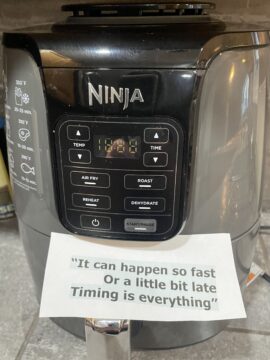
Our air fryer adorned with lyrics by Garrett Hedlund

Part One

This story begins, as no great story ever has, with a dustbuster.

That’s right: A cordless, rechargeable handheld vacuum cleaner. If you don’t know, consider yourself lucky. It means you have had so much household help, that you never needed to recognize that dustbusters exist. Align yourself with George H.W. Bush, amazed, as he was, by a supermarket scanner.

A dustbuster once infiltrated my life and as much as I would like to make it the culprit of part one of this story, I blame two other operatives. For a dustbuster to be an actual culprit it would have to star in an anime film—or take on the alternative meanings assigned to it by the Urban Dictionary. (Don’t go there for this particular word, unless  you want to read about raunch—or worse—ice hockey.)

As for the actual culprits, they are my husband Jim Mulvaney and his late mother, Eileen O’Keefe Mulvaney. My husband is an intrinsically good guy. But nobody is perfect. My mother-in-law—whom I loved deeply—had her own flaws. Super practical, but  more about other people’s needs as opposed to her own. When we cleaned out her house, we found scores of nearly identical striped, button-down oxford shirts in their original packaging. I realized it was the shirt she wore on a daily basis. She was not a serious hoarder. She just hated going to the dry cleaners. Read more »

Monday, January 29, 2024

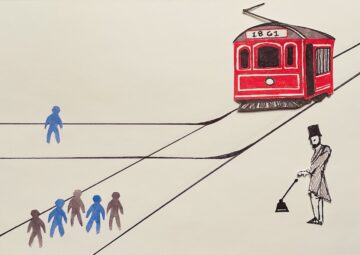
Lincoln’s Trolley Problem: Fort Sumter And Beyond

by Michael Liss

I have no purpose, directly or indirectly, to interfere with the institution of slavery in the States where it exists. I believe I have no lawful right to do so, and I have no inclination to do so. —Abraham Lincoln, First Inaugural Address, March 4, 1861

Did we need to have a Civil War? Couldn’t the two sides, geographically defined as they were, simply part before the shooting started? Did Lincoln intentionally choose war for any one of a variety of unworthy reasons that stopped short of necessity, including even something so mundane as a fear of losing face? Or was he faced with an intractable situation for which there was no simple, satisfactory answer—a type of political Trolley Problem?
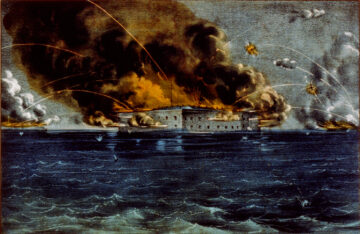


These questions were suggested by the recent comments from a 3 Quarks Daily reader to a 2020 article by Thomas Wells. While I don’t agree with the premise of Lincoln’s “culpability,” it is an issue that has been continuously debated by historians and opinion writers almost from the moment South Carolina forces shelled Union soldiers led by Major Robert Anderson at Fort Sumter.

Bombardment of Fort Sumter, Charleston Harbor, 12th & 13th of April, 1861. Hand-colored lithograph, Currier & Ives.

In fact, the debate raged both in public and behind closed doors even before the South Carolinians reduced the Fort on April 12-13, 1861. Depending on who does the telling, either Lincoln shrewdly baited the Confederates into firing on Fort Sumter, thus unifying much of the North for a shooting war, or belligerent South Carolina fired on Fort Sumter without good cause, thus unifying much of the North for a shooting war. If you are interested, I’d recommend James D. Randall’s discussion in his 1945 Lincoln The President, but, in either telling, at the end of the day, the war that followed Sumter was not inevitable, but the product of both sides’ choices. Read more »

The atom bomb and the two cultures: I.I. Rabi on the sciences and the humanities

by Jeroen Bouterse

I. I. Rabi

Several years before C.P. Snow gave his famous lecture on the two cultures, the American physicist I.I. Rabi wrote about the problem of the disunity between the sciences and the humanities. “How can we hope”, he asked, “to obtain wisdom, the wisdom which is meaningful in our own time? We certainly cannot attain it as long as the two great branches of human knowledge, the sciences and the humanities, remain separate and even warring disciplines.”[1]

Rabi had been interested in science since his teenage years, and grown up to be a Nobel-prize winning physicist. He had also been an important player in the Allied technological effort during World War II, as associate director of the ‘Rad Lab’: the radiation laboratory at MIT that developed radar technology. The success of Rad Lab, Rabi later reflected, had not been a result of a great amount of theoretical knowledge, but of the energy, vitality, and self-confidence of its participants.[2] In general, Rabi’s views on science and technology were somewhat Baconian: science should be open to the unexpected, rather than insisting on staying in the orbit of the familiar.[3]

‘A moralist instead of a physicist’

In Rabi’s accounts of his time leading Rad Lab, he would also emphasize the way in which he insisted on being let in on military information. “We are not your technicians”, he quoted himself, adding: “a military man who wants the help of scientists and tells them half a story is like a man who goes to a doctor and conceals half the symptoms.”[4] Indeed, the key to understanding Rabi’s worries about the two cultures – he would go on to embrace Snow’s term – is his view of the role science ought to play in public life. Scientists should not just be external consultants,[5] delivering inventions or discoveries on demand or listing the options available to the non-specialist.[6] In some stronger sense, they should be involved in directing policy decisions. Read more »

Fabula rasa

by Rafaël Newman

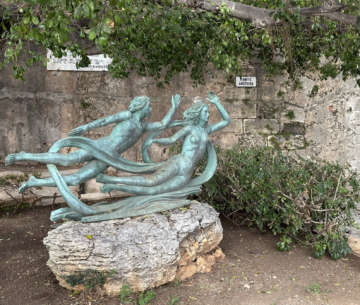
Ortigia, January 2024

The initial syllable of the English word “island”—or rather, just its very first vowel—is descended from the Proto-Germanic *awjo, meaning “an area on the water.” The element “land” was subsequently added to differentiate the word from other inflections of the Proto-Indo-European root for water, *akwa-. Our “island” is thus cognate with its German counterpart Eiland, although these days German speakers probably prefer Insel, derived from the Latin insula, which refers less ambiguously to a land mass entirely surrounded by water and not, as Eiland can, to a territory simply suffused with water.

The “s” in our “island,” however, was inserted much later, by a process of classicizing back-formation, to associate it with its etymologically unrelated synonym “isle”: as if to establish a linguistic lineage, to give island’s humble Germanic form a noble Roman pedigree. To link it, as it were, with another, greater, more patrician history.

The desire to link islands up, to settle them down, to connect them with the mainland, is an old one. Our continents, after all, are thought to have derived from the drifting apart of an original, unitary Pangea, and perhaps we have been yearning ever since for a return to that felicitous Ur-conglomerate. “No man is an island” (or rather, “iland”), wrote John Donne in 1624. Fast forward to the Confederation Bridge, or “fixed link” that unites Prince Edward Island with New Brunswick, inaugurated in 1997, and you can trace the modern history of a venerable conviction. Read more »

The Utopian Impulse (Part I)

by Angela Starita

New York magazine published a story about two sisters who decide to leave civilization and try surviving in the outdoors of Colorado. One has a 14-year-old son, and she brings him too. In fact, much of her motivation appears to be protecting him from dangers she perceives, existing ones and more she believes to be just on the horizon. The writer doesn’t know many of the specifics of those fears, but from text messages, she gleans that the mother, Rebecca Vance, believed that the world was on the verge of collapse and wanted to escape the ensuing survivalist brutality. Instead, the three died of malnutrition and hypothermia probably within two months of going “off grid.” In short, in trying to outrun anticipated violence, they instead faced a grueling, attenuated death.

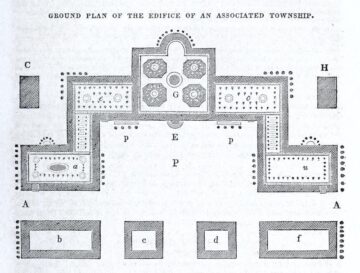
People quoted in the article attest to the sisters’ clear lack of familiarity with the backwoods camping let alone how to build a shelter, gather or grow sufficient food, generate heat, and all the other essentials to assure long-term survival. That aside, though, the sisters were acting out a typical response to their fear of the encroaching demands of the modern world. In their own panicked, inept way, the sisters were part of a long tradition of runaways looking to escape or reconfigure the rules of society as they understood them. It’s a familiar list—New Harmony, Oneida, the Shakers, even Jonestown—born of a familiar impulse: to start over and this time get it right. Read more »

Tempus Fuckit

by Akim Reinahrdt

Time slips
past us, fast flow,
like a river rushing over gray stones
Time drips
slower than slow
like thick sap hanging from pine cones

The Days Run Away Like Wild Horses: Bukowski, Charles: 9780876850053: Amazon.com: Books

I’m not sure time is real. I mean, things happen. Entropy and whatnot. But I don’t know if I accept that measuring the pace of happenings is anything more than a construct.

Don’t get me wrong. I know the world is round, or a close approximation thereof. I’m down with the science. But physicists, as a group, aren’t united on what time is. Something about time beingmeasured and malleable in relativity while assumed as background (and not an observable) in quantum mechanics.

So while we experience it as real, it may not be “fundamentally real.”

And that’s kinda how it feels to me.

I remember my 6th grade English teacher, Mrs. Newman (Ms. was not to her liking), telling us that the older you get, the faster time goes by. I’m not sure why, but that idea immediately clung to me. Though I was only 11 years old, or perhaps in part because of it, I got what she was saying. And I believed her. After all, she had lived four or five or six times (who could tell) as long as I had. So even though what she was describing sounded like a cliché passed on from generation to generation, I assumed her own experiences had borne it out. During the four and a half decades since, I have always remembered her words and noticed that, in a general sense, she was absolutely correct. Back then, a summer was endless.  Now, the years roll on like a spare tire picking up speed down a hill.

But that is a historical observation I make as I look back. My present, like everyone else’s, stretches and squeezes like an accordion.   Read more »

Activism as Art (Inaugural Rosemary Bechler Memorial Lecture)

by Gus Mitchell

This article is from a presentation made for the Rosemary Bechler Inaugural Memorial Lecture, an event organised by DIEM25, of which Rosemary was a founder member. It took place at the Marylebone Theatre in London on January 21st 2024. 

That music you just heard is a recording of the Aka People, recorded in the forests of the Central African Republic. The musicologist who collected it gave it the simple title: “Women Gathering Mushrooms.” I like that title because I think its literalness reveals something important. I don’t know if the Aka conceive of it as “art” in the same way that now, sitting in a theatre in London in 2024, we conceive of it. Undoubtedly though it is art in the truest sense.

Of course, it is very difficult––it is impossible––to avoid speaking in generalities when you’re using a word as general, as vast, as art. There are as many arts as there are artists. Avoiding abstraction is impossible. But that’s also part of what I’m going to try to say here. That is––that most of the ways we tend to think about art today are abstract. Too much so, I think. I think that art might in fact mean more than we currently allow it to. It might be more than we currently allow it to be. Read more »

Yalom’s Gift

by Marie Snyder

I recently binge-watched all of Group, a show inspired by the Irvin Yalom novel, The Schopenhauer Cure. So I revisited Yalom’s non-fiction to see how closely the series aligns to his actual practices.

The Gift of Therapy is a fascinating read from 2017 in which Yalom dives openly into his existential psychotherapy practice, explaining the four givens that affect how we think, feel and act that need to be explored at depth: death, isolation, meaning of life, and freedom (xvii). In the introduction, he jumps right into death denial revealed through a belief in personal specialness (xiii). Our current culture of selfies is likely rife with this! An existential perspective is best for clients who despair from “a confrontation with harsh facts of the human condition” (xvi). We didn’t see much of this type of discussion in the show. In fact, the therapist didn’t talk much at all beyond reminding the group to be honest and forthcoming. Read more »

On the Road: On Shaky Ground

by Bill Murray

The Balkans isn’t everybody’s first choice for summer holiday, but that’s where we’re headed this year. First we’re flying to Chișinău, while we still can, and I don’t mean to be flip. Forgive my wavering confidence in Western guarantors of freedom, democracy and territorial integrity.

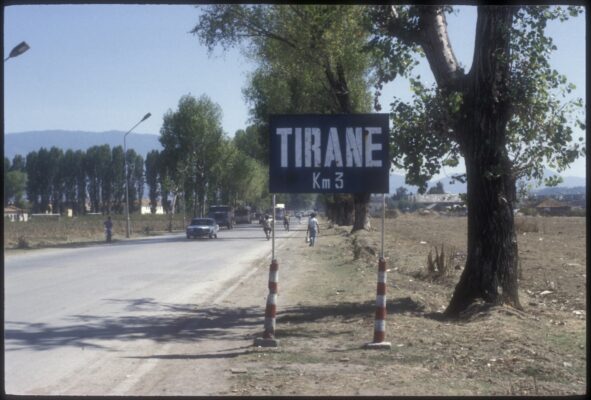
My idea then is to press south from the Moldovan capital through Romania and Bulgaria. Later we’ll head to Skopje, Lake Ohrid, Pristina and Tiranë. No Disneyland for us this summer. We’re going to Plovdiv.

Where my wife comes from in Nordic Europe, thuggery isn’t street crime and graft. Up there, thuggery plays out against dramatic backdrops, with a sense of the cinematic. It’s oligarch families flying drones through the Arctic, or it’s cynical manipulation of human lives, Russians importing Somali “asylum seekers,” then renting them bicycles to pedal off toward the Finnish border.

In the Balkans it’s not like that. Down there, we’re led to believe unkempt rogues and opaque political intrigue are common as London fog. In the Balkans, they say, thuggery is bona fide. Local. Home grown. And scoffing at the law starts with the leader. Read more »

On the 12/8 Path with Charlie Keil

by William Benzon

Charlie Keil in his study in Lakeville.
Man at work.

I knew about Charlie Keil somewhat before I met him and long before we began collaborating on various projects. In 1966 he published Urban Blues, which was a study of such singers as Bobby Blue Bland and B.B. King, blues musicians who wore sharp suits and performed in urban venues with electrified instruments. The book received wide acclaim, both in intellectual circles and in, of all places, the rock and roll press. And why not? After all, much of rock and roll was based on the blues. This lively and erudite book, published by an prestigious university press, University of Chicago, gave legitimacy to the work of critics publishing in Rolling Stone, the Village Voice, and Crawdaddy.

I don’t know just when of how I came to read it, but it electrified me. For not only did Keil write about the music, he wrote about the musicians and the communities in which they lived and performed. After all Keil was an ethnomusicologist, and it probably said so somewhere on or in the book. If so, it didn’t register with me. And, like many who read the book, I assumed that Keil was black. I mean, how could a white man know so much about black life and write so sympathetically about it? No, this Charlie Keil fellow had to be black.

While I might has bought the book soon after it was published, I don’t actually know that. But I’m sure I bought it sometime before the fall of 1973, when I went off to graduate school, because I remember talking with my Baltimore friends about the book, who were as taken with it as I was.

When I shuffled off to Buffalo – yeah, the Devil made me do it – I didn’t know that Charlie Keil was on the faculty there. I went off to the English Department at UB (State University of New York at Buffalo) while he was in American Studies. But I also hung out in the improvisation workshop run by Frank Foster in the music department. Though I never verified this, I had the impression that some of the people in the workshop were music students at Buffalo, while others were young local musicians who showed up to learn from a man who’d played with Count Basie, Sarah Vaughan, Elvin Jones and who knows whom else. Frank was one of the masters, and we were there to learn from him. Read more »