by Mike O’Brien
What a week it has been. I’m not referring to military outrages, legal bombshells or pop-cultural bombshells. Rather, I’m referring to the dozens of intensive (and intensely rewarding!) hours I spent catching up on my preferred corner of academic research: the empirical investigation of animal normativity. Big things are happening in this domain. Big things have been happening there for decades, but the pace has noticeably increased in the last two years, at least judging by the output of the authors I tend to follow.
Some of my readers may know that I am particularly interested in the work of Kristin Andrews, currently at York University in Toronto. I have covered some publications of hers in previous columns, most recently 2022’s “A pluralistic framework for the psychology of norms“, co-written with Evan Westra. Since then, no fewer than nine publications have been added to Andrews’ website, many co-authored with other movers and shakers in the burgeoning animal normativity scene. In addition to illustrating the current state of the field, the historical references in these recent publications (if I can call the 1970s and 1990s “historical” without sending a chill up the spines of my peers and elders) also trace the long trajectory of de-anthropocentrizing projects in cognitive and behavioural sciences. A particularly interesting antecedent is 1990’s “Towards a neurobiological theory of consciousness” by Francis Crick (!) and Christof Koch, which called for a program of research into consciousness that presupposed a neuronal rather than linguistic basis for conscious phenomena. A fortuitous proposal, in retrospect, accompanied by some rather interesting specific hypotheses about the underlying neuronal mechanics. Koch’s confidence in the material tractability of consciousness recently cost him a case of wine (presumably now sitting in David Chalmers’ cellar), although he should not be faulted for the mind-sharpening practice of attaching stakes to one’s bets.
To recap my previous coverage of Andrews’ work: In “A pluralistic framework…“, Andrews and Westra sketched out a conceptual toolkit for a research program that could investigate normativity in non-human animals. The main thrust of this project is to remove heavily concept-laden and human-specific definitions and criteria, and in their stead provide minimal, instrumentally serviceable tools that can be applied to a wide variety of animal behaviours. Read more »








 A little over a year ago I published
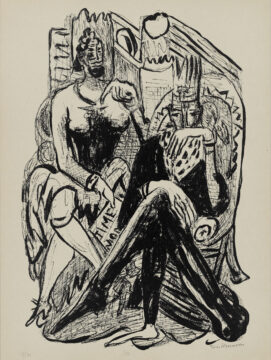
  Eddie Rodolfo Aparicio. White Dove Let US Fly, 2024.
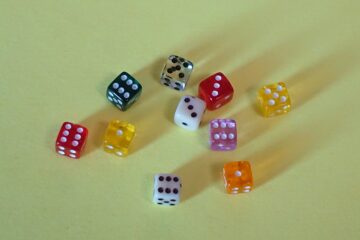 “You are aware”, I ask a pair of students celebrating their fourth successful die roll in a row, “that you are ruining this experiment?” They laugh obligingly. In four pairs, a small group of students is spending a few minutes rolling dice, awarding themselves 12 euros for every 5 or 6 and ‘losing’ 3 euros for every other outcome. I’m trying to set them up for the concept of expected value, first reminding them how to calculate their average winnings over several rounds, and then moving on to show how we calculate the expected average without recourse to experiment. It would be nice, of course, for their experimental average to be recognizably close to this number. Not least since this particular lesson is being observed by the Berlin board of education, and the outcome will determine whether or not I can get a teaching permit as a foreigner.