by Thomas R. Wells
In a world in which anyone can create fake sexually explicit images of anyone else, we should not be surprised when it happens, and we should not get especially upset if it happens to us.
Synopsis of my argument
Premise 1: It is now trivially easy to use a generative AI image apps to produce realistic looking deepfake nudes and explicit pornographic videos of anyone without their consent
Premise 2: P1 is, or should be, common knowledge (everyone knows it, and that everyone knows that everyone knows it)
Conclusion 1: Therefore, everyone knows that everyone knows that sexually explicit pictures of non-porn stars are almost certainly deepfakes created without that person’s consent
Premise 3: Privacy is the right to be mysterious to others: to determine for yourself what different people know, or think they know, about you.
Premise 4: If the deepfake images circulated of you were considered real by those friends and strangers who might find them then that would be a grave violation of your privacy and it would be reasonable to feel very upset about it
Premise 5: However, by C1, everyone knows that everyone knows that these sexualised images are not real
Conclusion 2: Therefore, it is not reasonable to get upset about finding deepfake nudes of ourselves circulating on the internet. The correct response is more of a shrug. Read more »
 “This is the mentality of our society. If someone is speaking English, he or she is really good, he or she is from a very good background,” one subaltern English learner tells the researchers in this study. “When someone speaks good English, Shah says, people assume that person is educated, knows how to carry himself, and is, crucially, ‘a good person’,” notes another.
 Dear Reader,

 The town had only one grocery store, and Steve wondered where the locals did their shopping. Certainly not here, but perhaps in a supermarket outside of town, one that required a car. Along with Julia, he picked up some Italian cheese, prosciutto, grapes, and a bottle of local wine, and they made their way up the hill to the house they’d rented for the week.
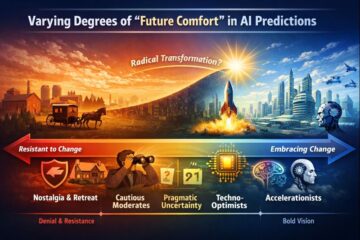 Back when I worked for large corporations, people would often talk of being in “period of change” or how they could “see the light at the end of the tunnel” after a period of heavy restructuring or similar. These days, you might be forgiven for wondering where the tunnel went. Change is incessant and showing no signs of slowing down. In fact, it is quite the opposite. We are entering a period when change might in fact actually be speeding up, even from its currently historically high levels. While not the majority view, nor the most likely scenario in my estimation, there is still a nonzero likelihood that we are in fact in the last few years of an era. Through the development of AGI – artificial general intelligence – the world could become unrecognizable in just a few years.
 Never before have I worried about rolling out of my bed or a chair and falling down, kerplunk! For no reason. Now I have to. I feel like a spacer on the first outer space mission, alert with every breath, having always to think about where to place each foot. constantly aware. As I walk, my legs sometimes shake. Sharp pangs wander erratically across my legs, occasionally intersecting with a joint, others centered around a muscle.
 Marco A Castillo. Mangle I, 2025.