
by Sauleha Kamal
 “This is the mentality of our society. If someone is speaking English, he or she is really good, he or she is from a very good background,” one subaltern English learner tells the researchers in this study. “When someone speaks good English, Shah says, people assume that person is educated, knows how to carry himself, and is, crucially, ‘a good person’,” notes another.
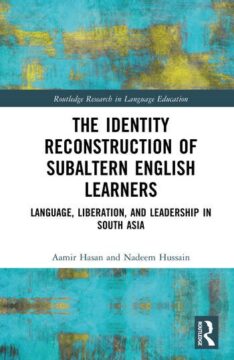
The Identity Reconstruction of Subaltern English Learners by Aamir Hasan and Nadeem Hussain is an ambitious book that draws on a qualitative study of language learners in South Asia to make connections between social mobility, leadership development and English acquisition. Through this data, and a detailed theoretical and historical analysis of the position of English in South Asia, it endeavors to fill a crucial gap in the area of English studies.
English occupies a distinctive place in former British colonies, and in South Asia in particular. Its significance extends to everything from communication to shaping access, credibility, and self-perception in ways that are difficult to disentangle from class. This book takes that relationship seriously, treating English as a social determinant whose effects are felt across education, leadership, and everyday dignity. In doing so, it offers a careful and largely persuasive account of how this language mediates power in the region.
The authors begin from a position that is rarely stated so plainly: the linguistic order that governs South Asia is unlikely to change in any meaningful way. The political will to dismantle the entrenched hierarchy between English and the vernaculars does not exist, and the historical moment that produced mass literacy through vernacular education elsewhere has passed. English remains the most valuable form of linguistic capital in the region, and access to it continues to determine who is heard and who is overlooked.
One of the book’s more important interventions lies in its treatment of the mother tongue. Rather than approaching vernacular education as an unquestioned good, the authors examine how its promotion is often used to minimize the importance of English or to justify restricting access to it. In South Asia, vernaculars have undergone a steady process of devaluation, to the extent that labels such as “Hindi-medium” and “Urdu-medium” function socially as markers of inferiority. The authors are attentive to the consequences of this devaluation, particularly for those who must navigate a culture where English confers a “halo effect” to speakers, having become a proxy for competence and character.
The historical chapters trace how this linguistic hierarchy took shape. English gained prominence through a convergence of colonial educational policy, missionary activity, and administrative necessity. While indigenous institutions were preserved in form (e.g., through madrassas and Sanskrit colleges), English education was reserved for elites whose cooperation was central to the colonial project. Over time, English became the dominant language across administrative, legal, political, and economic domains, while vernacular languages were steadily marginalized. The association of English with moral improvement and modernity, including its promotion as a path to women’s emancipation, further consolidated its status.
The book’s conceptual framework relies on the distinction between elites and non-elites, drawing on Antonio Gramsci’s historical framework, and Ranajit Guha’s subaltern studies. The book defines elites as hegemonic groups with access to power, Western-style education, wealth, and authority, while subalterns are defined as those who occupy subordinate positions within this structure. The framework is broadly effective, though the categories would benefit from greater precision. In South Asia, wealth, education, linguistic capital, and power do not always align neatly. There are economically powerful actors with limited English proficiency, as well as English-fluent professionals with little material security, and it would be useful to attend to these outliers are well and propose a more specific definition for this context. Paying attention to these internal distinctions would add nuance and further enrich the authors’ central claims.
The strongest sections of the book focus on identity, self-esteem, and social recognition. Drawing on social identity theory, the authors show how English speakers function as a socially dominant in-group, while non-English speakers are routinely assigned lower value. English proficiency is widely interpreted as evidence of education, refinement, and even moral worth. Participants repeatedly describe how speaking English alters how they are treated, how their opinions are received, and how much space they are afforded in public and professional settings. Silence, often the result of linguistic insecurity, emerges as a recurring experience with tangible social costs.
The authors argue that English plays a significant role in reshaping self-perception among non-elites. Fluency enables individuals to negotiate classed and caste-based interactions with greater confidence, to refuse mistreatment, and to assert boundaries. Leadership development features prominently in this discussion. English proficiency appears to affect persistence, decision-making, risk-taking, and the ability to influence others, largely because it confers credibility in contexts where resources and authority are controlled by English-speaking elites. For many participants, learning English functions as a form of leadership training in itself.
The book also engages with motivation theory, noting the limits of frameworks that emphasize aspiration without accounting for structural constraint. While imagined futures may shape investment in language learning, access to resources and supportive environments remains decisive. One of the study’s more striking findings concerns the relationship between English and self-esteem. The authors present evidence that English has become closely tied to dignity and social inclusion in South Asia, aligning it with basic needs rather than optional skills. Without it, participants report persistent experiences of marginalization, regardless of other qualifications.
Importantly, the authors do not frame English acquisition as a subtractive process. Their findings suggest that higher levels of English proficiency can strengthen respect for the mother tongue, supporting additive bilingualism rather than displacement. This complicates narratives that treat English as inherently corrosive to local languages and identities.
The book concludes with the argument that English has come to occupy a near “human right”-like status in South Asia. It is increasingly treated as a prerequisite for participation in public life, access to opportunity, and recognition as an educated subject. A novel contribution, this book is essential reading for anyone interested in understanding the socioeconomic fabric of South Asia or class dynamics in postcolonial societies more broadly.
***
The Identity Reconstruction of Subaltern English Learners: Language, Liberation, Leadership in South Asia comes out from Routledge on March 6, 2026.
Enjoying the content on 3QD? Help keep us going by donating now.