
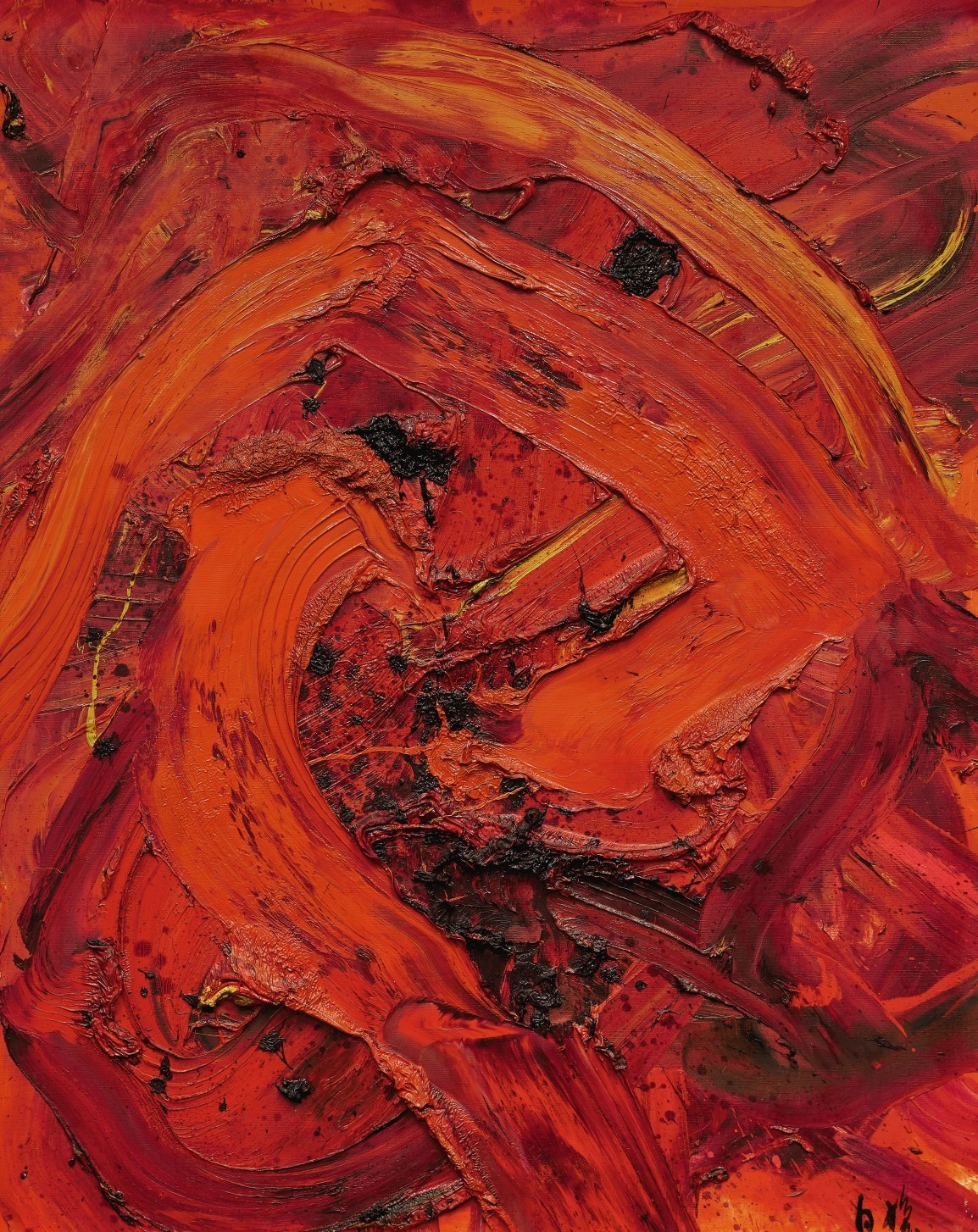
 Kazuo Shiraga. Untitled 1964.
Category: Monday Magazine
Though we are an aggregator blog (providing links to content elsewhere) on all other days, on Mondays we have only original writing by our editors and guest columnists. Each of us writes on any subject we wish, and the length of articles generally varies between 1000 and 2500 words. Our writers are free to express their own opinions and we do not censor them in any way. Sometimes we agree with them and sometimes we don’t.Below you will find links to all our past Monday columns, in alphabetical order by last name of the author. Within each columnist’s listing, the entries are mostly in reverse-chronological order (most recent first).
Globalization’s Exaggerated Demise
by Anitra Pavlico
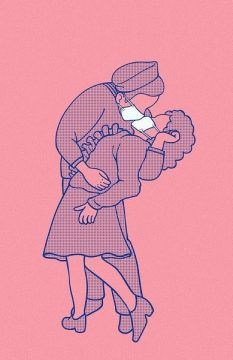 There has been much discussion lately of whether the COVID-19 pandemic will spell the end of globalization. It’s hard to get economists to agree on the meaning of the numbers, or foreign policy analysts to commit to a vision of the future in a world that changes from one moment to the next. Globalization means different things to different people and entities. Its many facets, and many narratives about those facets, complicate discussion about either a contraction or a resurgence of globalization. For corporations, it means access to inexpensive labor markets; for money managers, it means access to capital markets. For the typical business traveler, it may mean something as basic as greater choice of airlines and flight times for an international trip. For an optimistic humanist, it might symbolize enhanced international cooperation and a suppression of nationalism and xenophobia. For an environmentalist, it is marred by the dangerous policies that accelerate climate change. For a technocrat, it seems the obvious economic approach to accompany the paradigm of social-media-fueled connectedness, data collection, surveillance, and targeted marketing.
Regardless of what we talk about when we talk about globalization, most of the articles that I have seen over the past few weeks have posited that the coronavirus will mean the end of the current wave, just as the Spanish flu epidemic halted the wave of globalization that steamships, trains, and the telegraph ushered in. Soldiers returning home from fighting in World War I in 1918 helped to spread it. Nationalists’ fears of literal foreign “contagion” are not entirely unfounded, as the ease of international travel has certainly facilitated the spread of the current outbreak. The predicted reversal of globalization appears to be a sensible conclusion, as it would simply reflect the implosion of financial markets, shutdown of borders, grounding of planes, and freezing of lines of trade. Will it last, though?
Stephen M. Walt, professor of international relations at Harvard, writes a “realist’s guide” to the outbreak on the Foreign Policy website, suggesting that the realist approach, while it has had little to say in the past about public health or pandemics, may still shed some light on the future of globalization. Read more »
The Cancer Questions Project, Part 34: Patrizia Paterlini-Bréchot
Dr. Patrizia Paterlini-Bréchot is a tenured Professor of Cell and Molecular Biology and Oncology at Paris Descartes University and head of a research team at the French National Institute of Health and Medical Research (INSERM). She studied medicine at the University of Modena and Reggio Emilia, where she specialized in hematology and oncology. In 1988 she turned her focus on research in cell and molecular biology and published over 80 research articles and reviews in national and international scientific journals. She received numerous awards and honors including Best thesis in Medicine (1978), the Best research in Hematology (1979), Assistance Publique/Hôpitaux de Paris (1995, 2002), Technological development (2007), and European Inventor Award Finalist (2019). She is listed as an inventor on over 5 patents.
Azra Raza, author of The First Cell: And the Human Costs of Pursuing Cancer to the Last, oncologist and professor of medicine at Columbia University, and 3QD editor, decided to speak to more than 20 leading cancer investigators and ask each of them the same five questions listed below. She videotaped the interviews and over the next months we will be posting them here one at a time each Monday. Please keep in mind that Azra and the rest of us at 3QD neither endorse nor oppose any of the answers given by the researchers as part of this project. Their views are their own. One can browse all previous interviews here.
1. We were treating acute myeloid leukemia (AML) with 7+3 (7 days of the drug cytosine arabinoside and 3 days of daunomycin) in 1977. We are still doing the same in 2019. What is the best way forward to change it by 2028?
2. There are 3.5 million papers on cancer, 135,000 in 2017 alone. There is a staggering disconnect between great scientific insights and translation to improved therapy. What are we doing wrong?
3. The fact that children respond to the same treatment better than adults seems to suggest that the cancer biology is different and also that the host is different. Since most cancers increase with age, even having good therapy may not matter as the host is decrepit. Solution?
4. You have great knowledge and experience in the field. If you were given limitless resources to plan a cure for cancer, what will you do?
5. Offering patients with advanced stage non-curable cancer, palliative but toxic treatments is a service or disservice in the current therapeutic landscape?
Is online manipulation always hidden?
by Michael Klenk
Manipulation often seems to involve a hidden influence. Manipulators are pushing the emotional buttons of their unsuspecting victims, exploiting their subconscious habits and leading them astray. That view of manipulation explains a lot of the current moral outrage about digital technology and the companies behind it. Digital technologies provide the unprecedented potential for hidden influence, and, therefore, pose a manipulation threat, or so the argument goes.
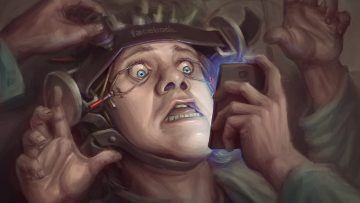
But the hidden influence view of manipulation is false. Manipulation neither requires hidden influence, nor is hidden influence sufficient for manipulation. For example, guilt-tripping is manipulative and also often clear as the day. When your partner who wants to go hiking, knowing that you don’t, has already packed the car with the beaming kids, it becomes hard to say no. You are being manipulated, but it is obvious to everyone what is going on. Conversely, hidden influence does not automatically make an interaction manipulative. For example, you may simply fail to attend to the actions of a nurse assisting in operation on you. So the nurse’s influence on you remains hidden, but that does not make it manipulative. Thus, the hidden influence view is inadequate to characterise and understand interpersonal manipulation. Manipulation may sometimes be hidden, but often it is not.
Therefore, we need a better understanding of manipulation. We cannot just rely on the fact that some interpersonal influence is hidden to determine whether we have a case of manipulation. Why care? Because understanding manipulation is crucial in the current critical debate about digital technologies in moral philosophy and related disciplines. Read more »
Catspeak
by Brooks Riley
Playlist for the end of time
by Brooks Riley
 1. As the coronavirus continues to disrupt human life in many corners of the globe, a phrase from George Frideric Handel’s Messiah has wormed its way through the background noise of my attention span. It occurs in a Part III recitative usually sung by a bass with enough gravitas to shake the earth as well as the listener.
Behold, I tell you a mystery; we shall not all sleep, but we shall all be changed in a moment, in the twinkling of an eye. . .
That mystery is now upon us, the mystery of how our world has changed ‘in the twinkling of an eye’—from rapacious consumerism to the maintenance of bare necessities, from globalization to localization and isolation, from ‘out and about’ to ‘home alone’—all because of a pathogen that reaches you faster than a package from Amazon.
. . .and we shall be changed. This is the phrase that dominates the aria following that recitative. The repetitions and soaring musical variations of this line, like a deluge of mantras, suggest an epiphany that will be undeniable, invoking secular salvation through long-term permanent change. The question now is, can we rebuild the world anew when this coronavirus crisis is over? Shall we be changed? More importantly, shall we change? And if we do, will it be for the better? Read more »
Soap and Sun
by Shadab Zeest Hashmi
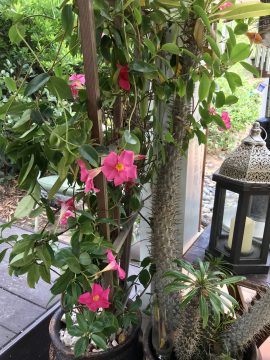 We get half a sunny day every other day since Corona has coaxed us to quit public spaces. In the past fortnight or so, sunlight has been in short supply just as masks, disinfectant spray and toilet paper. When the sun is out, it’s no ordinary gift; it brings a rush of joy that wipes out not only the free-floating, dystopic COVID -19 anxiety, but also the other recent traumas we’ve faced as a family. Indoors, socially-distant by three feet, hunched over our phones for news of loved ones, we forget it is spring, but mornings the sunlight hits the windows feel as if God has turned on the power-wash setting: one is shocked into vigor, tricked into optimism. On such a day, I step down the patio threshold as if pulled by a magnet; just out of the shower and still combing my wet hair, I’m suddenly aware of another gift— soap.
In recent months, my husband and I have been involved in taking care of our critically ill parents; each of them has somewhat recovered by now but our heads are still swimming with hospital visits, devastating scenes of witnessing the pain, discomfort and breach of privacy of those we love the most in this world. We step forward and offer what meager solace or cure we can muster but we are aware of limits. We’ve seen more needles, tubes, blinking-, beeping- monitors, procedures, more bruises on our loved ones’ skins in two months than our whole lifetimes. Reality is clothed in the clinical language of unpronounceable drugs, softened and made bearable by a sister, who, as a doctor, filters and translates it into the personalized language we need in order to participate in healing.
During this time, Corona has become a growing threat; fatigued and stressed, we wash and wash our hands in the hospital, at home, and come back to hold our parents’ hands; soap lingers in the air. We have not held their hands for as long as this since we were children. We are aware that any of us could be carriers of the deadly virus, also that distancing is antithetical to caregiving. And now, under lockdown, the thought occurs to me that our sadness and theirs is lessened by touch and contamination is lessened by soap. Read more »
Words of Wisdom for Troubled Times: Epictetus or Taylor Swift?
by Tim Sommers
Here’s a story that is almost certainly not true, even though I have heard it many times. A philosopher, or anyway a philosophy professor, is on an airplane listening to a businessperson explain what they do. There’s a lull in which the businessperson asks, “By the way, what do you do?”
“I’m a philosopher,” the philosopher answers.
The businessperson responds, “Oh, really? What are some of your sayings?”
One person who told me this story said that the philosophy professor responded, “To be is to be the value of a bound variable.” Which is a Quine joke, if you really want to get into it.
Here’s why I feel pretty confident this story is not true. I have heard it several times, from several different people, none of whom claim it happened to them, rather it always happened to an unspecified friend of theirs. A philosopher’s urban legend, I think.
But the fact that it gets repeated means something. What’s the lesson supposed to be? Probably, a little, we are smarter than people in business, which I am not endorsing, but mostly, we don’t really do sayings, which I would endorse in a qualified way. But do people think that we do that?
Here’s the question I get asked most often when I tell a nonacademic person that I teach philosophy, if I get a question at all. People ask me what the meaning of life is.
They are usually not serious. But sometimes they are. I used to say, “I don’t do that kind of philosophy.” Which is true, mostly. Occasionally, when really, sincerely pressed, I have said, “I don’t know, but I think it would be a really great if we could all try to be a little nicer to each other.” When they are not serious, like other nerds my age, I go with “The Hitchhiker’s Guide to the Galaxy”. The answer to “The Ultimate Question of Life, the Universe, and Everything” is, in case you didn’t already know, “42.” The issue is, “What’s the question exactly?”
But, anyway, like I said, I mostly just used to say that I don’t do that kind of philosophy. Then I came to the University of Iowa and the first class I was assigned to help teach was “The Meaning of Life”. So. I guess I do do that kind of philosophy. Read more »
Monday Photo
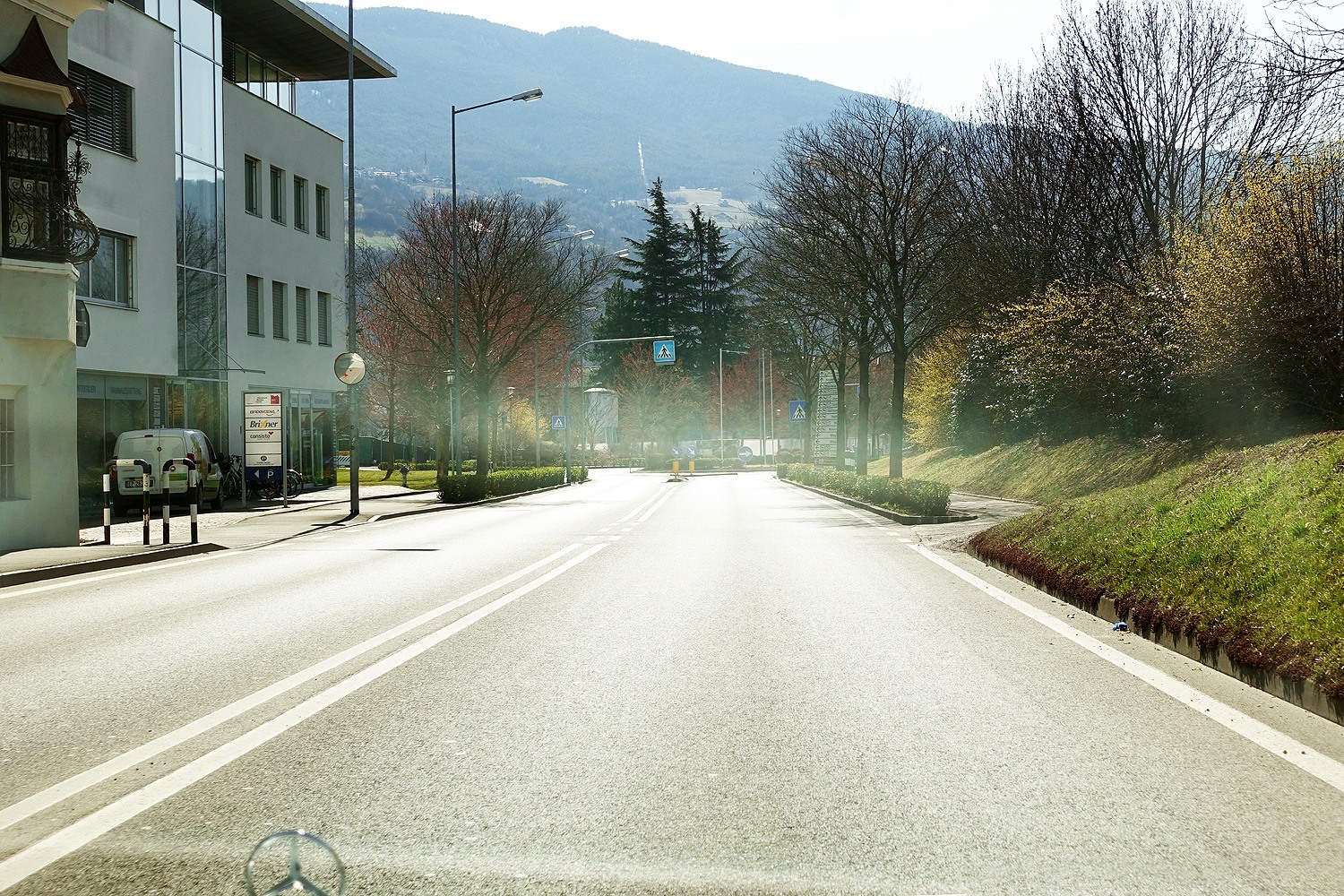
Empty main street of Brixen, South Tyrol, at midday in mid-March, 2020, because of the lockdown.
Morbid Symptoms: COVID-19 and Pathologies in the Body Politic
by Chris Horner
The crisis consists precisely in the fact that the old is dying and the new cannot be born; in this interregnum a great variety of morbid symptoms appear. —Gramsci
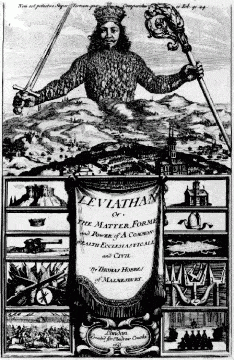
Does a crisis show us what we are ‘really like’? Whether it does or not, it has already been instructive to experience this one, in which our institutions are being stress tested, perhaps to destruction. As many have noted, COVID-19 is a political and economic crisis as well as a medical one. Its size and complexity can leave us groping around for the right interpretive and predictive tools. There are a number of models that we can turn to to help us understand how we react, or might react, and these often rest on assumptions about ‘human nature’. The problem is that they don’t agree on some basics, and thus can’t all be right. So which is the best one to turn to in a crisis?
Two Views of Human Nature
The view of humans and their social arrangements associated with Thomas Hobbes (1588-1679) is a bleak one: the human animal in the ‘state of nature’ – that is, without government or law – is in a state of constant war, or preparation for war, since no one can be sure of their own security. In the state of nature, life is ‘continual fear, and danger of violent death; and the life of man, solitary, poor, nasty, brutish, and short’ (Leviathan, chapter XIII, 1651). Only a strong sovereign power can ensure peace by imposing it through force, or the threat of force. If the civil and political bonds of such a peace are broken, we can expect people to revert to type as self interested individuals, with “war of all against all” (bellum omnium contra omnes ): a return to the state of nature triggered by the breakdown of the central authority, driven by fear of the other and only restored by force or the threat of force. Read more »
Stuck, Ch. 20. Am I a Man?: David Bowie, “Queen Bitch”
by Akim Reinhardt
Stuck is a weekly serial appearing at 3QD every Monday through early April. The Prologue is here. The table of contents with links to previous chapters is here.
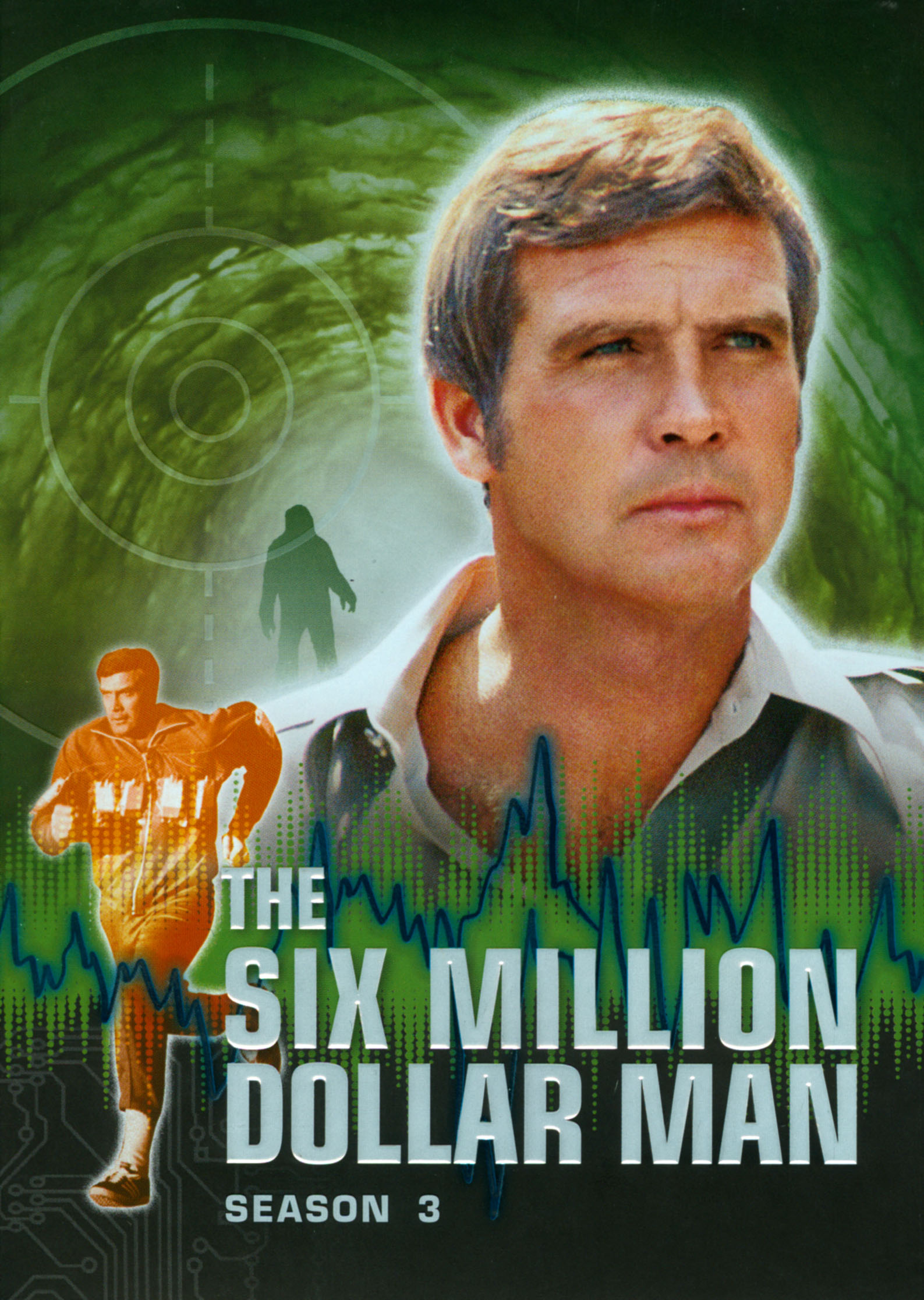 I was a minor mess in high school. Had no idea what to do with my curly hair. Unduly influenced by a childhood spent watching late ‘70s television, I stubbornly brushed it to the side in a vain attempt to straighten and shape it into a helmet à la The Six Million Dollar Man or countless B-actors on The Love Boat and Fantasy Island. I couldn’t muster any fashion beyond jeans, t-shirts, and Pumas. In the winter I wore a green army coat. In the summer it was shorts and knee high tube socks.
My home life was chaotic. My parents’ marriage was breaking down. My father drank too much, my mother screamed too much. I began spending a lot of time outside the house. I could pretty much come and go as I pleased, which was new and exciting.
I had a solid group of friends that I’m still close with to this day. Good guys. Not exactly Cassanovas. One of ‘em had a girlfriend for a bit. The rest of us didn’t have a clue. Mostly we drank, played pool, played cards, listened to music, and watched sports. I didn’t get laid. I didn’t even come close.
I went to the University of Michigan for college. I’d only applied because my mother’s friend’s son went there; mom told me Leonard liked it and that I should apply. So I did. And I got in. I also got accepted to several New York state schools, which were closer and cheaper, but I chose Michigan, even though I knew nothing about the place except for the funny football helmets. The University of Michigan was never any kind of goal. It was an accident. I didn’t even know it was supposedly an elite school.
I was 17 years old my first semester. Looking back now, I don’t think I consciously understood that I was running away as far as I could from a home life that had been emotionally volatile for as long as I could remember, but that’s exactly what I did. Read more »
Thursday, March 19, 2020
Some Unofficial Advice From Italy
by S. Abbas Raza
Since I live in northern Italy, a few friends in America have privately asked me if I have any advice for them as America now heads for the situation Italy has been facing. Most recently, my friend Anna Hall wrote this, “Are you ok Abbas? We are about to follow Italy into this abyss — suggestions for sanity and humanity welcome.” Okay, then, here is my personal, non-expert advice based on my experience so far:
• Stay calm but be concerned: this is probably the greatest single challenge the world has faced in our lifetimes. Decisions made in a panic are not good, so meditate, take your anti-anxiety medication, and don’t keep reading everything about Corona all day every day—I did that for a couple of days and then I couldn’t sleep. It is very important to pay attention to one’s mental well-being at this time, as well as physical.
• It is best to get serious advice and information from reputable scientific sources, not friends, family, or Facebook. Go here for some resources.
• Stay at home. Buy groceries for at least a week at a time (two if you can do that) and then don’t be tempted to run out for that one brand of potato chips you suddenly have a craving for. Now is the time to be disciplined about this. As one doctor advised, behave as if you have the virus and don’t want to give it to others.
• A good way to make a comprehensive grocery list is to walk through each room in your house with a pad and pen and look around carefully and see what you might run out of in the next week or two. This way, I remembered to buy shaving blades when I was in the bathroom looking around, for example, which I would have forgotten otherwise. Same happened with laundry detergent in the laundry room, etc.
• Convince others to take the problem seriously and insist that they cancel plans for socializing, travel, etc. Do this calmly and without getting worked up, otherwise they will dismiss what you say as the product of irrational fear. This will only work if we all do it. Obviously.
• Avoid public transport and walk if you can. Driving a car is also better than public transport, for once.
• The natural tendency is to want to visit one’s parents and other family in a time like this. Don’t. Instead Skype with them and keep in touch more than normal through phone, email, social media, and every way except actually being there. Everyone needs reassurance these days, and it’s nice for people who love you to hear your voice.
• Just in case, make a plan with your family about what you will do if one of you gets sick. Better to do this while calm and healthy than in a panic.
• Use this time to exercise more (we’ve been playing a lot of ping pong because we have a table at home), read, do stuff you’ve been putting off that can be done at home. Or just watch TV. That’s good too.
• I’ve also found that being extra clean and keeping the house spic and span helps a lot psychologically to ward off thoughts of disease.
• I asked my wife what she would advise people to do and she said, 1) Structure your day and have a schedule, 2) Buy hand cream because all this washing dries hands out, 3) Buy a variety of foods to store as you get sick of eating the same things, 4) Take an online course.
• Be extra kind to everyone and remain patient and avoid emotional outbursts. And stay home if you can!
Be well, and be safe.
Monday, March 16, 2020
Emancipation in Precarious Times: Review of “Capitalism on Edge” by Albena Azmanova
by Ali Minai
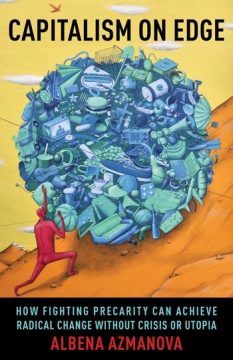 I must admit that when I first flipped through Capitalism on Edge: How Fighting Precarity Can Achieve Radical Change Without Crisis or Utopia by Albena Azmanova, it did not look too inviting. The blurbs on the jacket did nothing to reassure me, suggesting that this was yet another post-Marxist critique of greedy capitalists and their enablers. As it turns out, it is, but in a way that is more interesting than I had assumed. As soon as I started reading the Introduction, I was gripped by the lucidity of ideas and clarity of the prose. For an academic text written from the perspective of Critical Theory, this is a wonderfully direct, incisive and insightful book. One does not need to agree with all the details of the analysis to find reading it a rewarding experience.
Dr. Azmanova is Reader of Political and Social Thought at the University of Kent’s Brussels School of International Studies in Bristol, UK. She has written extensively on politics, economics, democracy, and social justice. The book is motivated by an issue that is on many minds, is the subject of many books, and has motivated recent movements such as the Occupy Movement, the Yellow Vests, and Sen. Bernie Sanders’ presidential campaign. It can be expressed concisely in terms of three intertwined questions: 1) Has capitalism led to a society that is unjust and extremely unequal? 2) Is the rise of (mostly) right-wing populism a response to this? And 3) Will this spell the end of capitalism? Her answers to these questions are: 1. Yes; 2. In part, but it’s deeper than that; and 3. Capitalism isn’t dying – just entering another phase unless we do something about it. The rest of the book is mainly about that third – most interesting – answer, and develops the idea of “precarity capitalism” – a capitalism that is all about living on the edge. Or many edges. Read more »
Monday Poem
“The writer [Lorca] died while mixing with the rebels, these are natural accidents of war . . .” —Spanish Dictator Francisco Franco.
“The country has to toughen up … part of the problem …is nobody wants to hurt each other anymore, right?” — US president, Donald Trump
Last Day of Federíco García Lorca
Federico, in pajamas and blazer died at night
wearing the sudden-death uniform of poets killed
because there is nothing more dangerous to despots
than an artist who tells the moment’s truth
because some force within insists
—accepting death for being one’s self
is life’s condition of being one’s self
because to speak is to be
This condition applies to all in all times
because nothing ever changes the constitution of love
& witness under any sky or sun. Though
the atmosphere of eras and places swings from
heaven to hell on a dime before the mass has time
to blink, and because the intractable who paint Guernica
or sing Canto Libre, artists who dare,
could well end with bullet through skull because,
to a despot, silence is golden even if desperate,
because despots know that painters and poets,
sculptors and dancers will speak truth
from momentary possession
because they’ve found the straightway
to the brainsoul of human kind,
a place despots only enter
by means of fear & blood
which always mocks
the divine
Jim Culleny
3/7/19
The last great contrarian?
by Ashutosh Jogalekar
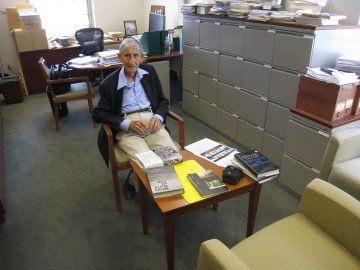
On February 28th this year, the world lost a remarkable scientist, thinker, writer and humanist, and many of us also lost a beloved, generous mentor and friend. Freeman Dyson was one of the last greats from the age of Einstein and Dirac who shaped our understanding of the physical universe in the language of mathematics. But what truly made him unique was his ability to bridge C. P. Snow’s two cultures with aplomb, with one foot firmly planted in the world of hard science and the other in the world of history, poetry and letters. Men like him come along very rarely indeed, and we are poorer for his absence.
The world at large, however, knew Dyson not only as a leading scientist but as a “contrarian”. He didn’t like the word himself; he preferred to think of himself as a rebel. One of his best essays is called “The Scientist as Rebel”. In it he wrote, “Science is an alliance of free spirits in all cultures rebelling against the local tyranny that each culture imposes on its children.” The essay describes pioneers like Kurt Gödel, Albert Einstein, Robert Oppenheimer and Francis Crick who cast aside the chains of conventional wisdom, challenging beliefs and systems that were sometimes age-old, beliefs both scientific and social. Dyson could count himself as a member of this pantheon.
Although Dyson did not like to think of himself as particularly controversial, he was quite certainly a very unconventional thinker and someone who liked to go against the grain. His friend and fellow physicist Steven Weinberg said that when consensus was forming like ice on a surface, Dyson would start chipping away at it. In a roomful of nodding heads, he would be the one who would have his hand raised, asking counterfactual questions and pointing out where the logic was weak, where the evidence was lacking. And he did this without a trace of one-upmanship or wanting to put anyone down, with genuine curiosity, playfulness and warmth. His favorite motto was the founding motto of the Royal Society: “Nullius in verba”, or “Nobody’s word is final”. Read more »
Perceptions
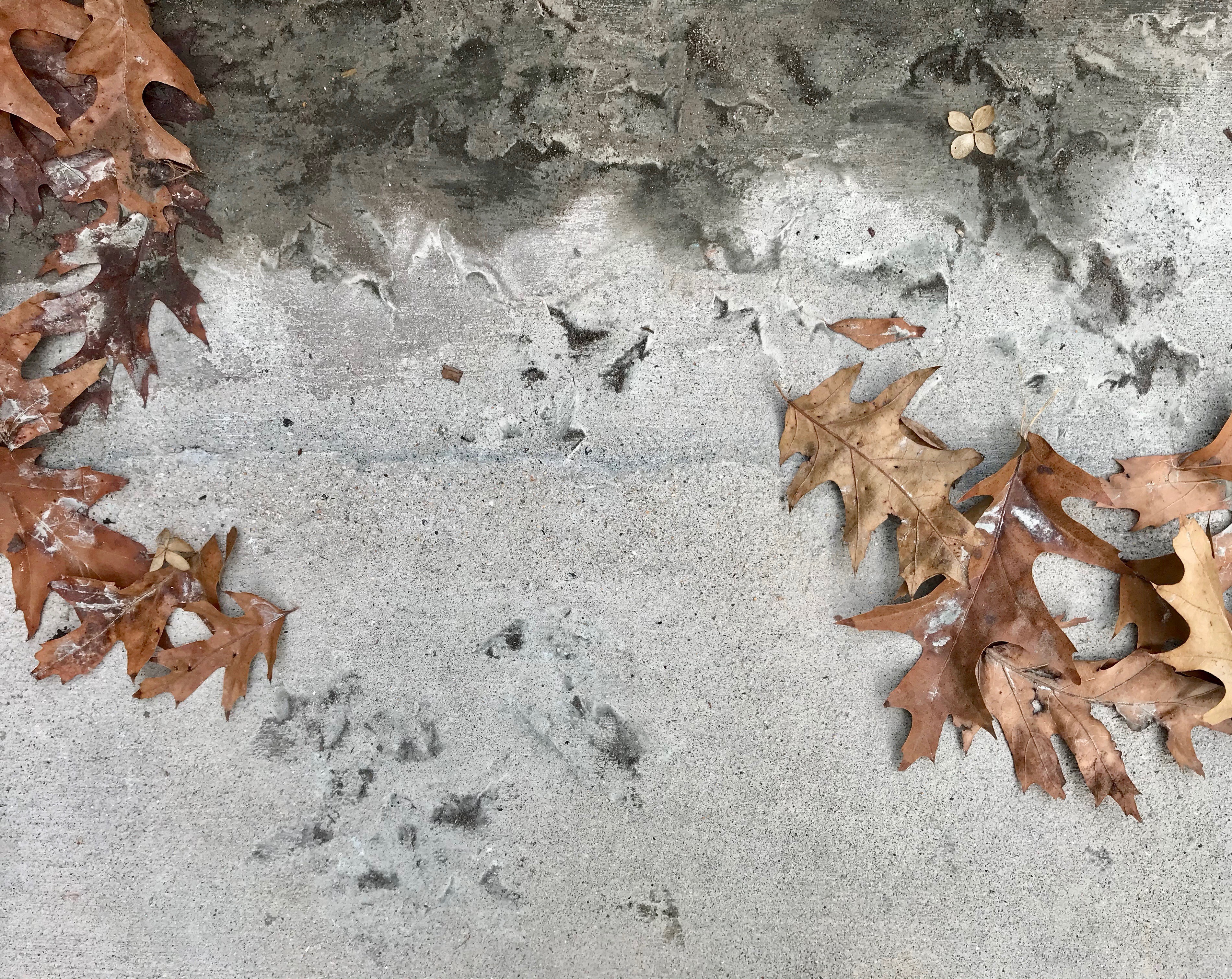 Sughra Raza. Mid-winter Fall. February 2020.
Digital photograph.
Whoops, I Caught the Writing-About-The-Virus Virus
by Joan Harvey
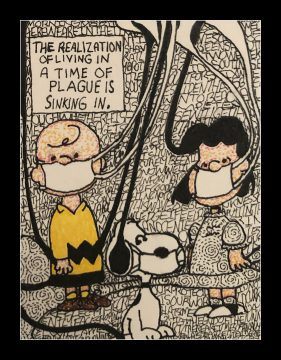
It’s a foggy gray day and the stock market is in free fall. Last week, because I’m one of those careless people who doesn’t pay too much attention to these things, I decided to go against my grain and try to educate myself a little more about the new plague. It is, anyhow, almost impossible not to think about. A short time ago it all seemed very abstract; there were only a few cases in America, and only two in Colorado. Today, although now there are only eight cases in Colorado (whoops, now nine, wait, now 17, today 33, now 77), everything looks grim. With the spread of the virus my thinking and behavior have had to keep evolving daily. And writing about this changing scenario begins to feel like trying to catch a greased pig. One day we’re behaving normally, scoffing at people in a shopping frenzy; the next week the WHO declares a pandemic and we realize we’ve seen nothing like this in our lifetime.
In an old issue of Cabinet Magazine from Fall/Winter 2003 (for some unknown reason stored on my computer), I come across an article by David Serlin, with the clever title, SARS Poetica. While SARS was far less dangerous, I’m still struck by how much in common that virus from almost 20 years ago has with our current bug: infection originating in China from the human consumption of exotic animals–in that case civet cats, in this case probably bats but possibly pangolins or possibly something else; the Chinese government in both cases concealing information about the epidemic; the photos of empty public spaces; the lost business revenue. Serlin points out that the economic losses by business were identified as the tragic victims of the virus, far more than were the actual human victims. Read more »
The Cancer Questions Project, Part 33: Özden Özer
Özden Özer, M.D. is a Hematopathologist at Marmara Leukemia Lymphoma Pathology Laboratory in Istanbul, Turkey. Dr. Özer had her medical training at Marmara University Faculty of Medicine Medical School and pathology training at Northwestern University School of Medicine, McGaw Medical Center, as well as at the University of Chicago where she trained under Drs. Janet Rowley and James Vardiman. Dr. Özer published numerous articles describing her findings in national and international medical journals.
Azra Raza, author of The First Cell: And the Human Costs of Pursuing Cancer to the Last, oncologist and professor of medicine at Columbia University, and 3QD editor, decided to speak to more than 20 leading cancer investigators and ask each of them the same five questions listed below. She videotaped the interviews and over the next months we will be posting them here one at a time each Monday. Please keep in mind that Azra and the rest of us at 3QD neither endorse nor oppose any of the answers given by the researchers as part of this project. Their views are their own. One can browse all previous interviews here.
1. We were treating acute myeloid leukemia (AML) with 7+3 (7 days of the drug cytosine arabinoside and 3 days of daunomycin) in 1977. We are still doing the same in 2019. What is the best way forward to change it by 2028?
2. There are 3.5 million papers on cancer, 135,000 in 2017 alone. There is a staggering disconnect between great scientific insights and translation to improved therapy. What are we doing wrong?
3. The fact that children respond to the same treatment better than adults seems to suggest that the cancer biology is different and also that the host is different. Since most cancers increase with age, even having good therapy may not matter as the host is decrepit. Solution?
4. You have great knowledge and experience in the field. If you were given limitless resources to plan a cure for cancer, what will you do?
5. Offering patients with advanced stage non-curable cancer, palliative but toxic treatments is a service or disservice in the current therapeutic landscape?
The Eerie Eyes Of The Lamb
by Thomas O’Dwyer
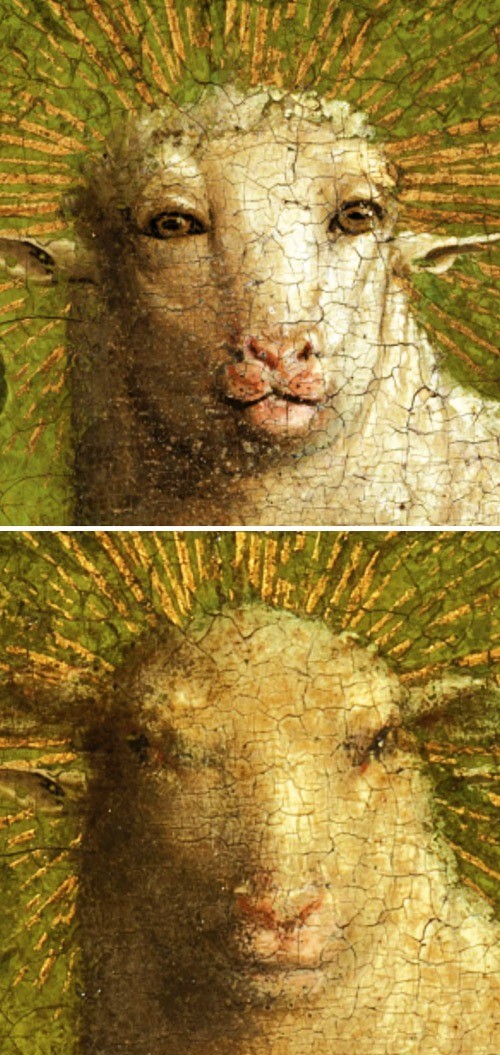
Across Europe, the doors of museums and art galleries, along with the gates of sports stadiums, are being slammed shut by the Covid-19 pandemic. This week, the oldest museum in Belgium, The Fine Arts Museum of Ghent, was among them. This is sad for it will prevent tens of thousands of art lovers and tourists from seeing a brilliantly restored 600-year-old masterpiece that has survived the slings and arrows of outrageous history to become a legend — and even a viral internet meme — along the way. Among its many adventures, it was stolen by Napoleon and was again looted and almost blown up by Adolf Hitler. Many art historians consider Jan van Eyck’s Ghent Altarpiece, also known as the Adoration of the Mystic Lamb, to be the most exceptional work of art ever created — sorry, Mona Lisa. The brilliantly restored altarpiece was the anchor of Jan van Eyck Year, a national celebration of the painter’s life and art. The exhibition, Van Eyck: An Optical Revolution, was the gold crown on the events.
Hubert van Eyck started to work on the painting around 1420, six years before his death, and his younger brother Jan continued and completed it in 1432. It is gratifying to note that the altarpiece, 3.5 meters wide by 4.5 meters tall, still stands in the place for which it was commissioned 600 years ago – in the chapel of St Bavo’s Cathedral in Ghent. But it is also startling to discover that it features in the Guinness Book of Records as the most stolen piece of art in history. Indeed one of its panels is still missing since thieves stole it 86 years ago and Belgian police have a 2,000-page file on the mystery.
The “optical revolution” title of the now-closed Ghent Museum exhibition was admirable, as even a casual glance at reproductions of the paintings make clear. We have become so used to photography and realistic art in recent centuries that it is almost impossible to imagine the impact that Jan van Eyck had on the artistic world of his day. But we can still be astonished as we examine the exquisite fine detail in every square centimetre of his work – jewellery, decorative designs on clothes and furniture, landscapes, skies, flora and fauna, even lettering. Botanists can still identify the species of meticulously painted plants — the altarpiece features 75 different kinds of herbs, plants and trees. It seems hard to grasp how such realism was captured 400 years before the first camera. Read more »
Poems and Tales
Mother Writes to the Lion of Kashmir, Long Deceased
5 August 2019
Dear Sheikh Sahib, daring son of Kashmir’s soil.
They tell me, you’re buried on the left bank
of Naseem lake, with views of the Hazratbal
shrine, which you rebuilt, your tomb guarded
by India’s paramilitary troops.
I tell them this represents one of those
paradoxes history keeps throwing up:
the same people who banished you from
Kashmir for long years now guard your tomb,
and the same people whose “Lion” you were
are disenchanted with you for selling out
to your paymasters in New Delhi who
also bankroll your son and his —both dare
not even sigh while India’s troops, shielded
by the Armed Forces Special Powers Act,
immunize themselves even for rape
as they brutally suppress a Vale of Saints.
Gone days when the refrain
Sheikh Mohammed Abdullah
answered our sovereign plea
Azadi Ka Matlab Kyah? Read more »