Apple orchard, path, and dandelion field in the hills above Franzensfeste, South Tyrol, in April of 2020.

Though we are an aggregator blog (providing links to content elsewhere) on all other days, on Mondays we have only original writing by our editors and guest columnists. Each of us writes on any subject we wish, and the length of articles generally varies between 1000 and 2500 words. Our writers are free to express their own opinions and we do not censor them in any way. Sometimes we agree with them and sometimes we don’t.Below you will find links to all our past Monday columns, in alphabetical order by last name of the author. Within each columnist’s listing, the entries are mostly in reverse-chronological order (most recent first).
Apple orchard, path, and dandelion field in the hills above Franzensfeste, South Tyrol, in April of 2020.
by Dave Maier
 The word “interpretivism” suggests to most people a particularly crazy sort of postmodern relativism cum skepticism. If our relations to reality are merely interpretive and perspectival (I will use these terms interchangeably as needed, the idea being that each interpreter has her own distinct perspective on a world not reducible to any single view), our very access to objective facts seems threatened. Nietzsche, for example, famously says that “there are no facts, only interpretations” (a careless misreading, but let’s not get into it here). Fast-forward to Jacques Derrida and the whole lit-crit crew, who claim that everything is a text; and with the triumphantly dismissive reference to that notorious postmodern imp, the game is over. Interpretation is for sissies; let’s get back to doing hard-nosed empirical science (or objective metaphysics).
On this account, the opposite of “interpretive” is something like “representational”: our successful beliefs simply get the world right, with no (subjective, open-ended, wishy-washy) interpretation required. This makes sense up to a point. Our beliefs portray the world as being a certain way, not as (primarily) meaningful or enlightening or useful, or whatever is characteristic of our favored interpretations. On the other hand, to distinguish belief from meaning in this way makes it seem as if interpretation does not concern itself with belief or inquiry at all. Yet even if interpretation is not the same as inquiry, or meaning the same as belief, they are – or so we post-Davidsonian pragmatists claim – more closely intertwined than this dichotomous account would indicate.
One way to sort this out is to jump right into it with a close analysis of the notions of meaning and belief in the manner of the later Davidson and Richard Rorty’s frustratingly dodgy use of same. We’ll do more of that later on (he warned); but today I wanted to try another tack. It is generally accepted that history in particular is an interpretive discipline (a “humanity,” not a “science”), yet it is commonly accepted as well that historians deal in facts. If we can see how this conceptual accommodation works in the narrower context, we may be able to transpose it, or something like it, into our larger one. In this post I will set the problem up, leaving you in suspense until next time when I reveal a possible solution. Read more »
by Leanne Ogasawara
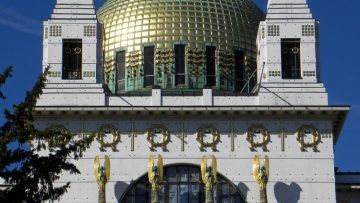
Arriving in Vienna, we immediately set out for District 14, in the western suburbs of the city. Exhausted after the long journey from Los Angeles, all we wanted to do was get something to eat and crash out in our room. Unfortunately, Viennese architect Otto Wagner’s legendary church was only opened to the public for four hours a week –on Sundays from noon to 4pm. And today was Sunday, so it was now or never!
Completed in 1907, the Kirche am Steinhof is considered to be one of the the most beautiful Art Nouveau churches in the world. Located on top of a wooded hill (Ah, the Vienna Woods!), the church is part of a sprawling psychiatric hospital—once one of the largest in Europe. It is also the place where a dear friend of mine had gone on her first date with the man she fell madly in love with decades ago.
It was an odd spot for a first date. But my friend assured me: It had been perfect–and they were still going strong!
Still, I had never been on the grounds of a psychiatric hospital before. The guard stationed at the front gate inquired if we wanted to see the church: Kirche? We nodded, and he pointed up the hill. There were maybe a dozen old buildings, each set within its own grove of trees, dotting the extensive grounds. The church loomed large above the wooded landscape. Its golden dome–recently renovated– was gleaming in the brilliant sunlight. I could easily understand why the locals called it: limoniberg (the lemon hill).
The hospital grounds were a cheerful place. It was only later that I learned its terrible history. Read more »
This pandemic changes everything, we can’t go back to the way we were. That’s what everyone is saying. Well, not everyone, but I don’t know how many times I’ve read some version of that over the past month.
I would like to reflect on that theme, albeit in perhaps and oblique and impressionist manner. I want to begin by invoking a recent essay in which Marc Andreessen urges us to “reboot the American Dream.” Then I move back half a century and look at Walt Disney’s version of, well, the American Dream. I return to the present through an essay by Ezra Klein and conclude with a video in which Sean O’Sullivan talks of how he came to form an NGO that worked on building Iraq early in this millennium.
Marc Andreessen: Let’s Build Something!
Roughly two weeks ago a prominent Silicon Valley venture capitalist, Marc Andreessen, issued a call to action, It’s Time to Build, which has been getting a lot of action, pro, con, and sideways. Here’s how it opens:
Every Western institution was unprepared for the coronavirus pandemic, despite many prior warnings. This monumental failure of institutional effectiveness will reverberate for the rest of the decade, but it’s not too early to ask why, and what we need to do about it.
Many of us would like to pin the cause on one political party or another, on one government or another. But the harsh reality is that it all failed — no Western country, or state, or city was prepared — and despite hard work and often extraordinary sacrifice by many people within these institutions. So the problem runs deeper than your favorite political opponent or your home nation. Read more »
by Zara Houshmand
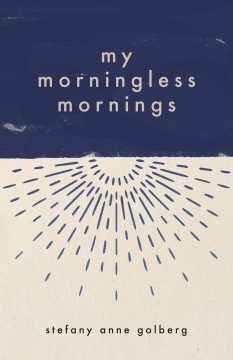 Stefany Anne Golberg’s My Morningless Mornings is one of the most unusual books I’ve ever encountered. It’s very quietly ambitious, framing its aspirations without obvious fanfare, and it accomplishes them with rare elegance and efficiency.
Ostensibly the book is a memoir, but just barely. Its narrative scaffolding consists of memories from a period of Golberg’s life when, as a young teenager, she kept a nightly vigil in her suburban Las Vegas home while her father descended into mental illness. The rest of her immediate family had jumped ship. Staying awake every night until dawn and then sleeping from dawn until noon, she evaded the morning—a time fraught with anxiety and the burdens of reality. The night time hours were filled with the drone of old films and documentaries on television and with stacks of library books and encyclopedias that fed her self-directed education.
That narrative scaffolding is constructed with exquisite finesse and reserve, without the faintest hint of melodrama. The things unsaid—the absences—are as powerful as what is revealed. Consider this passage:
From the window I could also see the evergreen trees that had been planted in front of my house when I was one year old. They had become sick and thin, following the rest of the backyard, making it easier for the sun to reach the anguished message my father had scrawled in giant block letters on the driveway earlier that spring.
What were they, the trees? Junipers, I think. They had round, pale fruits that tasted like rocks and were the color of a northern sea, the color of water Jules Verne must have sailed across in his little wooden skiff, the color of Jacques Cousteau’s eyes when he gazed across the bow, just before diving down deep. Maybe this is the fear we all share. That when the morning comes, and shines its light, we will have to read the message that has been put there before us. Or worse, that there will be so much sunlight and nothing at all to see.
That single image of the message written on the driveway is the totality of the story, one of a small handful of carefully placed details where the constant background tension of her father’s decline breaks through the surface. But in the voids created by that minimalist narrative, another world emerges. Here the mention of Jules Verne and Jacques Cousteau looks back to a passage earlier in the book, that launches from Cousteau’s late night television documentaries, and how Verne’s imaginary expeditions inspired his career, into the fathomless, sunless, undersea world as an expression of shadow work, and Verne’s fantastic vehicles as fully contained interior spaces where “a ship is a symbol for the perfection of one’s inner humanity.”
These chains of reflection crisscross through the book, weaving together themes of darkness and light, sleeping and waking, and the transitional regions of dawn’s twilight and the dream world. Read more »
by Scott F. Aikin and Robert B. Talisse

Democracy is a precious social good. Not only is it necessary for legitimate government, in its absence other crucial social goods – liberty, autonomy, individuality, community, and the like – tend to spoil. It is often inferred from this that a perfectly realized democracy would be utopia, a fully just society of self-governing equals working together for their common good. The flip side of this idea is familiar: the political flaws of a society are ultimately due to its falling short of democracy. The thought runs that as democracy is necessary for securing the other most important social goods, any shortfall in the latter must be due to a deviation from the former. This is what led two of the most influential theorists of democracy of the past century, Jane Addams and John Dewey, to hold that the cure for democracy’s ill is always more and better democracy.
The Addams/Dewey view is committed to the further claim that democracy is an ideal that can be approximated, but never achieved. This addition reminds us that the utopia of a fully realized democracy is forever beyond our reach, an ongoing project of striving to more perfectly democratize our individual and collective lives.
This view is certainly attractive. Trouble lies, however, in making the democratic ideal concrete enough to serve as a guide to real-world politics without thereby deflating it of its ennobling character. Typically, as the ideal is made more explicit, one finds that it presumes capacities that go far beyond the capabilities of ordinary citizens. It turns out that democracy isn’t only out of our reach, it’s also not for us. Read more »
I went for a walk in the afternoon.
I don’t like all the people with their masks.
I don’t like people without masks, they are suspicious.
I don’t like the people I encounter,
Because they force me to pull up my annoying mouthguard.
I don’t like the empty streets because I don’t encounter anyone.
I don’t like myself because I’ve had too much of it these past few weeks.
A friend recommended me to go to the balcony and look at the stars, they are especially beautiful to see right now, but it’s cloudy here.
At least you can smell the neighbor’s lilac.
That’s good.
Listening to “Song of the Wind” by Carlos Santana, I still like it.
That’s good too.
by Georg Hofer, translated from the original German by Facebook’s algorithm
***
by Anitra Pavlico
 As we continue to distance ourselves from others in the midst of the new coronavirus pandemic, we hear about other people’s new rituals and routines as we formulate our own. As each day to be spent at home stretches (looms) ahead of us when we awake in the morning, rituals give the day shape, symmetry, a framework. What significance do these new rituals have for us individually and as a society? What did the old rituals mean? What if we were to take an anthropological approach to our own predicament?
Health experts are now saying that the time-honored greeting in the West, the handshake, should be reexamined. Anthony Fauci says: “I don’t think we should ever shake hands ever again, to be honest with you.” While the origins are uncertain, people from ancient Egypt to Mesopotamia to ancient Greece were depicted as shaking or displaying open hands as a sign of trust thousands of years ago. People would show their empty right hand to demonstrate that they were not carrying a weapon and that they had amicable intentions. While the original motivation for showing your empty hand might have faded, the handshake is still a potent signal of willingness to cooperate and of trustworthiness. Yet as a deadly virus circulates, the handshake seems insensible. Some health experts have pointed to Japan, which has done much better than other nations in this pandemic, as a case in point: hand-shaking is not common there, and the society in general highly prizes cleanliness, with people routinely wearing a face mask even if they only have a common cold. It is hard to imagine the handshake going away, but the longer the pandemic lingers, the more likely that something else will enter the mainstream to take its place. The key is to develop ways to refuse a handshake without offending or embarrassing the other party. These social niceties do more to keep society functioning than COVID-19 has done, so far, to threaten its underpinnings. Read more »
by Christopher Horner
If you want to deserve Hell, you need only stay in bed. The world is iniquity; if you accept it, you are an accomplice, if you change it you are an executioner. —Jean-Paul Sartre
We need to learn, or re-learn, how to build comradeship and solidarity instead of doing capital’s work for it by condemning and abusing each other. —Mark Fisher
Hell is other people —Jean Paul Sartre

Politics is difficult. Doing politics, that is. The boring meetings, the leafleting, the marching in the wind and rain (if you can leave your house), the arguments, the confrontations and the blank incomprehension, the ad hominem attacks and much more. But the largest problem by far is other people. Some are the unconvinced, some are the apathetic and then there are the hostile, those you are opposing. More problematic, though, can be those who are supposed to be on your side. They can be difficult to endure. How many of them would you want to meet if you had the choice? Too often, in my experience, it is only a few, as the sheer hard work of trying to arrive at something like a collective will wears everyone out and tries everyone’s patience. Not all politics is like that of course: there can be the sense of comradeship from working with others one wouldn’t otherwise get to know. The experience of making a difference and working for a meaningful goal can be a wonderful thing.
This is hard to sustain though, when we experience defeat and frustration. The bitter moment in which one realises that for now (for how long?) the other side has the day. This has been a recent and bitter experience for the UK Labour Party supporters of Jeremy Corbyn in 2019, and of the many in the USA who marched and canvassed for Bernie Sanders in 2020, only to see him him stopped in the primaries. And quite apart from one’s official enemies, there have been real battles within those parties. With failure comes the temptation to have done, to walk away, either into inaction or in order find another, and inevitably smaller, group of like-minded activists. This latter has been a reliable feature of left politics for as long as anyone can remember: an addiction to splitting. After all, if the others aren’t part of the solution, they must be part of the problem, right? Read more »
by Tim Sommers

Suppose that we are better at recognizing and diagnosing injustices than we are at imagining what an ideal society looks like – much less redesigning our social institutions to achieve that ideal. Elizabeth Anderson, for one, has argued that egalitarians “have always been better at criticizing inequality than at devising a coherent and successful conception of a society of equals.” And Amartya Sen has argued that we don’t need any overarching ideal of justice to identify “manifest injustices”.
Suppose that justice has something to do with, or even is a kind of, equality.
The so-called Founding Fathers first principle (sans racism and sexism) was that “All… [people] are created equal.” Ronald Dworkin famously suggested that all modern theories of justice occupy the same “egalitarian plateau”. The “priority of equality” or the “presumption of equality” – the idea that equality is the default position when it comes to justice, and only departures from equality demand justification – is widely held.
Think of it like this. Aristotle said that justice was giving each person their “due” – and almost two and half millennial later Rawls and Cohen both (more or less) still agree. The presumption of equality is that what I am due is the same as what anyone is due. So, when I demand justice, aren’t I always demanding that I be treated the same – in some way or another – as others. Injustice, or at least the most basic kind of injustice, is a failure to treat like cases alike in a way that privileges or benefits some over others.
What have real life egalitarians and social justice activists wanted, then? Read more »
by Michael Klenk
 Our society needs virologists. Heeding their advice is valuable and consequential. In the Coronavirus pandemic, German politicians listened to the virologists, and Germany is doing relatively well. Other political leaders have (too long) ignored the virologists, and their citizenry is paying a high price.
Put another way; virologists appear to be systemically relevant. That term is central in the current German Coronavirus-debate. Systemically relevant institutions like hospitals, supermarkets, and gasoline stations are less affected by physical distancing measures than (allegedly) ‘systemically irrelevant’ institutions like florists, coiffeurs, theatres, and football competitions.
Talk of systemic relevance may be helpful to organise a society in crisis. It is like societal relevance with a survivalist spin. It implies that, in times of crisis, our ‘society’ shrinks back to a ‘system’ focused on the bottom levels of Maslow’s hierarchy of needs – health, food, and shelter. Societies around the globe have accepted this logic. Pandemic-related restrictions apply more strongly to those not deemed societally relevant, and people (predominantly) complied voluntarily. As an initial reaction to the pandemic, focusing on ‘systemic relevance’ has worked.
However, we can already see that ‘systemic relevance’ gets politicised. For example, lobbyists and interest groups are advocating for increased economic support or lessened Corona-related restrictions for their fosterlings, defending them as systemically relevant institutions. As the initial shocks of the pandemic have abated, as in Germany, people want to get back to normal as soon as possible and the term ‘systemic relevance’ is posed to be a vehicle for them to defend their various interests in the months to come. Read more »
by Brooks Riley
by Adele A. Wilby

After assuming the mantle of a ‘vulnerable’ member of society and with many of my contacts temporarily closed off to me consequent to the British government’s public health policy of ‘social-distancing’ in place during this coronavirus pandemic, time is something I have plenty of. Thus, I took a tour of the unread books on my sitting-room table. Three books screamed out at me that they had been waiting for some time for me to pick them up and read them, but they had been constantly pushed to the end of the queue in preference to more urgent others that were later arrivals. Now I have time for them; it was their turn to be read, and they were worthy of the attention. The complexity and beauty of plants are the themes of these three books: Jonathon Drori’s Around the World in 8o Trees, Stefano Mancuso’s The Revolutionary Genius of Plants: A New Understanding of Plant Intelligence and Behaviour and his The Incredible Journey of Plants.
Like many of us on this planet, apart from an aesthetic appreciation of plants and our favourite trees and flowers, I have not given too much attention to what actually constitutes a plant. Had I known that, according to Mancuso, 80 percent of the earth’s biomass is taken up by plants, I might have given these inhabitants of the planet greater thought. Likewise, I was astounded to learn from Drori that there are at least 60,000 distinct species of trees sharing this planet with us: understanding more about plants was clearly a necessity. Read more »
by Tamuira Reid
Go to where the trees are.
This is what the voice was saying. My voice. My real voice. Not the borrowed ones, the kind I try on for size when I can’t find my own, voices I can hide behind. Not those. My real voice likes to shoot from the gut, likes to tell me exactly what the fuck needs to happen and how it will go down. And it was telling me to go to the trees.
I find my son buried in a book in our living room, body sprawled out over the rug. I don’t say anything when I give him the backpack, not the one for school with OLLIE scribbled on the side in sharpie, the one I just found out he’ll no longer need, but the one with a roomier body and hidden pockets inside. The one that he asked for when he was four years old, the “pack-pack” that made him feel like a big boy. He didn’t want Thomas the Train that year; he wanted luggage. Something he could haul around the airport while I got us from point A to B.
I give him the backpack and watch him go to work. Just the essentials, only what you really need, although all he’s ever really needed is me. His nine year-old hands sift through shoeboxes of Legos and Hot Wheels, drawing pencils with chewed-up erasers, key chains with no keys. He begins to make decisions. Sort. Choose. Three big Ziplocs worth of toys because four is pushing it. Because if he packs too much shit he won’t have room for his snacks.
This is number twenty. The twentieth apartment we’ve lived in since he was a baby. In the city, out in the boroughs, across the country and sometimes over the ocean. Subletting, housesitting, visiting, cat-feeding. Staying afloat on adrenaline, on single-mom scrappiness. I want you to see the world, even if it means we don’t always have a place to come back to. There’s a storage locker somewhere in the Bronx full of my stuff, and it’s been sitting there, rotting, for over a decade. We’ve traded furniture for a Target purple suitcase that is duct-taped at the seams.
So when it’s time to pack, he doesn’t ask a lot of questions. He just gets busy. I think we both know when it’s time to leave. Read more »

Frederica Krüger during a rare outing now that the strict lockdown has been relaxed just a bit in northern Italy.
by Claire Chambers
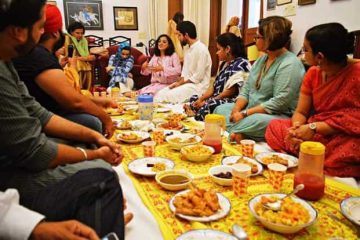
The last book I edited was about love and desire, and then I was slowly turning my attention to that other great universal pastime: food. For food is love; love in a more complex sense than mere carnality, a relationship that is layered as a paratha. The Pakistani novelist Bina Shah wrote to me about the nexus between food and love as follows: ‘Muslim South Asian cookbooks abound with tale after tale of a young child growing up watching a beloved grandmother preparing elaborate meals, sitting at the family dastarkhawan amid dozens of relatives and friends, participating in an Eid feast or perhaps wooing a possible lover with […] dishes’. Memories of love and fellowship season our memories of food, infusing particular meals with much more than the sum of their ingredients.
I was musing in this way as I began commissioning and editing a new anthology of Muslim South Asian food writing likely to be titled Desi Delicacies. But before I could finish my work, the SARS-CoV-2 pandemic really took hold and went global. I have written about how this initially paralysed me with fear so that—although I do not mention this in the article—I was unable for some time to do any further reading or writing.
I know that I wasn’t alone in experiencing writer’s block at the beginning of this lockdown. Moreover, since benefitting from an illuminating and curiously uplifting article by Aisha S. Ahmad, an academic who is no stranger to danger and puts the current health crisis in the context of other emergencies, this paralysis no longer worries me. As Ahmad writes, ‘the legacy of this pandemic will live with us for years, perhaps decades to come. It will change the way we move, build, learn, and connect. […] Your first few days and weeks in a crisis are [when] I would focus on food, family, friends, and maybe fitness’. Her recommendation that you should focus all your attention at the early phase of any crisis in looking after your mental health and securing your family and your home is sound advice. It is nothing to feel guilty about if it’s impossible to concentrate on reading, writing, and other creative or intellectual tasks at this time. Read more »
by Shadab Zeest Hashmi
“A pestilence isn’t a thing made to man’s measure; therefore, we tell ourselves that pestilence is a mere bogy of the mind, a bad dream that will pass away. But it doesn’t always pass away and, from one bad dream to another, it is the men who pass away…” —Albert Camus (The Plague)
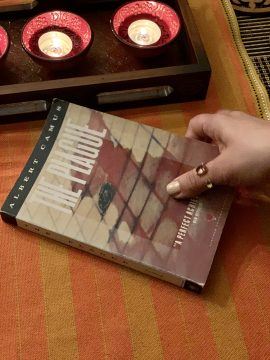
“So long as each individual doctor had come across only two or three cases, no one had thought of taking action. But it was merely a matter of adding up the figures and, once this had been done, the total was startling. In a very few days the number of cases had risen by leaps and bounds, and it became evident to all observers of this strange malady that a real epidemic had set in.” (The Plague, Page 35)
Death by pneumonia, and then another, and another, advancing in only days to large populations— caused by one of those crown-wearing microbes, a Coronavirus, deadly, beautiful under the microscope. They named it Novel Coronavirus. Once unsheathed, it leapt from animal to human, one town to another, then between land and sea borders. The first confirmed case in the United States was recorded on January 20, 2020. Only 20 days ago, we had wished each other peace and a vision clear as 20/20. But is a year of numbers and blurred vision. The Grand Princess sailed with 2000-plus, 21 infected by the time she passed under the Golden Gate Bridge. By March 18th there were 7,769 cases. Ten days later, on March 28th, they had risen to 116,505.
“The evening papers that day took up the matter and inquired whether or not the city fathers were going to take steps, and what emergency measures were contemplated, to abate this particularly disgusting nuisance. Actually the municipality had not contemplated doing anything at all, but now a meeting was convened to discuss the situation.” (The Plague, Page 15)
There was a memo early on, wasn’t there? One of them asked.
The man had no answers, only mirrors and insults inside. He spoke as if swirling in a perpetual drumroll. He appeared every day for the press conference, knotting a bright tie in a different color, head skewed; most days he favored red— red and oversized, as he snarled or shrugged at a question, red as he made his pounce. Read more »
by Pranab Bardhan
 In contrast with other genres in literature, in crime fiction, which mainly started in the mid-19th century, women writers (and even women sleuths) became active around the same time as male writers and sleuths in their stories. By some accounts around the middle of 1860’s, both the first modern detective novels (by female as well as male writers in US, UK and France) and the first professional female detectives in them (one Mrs. G— in one case, Mrs. Paschal in another, both working for the British police) appeared. Most of us, of course, are more familiar with characters in the Golden Age of crime fiction of the 1920’s and the 1930’s, particularly, Agatha Christie’s Miss Jane Marple and Dorothy Sayers’ Harriet Vane. The number of female writers and sleuths has proliferated in recent decades. It goes without saying that not all of the female crime novelists come out as feminists, and that some male writers can do feminist crime novels quite well.
Yet the stereotypical case of male crime novels has involved women as femme fatales (usually creatures born of male anxiety), or more often as victims of horrendous crimes, with a common display of vicarious eroticism over mangled beautiful female bodies. In more recent years we have met other creatures of male fantasy, like the freelance superwoman sleuth (and computer hacker) with a traumatized past, Lisbeth Salander, in the Swedish international best-selling Millennium series, that started in 2005 with The Girl with the Dragon Tattoo by Stieg Larsson, and continued after his death by David Lagercrantz, stories full of rape, murder, vengeance and computer hacking of dire secrets. (On computer hacking, a worthy successor of Lisbeth in sheer technical virtuosity is a brilliant female black teenager, Sam Morpeth, in Christopher Brookmyre’s recent thriller, The Last Hack; all through her dangerous heroic exploits she, however, never forgets to take care of a younger sister with learning disabilities while the mother is in prison). Read more »
by Ashutosh Jogalekar

Neil Shubin’s “Some Assembly Required” is a delightful book whose thesis can be summarized in one word – “repurposing”. As Steve Jobs once put it, “Good artists create. Great artists steal”. By that reckoning Nature is undoubtedly the most magnificent thief and the greatest artist of all time. Repurposing in the history of life will undoubtedly become one of the great paradigms of science, and its discovery has not only provided immense insights into evolutionary biology but also promises to make key contributions to our understanding and treatment of human disease.
Among many other achievements of Darwin’s great theory was the explanation and prediction that similar parts of organisms had similar functions even if they might have looked different. One of the truly remarkable features of “On the Origin of Species” is how Darwin gets almost everything right, how even throwaway lines attest to a level of understanding of life that was solidified only decades after this death. The idea of repurposing came about in the “Origin” partly as a reply to objections raised by a man named St. George Jackson Mivart. Mivart was in the curious position of being a man of the cloth who had first wholeheartedly embraced Darwin’s theory and studied with Thomas Henry Huxley, Darwin’s most ardent champion, before then rejecting it and mounting an attack on it, timidly at first and then vociferously. Mivart’s own tract on the subject, “On the Genesis of Species” made his not-so-subtle dig at Darwin’s book clear.

Mivart’s basic objection was similar to that raised then and later by creationists. Darwin’s theory crucially relied on transitional forms that enabled major leaps in life’s history; from fish to amphibian for instance or from arboreal life to terrestrial life. But in Mivart’s view, any such major transition would involve not just a sudden change in one crucial body part, say from gills to lungs, but a change in multiple body parts. Clearly the transition from water to land for instance involved hundreds if not thousands of changes in organs and structures for locomotion, feeding and breathing. But how could all these changes arise out of thin air? How could gills for instance suddenly turn into lungs in the first lucky fish that crawled out of water and learnt how to survive on land? This problem according to Mivart was insurmountable and a fatal flaw in Darwin’s theory. Darwin took Mivart’s objections seriously enough to include a substantial section addressing them in the sixth and definitive edition of his book, first published in 1872. In it he acknowledged Mivart’s problems with his theory, and then did away with them succinctly: There is no problem imagining organs being used in different species, Darwin said, as long as they are “accompanied by a change in function.” In writing this Darwin was even further ahead of his time than he imagined. Read more »