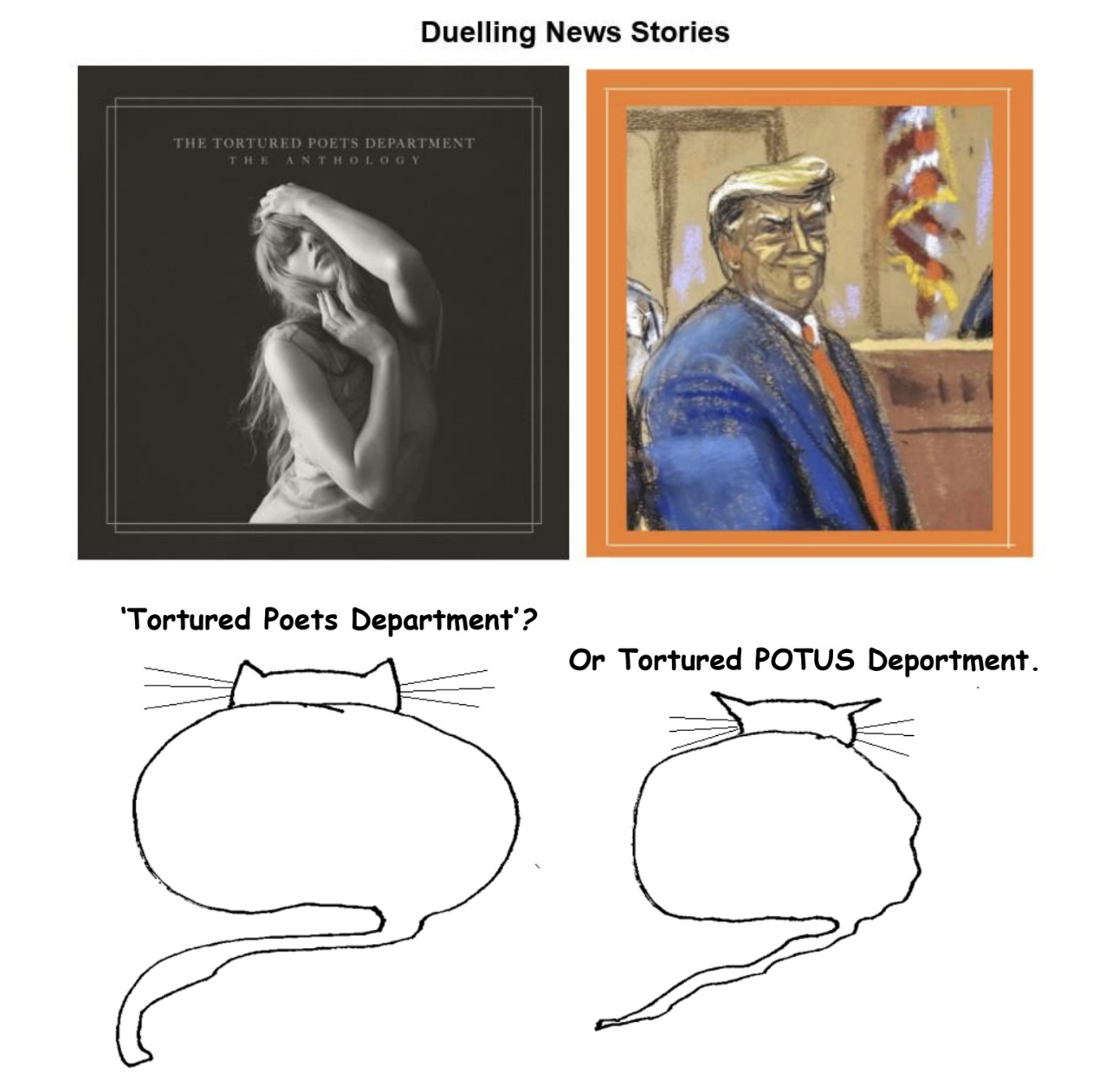
“No footballer no football manager no football club no football reporter no football pundit no Ian Wright no Gary Lineker no football authority of any kind not FIFA not UEFA not the FA not one of them has even mentioned the murder on screen of the captain of the Palestine football team recording his own death at the hands of the Air Force of a country that still fully participated in every one of your football tournaments and competitions.”
Words by George Galloway, M.P. Found by Rafiq Kathwari
Click on Read More for translations into Irish, German, French, Scot, and Slovenian by eminent literary figures at the invitation of Gabriel Rosenstock, the noted Irish poet. Read more »
Professor, writer, talk show host, part-time guitarist–Robert Pogue Harrison stands in a category of one among American intellectuals of his generation.
His first book, The Body of Beatrice (1988) a study of the Vita Nuova, lay well within his wheelhouse as a Dante scholar; since then, however, Harrison has charted an increasingly idiosyncratic course as a thinker, a writer, and an educator––in the broadest sense of the word.
Harrison joined the faculty of Stanford in 1986 and became chair of the Department of French and Italian in 2002. He turned 70 this year and announced his retirement. (Andrea Capra’s tribute, part of at a day-long celebration of Harrison’s career at Stanford held on 19th April, was recently republished by 3 Quarks Daily.)
Harrison has written books at a steady clip, each beautifully written and finely wrought, combining intensely felt thought and erudition with quietly challenging daring. His subjects–the forest, the garden, the dead, our obsession with youth–might appear dauntingly bottomless. Yet Harrison’s style, a graceful inter-flowing of literary, philosophical and (increasingly in his recent work) scientific reference-points, gives the impression that one is both ascending and descending, reaching strange giddy heights while delving deep to the essential mysteries at the core of the matter in hand.
It’s the same style that marks the conversations and monologues of his radio show-cum-podcast, Entitled Opinions. I stumbled across an episode of Entitled Opinions sometime in 2020 on the iTunes Podcast app while looking for something about W.H. Auden. But the show has been broadcasting for almost 20 years, “down in the catacombs of KZSU” (Stanford’s local radio station) where, in Harrison’s phrase, “we practice the persecuted religion of thinking.” Read more »
Suppose a cop pulls you over for speeding. What do you think should happen? My guess is you think he should give you a warning and let you off without a ticket. Why? Well, because you will, no doubt, be polite, respectful and contrite (or at least you will attempt to appear to be) and because you are a generally law-abiding citizen, you aren’t drunk, and you are not obviously transporting guns, drugs or kidnapped children.
That’s fine, but now let’s take your personal interest out of it. Suppose a driver gets stopped for speeding. The reason for the stop is that speeding is unsafe. A speeder presents a danger. That danger has nothing to do with whether the driver is polite. Politeness and rudeness are completely beside the point. So how would you want the cop to decide whether or not to write a ticket? What criteria would you want him to use?
How about tribal membership? When I was a kid my world was divided into two tribes. There were long-haired, hippie pot smokers like me on one side and short-haired, beer-drinking cops on the other. It was a simpler time. We made life miserable for each other whenever we got a chance. I suspect none of us today believes that tickets should be issued or not issued based on tribal membership, however delineated. Too much room for mischief. But we also don’t think everyone who gets pulled over should get a ticket. So, if it isn’t politeness, and it isn’t tribal membership, what should the determining factor(s) be? Read more »
There is a meme on the internet that you probably know, the one that goes, “Men will do x instead of going to therapy.” Here are some examples I’ve just found on Twitter: “Men will memorize every spot on earth instead of going to therapy,” “men would rather work 100 hours a week instead of going to therapy,” and “men would literally go to Mars instead of going to therapy.” The meme can also be used ironically to call into question the effectiveness of therapy (“Men will literally solve their problems instead of going to therapy”), but its main use is to mock men for their hobbies, which are seen as coping mechanisms taking the place of therapy (“men will literally join 10 improv teams instead of going to therapy”). The implicit assumption in this formula is that the best way for men to solve whatever existential problems they may have is to go to therapy. I don’t particularly like this meme, and I don’t think therapy is necessarily the best way for a man to solve his problems (although it may be in some cases), but what do I know? I’m setting myself up for this response: “men will write a 2,500-word essay about why you shouldn’t go to therapy instead of going to therapy.” Fair enough. I should specify that I don’t have an issue with therapy itself; instead, I have an issue with a phenomenon I find pervasive in contemporary American culture, which is the assumption that therapy is a sort of magic cure for any ills one may have. Read more »
The short stories in Kindergeschichten (Children’s Stories, 1969) by Swiss author Peter Bichsel are not actually for children. True, they are short, easy to read, and feel a bit like spare, minimalist fairy tales. But the moment you think you’ve grasped what they’re all about, they slip away. In the introduction to my German language edition, the stories are said to “seduce us, playfully, into thinking,”* and this was exactly my experience reading them. It’s not that they’re inappropriate for children, but more that children will likely only find them silly, whereas an adult will very likely see layers of meaning and existential crisis.
Some of the stories are about a person who takes an absurdly skeptical stance about something that is widely known. For example, in the story “Die Erde ist rund”(“The Earth is Round”), the protagonist knows intellectually that the Earth is round, but he doesn’t truly believe it, so he undertakes an absurd journey to prove it to himself.
The stories also feature characters who ridiculously imagine that they can live outside the confines of society and pursue radical autonomy. For instance, the protagonist of “Ein Tisch ist ein Tisch” (“A Table is a Table”), having grown bored with his humdrum life and grown frustrated with how things always stay the same, decides to give different names to everyday objects, with the result that no one can understand him when he speaks. He ends up forgetting the original names for things and eventually falls silent, able to talk only to himself. Read more »
Taiwan is an independent prosperous liberal democracy of 24 million free people that the Chinese Communist Party solemnly promises to annex to its empire by whatever means are necessary. Although Taiwan’s flourishing capitalist economy once allowed it to outgun and hence straightforwardly deter China from a military invasion, this military advantage has switched to China over the last 20 years. If Taiwan is to be kept free it must find another means to deter the CCP.
In fact it makes sense for Taiwan to develop a new deterrence that rests on multiple pillars and is thus robust to the failure of any one of them. Hence Taiwan appears very sensibly to be pursuing closer and more militarised alliances with America and other democracies of S.E. Asia threatened by China’s imperial expansionism (especially Japan and S. Korea). At the same time, Taiwan is moving to adopt a ‘porcupine’ strategic posture, investing in large numbers of cheap access denial weapons such as sea mines, torpedo boats, and anti-ship missiles that would exact catastrophic losses on any amphibious invasion fleet.
An additional possibility is for Taiwan to develop an independent nuclear deterrent of its own, which would be well within its technological capabilities (and something the KMT dictatorship actively pursued in the 1960s to 1980s before America persuaded them to drop it). On the one hand a nuclear deterrent would free Taiwan from dependence on US promises to risk a direct large-scale war with a nuclear armed super-power to stop a Chinese invasion (and the presidential elections that determine the worth of those promises). On the other hand, the ability to escalate a Chinese invasion to a nuclear conflict would also allow Taiwan to coerce its allies into upholding their promises of conventional military aid in case of an invasion, thus increasing the deterrence value of those promises in the eyes of the CCP. Read more »
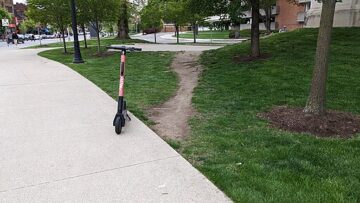
Desire path at Ohio State University. Image credit: dankeck, CC0, via Wikimedia Commons
If you spend any time in a place with public parks, gardens, or simple green areas fenced in squarely by concrete walkways, you’ll be familiar with the sight of trampled paths cutting across the grass, tracing a muddy connection through that which the street would lead you around. Depending on your mood and disposition, you might be annoyed by the sight: can’t people spend the extra few minutes to go around? Is their time really that valuable that they desperately have to cut their walk short by a few minutes? Can’t they just, well, keep off the lawn?
Or you might have perused such shortcuts yourself. Perhaps slightly sheepishly and with a vague sense of doing something forbidden, you reasoned that going all the way around to get to the bus stop is really too much of a bother—and besides, what if you miss your bus? Better to quickly dash through; it’s not like your own footprints will do all that much to deepen the path, anyway.
Or perhaps, you paused a while to wonder. Why is there a need for such a path? Evidently, enough people at point A wanted to go to point B using the shortest route to defy city planners by voting with their feet. Why wasn’t that path there in the first place?
From this point of view, such a desire path represent a failure of top-down planning to anticipate the bottom-up reality of the person in the street, so to speak. They’re a design flaw: after all, cities and the streets traversing them are (or ought to be) designed for the convenience of the humans inhabiting them. The layout the city planners intended is not a divine law, but an all-too-human best guess at what works; and desire paths are ways to demonstrate what doesn’t, not transgressions against the way things must be. In a design perfectly attuned to human needs, desire paths would be unnecessary. It’s not the people who cut across the grass that are at fault, it’s the layout of the streets that fails to conform to human needs. Read more »
It was the summer of 1961. I was six years old. My mother and I had arrived in Omaha the night before, flying out of what was still “Idlewild,” not JFK International Airport, as it is now named. We would visit relatives with roots in the same Eastern European shtetl as my mother. Unlike most of the family, this branch had left the New York area for the cornfields of the American Midwest.
The relatives—Max and his wife, Sarah, their grown children Geraldine and Stanley and a bachelor brother, Sam—were the only Jewish people on their street. My mother told me this before we left—to prepare me. She knew that coming from the Midwood section of Brooklyn, I would find this odd. No other Jews? My mind, though, was fixated on adventure, being so far from New York for the first time, meeting new cousins and taking my first airplane ride.
Cousin Sarah, her hair already white, told me she had never been on an airplane. I remember the envious tone in her voice. I noticed her tone carried a signal that I was too young, thus undeserving, to have been granted this privilege.
I blew that off, as kids do at an age when guilt does not, or should not, get in the way of a good time. My mother suggested that I go across the street to play with a little girl who lived in a big house. I probably guessed she wasn’t Jewish but my mind was still fixated on this new adventure. Read more »
If you don’t like people, you hadn’t ought to be in politics at all, and Henry talked about the common people but I don’t think he liked them… —Harry S. Truman to Merle Miller, in Plain Speaking.
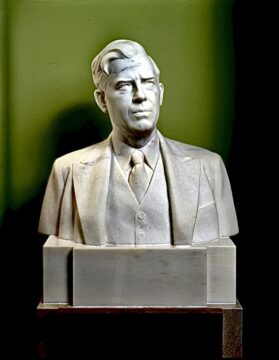
Bust of Henry A. Wallace, by Jo Davidson. U.S. Senate Collection.
Truman wasn’t the most diplomatic of men, particularly when he’d had a couple of bourbons, but as harsh as the above might sound, it was probably a pretty accurate evaluation of the man who was his immediate predecessor as Vice President and wanted to be his replacement as President. Henry Wallace wasn’t a cold-blooded stuffed shirt, like Truman’s 1948 opponent, Thomas E. Dewey. Instead, his warmth was limited to his passions, and people, at least individuals, generally weren’t among those.
This strange man—and he was strange—part visionary, part brilliant scientist, part fantasist, part organizer and administrator, part orator, alternatively inspiring and exasperating, competent and a little crazy, came very close to being President. The question of “what if he had” may be the biggest “what if” since Abraham Lincoln was assassinated and Andrew Johnson succeeded him. Had a Wallace butterfly been given enough time to flap his wings, we would probably be living in a very different world.
How different? At home, one that reflected his passions: a re-invigoration of the New Deal after the loss of velocity during World War II, and an entirely different approach toward domestic “security” with a scaled-back role for those agencies doing the “domestic securing.” Abroad, no NATO, no Marshall Plan, no Berlin Airlift, no support for a continuation of colonialism, including America’s. An altered alignment with Mao and the Chinese Communists, and, perhaps most fatefully, an entirely different approach to the use and proliferation of nuclear weapons. Finally, the Bear in the Room—a different, less confrontational way of engaging Joe Stalin and Russia.Read more »
Horizon’s circle, beyond which you can see no further in any direction other than up, hems us in, but looking up you can see forever, or as far as lightspeed allows, or until more time passes or, more accurately, until it shifts again, now.
But by then, you yourself may have passed, whatever that means, since “to pass” is merely an oblique expression that hints of standing under without understanding, although there’s so much in life that shows the truth of things spoken is deficient, yet has become second nature, and acceptable.
We’ve become creatures of holy misunderstandings and miss the mark, we sin, and live by those misunderstandings
In popular media, physics often comes up for one of two competing reasons. The first is to introduce a touch of mysticism without labeling it as such. Whether it’s Carl Sagan talking about our bones as stardust, or Lisa Randall suggesting some extra dimensions of space, these pronouncements are often presented to evoke the listener’s primal awe—an ancient and venerable form of entertainment. The second reason is just as venerable, and often as entertaining. Sometimes, physics just gets results. Think of MacGuyver in MacGuyver, Mark Watney in The Martian, or those stunt coordinators in Mythbusters—characters whose essential pragmatism couldn’t be further from the tremulous epiphanies of the theorists.
Dramatically, the esoteric and the everyday can seem like opposites, and many fictional plots seem to advise against bringing them together. Mad scientists, those cautionary anti-heroes like Drs. Frankenstein and Manhattan, are often characters who both stumble upon hidden truths and put them to terrible use. But in the real world of physics, it’s common to forge connections between the realms.
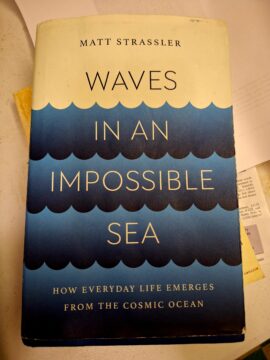
Physical analogies, examples that link unfamiliar physics to everyday experience, are important in forging such connections. Waves in an Impossible Sea: How Everyday Life Emerges from the Cosmic Ocean, a new book by the physicist Matt Strassler, is an impressive attempt to explain contemporary physics using little math but many analogies. Strassler mainly goes against the archetype of the theoretical physicist as the purveyor of primal awe. Instead, he’s a practiced teacher, more interested in accuracy than amazement. In seven concise sections—Motion, Mass, Waves, Fields, Quantum, Higgs, and Cosmos—he covers the basics of physics with minimal fuss, but with a charmingly dorky earnestness. Read more »
An avid walker, I like making great rambling loops around my neighborhood. Along the way, I’ve noticed four Little Free Libraries that I must have probably strolled past, oblivious, a thousand times… each is cute in its own way; one built surrounded by bird feeders, another positioned at the perfect height for a small child to reach inside. My favorite is in a neighborhood where the houses are a million dollars more expensive than the one’s on my side of the street—in California, it’s all about the zip code.
Having spent the past ten years building a massive multi-room library of my own, I felt I should leave these little libraries to others—But then I thought, why not just have a quick peak inside? And maybe even distribute a few books of my own…. And so, I trotted over to the one closest to my house.
Being one of those kinds of people who cares about what book sits next to another on the shelf, I spend a lot of time arranging my library. I like it when books of a kind sit side-by-side with others of a like mind. I think of them in conversation with each other: there are stacks of fiction and nonfiction related to Japan across the room from rows of essays and stories roughly revolving around the art of translation. In pride of place is my shelf of “top ten novels” and shelves devoted to the work of mentors and teachers. And, I have multiple shelves of books with ghosts. These are not ghost stories per se, but are works of speculative fiction that embrace the magical real in the world. Read more »
The barbarians and their arrogance have won, their shouted assertions offered up as commandments. No one can be right who disagrees with them.
The barbarians and their death cult have won, their zombie god lording over us. The spirits of trees and animals and waters and sky and mountains have been driven mute.
The barbarians and their lust for shiny trinkets have won, their new world a wasteland of flashy baubles. The stars are washed out above us.
The barbarians and their genocidal urges have won, their swords encrusted with dry blood. Nations uncounted decimated to tenths, or even zero.
The barbarians and their bar-bar talk have won, countless languages stricken from the mouths and ears. We can only think this way.
The barbarians and their bloody vengeance have won, howling in the name of justice. Transgressors thrown into iron cages, we are forever paying fines.
The barbarians and their greed have won, their eyes glow green. A cast of paupers define their wretched wealth.
The barbarians and their selfishness have won, their rights dictating how we must exist. Societies fragmented and families, like split atoms, reduced to sub-nuclear components. Read more »
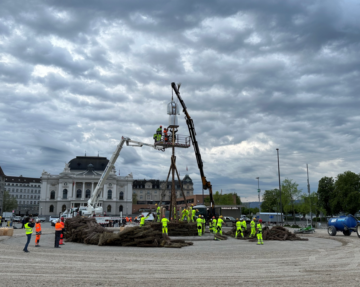
Those of us employed in the city of Zurich got some extra time off last week. Every year, on the third Monday in April following the vernal equinox, the Zentralkomitee der Zünfte Zürichs—the Central Committee of Zurich Guilds, also known by its German initialism ZZZ—stages Sechseläuten, a festival featuring a parade and a bonfire. The event, whose pronunciation in the local dialect—Sächsilüüt—makes it sound a good deal sexier and lewder than it actually is, draws in equal parts on history, historicizing revival, and mythology, and is advertised by its promoters, with a prudent hedge, as “the largest Swiss Volksfest in Zurich.”
First the history. During the 14th century, in what would one day become Switzerland’s biggest city, the tradesmen’s guilds used their growing economic might to challenge the local patriciate and were able to establish a power-sharing arrangement, with the guilds and the nobles organized into a council with variously weighted competencies. Rudolf Brun (c. 1290-1360), the leader of the guild revolution in 1336 and Zurich’s first independent mayor, is commemorated in the name of a bridge over the Limmat in the Altstadt, on the route of the Sechseläuten parade.
Brun’s newfangled corporate oligarchy lasted into the 19th century, when, as the power of the guilds was waning amid the rise of capitalism and popular democratic ambitions, the traditional medieval and Renaissance costumes of the guildsmen began to be trooped each spring as a reminder of their bygone importance: this is the historicizing element in the etiology of Sechseläuten, akin to the “revival” and marketing of allegedly traditional tribal tartans in the early modern period in Scotland, as local Scottish power had in fact been weakened.
And finally, there is the festival’s mythological source: in memory of what the ZZZ insists on calling a “heathen” custom, the advent of spring in Zurich is celebrated in mid-April with winter burned in effigy, in a recreation of a putatively prehistoric rite. Read more »

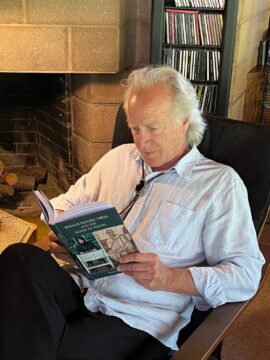

 There is a meme on the internet that you probably know, the one that goes, “Men will do x instead of going to therapy.” Here are some examples I’ve just found on Twitter: “Men will memorize every spot on earth instead of going to therapy,” “men would rather work 100 hours a week instead of going to therapy,” and “men would literally go to Mars instead of going to therapy.” The meme can also be used ironically to call into question the effectiveness of therapy (“Men will literally solve their problems instead of going to therapy”), but its main use is to mock men for their hobbies, which are seen as coping mechanisms taking the place of therapy (“men will literally join 10 improv teams instead of going to therapy”). The implicit assumption in this formula is that the best way for men to solve whatever existential problems they may have is to go to therapy. I don’t particularly like this meme, and I don’t think therapy is necessarily the best way for a man to solve his problems (although it may be in some cases), but what do I know? I’m setting myself up for this response: “men will write a 2,500-word essay about why you shouldn’t go to therapy instead of going to therapy.” Fair enough. I should specify that I don’t have an issue with therapy itself; instead, I have an issue with a phenomenon I find pervasive in contemporary American culture, which is the assumption that therapy is a sort of magic cure for any ills one may have.
 Sughra Raza. Self Portrait After Dark, Butaro, Rwanda, November 2023.
 Taiwan is an independent prosperous liberal democracy of 24 million free people that the Chinese Communist Party solemnly promises to annex to its empire by whatever means are necessary. Although Taiwan’s flourishing capitalist economy once allowed it to outgun and hence straightforwardly deter China from a military invasion, this military advantage has switched to China over the last 20 years. If Taiwan is to be kept free it must find another means to deter the CCP.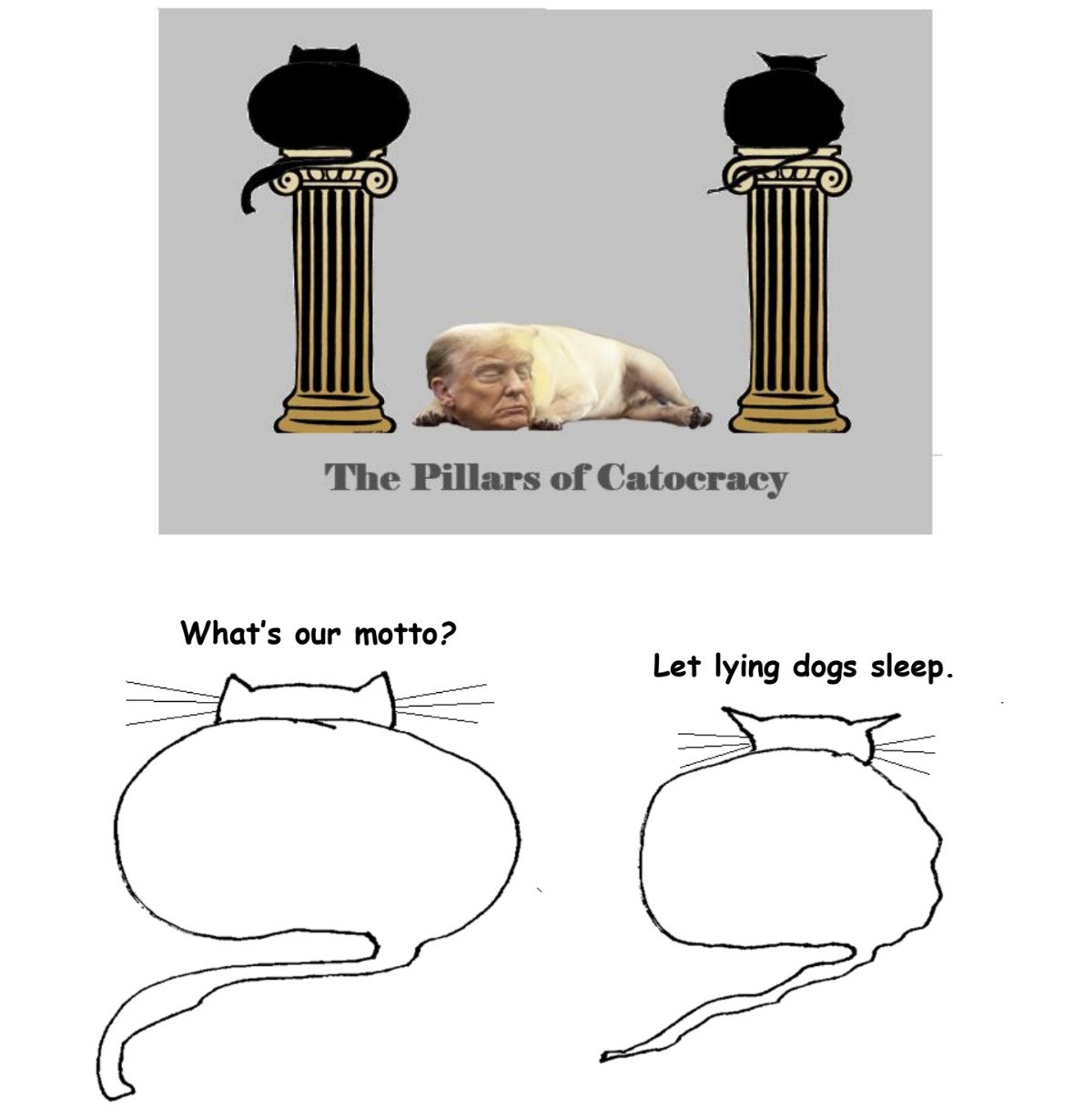

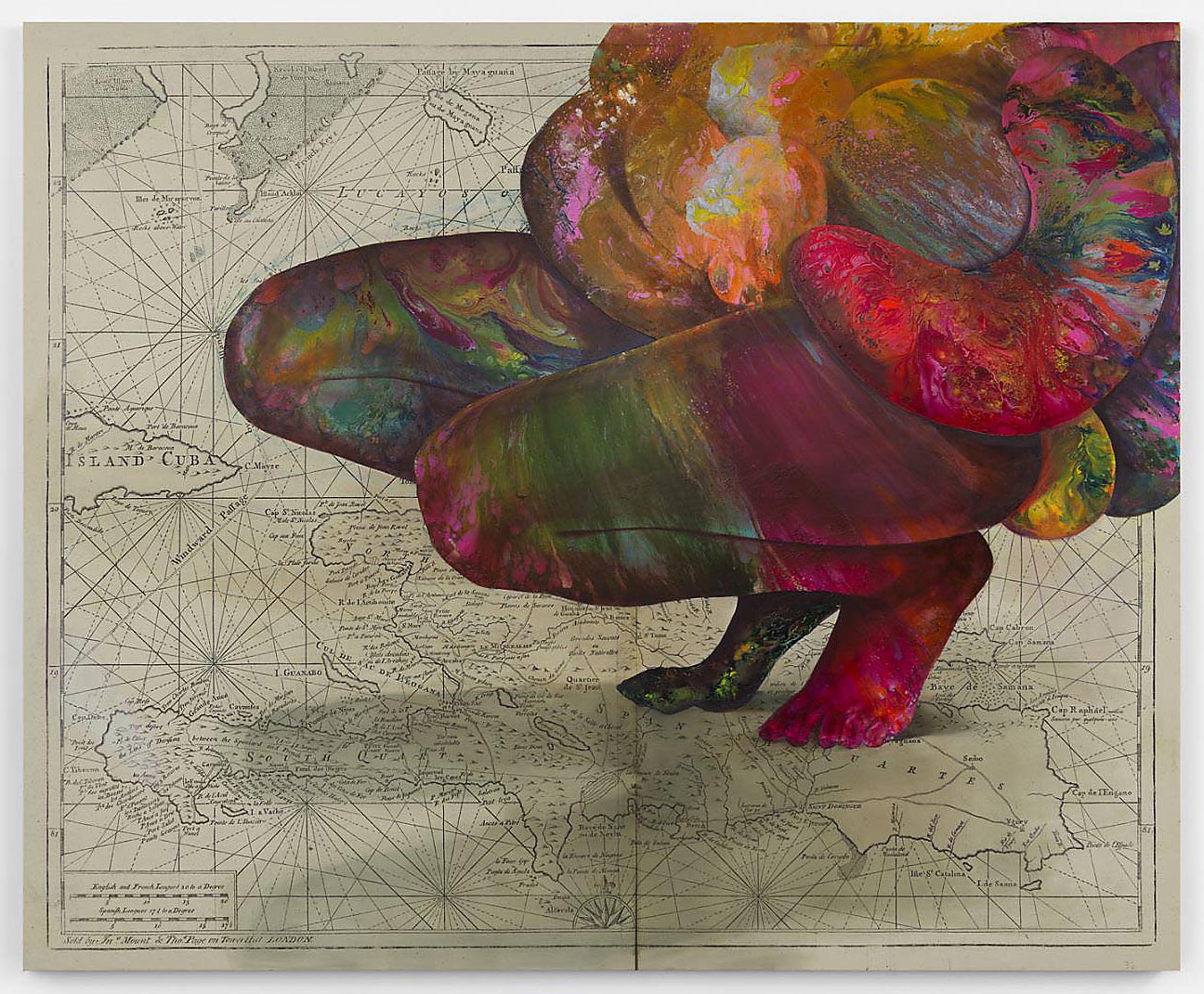 Firelei Baez. Untitled (A Corrected Chart of Hispaniola with the Windward Passage), 2020.
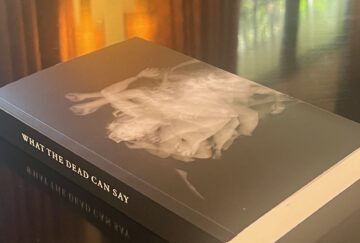 by Leanne Ogasawara
 The barbarians have won.