by Chris Horner
Death is not an event in life: we do not live to experience death —Wittgenstein
The anaesthetic from which none come round —Phillip Larkin

What can we do with the thought of death? Nothing can be done about death: you, me, everyone will die. Thinking can’t remove the fact. But the thought of death is another matter. We live with it; we get accustomed to it; we put it out of mind.
Not always of course: that epicurean advice meant to comfort us, that ‘where death is, I am not, and where I am death is not’, has its limits, particularly when we wake in the night. So does the admonition that since we don’t grieve for the aeons in the past when we did not exist, we should not mind not existing in the future. For that is what we fear: no future. We are creatures in time, forever projecting ourselves forward, and so the future we might miss weighs with us more than any past we never had. It’s another reason for dismissing the irritating injunction to live every day as if it were one’s last. We can’t do that: we need to know there will be a tomorrow.
Still, we make a pretty good fist of it on a daily basis. It’s as if the knowledge we have can be safely tucked away and disavowed: ‘I know very well how things are…but still…’ But one day, perhaps not too far in the future, we will cease to exist, be erased, vanish forever. For that is what death is, however we dress it with phrases like ‘passing on’. And we – me, you -are only one diagnosis away from that becoming imminent. Closer every day, comes that unimaginable end. Is it like going into a deep dreamless sleep under an anaesthetic and never waking? I hope so. There are lots of bad ways to die but that seems about the best to be wished for. Read more »
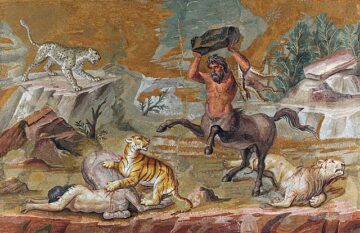 There is no genuinely effective lyric poem unless there is a line which lodges itself in the brain like a bullet. Often – though not always – these lines are the first in a poem, the better to abruptly propel the reader into the lyric. William Wordsworth’s “I wandered lonely as a cloud,” Walt Whitman’s “I celebrate myself, and sing myself,” or Langston Hughes’ “I’ve known rivers.” For example, John Donne and Emily Dickinson are sterling architects of not just the memorable turn-of-phrase, but the radiant introductory line as well. Think “Batter my heart, three-person’d God” or “I heard a Fly buzz – when I died.”

 In
In 

 Amy Sherald. They Call me Redbone but I’d Rather Be Strawberry Shortcake, 2009.
 In November 2023, in an essay for the German national newspaper die taz, I wrote that Germany’s Jews were once again afraid for their lives. It was—and is—a shameful state of affairs, considering that the country has invested heavily in coming to terms with its fascist past and has made anti-antisemitism and the unconditional support of Israel part of its “Staatsräson,” or national interest—or, as others have come to define it, the reason for the country’s very existence. The Jews I’m referring to here, however, were not reacting to a widely deplored lack of empathy following the brutal attacks of October 7. In an open letter initiated by award-winning American journalist Ben Mauk and others, more than 100 Jewish writers, journalists, scientists, and artists living in Germany described a political climate where any form of compassion with Palestinian civilians was (and continues to be) equated with support for Hamas and criminalized. Assaults on the democratic right to dissent in peaceful demonstrations; cancellations of publications, fellowships, professorships, and awards; police brutality against the country’s immigrant population, liberal-minded Jews, and other protesting citizens—the effects have been widely documented, but what matters most now is now: the fact that the German press is still, four months later, nearly monovocal in its support of Israel and that over 28,000 civilians, two-thirds of them women and children, have died.

 by David J. Lobina


 ew years, I keep getting stuck on the same question: Don’t these people have grandchildren? How can corporate decision-makers spend their days actively working to destroy the environment, pollute the water, kill off the animals, melt the glaciers, and incinerate the biosphere? Even if what they care about the most is making more money no matter how much money they already have, don’t they care at all about the world they’re leaving for their kids?