by Robert Jensen
Smart people sometimes say not-so-smart things about freedom of speech.
Let’s start with Elon Musk, the boss at Tesla and SpaceX, and his often-quoted declaration that he is a “free-speech absolutist.” Whatever one thinks about Musk, he seems to be a smart person. But that’s a silly statement.
After he bought Twitter and then banished from the platform various people whose speech he didn’t like, critics labeled Musk a hypocrite. I’m not much interested in that, since I’ve never met anyone who didn’t have a bit of hypocrisy hiding somewhere in their lives, myself included. A more important observation is that if Musk, and all the other people who claim to be free-speech absolutists, actually meant it, they would be admitting that they are moral monsters.
No one really means it. There is no such thing as a free-speech absolutist.*
To be a true absolutist—and to endorse that as the guiding principle for First Amendment law in the United States—would mean rejecting any limits on any speech no matter what the consequences. That’s what “absolute” usually means—to do something, well, absolutely, without exceptions.
Absolutism would mean there would be no libel laws allowing people to recover damages when others deliberately lie about them. There would be no laws against the distribution or possession of child sexual abuse materials, once more commonly called child pornography. There would be no laws against speech that advances a conspiracy to murder someone. And the list goes on.
Imagine that I publish a story saying Elon Musk runs an international drug trafficking ring, that he uses those illicit profits to offset hidden losses at Tesla, and that his mismanagement of the electric car company is the result of his addiction to fentanyl. That story is, to the best of my knowledge, false on all counts. If Musk sued me for knowingly making false and defamatory statements (the kind that injure one’s reputation), he likely would recover money damages, punishing me for my speech, a rejection of an absolutist interpretation of freedom of speech. Most people would agree that libel law is justified. Read more »
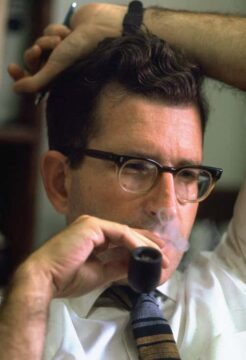 Noam Chomsky was rumoured to have left us almost a month ago, but he always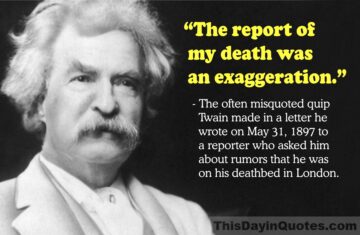


 There are only four U.S. states where white people are
 Even after discussing Daniel Chandler’s inspiring

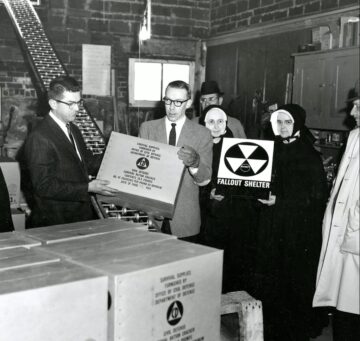 How did the survey come about? FDR had created an Office of Civil Defense in 1941, but it took the USSR’s first atomic bomb test to prompt Truman to reboot it in 1950 as the Federal Civil Defense Administration. In 1958 the FCDA begat Eisenhower’s Office of Civil and Defense Mobilization; in 1961 the OCDMA, moved by Kennedy from the executive into the Defense Department, became the Office of Civil Defense (tradition!), which soon launched its National Fallout Shelter Survey Program. Including those designated earlier, by 1963 the government had identified shelter spaces for 121 million people, and stocked enough of them for 24 million.

 For a couple of days, some things at 3QD may not work exactly as expected. We will be updating some of the pages at the site in the next few days. We appreciate your patience!