by Tim Sommers

In Bowers v Hardwick (1986), the Supreme Court Case that affirmed the government’s right to criminalize sodomy, Justice Antonin Scalia famously insisted there that there was no “right to homosexual sodomy.” This was disingenuous in more than one way. First, the statue in question criminalized sodomy in general and not homosexual sodomy in particular. But, more fundamentally, no one was arguing for sodomy as a basic right. They were arguing for a basic right to be free to make their own decisions about their own bodies, consensual intimate relations, and families – including intimate relations and the families shared by people of the same sex.
Such a right, if it exists, is unenumerated. That is, it’s not specifically mentioned in the Bill of Rights. On the other hand, the Ninth Amendment says, “The enumeration in the Constitution, of certain rights, shall not be construed to deny or disparage others retained by the people.” The tricky bit, of course, is how to know which other rights might be retained by the people though unenumerated.
In Roe v. Wade, Justice Douglas cited a “line of decisions” that established a “penumbra” of privacy. He was much lampooned for his language, “penumbra” in particular, but there’s a relatively straight forward line of reasoning available here. One way to derive an unenumerated right is to show that it is implied by, or follows from, an enumerated right. The enumerated right of citizens to be secure in their persons, houses, and papers and effects (the 4th), for example, makes no sense without the underlying assumption that you have a right to be in control of your person in the first place. Further, the “liberty” and “property” that the 14th Amendment says shall not be denied “without due process of law” surely includes the right to some degree of control over your own body.
One of the few things that Justice Alito gets right in the Dobbs (2022) decision (allowing States to criminalize any kind of abortion and, to some extent, birth control) is that he doesn’t describe the issue primarily as “privacy” – but rather as an appeal “to a broader right to autonomy.”
The relevant string of cases that develop and extend this right to autonomy and, yes, privacy, too, includes (at a minimum) Loving v The State of Virginia (the most aptly named SCOTUS case in history since it decriminalized interracial marriage), Griswold v Connecticut (access to birth control for married people), Roe v Wade (abortion decisions are left to pregnant people), Lawerence v Texas (reversing Hardwick, it decriminalized same-sex intimacy), and Obergefell v Hodges (legalized same-sex marriage). Defenders of this tradition argue that it, like the Bill of Rights itself, this is not part of a haphazard list of freedoms, but what follows from a cohesive conception of liberty. “The only freedom which deserves the name,” John Stuart Mill wrote, “is that of pursuing our own good in our own way.” Read more »
 Anjum Saeed. Untitled (After Rumi). 2012.
 In October last year, Charles Oppenheimer and I wrote a
 infamous lepidopteran, Cydia pomonella, or codling moth. The pom in its species names comes from the Latin root “pomum,” meaning “fruit,” particularly the apple (which is why they’re called pome fruits), wherein you’ll find this worm. It’s the archetypal worm inside the archetypal apple, the one Eve ate. (Not. The Hebrew word in Genesis, something like peri, just means “fruit.” No apple is mentioned. And please, give the mother of all living a break.)



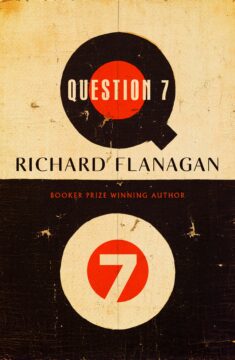 The Australian author Richard Flanagan is the 2024 winner of the prestigious Baillie Gifford Prize for Non-Fiction for his book Question 7. The book is a brilliant weaving together of memory, history, of fact and fiction, love and death around the theme of interconnectedness of events that constitute his life. Disparate connections between his father’s experience as a prisoner of war, the author H.G. Wells, and the atomic bomb all contributed towards making Flanagan the thinker and writer he is today. The book reveals to us his humanity, his love of family and of his home island of Tasmania; it is what Flanagan expects of a book when he says, ‘the words of a book are never the book, the soul is everything’, and this book has ‘soul’.
 After I moved from the UK to the US it took me only a couple of years to cede to my friends’ pleas and start driving on the right. When in Rome, and all that. But I still like to irritate Americans by maintaining that we Brits are better at this essential mechanical skill. I mean, when we drive, we
 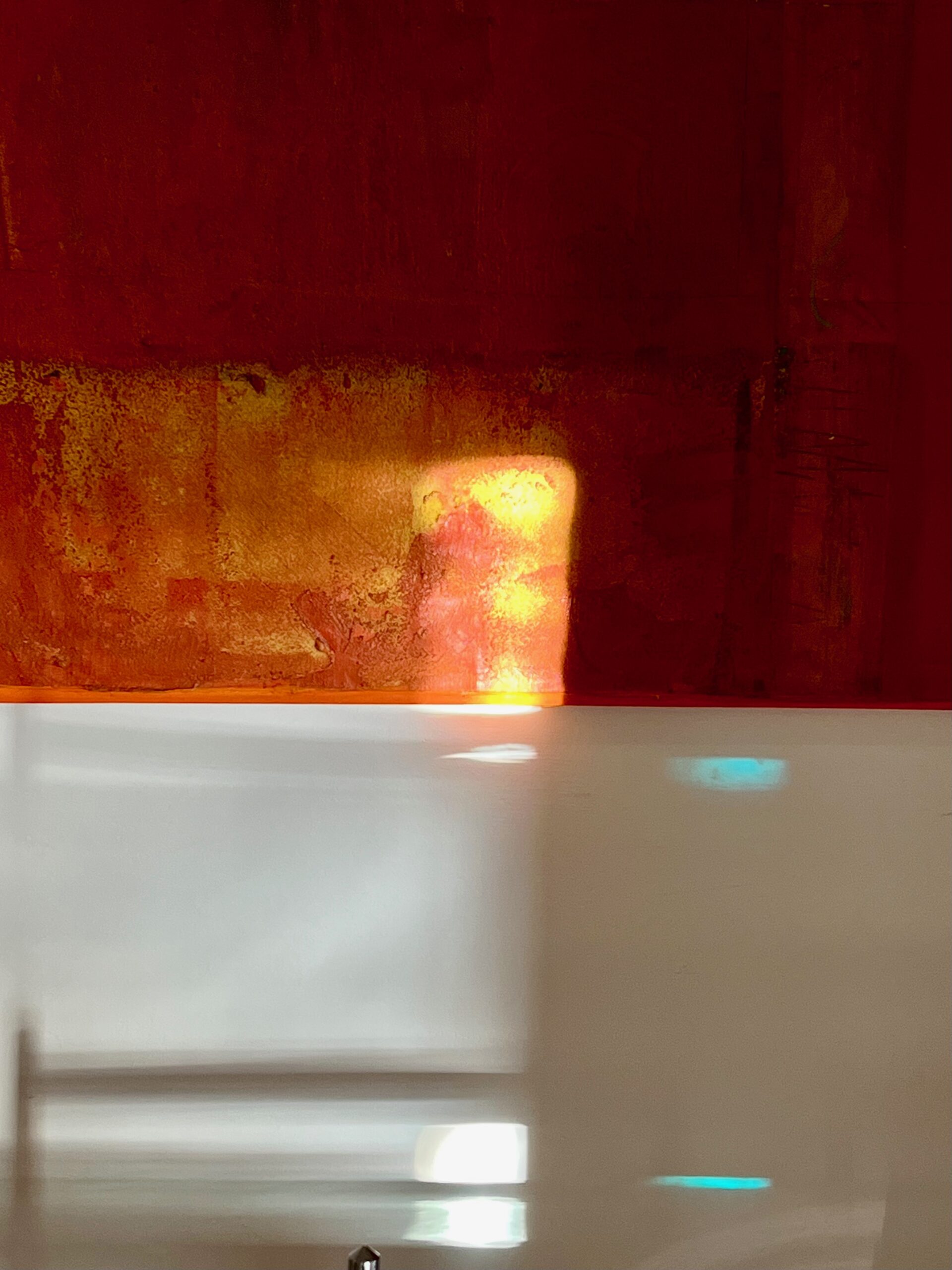 Sughra Raza. Ephemeral Apartment Art. Boston January 4, 2025.
 The same media that warned us against Donald Trump now warn us against tuning out. Though our side has lost, we must now ‘remain engaged’ with the minutiae of Mike Johnson’s majority