by Gerald Dworkin
Subjects were asked to choose between two treatments for 600 people who had a fatal disease. Treatment A was predicted to result in 400 deaths.
Frame Treatment A
Positive saves 200 lives
Negative 400 people will die
Treatment A was chosen by 72% of participants when it was presented with positive framing (“saves 200 lives”) dropping to only 22% when the same choice was presented with negative framing (“400 people will die”).
Another example: 92% of Ph.d students registered early when there was a penalty for late registration, but only 67% did so when the penalty was framed as a discount for early registration.
Those who choose because of these framing effects display a cognitive bias leading to choices that are less than fully rational.
More recently psychologists and philosophers who are part of the so-called experimental philosophy group (x-phi) turned their attention to whether such framing effects affect judgments about what to do in various well-known examples of moral dilemmas such as the notorious trolley problems. Those of you lucky enough to have escaped the latter will be exposed to them anon.
Here are some examples of framing effects in people's responses to the following hypothetical cases used by philosophers to determine what are called “moral intuitions.” These are the judgments that people make about what is right or wrong, and what they would choose to do in these cases.
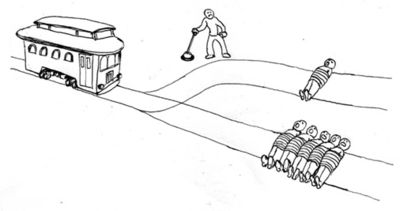
1) Standard trolley case. A runaway trolley is heading for a track on which five people are trapped. You are standing by a switch that can divert the trolley onto a track where there is only one person trapped. Should you or should you not divert the trolley?
2) Heavy Man. There is a heavy man standing on a bridge over the tracks. He is standing on a trap door that you can release by pulling a lever. If he drops onto the track with the five people ahead his body will stop the trolley before it gets to them.
3) Heavy Man. Same as above but you are standing on the bridge and have to push him over.
Many people believe that while you ought to divert the trolley in the standard case one ought not to do so in the Heavy Man case. It does not matter, for our purposes, whether you agree or not. What you probably do not believe, and should not believe, is that the order in which you present the cases should affect your judgments about what to do. That is, if we present 1 and then 3, or 3 and then 1, the judgments about what one ought to do in the two cases should not be affected.