Two Women

by Andrea Scrima

A few years ago, when I learned that a large trove of photographs taken, for tax purposes, between 1939 and 1941 of every building in each of New York City’s five boroughs had been digitized and published online, I set out to look for my parents’ birthplaces. Sitting at my desk in Berlin, I suddenly found myself on East 148th Street between Brook and St. Ann’s Avenues, searching for the building my mother’s grandparents purchased with the earnings of the family business after arriving in New York in the late nineteenth century. I remembered that I’d seen it in the background of an old family photograph, and so I fetched the ladder and hauled down the heavy tin box and found the picture in an old manila envelope marked “Bronx.”

My mother had been dead for several years, but here, in this sepia-toned, scalloped-edged photograph, she was a little girl of three or four, her sister eight or nine. It was summertime, she and Frieda were wearing sleeveless white dresses, and they each had a white ribbon in their hair. My mother’s right hand was resting in her sister’s lap; they were sitting on a low stone wall, scowling. Heavy shadows hung over their features, and it was difficult to tell if they were angry or merely squinting in the bright sunlight. And then I saw that what I’d long taken to be a metal grate or fence of some kind in the background was actually a stretch of arched windows reflected in a large fountain or pool.

My discovery that it was not, as I’d long believed, the steps of my great-grandparents’ building that the two were sitting on was due to the fact that I’d finally found it, found 516 East 148th Street in the online archive of the New York City Department of Records and Information Services. It was a respectable-looking five-story brick structure with flower boxes on the windowsills; it had long since burned in the Bronx fires of the 1970s and been torn down. I wondered what floor they’d lived on. My mother and her sister had grown up there, attended P.S. 27 around the corner and played in St. Mary’s Park across the street from the school.

Holding their photograph in my hands and staring at the screen before me—at this building I’d gone searching for once, many years ago, only to discover that the lots had long since been redrawn and that the house number, which would have been one last trace of the vanished building, no longer existed—I felt caught in time between the two images, and all at once I understood that this picture of my mother and her sister scowling in the sun was, at the very moment a city employee photographed the building nine or ten years later, resting in a box somewhere behind that brick façade; that it was, in some form, physically present in the image, and that a twelve- or thirteen-year-old version of my mother was somewhere nearby, absent from this photograph of 516 East 148th Street, but alive and breathing; a seventeen- or eighteen-year-old Frieda, alive and breathing, just outside the camera’s frame, perhaps, or indoors, doing schoolwork. Read more »


Monday, December 23, 2019

Stuck, Ch. 7. Bartender Bookmarks: Thin Lizzy, “Rosalie”

Stuck is a weekly serial appearing at 3QD every Monday through early April. The Prologue is here. The table of contents with links to previous chapters is here.

by Akim Reinhardt

A latter day incarnation of Harper's
A latter day incarnation of Harper’s at W. 231st St. and Albany Crescent.

During high school, my friends and I used to drink at a local Irish bar. And when I say Irish bar, I don’t mean some contrived yuppie shit hole with an Irish name, a bunch of Gaelic tchochkes splattered across the wall, and overpriced pints of Guiness poured poorly. I mean a working class bar in the Kingsbridge section of The Bronx where Irish immigrants drank, mostly bottles of Bud emptied into small, stemmed glassware. Whatever’s cheap.

The place was called Harper’s. The clientele was mostly old men, with a cacophony of younger people occasionally crowding in on the weekends. Me and my friends started drinking there when we were 16. The legal age in New York was still 18, and neighborhood bars usually didn’t care so long as you were within a couple of years. I didn’t bother buying a fake ID until I went away to college in Michigan. At corner bars in The Bronx, no one even bothered to ask.

Harper’s was the kind of quiet hole in the wall where nothing was happening, but anything could happen and it wouldn’t surprise you. Like out of the blue one night, some guy setup a guitar and small PA, and started singing sad sap Irish folk songs like “I Wish I Was Back Home in Derry.” Harper’s never had live music, but suddenly there he was.

No one paid attention. He never came back.

At some point you were also sure to have someone come into the bar and try to sell you something. Maybe a woman hawking black market movies on VHS, or a huckster pretending to be deaf and mute, collecting money for a fake charity, or some guy peddling roses that you could give to your lady.

None of us ever had a lady. All we ever bought was booze. Read more »

Monday, April 30, 2018

Older White Men

by Akim Reinhardt

Old white men wearing ties can do anything they want.
-Mike Cooley, “One of These Days” (2001)

I am more powerful than I used to be, and it unnerves me.

I am a white man. And to be a white man in America is to have more power than women and people with darker skin. Just like rich people are more powerful than the poor, and heterosexuality holds more power than transexuality. I’ve been a white guy all my life, a half-century of it now, and for most of that time I’ve been aware that my skin color and increased testosterone endow me with extra power in our society. It’s been a learning curve, to be sure, one that I continue to climb as best I can. And the first lesson came at the hand of my father the only time he ever struck me.

Both of my parents suffered abuse as children, and when they made me and my sister, they swore they would not beat us. But there was this one time . . .

My father was working at a small, private school in the Bronx on a summer afternoon. The owners had hired him to repair a stone retaining wall. My father ran a small contracting business and often had one or two men working with him. Even though I was perhaps no more than six or seven years old, I knew this because I sometimes tagged along with him on jobs, like I had on this day. And so as I watched him labor and sweat beneath the hot sun, moving earth and lifting heavy stones, it occurred to me that normally he would have another worker to at least help with the worst of this grunt work. And indeed, there was another worker there. A black man who was close by, wearing work clothes and tending to some other manual task. So when my father let out a mild complaint about the weight of the rocks and the heat of the day, I offered what I thought was a perfectly reasonable suggestion:

“Why don’t have you have the black man do it?”

He turned, eyes afire, and slapped me across the face.

He thought I was being racist in a way that reminded him of growing up in segregated North Carolina, where even a white child could openly suggest the ordering around of black people. He would not suffer that in me. He would beat it out of me, if necessary.

But as soon as my tears welled up, he regretted it. He understood. Read more »

Monday, March 10, 2014

Remembering Winter

by Akim Reinhardt

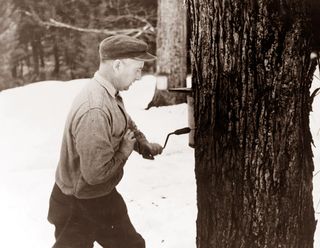
Tapping a Maple TreeIn an early episdoe of Mad Men, a character named Ken Cosgrove publishes a short story in the Atlantic Monthly. It'sentitled:

“Tapping a Maple on a Cold Vermont Morning.”

That's just about pitch perfect for the American literary scene circa 1960. The coating of influential New England literati is so thick on the young author, you can practically see it glisten.

But the reason I recently remembered “Tapping a Maple on a Cold Vermont Morning” had nothing to do with Mad Men or literature. Rather, it's because of late I've been remembering winter.

For much of the United States, including here in Maryland, it has been a particularly fierce winter. Not the snowiest necessarily, though there has certainly been snow. But long and cold.

This is my 13th consecutive winter in Maryland, and it's the first one that harkens back to my experience of onerous winters in harsher climes.

From the mid-1980s to the late 1990s, I toughed it out, spending the better part of seven winters in southeastern Michigan and another five in eastern Nebraska. These are serious winter places. They're not Siberia or Winnipeg, but they will punch you in the face, and you need to come to terms with that if you live there.

Southern Michigan winters, first and foremost, are just plain long. Snow usually begins falling in November and never quite goes away. Just when you think it might all melt off, boom! Another half foot covers everything. None of this March goes out like a lamb stuff. Every bit of March is winter. So is a chunk of April.

When will it end? you find yourself pleading aloud to no one in particular. It just goes and goes and goes. It grinds you down and forces you to get back up again. Every year you know what you're in for. Body blow after body blow. And you wonder to yourself how the people from northern Michigan and the Upper Peninsula, the ones who mock you for your soft, southern winters, how do they do it?

Read more »