
by Ken MacVey
There are many causes of Trump’s double ascent as president, including, perhaps just randomness, such as Comey’s re-opening of the FBI investigation of Hillary Clinton 11 days before the 2016 election supposedly based on a belatedly discovered laptop. But it can be argued there were a number of background features in our economic, legal, and political landscape that would still have made some version of Trumpism more likely with or without Donald Trump as its specific exemplar.
Here we will review how the stage was set for the establishment of America’s version of crony capitalism even if Donald Trump had been sent back by the voters to The Apprentice instead of the White House. The focus will be on two factors: the “corporate greed is good” ethos that Milton Friedman helped promote and Supreme Court decisions, such as Citizens United, that radically transformed how election campaigns are funded. The two in fact go hand in hand in fueling crony capitalism that ironically runs over the vision of capitalism Friedman promoted and the rule of law upon which the Supreme Court’s authority rests. We will then see how Trump 2.0 has taken full advantage of this stage setting.
What Is Crony Capitalism?
The phrase “crony capitalism” refers to reciprocal relationships between elite groups of monied businesses and individuals on one hand and political officials on the other within a backdrop of private and public sectors. By these relationships each side economically and politically prospers by the exchange of money and government favors on a transactional basis. This seemingly populist phrase apparently was coined in the 1980s by Time magazine’s business editor. Yet the phrase in recent years has been ascendant, used both by leftist anti-capitalists and right-wing conservatives and libertarians to disparage government and business relationships they disfavor. The specific phrase has even gained attention in some academic circles as a designated field of study. These studies focus on dealmaking between financially well to do elite businesses and key public officials by which “scratch my back and I’ll scratch yours” dealings they hope to prosper. These studies have focused on countries in East Asia and Latin America and particularly India and Russia. So far, the United States not so much.
Stanford political scientist Stephen Haber, in an essay on “The Political Economy of Crony Capitalism,” argues that these relationships flourish when the rule of law and governance institutions such as an independent legislature or judiciary are weak or lacking. He hypothesizes that because businesses cannot rely on conventions and institutions to provide a stable framework to protect property rights businesses have to resort to financial incentives to get political officials to provide an alternative form of stability. Businesses recognize dictatorial or capricious governments have the power to take away their property and thus these businesses are willing to shell out money as an insurance policy against political caprice. Read more »
 A good weather colloquialism can be quite suggestive. Take



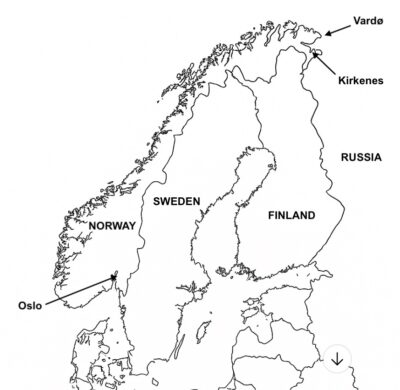 It’s different in the Arctic. Norwegians who live here make their lives amid long cold winters, seasons of all daylight and then all-day darkness, and with a neighbor to the east now an implacable foe.






 by David J. Lobina