
by Lei Wang

My best friend sometimes requests on first dates that they both get there 45 minutes early and work at the coffeeshop or bar together in silence; if her date doesn’t have their own quiet work to do, they can otherwise entertain themselves or just watch her write. But Do Not Disturb. She needs to write her novel in peace, but also she needs a supervising adult to help her write, please.
I am surprised at how many strangers say yes to and then obey this invitation (out of dozens, she has only gotten one outright refusal and one who didn’t take her seriously and tried to distract her, which didn’t end well for him). Then again, maybe everybody hustling in L.A. just wants to parallel play.
I have not employed romantic prospects in quite this way, but have certainly otherwise elicited lovers as pawns for productivity hacking. I asked a delicious baritone to withhold a voice note from me until I sent an important e-mail I had been delaying for months. For a recent deadline, an online-only paramour slowly revealed himself to me through a series of extraordinarily tasteful photos—each photo a treat for meeting a specific writing goal. But we somehow fell off before my due date, and so I never got to the final reward.
Alas, I wish I could be intrinsically motivated by the work itself, but it seems I keep needing to resort to low-brow dopamine exploits to do the things I actually truly want to do. According to Gretchen Rubin’s personality theory of the Four Tendencies, I am hopelessly an Obliger: someone who meets outer expectations, but resists inner expectations.
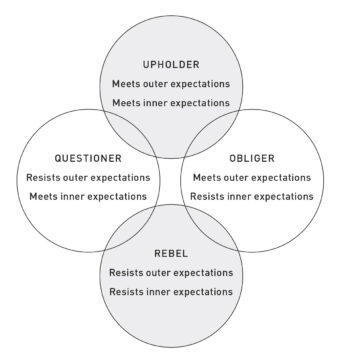
That is, I’m great at meeting external, imposed goals and deadlines—the structure of high school really worked for me—but not so great at meeting my own creative goals amidst the freedom and deadlinelessness of the real world. (Thus it seems I can write these columns because I don’t want to disappoint the Razas, etc., but if I had my own blog, it would probably languish.)
The people I’m jealous of are good at meeting both internal and external expectations; the people who are good at neither are the Rebels. My main dream if I ever get some spare income is to hire a bunch of personal trainers or go to boot camps for everything I want to learn: French, Japanese, classical guitar, painting, modern dance. In the age of Duolingo and Coursera, this seems sacrilegious and also a bad deal.
But why is it that I need someone else to be the keeper of my dreams?
One theory is that those who grew up under too strict supervision and structure don’t cope well with newfound freedom. Too much external watching can weaken the muscles of internal watching; so watch out, helicopter parents. There is an argument for the famous Marshmallow Test, which tested children for their ability to delay gratification for treats (not just marshmallows because who wants more raw marshmallow? but chocolate and other candies too), that the children who succeeded were really just trying to impress their parents.
Anyhow, these are my excuses, but the inamorata are my solution.
The ideal goalkeeping happens right before the falling-in-love stage, which is roughly correlated with the I-still-want-to-impress-them-with-my-discipline stage; I am attracted to people who are attracted to hard work. Goalkeeping doesn’t work so well with my dear friends, who love me already, whether or not I meet my goals, fortunately and unfortunately. But someone who I fantasize could love me if only I met their expectations? And if they help me pretend that their expectations are actually my own expectations for myself? I don’t know how other people use sexting.
During the pandemic, I flirted extensively via exchanging productivity voice memos with a fellow artist; each morning, we told each other what we were going to accomplish that day. Except this stopped being effective once we liked each other too much and the voice memos became 45 minutes long, and served as distractions instead.
I think the universe knows what works for me by now, and so sends me cosmic helpers. I promised a handsome stranger I met at an overnight airport layover this spring that my book would be finished by fall, and somehow this feels more real than any other book deadline I’ve made.
It’s hard to do something solely for myself. It’s hard to do it not for performance, not for a good job, an A+ or a gold star, and writing a book is really a prolonged period without a “good job” in sight. Annie Dillard says of writing that “your work is so meaningless, so fully for yourself and so worthless to the world, that no one except you cares whether you do it well, or ever.” She continues in The Writing Life: “Nor does anyone need your manuscript; everyone needs shoes more.”
My book is for my future friends, I’d like to say, but they are hard to imagine in the abstract (who are you?), and so I use my concrete crushes. I use them shamelessly, though I wish I had more noble means to my ends. A therapist I knew once wrote a whole book for a conscientious but difficult client who desperately wanted results. Before each session, the therapist finished a chapter full of theories and exercises the client could review at home, and suddenly there were twelve chapters. Perhaps it is nice for people to be used in this way: to be helpful just by existing, as audience. That is the purpose of a muse, I suppose, except my muses inspire only the work getting done, and not the work itself.
There are anti-procrastination cafés nowadays, like the Manuscript Writing Café in (where else) Tokyo where you pay by the hour after declaring your writing goals and can hire, at different rates, someone to check in with you at the end (mild), encourage you every hour (normal), or lurk behind your chair as you work (hard). Body doubling as ADHD strategy can be a lucrative business.
Then there are the four-hour-long Youtube videos in which you can pretend you are an Asian teenager in your bedroom with a closed door. Every so often the door opens and an Asian mother (or a parody of one) checks in to see if you are doing your homework.
Whatever works, right?
Whoever gave attributes to the Abrahamic God understood the power of somebody watching, 24/7.
The gods of Olympus seemed both avoidable and distractable, not to mention the fact that they often cared more about loyalty than morality and got into plenty of trouble of their own (who knew where Zeus was if you weren’t a pretty woman). They could hear of your bad deeds through gossip or happenstance, but nothing really escapes omniscience. Santa is a lesser God with earthly gifts, but the same ability to know whether you’ve been Bad or Good, and charcoal is a nice little reminder of hell.
And yet this is what appeals to me about divinity, the sense that someone other than my own conscience is watching, as opposed to a godless universe. Even to imagine we are being watched is to imagine a universe that cares, that is not just a void filled with bubbles of unbearable privacy. (I guess society also watches, but only from the outside; I want to be watched from the inside, without veneers. I want a cozy, inspiring cosmic babysitter.)
Imagine if you could have some kind of personal relationship with your favorite celebrity/person you admire most in the world, if somehow they cared about you and how you lived your life. Fandom seems to be the contemporary way of worship, according to Katherine Churchill, an academic medievalist who compares Jesus stans from the Middle Ages to modern-day K-pop fans and the Virgin Mary to Beyoncé (they’re both immaculate).
If Beyoncé or whoever-it-is for you really wanted you to be Good and knew when you weren’t, if your most dearly beloved author lurked behind your laptop, if BTS showed up at your weekly dance class, how motivated would you be?
Sometimes I imagine the future love of my life is watching every moment of my life: what would I do, who would I be, in this case? How would I wash the dishes? And would they love me even after they have totally seen my secret pettinesses? The dream of true love is someone who would unconditionally love me and yet be someone who I would want to continuously impress, over and over again.
For now though, the cute stranger from the airport texts, after months, to see how my book is going. A motivational gift horse from the universe. I’m not going to reply until it’s done.
***
Enjoying the content on 3QD? Help keep us going by donating now.