
by Mike Bendzela
Some people are haunted by words others have spoken, or by events they’ve seen and heard in various media, or by embarrassing episodes from their pasts. I can be just as vulnerable to being haunted by such things, but lately something seemingly trivial has stayed on my mind. Perhaps this is because, as the wider world veers increasingly out of my ken, I have acquired a kind of myopia that steers me toward only what is in front of my own bare eyes. I eschew the media as much as possible, listen only to non-commercial radio, peruse the newspaper a bit over breakfast. I can engage myself with little of it. Call me out of tune. That may be why I have a mind to be haunted by some ants.
Earlier this summer our neighbor, who lives with his wife tucked in the woods across the road from us, began cutting trees around his house because they were dropping limbs and creating a hazard. Knowing we heat with firewood, he asked me if I would like the logs as he had no use for them. I said, “Sure,” and he began bringing over bucket loads of wood with his tractor and dumping them in our dooryard for me to cut up and split.
I spent a couple of weeks with an ax and a mechanical splitter breaking apart the logs as quickly as possible; if I got the wood properly split and stacked now, we could begin burning it by mid-winter. One maple tree he cut down was so large it took several trips with the tractor to transport it to our driveway. He managed to get the trunk cut up into sixteen-inch chunks, the standard size for firewood, which made handling easier for him. The center of this tree was rotted out, so that essentially he brought over fat disks of wood that looked like thick, lumpy wheels with black hubs. There they sat in a heap for at least a week before I could work my way to them with the wood splitter.
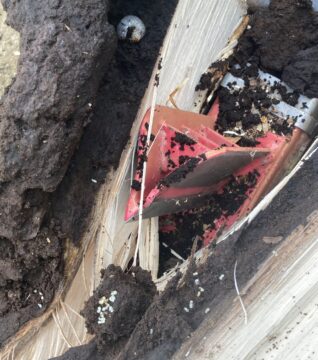
Hoisting a maple log onto the splitter platform, I was amazed at what tumbled out of the center of it: a rich, deep-brown material, as if the tree had been stuffed with chocolate cake. How I would love to have a truckload of this compost to put in my garden, I was thinking, and as I engaged the splitter, a crowd of panicked ants poured like water out of the black hole in the log and swarmed my gloves and bare arms. They immediately covered the splitter and began to run all over the place. These were small, burgundy-colored ants, which I would later identify as red carpenter ants, Camponotus pennsylvanicus. I had just hoisted an entire nest of these carpenter ants onto my wood splitter. As the splitter’s ax head broke open the log, the ants’ panic intensified and even more of the dark brown matter spilled out into the daylight. I found it to be composed not only of the decayed sawdust the ants had produced as they chewed out the galleries in their maple hallways, but ant frass (poop), the remains of unidentifiable insect carapaces, leaf bits, and some acorn shells. This is no mere insect colony, I thought. The cavity these ants had excavated in the maple tree had become home to hoarding rodents, perhaps chipmunks; and the gallery walls were studded with the pupae of some beetle, probably a June bug. This might be better termed an ecosystem. To the inhabitants, it was their universe.
Once the big log was split in half, I looked more carefully at the ants as they scattered, one ant in particular arresting my attention: Her jerky, spasmodic movements conveyed a panic even more acute than in the ants that had scattered. Is that anguish I detect? Nah. Only we big-headed apes are in possession of the finer feelings, which probably explains a lot about the way we treat each other . . .
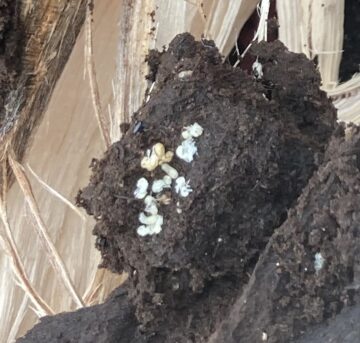
She was struggling with something in her jaws, something she was trying to haul away, something pale white and folded origami style. It was an ant pupa, one of her myriad of sisters. Knowing a little about eusocial Hymenoptera species from having kept honeybees many years ago, I understood that this infant sister was more related to the minor worker hauling her away than to her own mother: Because of the ants’ peculiar genetics, the non-reproducing sisters (the workers) share up to 75% of their genes with one another. These sisters inherit 50% of their queen mother’s genes and an identical set of their drone father’s haploid genome. This made that nurse ant more than a mother to the pupa she was trying to rescue.
But as feisty and selfless as this minor worker ant was, she had nowhere to go with her baby sister. The nest was cloven in half, the ants’ galleries were exposed to withering sunlight, and all the pupae had spilled out of their nurseries and lay before me like grains of white rice. The hospital has been destroyed! I thought. Infants are tumbling out of their incubators while brave nurses scramble to sweep them out of harm’s way.
I experienced a pang of guilt for destroying the ants’ universe: But why? They’re just ants. Besides, this particular wave of death is nothing: A few miles down the road, a large parcel of woodland has been cleared to make way for a commercial outlet that is built within days. What life succumbed there? A little further away, whole hectares of forest in our town have been razed to make way for a vast array of solar panels. They call this a “farm”! As of this writing, over 7 million hectares are on fire in Canada, and the scar of the bitumen mining operation in northern Alberta continues to expand like a cancer into boreal forest. The minor atrocity committed in the dooryard is but one of billions committed daily.
In his book Biophilia, biologist Edward O. Wilson describes revisiting a section of South America after many years to study tropical ants, and he recalls being “shaken” by the sight of cleared land where once rainforest had stood: “[T]ens of thousands of species had been scraped away as by a giant hand and will not be seen in that place for generations, if ever.”
While I was watching that nurse ant struggling to pull the pupa to a safe place that no longer existed, a cynical thought came to mind, Why bother?, only to be chased out by a higher truth: What did you expect her to do? The ants could not have known that their universe had been chopped into segments and stacked haphazardly in someone’s yard. For weeks the queen had continued to lay eggs in the wreckage of that maple trunk, while nurses tended first to the larvae and then to the pupae, as they have been doing for tens of millions of years. This is what they do, and will continue to do, come hell or high water, until the ax falls.
After weeks have passed, I search the woodpile for the remains of the ants’ nest, now split into pieces and stacked in with the rest of the firewood. The wood has already begun to dry out in our preternaturally intense northern New England heat wave, and there are no signs of ants anywhere. Their cleaved nest galleries sit vacant and exposed to the sun like the ruins of some forgotten Bronze Age city.
Edward O. Wilson, Biophilia (Cambridge, Massachusetts: Harvard University Press, 1984) p. 25.
Images
Photographs by the author
Enjoying the content on 3QD? Help keep us going by donating now.