
by Michael Liss
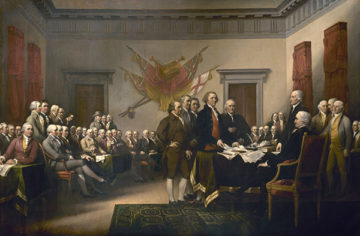
November 1800. In the Presidential rematch between John Adams and Thomas Jefferson we have a clear loser, but not yet a winner. John Adams will be returning home. Thomas Jefferson, thanks to a bizarre tie in the Electoral College with his erstwhile running mate, Aaron Burr, will have to wait for the House of Representatives. Whatever that result might be, it is clear that a new team is coming to Washington. Jefferson’s Democratic-Republicans have flipped the House and have narrowed the gap in the Senate. Over the course of the next few months, thanks to by-elections, three more Federalist Senators will go down, and Jefferson’s party will control both the Executive and Legislative branches.
It’s fair to say that many Federalists are in a panic. Through Washington’s two terms and Adams’ first, being in power is the only thing they have known. It was so easy in the beginning, given Washington’s enormous personal prestige. Then, because people will talk, and there were more ambitious and talented men than there were positions to fill, the grumbling set in. It took just three years from Washington’s 1789 inauguration for Madison’s (and, sotto voce Jefferson’s) new political party to emerge, and, although the Democratic-Republican team did not contest the Presidency against Washington in 1792, it was part of a loose Anti-Administration coalition that won the House.
The grumbling increased in Washington’s Second Term, first directed at his Cabinet, particularly Alexander Hamilton, then, respectfully, of course, at Washington himself. A great man, yes, it was whispered, but in decline and controlled by his advisors. Among the whisperers was Washington’s own Secretary of State, Thomas Jefferson, who left the Administration at the end of 1793 to return to Virginia and do what Jefferson did exceptionally well—ponder, and quietly, oh so quietly, move political chess pieces around on the board.
The Federalists’ reign was not over: in 1796, enough people thought John Adams had earned a stint in the hot seat, and, by the narrowest of margins and with the help of the House of Representatives, Adams held the office for the party. Still, the balance of power was inevitably shifting away from the Federalists. The Party was basically “aging early,” becoming stiff, cranky, lacking in new ideas. Read more »

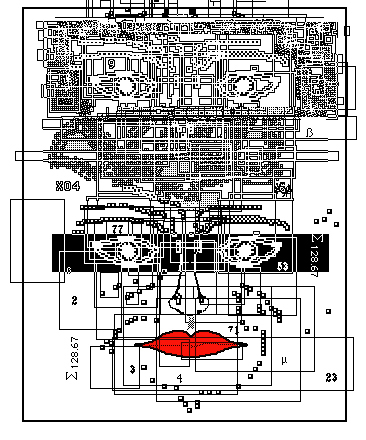
 Aqui Thami. Resisters, 2018.
 I can’t sing. Or so I always thought. A notorious karaoke warbler, I would sometimes pick a country tune, preferably Hank Williams, so that when my voice cracked, I could pretend I was yodeling. Then one night, I stepped up to the bar’s microphone and sang a Gordon Lightfoot song.
 My father’s mother—Annie Newman, my grandmother or Bubbi—was born Hannah Dubin in a shtetl in what is now Ukraine a few years before the Great War. One of her earliest recollections—in addition to the image of her own grandmother hiding in a baby carriage to escape marauding Cossacks—was of being able to see troop movements from the roof of her house, presumably during the Russian Imperial Army’s advance against Austria-Hungary, an engagement that occurred in Galicia, farther to the west, in 1914. Much later, in the aftermath of the nuclear accident in Chernobyl in 1986, when that obscure place was suddenly on everyone’s lips, she began recalling that her village, which she called Priut, in a region she referred to by its Russian name as Екатеринославская губернія, or Yekaterinoslavskaya guberniya—the Yekaterinoslav Governorate, a province of the Russian Empire—was not far from that site, which had now become infamous for a catastrophic meltdown.
 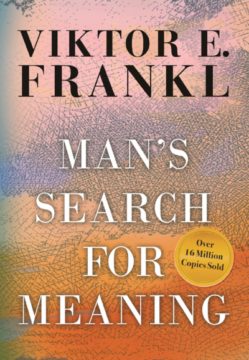 A dear friend of mine recently passed away unexpectedly. He had recommended I read Viktor Frankl’s
 In the typical American city where we live, the average commute time is 78 minutes a day and 97.5% of
  The
The 

 Every generation, when it reaches a certain age, makes two proclamations: Saturday Night Live used to be funnier, and “kids these days” are lazy and stupid.
 I think of Pearl S. Buck and end up thinking of William F. Buckley. I think of