by Brooks Riley
I didn’t plan to write about Caspar David Friedrich for his 250th birthday. He belongs to a different time in my life and a different aesthetic pathology. But as the date edged closer, I found myself missing that impossible reach for the sublime that his work had once provoked in me.
I cannot not write about him.
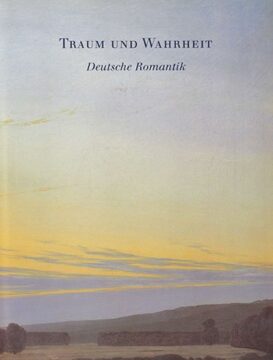 The first time I became aware of Friedrich, many years ago, I was in Zurich to meet an elderly Jungian psychoanalyst—my head stuffed with theoretical questions and eerie dreams with soundtracks by Scriabin. Walking down the Bahnhofstrasse, I passed a bookstore window displaying a stunning art book with the elegant title Traum und Wahrheit (Dream and Truth) and a simple subtitle: Deutsche Romantik. I didn’t yet speak German, but I knew enough to be interested. The book was too heavy for my luggage. I bought it anyway and had it shipped.
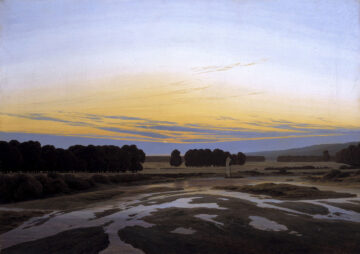 What lured my eye to the cover as I passed by was a partial view from one of my now favorite Friedrich paintings, Das Große Gehege (The Great Enclosure)—a cool marshy landscape evoking real ones I would later see from train windows. How could just a corner of a painting have such power? It was the light, the late afternoon saturation of yellow, the black shadowed trees, and the hint of evening gloom already visible as gray on the horizon even though the sky above was still blue. I was captivated.
Later, it was the darkness that would keep me going back to his work.
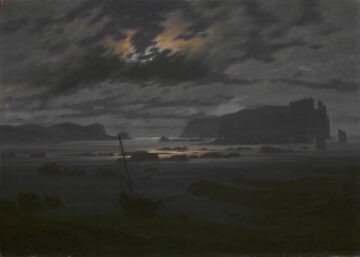
Caspar David Friedrich loved the dark. He loved it so much that he got married at 6 am on a cold January morning, long before a Dresden sunrise. He often went out for walks along the Elbe at dawn or at dusk and lurked in the twilights or the moonlights, bringing home threads of illuminated thinking one can only have at night in the dark. I understand him. Darkness, with its tendency to distort as well as to obscure, is conducive to thinking in unlikely ways, offering a different kind of clarity that is difficult to achieve in daylight, when the light interferes demanding attention. Read more »

 Because I have taken some medical leave from 3QD in the past few weeks, we have not had magazine posts for a while, though we have continued to post curated articles in the “
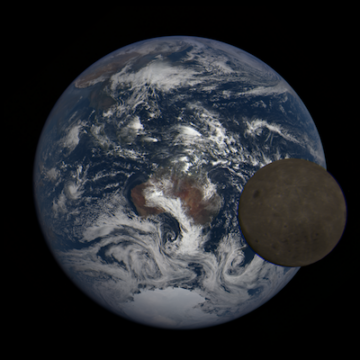
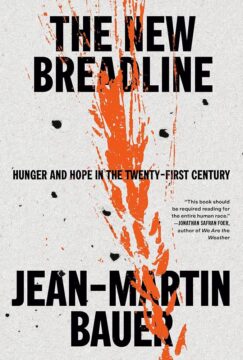 Many decades ago, I was fortunate to have had the opportunity of living in India for several years. I was enthralled by that country: its cultural richness; the environment; the food, but most of all the friendliness and warm hospitality of its diverse people. There were, of course, issues that confounded me and stark contradictions stared back at me from many directions, but of particular concern was the scale of the poverty amongst vast sections of the population, an issue that visited me at home frequently. A small begging community gathered regularly at my front gate, hungry and calling out for food. As my knowledge of the Indian social structure deepened, I came to understand that these people belonged to the most oppressed castes in Indian society and not only they, but a multitude of others were living in poverty, and with hunger.



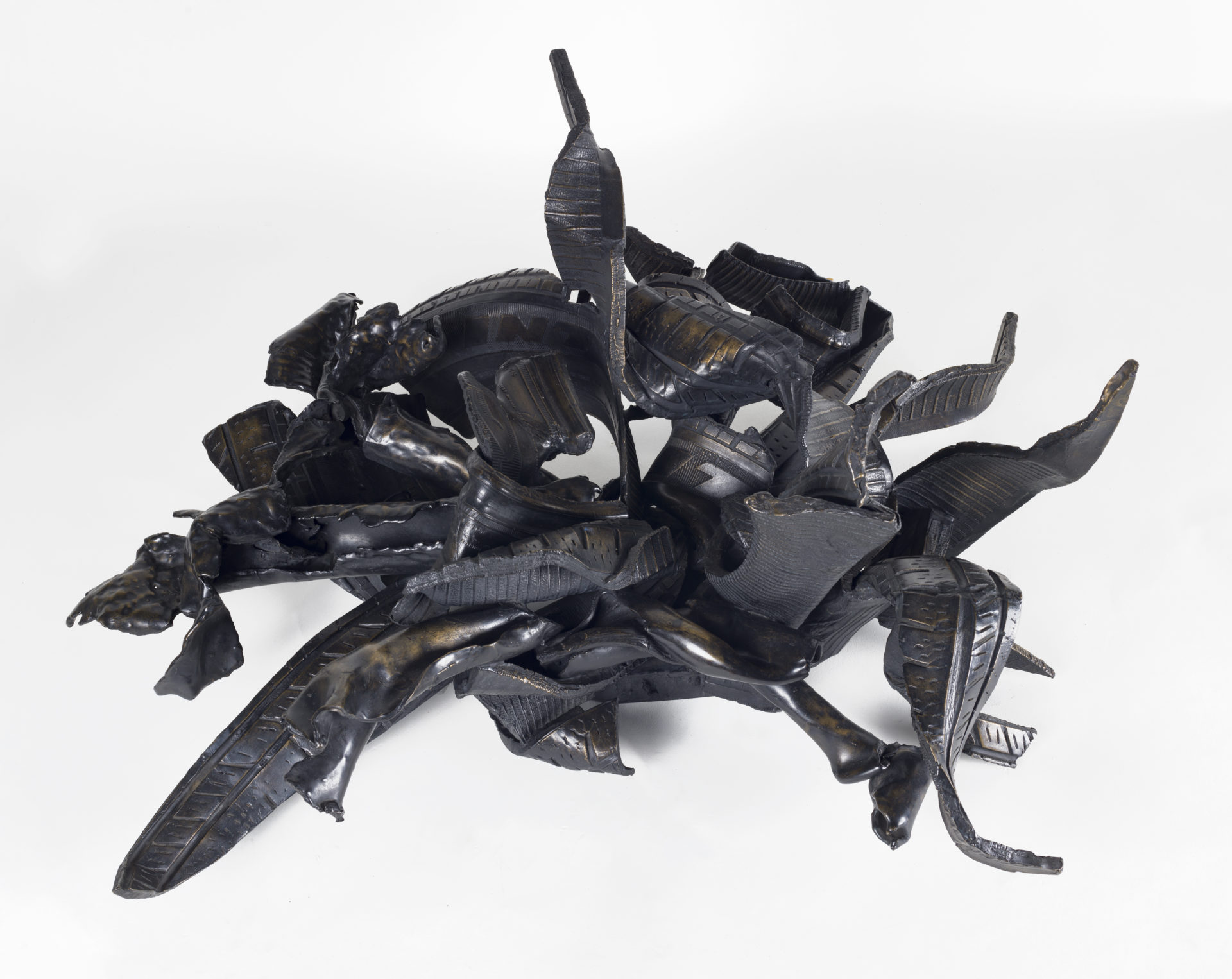 Chakaia Booker. Romantic Repulsive, 2019.
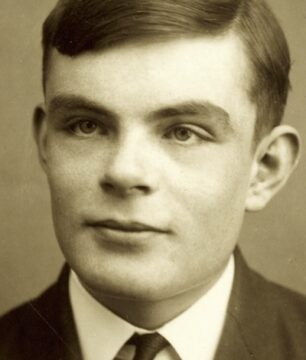 I will use this column to defend myself against the accusation, first made by my surgical assistant Mr. Alan Turing, that I was negligent in the death of an individual under my medical care. Or, as one armchair prosecutor has said, that I am “a stereotypically British sentimentalist who thinks dogs are more human than people.”
 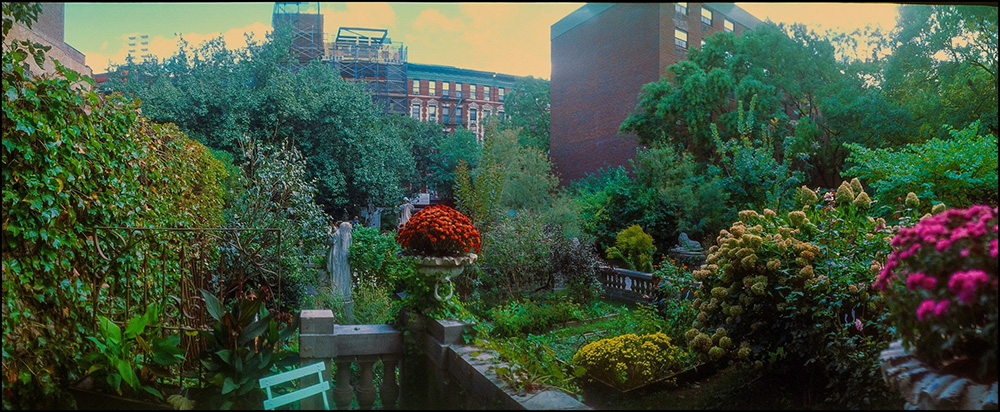 There is a beautiful garden in a quiet tree-lined street in Manhattan’s Little Italy. There are rows of flower, lush, abundant and slightly wild, a stone balcony you can imagine Romeo climbing up to, stone balustrades, several lions, one with climbing vines adorning his face, a sphynx, various other statues, a copy of a Hermes medallion from the late antiquity, a fig tree and a hydrangea tree, giant shady pear trees, and many small hidden paths that lead to gazebos and intimate garden spaces. People in the garden sit and while the time or read by a little table. In a very small space, Elizabeth Street Garden has been able to replicate the richness of life, spaciousness of spirit, the magnanimity and dedication to beauty of the best Italian gardens. It is one of the truly great places in NYC. But after 12 years of struggle between the city and garden advocates, on June 18, 2024, the