
by Barbara Fischkin
The place where I learned the most about diversity, equity and inclusion was not at my liberal summer camp in New York’s Catskills mountains—but at a pig farm in northern Kansas. To be fair, if it wasn’t for camp, I never would have pitched a tent under the big sky of the Jensby farm.
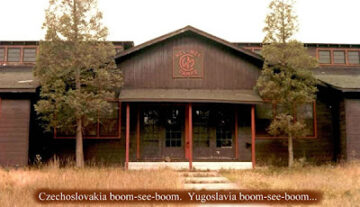
I was there because, as my last chapter noted, Wel-Met, my summer sleep away camp, had a free-range philosophy. Campers planned their own activities, hiked into the woods for sleepovers and—when older—lived in tents rather than bunks. This was a preparation for the next step: Cross-country camping trips. Wel-Met ran six of these each summer and in the 1960s they all stopped at the farm of Clarence and Florence Jensby. The Jensbys welcomed all with open arms—campers and returning counselors alike. (I arrived three times). On the surface, we could not have been more different. Or in today’s lingo, more diverse. Most of us were Jewish New Yorkers. The Jensbys were Christian midwesterners.
It did not matter. With great panache, the Jensbys introduced us to their operation and their pigs who, well, smelled like pigs. This came as a surprise to the city slickers. Mrs. Jensby demonstrated, with schoolteacher-like skills, how to prepare a live chicken for dinner. Trip after trip, year after year, she showed city kids how she would break the chicken’s neck, pluck the feathers, yank out the guts and prepare it for cooking. Some campers were horrified. I saw her humanity. I saw her as a farmer who worked quickly to minimize suffering. Today, when I view pictures of chickens raised in crowded coops, not free-range—or hormone or antibiotic free—I think of how Mrs. Jensby did it better.
I also have a memory of Mrs. Jensby dressed up, wearing her good shoes and leaving the farm—perhaps for church. I wondered how she did this without stepping on any animal droppings. I wondered how she had transformed herself so quickly from farm wife in a blood-stained apron to a “proper” lady. A lifelong lesson: there is more to a person than you see at first. Read more »

 Many environmentalists find the climate change policy problem baffling. The core mechanism of how certain molecules create a greenhouse warming effect on the earth is extremely clear (and has been known for
  Since 2010
  Philip Graham:
 When I think about AI, I think about poor Queen Elizabeth.
 Sughra Raza. Self Portrait, Kigali, January 17, 2016.
 As someone who thinks about AI day-in and day-out, it is always fascinating to see which events in the AI space break out of the AI bubble and into the attention of the wider public. ChatGPT in November 2022 was of course one. The
 Like the Montagues and Capulets, the owners of Zam Zam and Victory restaurants – adjacent to one another on Singapore’s North Bridge Road – have been at war for roughly a century. A one-time partnership turned bad led to two families operating restaurants with almost identical menus to operate in parallel.

 January 16 is the anniversary of the death of Margarete Susman (1872-1966), the German-born Jewish philosopher and poet who survived the Third Reich in Swiss refuge and is buried in Zurich. To mark the occasion this year, Martin Kudla, a lecturer in Jewish intellectual history in Germany, organized a performance of lyrical texts by Susman that had been set to music by various 20th-century composers, and which he had discovered doing archival work, sung by a mezzosoprano with piano accompaniment in a recital held at Goethe University in Frankfurt.
 Are you savvy?
