by Thomas R. Wells
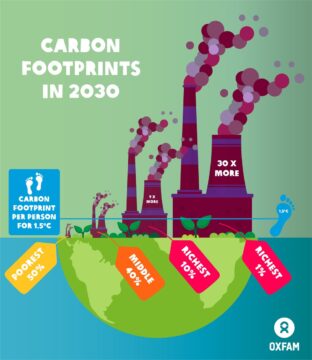 The world’s richest 1% have more purchasing power, and hence more command over what the economy produces than ordinary people. They can afford a more extravagant lifestyle – at the extreme including multiple yachts, mansions, and private jets. One may reasonably quibble with the way activists like Oxfam produce their numbers, but it is obviously true that the average 1 percenter has a far greater climate impact than the median person in a rich country, let alone the world. What a waste! What a crime against the planet! How can it be allowed to continue?
Oxfam, Guardian readers, an unfortunate number of my academic colleagues, and many others are confusing questions of fairness (whether huge economic inequality can be justified) with questions of harm (whether inequality speeds up climate change). Specifically, it can be true that
Per person, rich people do enormously more harm to the climate than ordinary people, and
Redistributing wealth from the rich to the poor would make the world fairer
Without it being true that
Redistributing rich people’s wealth would result in less harm to the climate
I. A Robin Hood tax on the rich would increase climate change
The reason is quite straightforward. Per dollar, rich people’s spending is far less carbon-intensive than that of ‘ordinary’ (middle-class) people, let alone the world’s poor. If the purchasing power of the rich were transferred to ordinary people, it would be spent on the things we want, which tend to be more carbon-intensive. The result would be an increase in total GHG emissions and an acceleration of global climate change.
Perhaps this needs more explanation.
Rich people — pretty much by definition — already have most of the material things they want. So most of their money is spent on more immaterial things, requiring far less energy and matter in their production and consumption, and far more labour. Because they are so much richer than ordinary people they can afford to directly employ people to serve their needs – cooks, nannies, gardeners and so on. Many of the material objects they do buy are produced in unnecessarily labour intensive — basically artisanal — ways, such as million dollar cars and Louis Vuitton handbags.
Some of this consumption may be because the rich like nice things, just like anyone else, and they can afford to have them. Some of it may be due to a spiritually empty desire to show off their status via conspicuous consumption. The important thing is that although the rich spend a lot of money the way they spend it is not particularly carbon intensive. At least, it is less carbon intensive than the way we middle class people spend our money, and much less than how the world’s poor do. Read more »




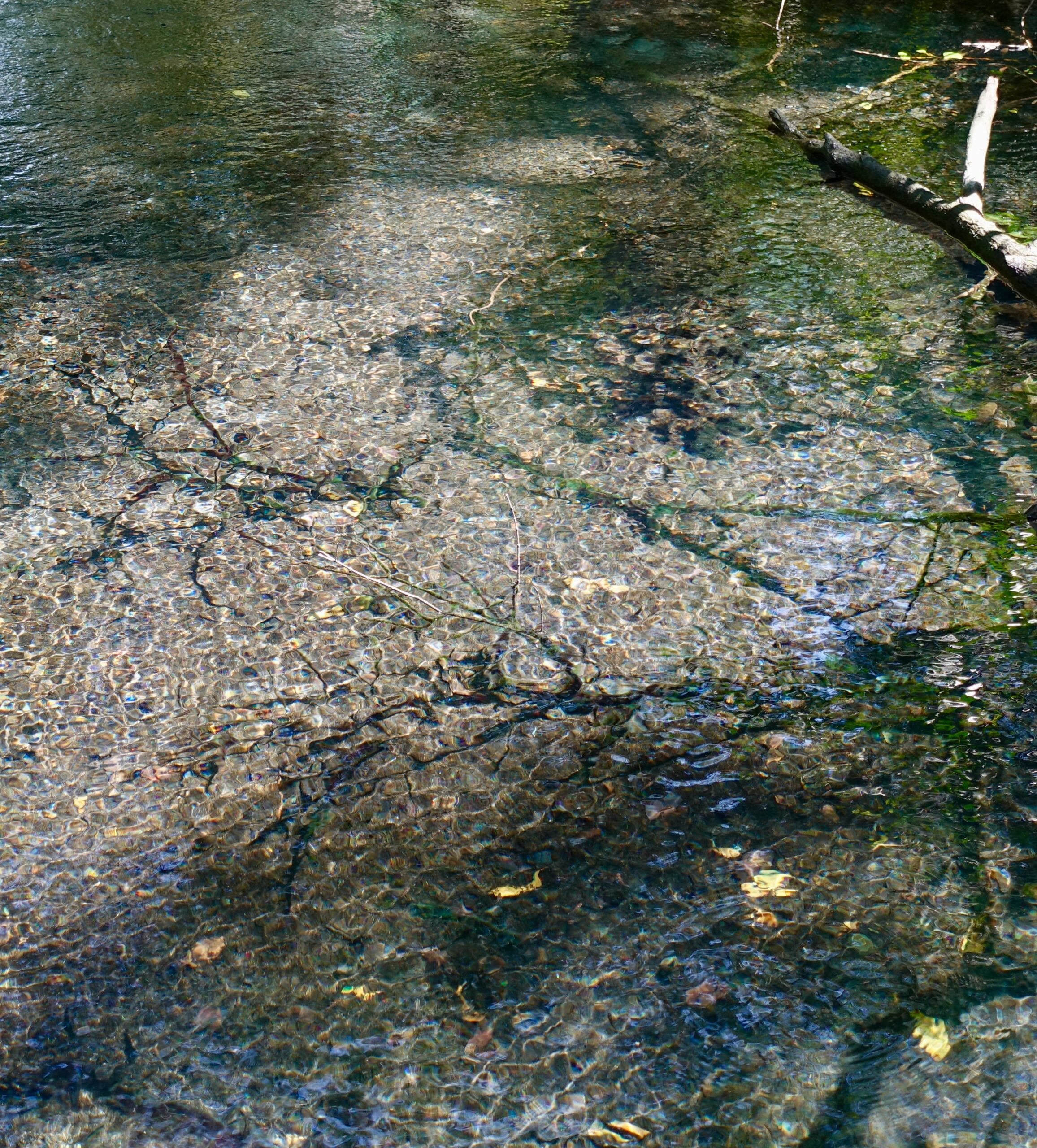 SUGHRA RAZA. Shadows On The Riverbed. Celestun, Mexico, March 2025.
 In 2007, the neuroscientist Sabrina Tom slid volunteers into an fMRI scanner at UCLA and offered them coin-flip gambles. Win twenty dollars or lose twenty. Win thirty or lose ten. Will you take the bet? Most people refused any gamble where the potential loss exceeded about half the potential gain. The scans showed why: as potential losses grew, the brain’s reward regions responded more sharply to what could be lost than to what could be gained. Loss aversion — losing something hurts roughly twice as much as gaining it feels good — was visible in the tissue.
 Allopathy and homeopathy are two contrasting theories of medicine. Allo, meaning other, and homo, meaning same, indicate how suffering (pathos) is cured in these two approaches. Modern medicine, speaking generally, is based on the principle of allopathy, meaning that sickness is counteracted by healing and therapeutic treatments; homeopathy, often considered alternative medicine or pseudoscience, is based on the idea that “like cures like,” so rather than introducing an antidote to an illness, the medicine used is meant to produce a response similar to the illness itself, stimulating the body’s natural healing mechanisms and curing the underlying ailment.
 Political discussions and debates leave me cold. That’s because I abhor conflict, and politics always seem to be accompanied by disagreements, fights, raised voices, and anger. When I think about the hot topics in the 60s and 70s, many of them centered on matters of race, I associate those times with images of red-faced individuals confronting one another, not infrequently accompanied by fists, even guns. Sometimes soldiers or militias or mobs.
 KK: One of my best friends from high school, Brian Boland, was a regular on the main stage at Second City, which helped define improvisational comedy and produced so many famous comic actors. He’s also an accomplished voice actor and has been in some ads our readers have probably seen (like for Geico). He brought two of his colleagues and they each took on characters in the story, “The Ad Man After Dark.” It was amazing to witness how they brought the characters to life and entertained the audience.
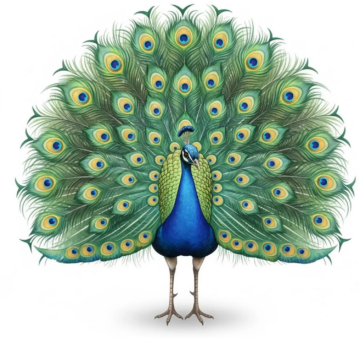 Do birds have a sense of beauty? Do they, or does any animal, have an aesthetic sense? Do they respond to beauty in ways we might find familiar – with a feeling of awe, suffused with attraction, mixed with joy? Do they seek it out, and perhaps even work to fashion it from their surroundings? Darwin thought so, and made the idea the subject of his second major work, The Descent of Man (1871). In it, he outlined a mechanism by which the sense of beauty might, by shaping mating preferences, work to shape the form of insects, fish, and birds in a manner parallel to the better known process of natural selection. The resulting beauty of form, sound, or movement, Darwin argued, is neither the result of intelligent design, nor a necessary indication of superior fitness. Beauty, as