
by Lei Wang

I solemnly swear this is not a column complaining about my parents.
But the first time I listened to this ten-minute meditation on Imagining Ideal Parents by the clinical psychologist and Tibetan Buddhist teacher Dan Brown, I cried the entire way through. Also the second, third, fourth, etc. times.
“Imagine yourself as a young child, only in this scene, you grew up in a family different from your family of origin,” Dr. Brown begins in his matter-of-fact manner, “with a set of parents ideally suited to you and your nature…” He continues asking you to imagine: parents who are perfectly attuned to your unique being—your internal state and not just your behavior—who are protective but not over-protective, and who are delighted and unthreatened by your discovering your sense of self, even if that self is very different from them. Parents who have no agenda for you.
I was confused at first about the premise of this meditation because I was still under the impression (a few years ago) that meditation is about accepting reality exactly as it is, and what good was this imagining anyway? Wouldn’t my mind compare these ideal parents to my very human ones and begrudge the gap even more? Wasn’t it just wishful thinking? But Dr. Brown wrote a comprehensive textbook on attachment disorders, and a good part of healing, apparently, is using imagination to create new possibilities, even for the past. Imagining can replace negative experiences with positive ones, giving one’s brain new grooves to groove in, especially when there are also emotions involved (my crying is productive!).
But I still felt guilty. Because I have to admit: when I first started following the meditation, I found myself imagining without realizing it a white, possibly even European family of origin for myself, loosely based on the families of some of my fancy college classmates, where the dad was some benevolent entrepreneur who understood how the world worked and played with investments that allowed him to be both wealthy and home a lot and the mom was a successful artist who still had plenty of energy to nurture and entertain with Barefoot Contessa recipes. I imagined not only an aesthetic, uncluttered house very different from my home of origin but a library and generational wealth.
THIS is what I wanted from my parents? How shameful. But of course what I really wanted was for them to have had a life where they felt safe and secure, instead of being flummoxed as immigrants in the new world while missing the old. What I wanted was for them to care about frivolous things like emotions and life purposes, and to do so, I had to imagine them as different people entirely.
I wanted to be a third-generation kid, the kind that John Adams, presidential immigrant in a brand-new country, pointed to when he said in his colonizing way, “I must study politics and war that my sons may have liberty to study mathematics and philosophy. My sons ought to study mathematics and philosophy, geography, natural history, naval architecture, navigation, commerce and agriculture in order to give their children a right to study painting, poetry, music, architecture, statuary, tapestry, and porcelain.”
Privilege is the right to study frivolous things, as we all know re: liberal arts colleges. But more than that, privilege is a feeling. A map, more even than the things on the map. It is a set of beliefs: that things will be okay, that you can be safe and secure, that survival is taken care of so you can consider other things.
Deepak Chopra said he taught his children how to meditate from the time they were four years old and also told them, “I never, ever want you to worry about making a living. If you’re unable to make a living when you grow up, I’ll provide for you, so don’t worry about that. I don’t want you to focus on doing well in school. I don’t want you to focus on getting the best grades or going to the best colleges. What I really want you to focus on is asking yourself how you can serve humanity, and asking yourself what your unique talents are.”
Of course, as reverse psychology goes (though I believe this was not a trick on his part), his children got the best grades, went to the best schools (Brown, Columbia, Northwestern), and are more than financially self-sufficient. They’re also doing good in the world, continuing their father’s legacy of self-help books and documentaries; nepo babies could do worse. But the real privilege of growing up with Deepak Chopra was the lifelong beliefs he instilled: that there was some reason they were here on Earth in their singular situation and it was up to them to figure out how to express it. What would it be like to even imagine growing up like that?
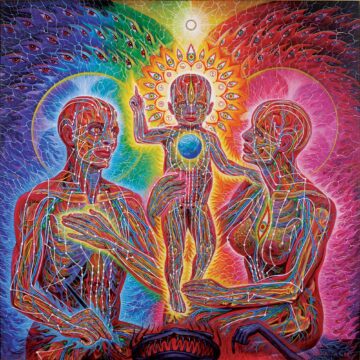
Holy Family by Alex Grey
Recently, in a healing class, I received a healing tool called Perfect Parents. This is meant to be an energetic transmission that bridges in the pure essence of your parents’ personalities, as they would be if they just so happened to be fully awakened/enlightened beings. The fact that they were essentially still MY parents at the core, just without their trauma and conditioning, felt important. It was not reparenting myself as myself, and it was also not imagining my parents as other people.
And this is powerful because it’s how we love. We fall in love with essence, with the potential of what someone could be if they truly could shine their light in the world. I suppose this is why babies are easy to love—there is less in the way of their shining. They still can be anything we imagine them to be, while an adult is more of a reality, an already half-baked story. Though believing this story can be a limitation; the reality is that anyone can still change in any moment, as can we.
The family constellations therapist, Bert Hellinger, who does a lot of work with parental healing, nevertheless likes to remind his clients, “Your parents are the only ones for you.” Quite literally. They are the only ones who could have made you, you. Genetically but also traumatically, the whole package. So if you like who you are at all, it’s not in spite of (and often because of) them. Of course, there are truly abusive parents, but more often, according to Hellinger, parents do a thousand things and we pick the few we were negatively affected by to focus on, which seems to be the parody of therapy. Imagine a world without parents: who would we blame for our problems?
Hellinger thinks everyone should write ten pages on what good their mother has done for them, what good their father has done for them. I tried this once, making a list of 100+ things each that my parents have given me, ranging from the obvious (life, good hair genes), to the questionable (would I be so idealistic if not rebelling against my mother’s practicality? or so minimalist if not in response to their hoarding tendencies?).
When I try to imagine the unconditionally compassionate essence of my mother, I wonder: would she still try to press food on me, or is that a condition of being Chinese that I’d like her to keep? Would we still have personalities without our issues? Though someone did once ask my healing teacher: if we were perfectly enlightened, does that mean we would be able to accept anyone as our partners? And he said no. After all, as Elizabeth Gilbert mentioned in her book on marriage, even (monogamous) seagulls with brains the size of D batteries bond only with certain seagulls and not others, and sometimes get divorced.
Once, I worked with a family constellations therapist on feeling smothered by my mother. I shared that my mother had miscarried a few months before becoming pregnant with me: a boy. The therapist told me to imagine my brother next to me when I interacted with my mother. I tried it the next time I saw her and the intensity of her energy did feel more diffuse: a softness in her eyes. I’m not sure if it was imagining my brother that did it; maybe it was simply imagining less pressure on me. Because of the one-child policy at the time in China, if this brother of mine had lived, I wouldn’t have been able to exist at all.
When I think of my ancestors, I like to imagine them happy and in love, but of course in that long long line of people, there must have been those who didn’t want the person they ended up with, those who didn’t want this or that child, those who may have been forced, those who had to contort themselves, those who hated the situation they were in. One definition of ancestors is simply all the people who had to fuck you into existence. All of that had to happen, for you to be here. Thanks, everyone.
To end, I wanted to quote a bit from the following poem and summarize the rest but it was too good to summarize, as all good poems are, so here it is in all its acerbic and all-accepting glory:
“I Go Back to May 1937”
by Sharon Olds
I see them standing at the formal gates of their colleges,
I see my father strolling out
under the ochre sandstone arch, the
red tiles glinting like bent
plates of blood behind his head, I
see my mother with a few light books at her hip
standing at the pillar made of tiny bricks,
the wrought-iron gate still open behind her, its
sword-tips aglow in the May air,
they are about to graduate, they are about to get married,
they are kids, they are dumb, all they know is they are
innocent, they would never hurt anybody.
I want to go up to them and say Stop,
don’t do it—she’s the wrong woman,
he’s the wrong man, you are going to do things
you cannot imagine you would ever do,
you are going to do bad things to children,
you are going to suffer in ways you have not heard of,
you are going to want to die. I want to go
up to them there in the late May sunlight and say it,
her hungry pretty face turning to me,
her pitiful beautiful untouched body,
his arrogant handsome face turning to me,
his pitiful beautiful untouched body,
but I don’t do it. I want to live. I
take them up like the male and female
paper dolls and bang them together
at the hips, like chips of flint, as if to
strike sparks from them, I say
Do what you are going to do, and I will tell about it.
***
Enjoying the content on 3QD? Help keep us going by donating now.