
by David Greer
Standing face to face with an Anna’s hummingbird hovering a foot or two from my nose, I felt a little mesmerized. Anna’s hummingbirds tend to have that effect on me. They’re otherworldly creatures, with a world of mystery packed into a body that weighs not much more than a paperclip. Hummingbirds are the only bird capable of both hovering and flying backwards, thanks in large part to a unique wingbeat pattern that has inspired the design of surveillance drones. The Anna’s male’s courtship dive surpasses 90 feet a second, though you’re more likely to hear it than see it. If you’re familiar with the alarm whistle of a Rocky Mountain marmot, you’ll know what to listen for. The male Anna’s iridescent head feathers flash like an amethyst when caught by the sun. And it’s absolutely fearless, sending birds many times its size packing when they threaten its territory.
Then there’s the fierce intelligence of the hummingbird. Corvids (crows, ravens, jays, magpies) and parrots are considered the smartest of the avians, but the hummingbird is no slouch either. With the largest brain-to-body ratio of any bird, its brain accounts for over 4% of its total body weight—more than twice the relative size of the human brain. The more science understands about the intelligence of birds, the clearer it becomes that “bird brain” is one of the most misused insults of all time.
What this bird wanted as she assessed me with her beady eyes wasn’t immediately clear. Hummingbirds are known to memorize the faces that keep their feeders topped up, and to issue in-your-face reminders when the supply falls short, but I didn’t have an active feeder installed. They are also known to memorize every bloom they have visited in recent days so as not to waste energy on a flower that has not yet had time to replenish its supply of nectar. Impressive, but not relevant to our encounter.
The hummingbird flew off as suddenly as she had appeared, coming to rest among the leaves of a nearby alder. It soon became apparent to me, after observing her comings and goings, that in that alder was a tiny nest. I took the female’s warning to heart and gave the tree a wide berth for a few weeks until it became clear that the eggs had hatched and the fledglings had flown. And then I climbed the tree and examined the nest.
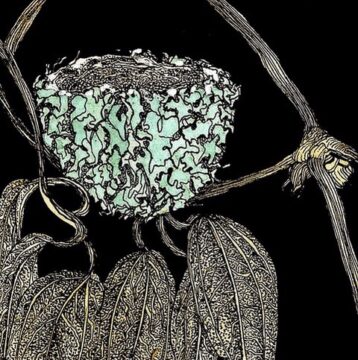
Hummingbird nests are the smallest in the avian world. This one looked like it had been woven together primarily with moss and lichen, the whole bound together with an almost invisible netting of spider silk. It had the appearance of an unimaginably intricate and beautiful sculpture, with every component carefully chosen and placed for its contribution to the safety and comfort of the nest’s short-term tenants. The lichen added an element of camouflage that made the nest almost impossible to see. Accident or design?
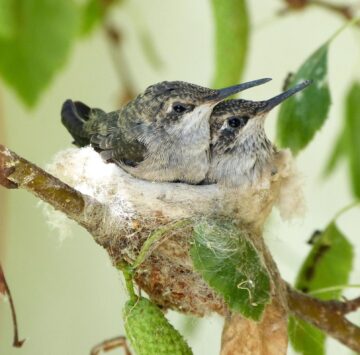
Spider silk is ideally suited for the construction of hummingbird nests, not only strengthening the structure but also providing the needed flexibility for the nest to expand over time with active young inside. Still, it’s a little mind-boggling to imagine that hummingbirds in all probability had perfected the use of spider silk for nest-building millions of years before Homo sapiens was a gleam in the eye of Homo erectus. Nowadays spider silk is used for nest building by most hummingbird species and by other birds as well. Naturally scientists versed in biomimicry took note, and the properties of spider silk have inspired inventions as diverse as medical sutures and bulletproof vests.
Roughly sixty-six million years ago, an asteroid plummeted into the sea near the Yucatán peninsula. That spelled the end of every dinosaur except the bird, which had evolved about a hundred million years earlier from speedy two-legged dinosaurs such as the Velociraptor, the engaging critter that had its modern moment in the spotlight in “Jurassic Park”. Lighter in weight, capable of flight, not picky eaters, birds had an evolutionary advantage when it came to living in a post-apocalyptic world. Their descendants today are the most diverse of all vertebrates, with more than 11,000 bird species, for every one of which exists a covey of avid birdwatchers.
This diversity of species is reflected as well in the range of locations and structures birds employ to raise their young: cup nests and elaborately woven covered domes; hanging pendants dangling from the tips of branches; floating mats on lakes and massive platforms on jagged treetops; burrows in the ground and holes in trees; ledges in caves and on cliffs; bare scrapes on the ground reminiscent of those of their earliest ancestors; and the massive dirt pile unique to the brush turkey (more of which later).
The smallest bird in the world, Cuba’s bee hummingbird, tips the scales at around two grams (the weight of a dime). The largest, the ostrich, weighs more than 300 pounds, though ostriches are pipsqueaks compared to elephant birds, the biggest of which weighed over a ton before joining the growing ranks of large extinct species around a thousand years ago. The dimensions of birds’ nests similarly reflect the diversity of their manufacturers, from the inconspicuous thimble of the bee hummingbird to eagles’ nests the size and shape of overturned SUVs, weighing up to a couple of tons.
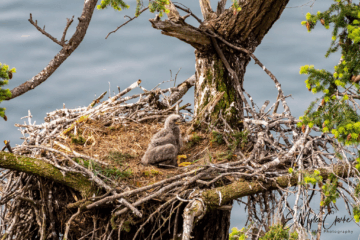
Sticks and dead branches are the material of choice for a bald eagle’s nest, forming a sturdy platform that may expand year by year with repeated renovations and additions. Eagles, unlike hummingbirds, typically reuse their nests, but eagles and hummingbirds do have one thing in common in their nest-building habits: they’re both likely to add mosses and lichens if they’re available-hummingbirds on both the outside and inside of the nest, eagles in the middle, to provide a soft cushion.
In between are the passerines, the perching birds that include songbirds and most bird species. Most common are the tidy cup nests and domes with constructed roofs for extra protection, woven of grasses and twigs and mud and whatever other materials are locally available, whether natural or human-made: snakeskins and string and cigarette butts, face masks and food cartons and coffee cups. Some nests have been found to have been made entirely of plastic. And the more complicated the nest, the greater the opportunity for males to embellish their creations with elaborate designs to impress a potential mate. A sturdy and cozy nest serves little purpose in the absence of requited love.
Horned coots are pragmatists at heart, and patient builders. They rely solely on natural materials: pebbles they pile on the bottom of a lake in the Andes to create a natural island that breaks through the surface and may weigh as much as a ton and a half. History does not record which particular coot came up with the idea in what geological era, and whether eyebrows were initially raised among its fellow coots, though it’s another example of bird intelligence at work and yet more evidence, if any be needed, of the lengths to which a parent will go to provide a safe nursery for its child. What I’d like to know is whether the original coot nest builder thought through the process by which a single dropped pebble would transform into an island when supplemented with a ton or so of additional pebbles. Or was it simply a case of trial and error involving myriad generations of myriad coots? Evolutionary zoologists, kindly step up.
The record for the largest nest of all (if you can call it a nest) may go to Australia’s brush turkey, which spends close to three months building a gigantic mound of leaf litter and soil, up to twenty feet in diameter and four tons in weight, to create an incubator for its eggs. Needless to say, the brush turkey is not universally popular with suburban residents of Brisbane whose gardens may be requisitioned, without consultation, for the grand purpose. Brush turkey mounds, incidentally, may be the most authentic representation of the egg-rearing practices of some early birds during the dinosaur era—a practice the brush turkey shares with crocodiles but not with other modern birds.
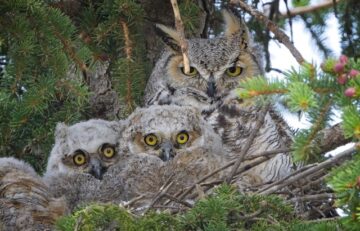
Cavity nesters such as woodpeckers and owls avoid the need for complicated materials by taking advantage of natural hollows such as those in trees, whether healthy or dying. Woodpeckers use their built-in chisel beak to shape a cavity to their liking, thereby doing a favor to later occupants such as owls whose beaks are designed for ripping rather than drilling. Owls may also take advantage of eagle or hawk nests abandoned by earlier occupants. Smaller and less shy cavity nesters such as swallows happily occupy cavities created by humans such as eaves and nest boxes, building their nests with beads of mud. Some swallow-like swiftlets, meanwhile, nest in caves and on cliffs, avoiding the need to search for materials by constructing their nests with their own hardened saliva—the prized ingredient in bird’s nest soup.
Some larger cliff nesters casually adapt to artificial cliffs erected by humans. From my sixteenth-floor office in Edmonton some years ago, I could look across to an active peregrine falcon nest on a ledge on a neighbouring building. The only downside I recall was having to sidestep random bits of pigeon during lunchtime walks.
Safer to be a skyscraper-nester than a ground-nester when predators are on the prowl. Ground-nesting birds such as nighthawks and grouse rely on camouflage and stillness for protection. Killdeer, somewhat more visible, have evolved the convincing broken-wing illusion to lure potential predators away from their nests. While such defences may be sufficiently effective against native animals to ensure the survival of enough chicks to maintain healthy populations, the odds shift when exotic species invade. On the Salish Sea island where my cabin sits, the drumming of blue grouse used to be a reliable harbinger of spring. And then one year, several years ago, the grouse fell silent. I’ve heard none since, though I listen for them every April and May. What I have noticed instead are raccoons and rats, neither of which existed on the island until recent years, though the grouse-killers could have been feral cats. Cats are estimated to destroy two million nests a year in Canada alone, though one wonders how such a calculation is reached, cats being cats.
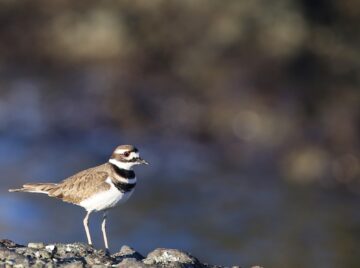
Meanwhile the killdeer that nest on the grassy point in the nearby park have to contend with dogs running loose, their owners ignoring the prominent signs requesting dogs to be leashed. Whatever the reason, killdeer are now seen less frequently on the point than in earlier years. Are dogs running wild the reason? Quite likely so. Their owners quite possibly describe themselves as nature lovers, but perhaps not nature lovers who take a moment to consider the purpose of signs.
Birds that build nesting platforms on lakes face similar challenges from different sources. I have watched loon nests close to shore being swamped by wakes from increasingly ubiquitous and oblivious jet-skis racing in tight herds.
It only takes a deep time moment for defences evolved over thousands or millions of years to be rendered pointless by human carelessness and unintended consequences.
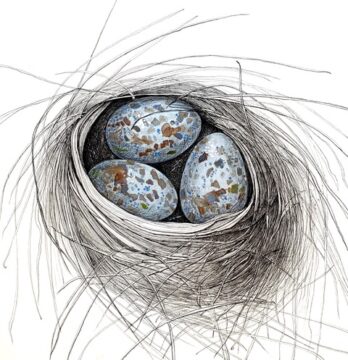
But back to bird intelligence, for a moment. A debate has been raging in recent years in the ornithological community as to whether birds are guided purely by instinct in building a nest or rely on learning. Can the manipulation of nest materials be considered use of tools? In The Bird Way, Jennifer Ackerman notes that nest-building “requires making informed decisions about location and choosing appropriate materials to shield young from the elements and protect against predators” and that “birds that build elaborate nests learn and become better nest builders over time” (251-52). Alfred Russel Wallace, who developed the theory of evolution by natural selection simultaneously with Darwin, concluded that birds build their nests not by instinct but more likely through the application of reason. Zoologist Susan Healy laments the fact that since the mid-20th century the notion that nest building by birds is innate has firmly taken hold. She emphasizes the need for further research, noting that most recent data “all speak to nest building being much more than instinctive”. In short, stay tuned for updates on the intelligence of birds building nests.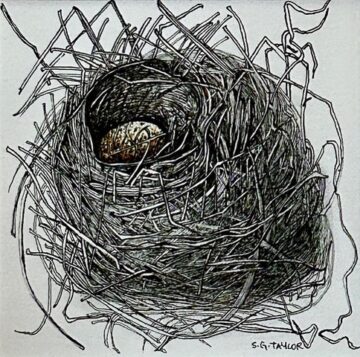 For some reason my fascination with birds in boyhood began not with a birding life list but rather with a collection of nests from my Ottawa neighborhood: Baltimore oriole pouches detached from the outer tips of Dutch elm branches; song sparrow cups gently extracted from boxwood hedges; the dried mud bowls of American robins, trailing stray twigs; a single delicate hummer’s nest, barely the width of a silver dollar and studded with lichens. That decaying bird nests might be teeming with vermin for some reason had not entered my mind as I lovingly arranged my finds on cellar shelves, though I’m sure it entered the mind of my mother, she of infinite patience with my weirder obsessions. Suffice it to say that when I returned from summer camp, my nest collection had mysteriously disappeared. In defence of my childhood obsession, I hasten to point out that London’s Natural History Museum claims to have collected more than 5,000 birds’ nests, presumably without first consulting mother.
Though I never progressed to maintaining a birding life list, my interest in birds has only increased with time. I find myself as captivated by the ragged vee of tundra swans flying north in spring as I do by the ethereal call of a loon on a northern lake or the tiny nuthatch marching down the trunk of a pine. Lewis Hyde eloquently describes the sense of awe that birds inspire in his recent Harper’s article on deep time: “I once asked a friend why he was so dedicated to watching birds, and he replied, simply, ‘Darshan’. In Indian religions, ‘darshan’ refers to the auspicious sight of a divinity or great teacher. More widely it has come to mean any glimpse of the marvelous or awe-inspiring: the ocean in storm, the cougar watching the hiker, the invisible butterfly suddenly in focus.”
***
Thanks to Susan Taylor for permission to reproduce images of her paintings of birds’ nests. Her current work may be seen at bloodstargallery.com. Thanks also to Myles Clarke for his photograph of an eagle’s nest and to Chris Roberts for his image of horned owls.