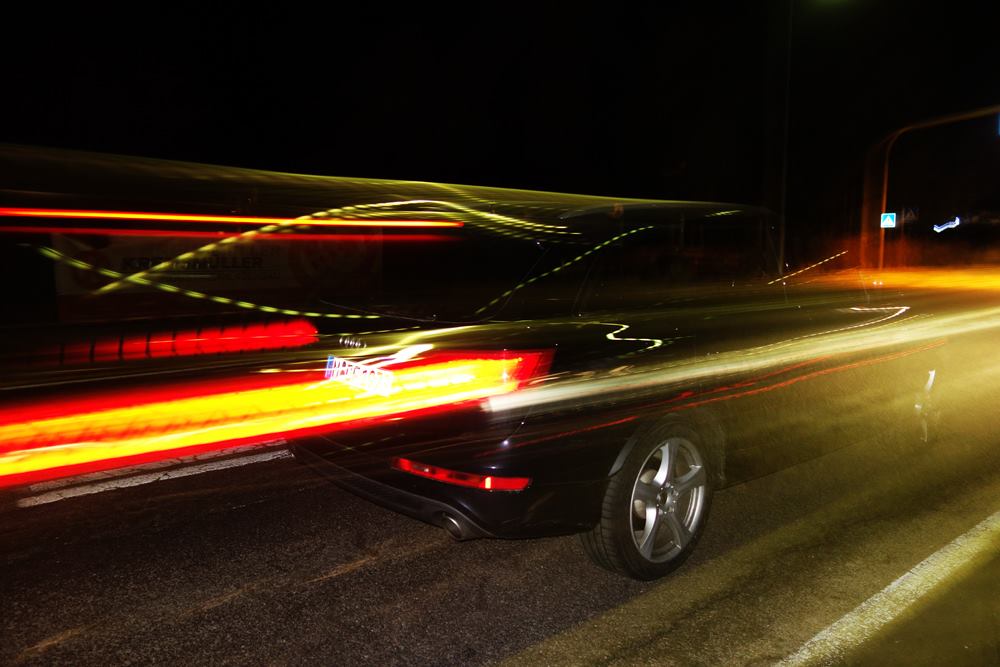
I took this photo of a car passing by at night with a slow shutter speed (for the streaks of light) and with a quick flash at the end to freeze the darker parts of the car (that’s why the wheels, for example, are not blurred), and I liked the resulting effect. Photo taken on Brennerstrasse in Brixen, South Tyrol, in February of 2014.
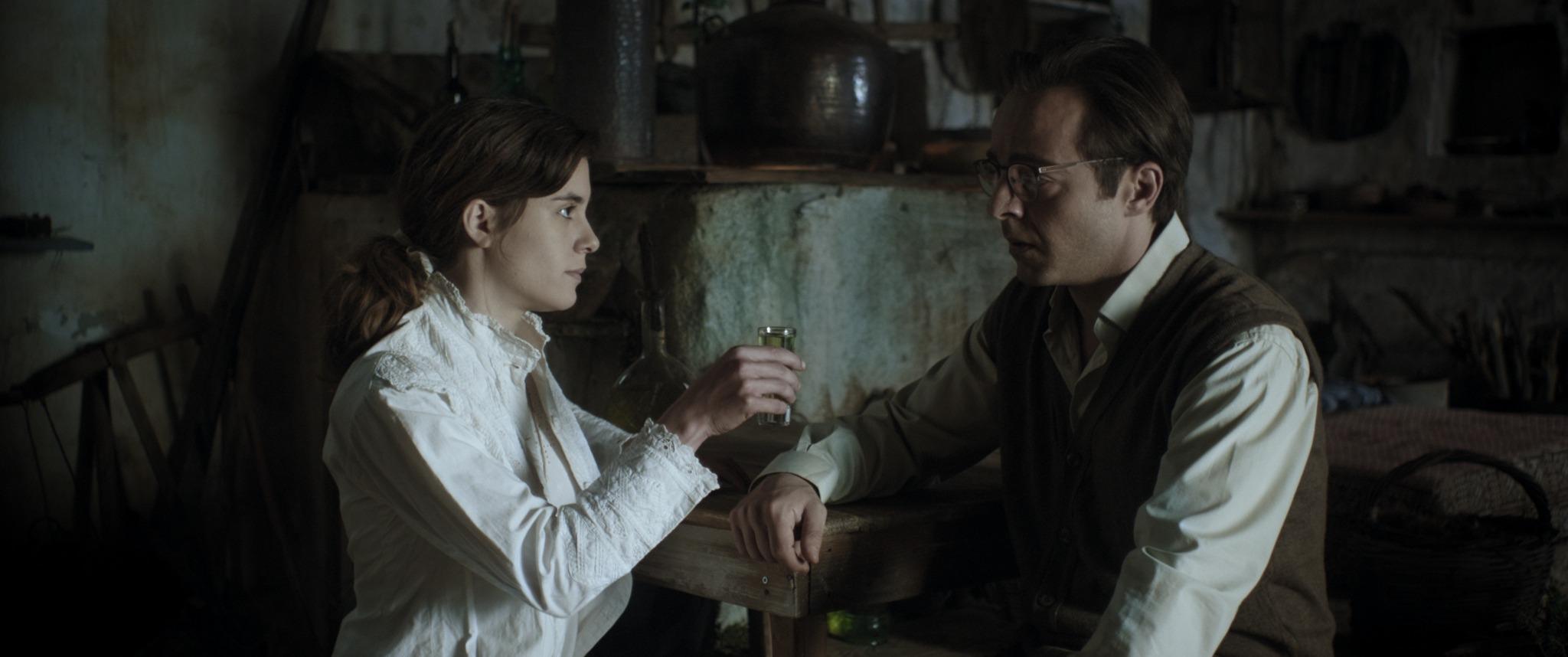
Here’s to your health: Danae (Anastasia Rafaella Konidi) introduces Panos (Prometheus Aleifer) to the not-so-simple life.
“The forest is deep. It’s easy for those unfamiliar with its ways to find themselves lost.”
So says a beguiling young woman, Danae (Anastasia Rafaella Konidi), who lives in a tumble-down cabin in the woods. She says this in caution to Panos (Prometheus Aleifer), a doctor who has just moved to a nearby village. Panos, in a moment of cell-phone distraction, nearly ran her over and has tracked her down to see if she’s OK.
She’s not. Marring her wholesome beauty is an alarming intermittent skin condition, although it doesn’t seem to bother her very much. And her father, an old, long-bearded flesh-and-bone maniac, molests her.
Panos wants to go seek help for her. After all, as he tells a villager, “we’re not living in the Middle Ages.” But some women are hard to leave. Very.
Panos and Danae become, as the film’s title reflects, Entwined.
Danae speaks in a peculiarly old-fashioned, literary manner. Obsessed with keeping her hearth fire lit, she lives primitively and seems not of this time, nor of any specific time really. She dresses in loose white skirts and blouses, cooks simple fare, gathers branches, and listens to an eerie violin tune on an ancient, warped phonograph. She’s hospitable, tender, and has a pantheistic reverence for her surroundings.
As Danae casts her spell over Panos, so this defiantly minimalistic, low-budget Greek horror fantasy, director Minos Nikolakakis’s first feature, casts its spell over us.
Its screenplay by John de Holland, who also plays Panos’s half-brother George, is willfully gaunt, though it unmistakably underlines the idea that science can’t explain everything.
Cinematographer Thodoros Mihopoulos brings the woods very much alive — beautiful and more than a bit threatening. Composer Sotiris Debonos’s score combines scratchy strings, neo-baroque themes, and electronic atmospherics. These enhance the resonant tree creaks and bird calls mixed by editor Giorgos Georgopoulos into a hallucinogenic, lulling, primal embrace.
Every now and then we cut away to George, back in civilization and calling repeatedly to see what’s become of Panos. George’s wife assures him that Panos is probably doing just fine.
After all, what horrible force could involuntarily isolate us so completely in the modern world? Add to the 2019 film’s chilling characteristics its power as premonition.
“I need light, not prayers,” Panos irritably tells a muttering villager at a patient’s bedside. But as it turns out, the good doctor may need both.
I often hear it said that, despite all the stories about family and cultural traditions, winemaking ideologies, and paeans to terroir, what matters is what’s in the glass. If a wine has flavor it’s good. Nothing else matters. And, of course, the whole idea of wine scores reflects the idea that there is single scale of deliciousness that defines wine quality.
For many people who drink wine as a commodity beverage, I suppose the platitude “it’s only what’s in the glass matters” is true. But many of the people who talk this way are wine lovers and connoisseurs. For many of them, there is something self-deceptive about this full focus on what is in the glass. Although flavor surely matters, it is not all that matters, and these stories, traditions, and ideologies are central to genuine wine appreciation.
Burnham and Skilleås, in their book The Aesthetics of Wine, engage in a thought experiment that shows the questionable nature of “it’s only what’s in the glass that matters”. They ask us to imagine a scenario in 2030 in which wine science has advanced to such a point that any wine can be thoroughly analyzed, not only into its constituent chemical components (which we can already do up to a point), but with regard to a wine’s full development as well.
Love takes off the masks that we fear we cannot live without and know we cannot live within. I use the word “love” here not merely in the personal sense but as a state of being, or a state of grace – not in the infantile American sense of being made happy but in the tough and universal sense of quest and daring and growth.—James Baldwin
Real social transformation, real change has to come out of a love of life and a love of the world…—Adrienne Rich
Finally, outrage. Intense, violent, peaceful, burning, painful, heart-wrenching, passionate, empowering, joyful, loving outrage. Finally. We have, for decades, lived with the violence of erasure, silencing, the carceral state, economic pain, hunger, poverty, marginalization, humiliation, colonization, juridical racism, and sexual objectification. Our outrage is collective, multi-ethnic, cross-gendered and includes people from across the economic spectrum. One match does not start a firestorm unless what it touches is primed to burn. But unlike other moments of outrage that have briefly erupted over the years in the face of death and injustice, there seems to be something different this time; our outrage burns with a kind of love not seen or felt since Selma and Stonewall. Every scream against white supremacy, each interlocked arm that refuses to yield, every step we take along roads paved in blood and sweat, each drop of milk poured over eyes burning from pepper spray, every fist raised in solidarity, each time we are afraid but keep fighting is a sign that radical love has returned with a vengeance.
In this time of civil unrest and democratic insurgency, the kind of k-12 and university education we are providing to the nation’s children and young adults is of paramount importance. A democratic education, following Dewey, is the keystone to a functioning democratic society. Public schools are responsible for providing our children and young adults this kind of education. Within schools, teachers-in-relation to their students are the engines of learning and intellectual/emotional development. A teacher who teaches in the service of democracy in the United States, regardless of grade-level and content area knowledge, has three primary objectives: 1) To teach their students how to think critically; 2) To help their students develop habits of mind/body that are consistent with the demands of democratic life; and 3) To protect and nurture their students’ natural curiosity and creativity. In order for them to be able to meet these objectives within our current historical context, we must reassert the importance of what bell hooks calls an “ethic of love” and Paulo Freire called a “pedagogy of love” into the praxis of teaching/learning. Read more »
My decision not to go into downtown Portland for the protest demonstration has held up for four weeks now. The Federal provocateurs have finally begun to leave, and the threat of violence has been reduced to comparative insignificance. . . so it seems that if I were to show up now, it would merely underline that I am a craven fair-weather sort of progressive. That die is cast.
What have I been doing instead? Well, same as everybody. Sheltering in place. Cooking dinner. Trying to stay on my path. I’m a writer born in 1950, so I’m past the ditch-digging and hustling part of my life. But my path hasn’t changed.
I read things. I write poems or essays. I think about that next book. I take long walks to mull it over. I come back to our quiet, clean-but-becoming-threadbare home, ascend the stairs to my cluttered study, find the book or page or little stack of half-realized ideas, and make some tiny increment of progress. Two words that fit together. Two ideas. Two sentences. This is my near horizon.
It feels very far indeed from the Federal Courthouse. The anger of Black Lives Matter (which makes sense to me). The anger of Trumps and Trumpies (which seems evil and hard to account for). Just two miles from my house – I’ve walked it often. Across an elm-shaded neighborhood. Over the Hawthorne Bridge. And then there I am, staring at the plinth where the bronze elk ought to be standing. The boarded-up shops. The beaten-brown grass. The sprawl and slash of graffiti covering nearly every surface.
I’ve been there by day, but never at night.
This is my far horizon: discord, the derangement of politics, slogans, lies and delusions, conflict, power plays. Shouting. Orderly protest. State-organized cruelty. Aspiration for democracy. Truncheoning of democracy.
* * *
How to navigate between and among these worlds? Flailingly is my usual answer, as it for most of us. Just muddling along.
But a Chinese poet from the 700s is also, often, my guide: Tu Fu, a minor court official of the Tang era. A wry, thoughtful guy who lived on a houseboat and liked to drink. Read more »
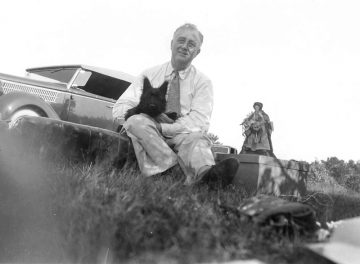
August 8, 1940. Courtesy of the Franklin D. Roosevelt Library website.
It is March of 1944, and Franklin Delano Roosevelt is dying. His physicians, Lieutenant Commander Howard Bruen and Vice-Admiral Ross McIntire, know it, as do a handful of others McIntire brought in. FDR probably knows it as well, no matter how much his doctors may have sugar-coated their findings. He has cardiac insufficiency, arteriosclerosis, congestive heart failure, an enlarged and failing left ventricle, and mitral valve issues. Modern medicine would likely have offered more productive years of life, but, in the era before sophisticated heart surgery, before the development of a heart-lung machine, and with a very limited formulary of drugs, it is just a matter of time, maybe a year at most.
His decline was obvious. You could see it on his face, in the amount of time he needed to recover from exertion, in the loss of weight. He had undertaken a long sea trip on the USS Baltimore to visit American forces in the Pacific, but spent much of it in his stateroom, resting. An ordinary man of that time would have scaled back, gradually becoming a convalescent. But FDR was no ordinary man, and 1944 no ordinary time. Obviously, the Democratic Party would re-nominate him for an unprecedented fourth term, if he wanted it, but there was deep concern in the family that he would never survive. Eleanor Roosevelt was later quoted as saying, “If Franklin loses, I’ll be personally glad, but worried for the world.”Read more »
[This is the second in a series of essays, On Climate Truth and Fiction, in which I raise questions about environmental distress, the human experience, and storytelling. All the articles in this series can be read here.]
When I was a kid, I used to wonder about the possibility that the planet could slip back into an ice age. I grew up in the Rocky Mountain region of the northwestern USA, where winters lasted half the year and summers were brief and blustery. I hated being cold all the time. Aware that ice ages result from some sort of natural cycles, I worried what might happen if the planet should head that way again. I tried to imagine how we would construct cities and farms, how we would travel between countries or even build roads, if huge glaciers grew down from the Arctic Circle and smothered our little mountain town.
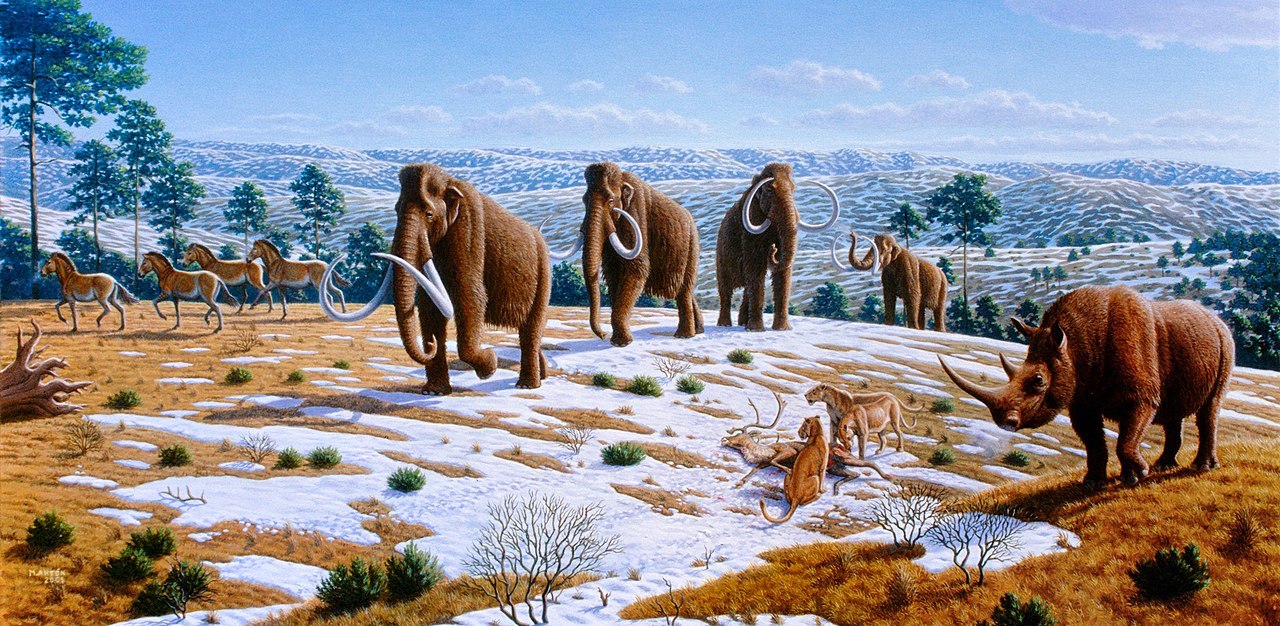
So I was surprised to learn, much later, that we actually do live in an ice age. In historical memory, we’ve been enjoying a warmish, rather pleasant phase of this ice age, to be sure—an interglacial phase, called the Holocene, that’s persisted for about ten thousand years. But interglacial phases, like our present one, have only been brief respites, as the ice age has cycled between glacial and interglacial phases over the past two million years. Past interglacials never lasted very long and, left to its own geological devices, all signs suggested that this one would end too, to be followed by a much longer glacial phase—the stuff of my nightmares. Read more »
On the first day of August in Year One AC (anno coronae), I boarded an Intercity train in Zurich bound for Singen, in the German federal state of Baden-Württemberg. In Singen I transferred to the Intercity headed to Stuttgart but left the train a few stops shy of the state capital, at the town of Horb am Neckar, where I was met by friends and driven to Burg Hohenzollern. Looming over the mild and hilly Swabian countryside, the castle is the ancestral seat of the senior branch of the dynasty that would go on to rule Prussia, and eventually the German Empire, before retiring to wealthy obscurity at the end of World War One.
What was noteworthy about my first excursion across the Swiss border in over six months, since a winter holiday spent in Alto Adige before the lockdown, was not so much its particular destination (although that will bear mention below) as its timing: August 1, or Erschtouguscht in Swiss-German dialect, is the annual commemoration of Switzerland’s founding, and thus, depending on your political coloration, either a uniquely unpatriotic day to leave the country, or the ideal moment for an escape from the pathos and pyrotechnics of a populist rite.
European national holidays are typically history-laden affairs, at least in their original conception. Of the countries just beyond Switzerland’s borders, France hosts the most venerable festivities. The Quatorze Juillet marks the significant initial, if not particularly effective, revolutionary gestures of July 1789, and lends the symbolic elements of its exercise – stormed ramparts, tricolore, battle hymn – mutatis mutandis to the general vocabulary of national identity. Italy’s is the next eldest, although it celebrates a political event fully two centuries later: the Festa della Repubblica, on June 2, commemorates the referendum in 1946 in which the Italian electorate opted for a republican form of government following the fall of fascism, and features wreath-laying and a military parade. Read more »
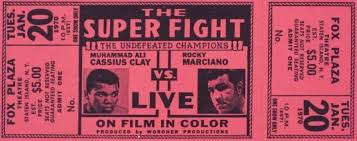
In early 1970, after three years of fighting induction into the army, Muhammad Ali neared the end of his resources. In that same year, before he left for prison, my father gave me boxing lessons. I wasn’t going to be the type of fighter Ali was. According to my father, instead of back-peddling on my toes I needed to fight on the inside.
Between lessons I listened to stories about Jack Dempsey perfecting the weave, ducking under a jab, twisting all of his weight into a short left. Then about my father’s favorite, Rocky Marciano, who paid two punches to throw one and hit so hard it was worth it.
Rocky was from my father’s youth, when tough Irish, Italian and Jewish kids ran the black and white streets of eastern cities. An inside-the-game fighter, Rocky spoke straight at the camera in slow, perfect sentences, as if on the twenty-third take of his own thoughts. He didn’t threaten the limits of my father’s understanding. Instead, he was a man among his kind of men.
Ali was different; Black, lecturing, out of bounds, on his own, making change. I wanted from Ali what my father wanted from Rocky. Read more »
Once we thought we’d look into a cruise. As skeptics in principle, we agreed we’d have to choose carefully. We wouldn’t join an enforced entertainment experience with a thousand shipmates enduring professional smiles.
We wouldn’t just pocket a few easy off-the-beaten-track conquests (although these look promising). The fun of those is getting there on your own. This ruled out a queasy crossing of the Drake Passage with newly retired strangers. Fine.
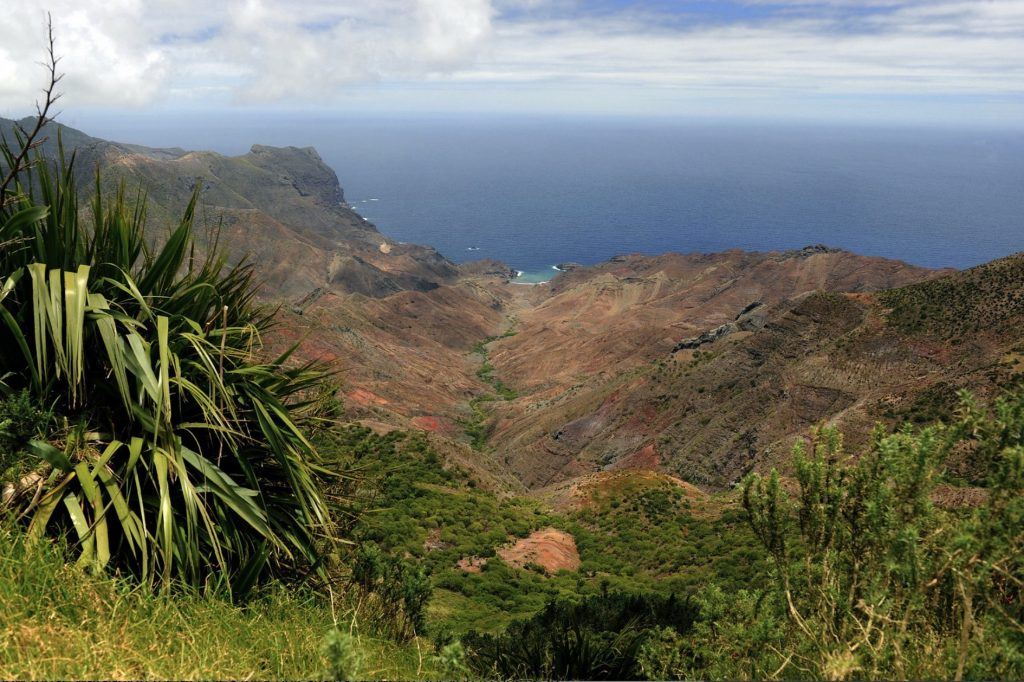
The Royal Mail Ship St. Helena
We wouldn’t sail anyplace that made our fellow cruisers too keyed up to have fun. This ruled out anything billed as a “trip of a lifetime.” Them’s marketing words. Finally, we hadn’t the free time for tramping aboard a cargo ship, although Gregory Jaynes’s Come Hell on High Water makes a strong case. One of these days.
We settled on sailing from Walvis Bay, Namibia on the world’s last royal mail ship, the RMS St. Helena, a stubby little bulldog bound for St. Helena and Ascension Islands, some 1800 miles east of Brazil and 1200 miles west of Angola, in the middle of the South Atlantic Ocean, among the more remote places on earth.Read more »
During the 1990s, the impossibility of a black president was so ingrained in American culture that some people, including many African Americans, jokingly referred to President Bill Clinton as the first “black president.” The threshold Clinton had passed to achieve this honorary moniker? He seemed comfortable around black people. That’s all it took.
Because an actual black president was so inconceivable that a white president finally treating African Americans as regular people seemed as close as America would get any time soon.
In 1998, Nobel Laureate Toni Morrison brought Clinton’s unofficial title to national attention with a New Yorkeressay aimed at discrediting the impeachment proceedings against him. One of Morrison’s rhetorical devices was to check off all the boxes in which Clinton displayed “almost every trope of blackness,” including being raised in a working class, single-parent household, and loving fast food.
By 2003, the idea of a black president was still outlandish enough that it served as common comedic fodder. Chris Rock starred in the film Head of State, a fantasy comedy in which Chicago Alderman Mays Gilliam becomes a fluke president. And Dave Chappelle portrayed an unabashedly African American version of President George Bush in a Chapelle Show sketch. The skit’s running joke was how outrageous and “unpresidential” it would be to have a black chief executive. Read more »
Of all the places I’ve never been, Borneo is my favorite.
I have several times been within spitting distance: to the Philippines—as far south as Panay; to the court cities of central Java and to the highlands of Sulawesi, in Indonesia. I’ve spent many happy days on Peninsular Malaysia. Have lived in Tokyo, Hong Kong, and Kaoshiung~~~But as they say, “Close, but no cigar!”
My college boyfriend was a great fan of Joseph Conrad. He wanted to follow in the great man’s footsteps. He planned it all out. We’d go up the Mahakam River. “More than a river, it’s like a huge muddy snake,” his eyes danced with excitement, “Slithering through the dense forest.” We talked about Borneo endlessly. He promised I would see Borneo’s great hornbills, wearing their bright orange helmets– with bills to match. And primates: maybe we would see a gibbon in the tangle of thick foliage –or an orangutan. There would be noisy parrots in the trees and huge butterflies with indigo wings like peacock feathers, fluttering figments of our imagination. He told me that nothing would make him happier than to see the forests of Borneo.
A cruel young woman, I vetoed Borneo –and dragged him off to Kashmir instead. And to make matters worse, a year later, Gavin Young came out with his highly acclaimed book, In Search of Conrad, in which he does just what my boyfriend had wanted to do: follow Conrad to that famed trading post up “an Eastern river.” Read more »
I serve as the family cook as well as the family DJ, so no dinner party preparation is complete without a small stack of CDs waiting for guests to arrive. When the doorbell rings and my wife Alma walks to the front door to greet our earliest guests, I idle the burners on the stove and hurry to the living room stereo, where I press Play for the first CD. A song should already be in progress before the exchange of Hellos, because music, like furniture, is a form of home decoration, filling and defining silence the way a couch or chair fills and defines space. The music must be dialed low, just enough for a home to express quiet domestic welcome. I like to think that I’m long past my ancient feckless undergraduate days of booming a song through an open window.
Yet over dinner, rarely does someone ask, “What is that lovely music?” Such a longed-for question always fills me with joy—someone heard its beauty too!–and I’m happy to reply, “Oh, that’s Brian Eno’s Music for Airports,” or “We’re listening to the Afro-Spanish singer Buika Concha,” or “You like the Kora Jazz Trio, too?” Am I the only one who can be diverted from dinner chitchat by an airy chorus, or a husky vocal phrase, or a tack piano’s piquant modulation?
That magic question does get asked from time to time. I remember in particular one evening, many years ago, when I hit paydirt as guests passed serving plates and bowls back and forth at the dinner table and an austere mix of resonant metallic percussion, choral voices, an organ and a violin wafted from the living room.
“What are we listening to?” my old friend Bruce asked. Bruce! Of all my friends, I knew he had that question in him.
Do it yourself skate park near the old Morris Canal.
That, I assume, is the floor slab of a demolished industrial building. It’s located near one of the remaining fragments of the Morris Canal in Jersey City. Back in the day the Morris Canal delivered anthracite coal from Eastern Pennsylvania to New Jersey and New York City – the Hudson River is no more than half a mile to the right of this slab. Things have changed; the Morris Canal was abandoned in 1924. I don’t know just when guerilla skate boarders appropriated this slab for their sport, but I took the photo at 6AM on July 30, 2011. One feature in this do-it-yourself (DIY) skate park remains unfinished – that pile of dirt and rock to the right of center. Notice the Myspace URL at the bottom of the photo.
DIY parks have been an aspect of skate boarding for a long time. There aren’t enough purpose-built parks to meet the demand. People don’t like skate boarders using public sidewalks, plazas, parks, shopping centers, and streets, and skate boarders don’t like be harassed for doing what they love. What to do? Find an out-of-the-way spot and build your own park, that’s what. Read more »
Perhaps imprudently, your humble blogger continues to toil in the philosophy mines for blogging material, even in this stressful time. And there will be such postage eventually, of that you can be sure! However, prudence enough remains to prevent him from posting half-baked nonsense; so in the interim, let us return once again to the podcast, and enjoy some fine music while we wait.
Thanks to everyone who rose to the occasion and contributed to Jon Hassell’s gofundme appeal, as promoted here in my last two posts (here and here; the mixes are here and here). If you haven’t contributed yet, now’s your chance!
As the notes below indicate, this mix as well includes an appeal, of a different sort. If you have been following the developing situation in Belarus and would like to help, TXT Recordings is offering a name-your-price option to pick up a release by Belarus artist Alexander Ananyev, the proceeds to be donated to Support for Belarus. (Also, the record is pretty good, and naturally we’ll be hearing a track from it here.)
These days, fights about social identity are coming to the boil. Could mindfulness practice lower the temperature of those disputes? I want to suggest that it could. To understand why, it’s useful to start by describing the psychological components of social identity. There are a variety of ways of thinking about the topic; many have addressed it. I want to highlight three dimensions.
First, identity enters the body and the imagination. You can tell what groups people belong to from their languages, accents, clothing, symbols, habits, and ways of carrying themselves. Some Sikhs wear turbans on their heads; some Catholics wear crosses around their necks. Most Brazilians and Portuguese speak the same language, but with different accents. Women tend to carry handbags and men wallets. People have strong emotions about the way their bodies and words disclose their affiliations — sometimes pride, sometimes shame. They love their country’s rivers and mountains; they relish the food and drink of their neighborhoods; there are songs that bring them to tears, smells and gestures that evoke the sense of being at home in the world. Even when people reject their identities of origin, the disavowals often have the effect of acknowledging the relevance of those identities to their self-understanding. Let’s call this the expressive aspect of identity.
One could try to argue that Christianity is a more imaginative and beautiful religion than Buddhism, or vice versa, and it might be fun to waste some time on that debate, but it really doesn’t make sense to say that one group’s languages or symbols are superior to another’s. Some expressions of identity are morally contestable (consider headscarf bans or statues of Confederate soldiers), but as a general rule, people are, and should be, free to express their identities. Read more »
We have argued in a recent article in 3 Quarks Daily that there is a moral obligation for those who are able to safely be vaccinated against serious diseases such as measles and COVID-19 to do so. The gist of the argument is that, when certain factual conditions are met, people have a duty to accept vaccination. There are two conditions. First, there is a significant benefit to the person who is vaccinated and little risk. Second, there is a significant benefit to those to whom the person might otherwise transmit the disease. The benefit is a reduction in the risk of serious harm, which obtains if the disease is life-threatening or seriously threatening of significant pain, physical or emotional damage, or significant expense or effort to avoid these, to a significant subset of the population. We will refer again to these conditions, so let’s have a term for them. Call them the “factual preconditions” of an obligation to accept vaccination.
In this essay we are interested in a different set of issues–those surrounding the use of legal coercion to enforce the moral duty above. It is important to see that the two questions are distinct. There are moral obligations that we do not use the law to enforce. For example, we are generally obligated to tell the truth. People often lie when they are obligated not to do so. But lying is not generally a criminal offense. Suppose that someone who is seriously hurt and trying to get to an emergency room in his car, asks us where the nearest emergency room is. If we gave him false directions, we would clearly be failing to comply with a moral obligation to tell the truth in such circumstances. But, to our knowledge there is no law which requires us to tell the truth in such a circumstance.Read more »

 I often hear it said that, despite all the stories about family and cultural traditions, winemaking ideologies, and paeans to terroir, what matters is what’s in the glass. If a wine has flavor it’s good. Nothing else matters. And, of course, the whole idea of wine scores reflects the idea that there is single scale of deliciousness that defines wine quality.
 Finally, outrage. Intense, violent, peaceful, burning, painful, heart-wrenching, passionate, empowering, joyful, loving outrage. Finally. We have, for decades, lived with the violence of erasure, silencing, the carceral state, economic pain, hunger, poverty, marginalization, humiliation, colonization, juridical racism, and sexual objectification. Our outrage is collective, multi-ethnic, cross-gendered and includes people from across the economic spectrum. One match does not start a firestorm unless what it touches is primed to burn. But unlike other moments of outrage that have briefly erupted over the years in the face of death and injustice, there seems to be something different this time; our outrage burns with a kind of love not seen or felt since Selma and Stonewall. Every scream against white supremacy, each interlocked arm that refuses to yield, every step we take along roads paved in blood and sweat, each drop of milk poured over eyes burning from pepper spray, every fist raised in solidarity, each time we are afraid but keep fighting is a sign that radical love has returned with a vengeance.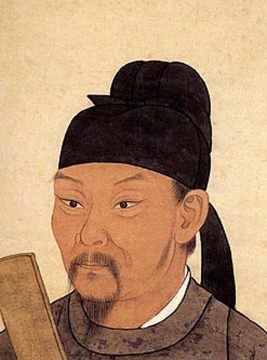

 During the 1990s, the impossibility of a black president was so ingrained in American culture that some people, including many African Americans, jokingly referred to President Bill Clinton as the first “black president.” The threshold Clinton had passed to achieve this honorary moniker? He seemed comfortable around black people. That’s all it took.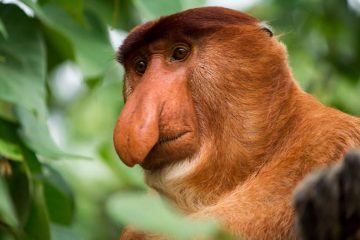
 I serve as the family cook as well as the family DJ, so no dinner party preparation is complete without a small stack of CDs waiting for guests to arrive. When the doorbell rings and my wife Alma walks to the front door to greet our earliest guests, I idle the burners on the stove and hurry to the living room stereo, where I press Play for the first CD. A song should already be in progress before the exchange of Hellos, because music, like furniture, is a form of home decoration, filling and defining silence the way a couch or chair fills and defines space. The music must be dialed low, just enough for a home to express quiet domestic welcome. I like to think that I’m long past my ancient feckless undergraduate days of booming a song through an open window.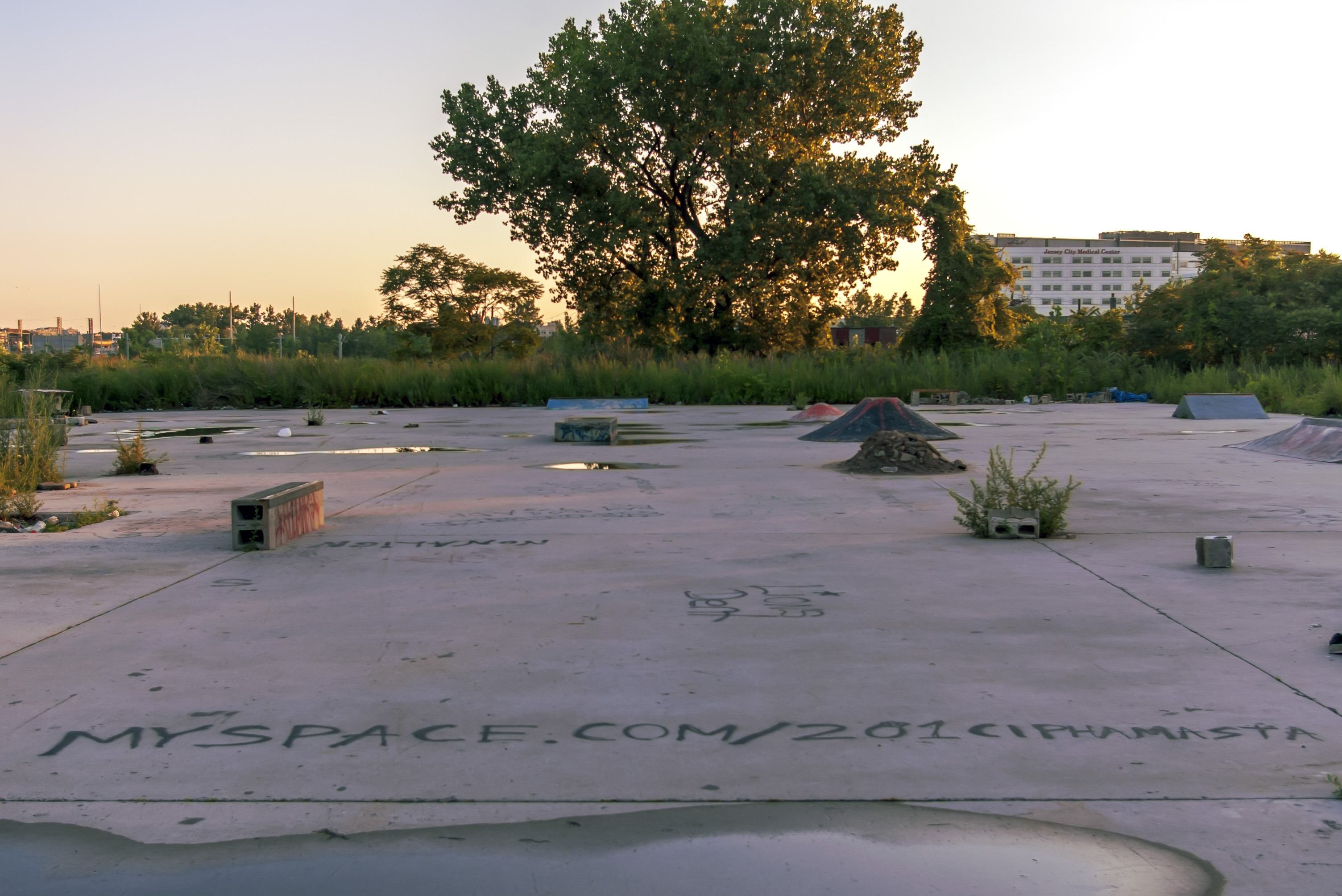
 Perhaps imprudently, your humble blogger continues to toil in the philosophy mines for blogging material, even in this stressful time. And there will be such postage eventually, of that you can be sure! However, prudence enough remains to prevent him from posting half-baked nonsense; so in the interim, let us return once again to the podcast, and enjoy some fine music while we wait.
 We have argued in