If I had been born as an Australian Aborigine, or an American Indian, I’d probably have been a shaman. If I’d been born in ancient India, Greece, Israel, or medieval Europe, I might well have been a priest. If I’d been born in colonial America, I might have been a clergyman; Harvard, Yale and Princeton were started to train clergymen.
As it is I was born in 1947 in a hospital in Pittsburgh, Pennsylvania, steel country. I spent the first four years of my life in coal country, Ellsworth, Pa. The family then moved to Johnstown, Pa., as much coal as steel country. Though she had been raised as an Episcopalian, my mother took me and my sister to Sunday school in a nearby Lutheran church. My father stayed home. But he did attend services on Christmas Eve.
I couldn’t have been more than six or seven years old when I had my first cosmological idea. By that time I was attending Sunday school at a Lutheran Church in the neighborhood where we lived. The teachers told us marvelous stories from books with colorful illustrations. I figured out that the world was a movie God created for the entertainment and enjoyment of the Baby Jesus. One thing puzzled me, though. Movies are flat, but our world is round. I never figured that one out. Perhaps I’m still working on it.
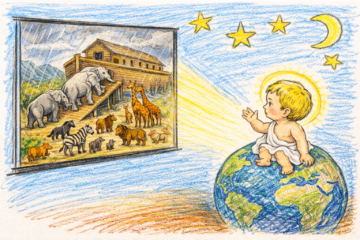
My sister is four years younger than I am. I don’t know what she thought about the Baby Jesus. Early in the 21st century she would convert to Shinnyo-en Buddhism, an esoteric sect founded in Japan in the first half of the 20th century. Back in 2013 she invited me to attend a lovely interfaith Celebration of the Equinox Shinnyo-en held in St. Bartholomew’s Episcopal Church in Manhattan.
Bertrand Russell and Madeline Murray
Sometime during my early teens I was rummaging in boxes of paperback books my father kept in the basement. I found, and read, George Orwell’s 1984, which had a lurid pulp-style cover depicting a shapely woman in tight blue overalls wearing a button for the “Women’s Anti-Sex League.” I forget what the cover of Aldous Huxley’s Brave New World looked like, but I read it too. Theodore Reik’s Listening with the Third Ear introduced me to psychoanalysis. And then there was Bertrand Russell’s collection of essays, Why I Am Not a Christian, devastating and witty. Read more »
 The debate about whether artificial intelligence might one day become conscious is philosophically interesting. It raises age-old philosophical questions in a new form: What is a mind? What counts as experience? What would it mean for something made of code and silicon to have beliefs, desires, or a point of view? I covered some of those issues in a


 My previous 3QD column
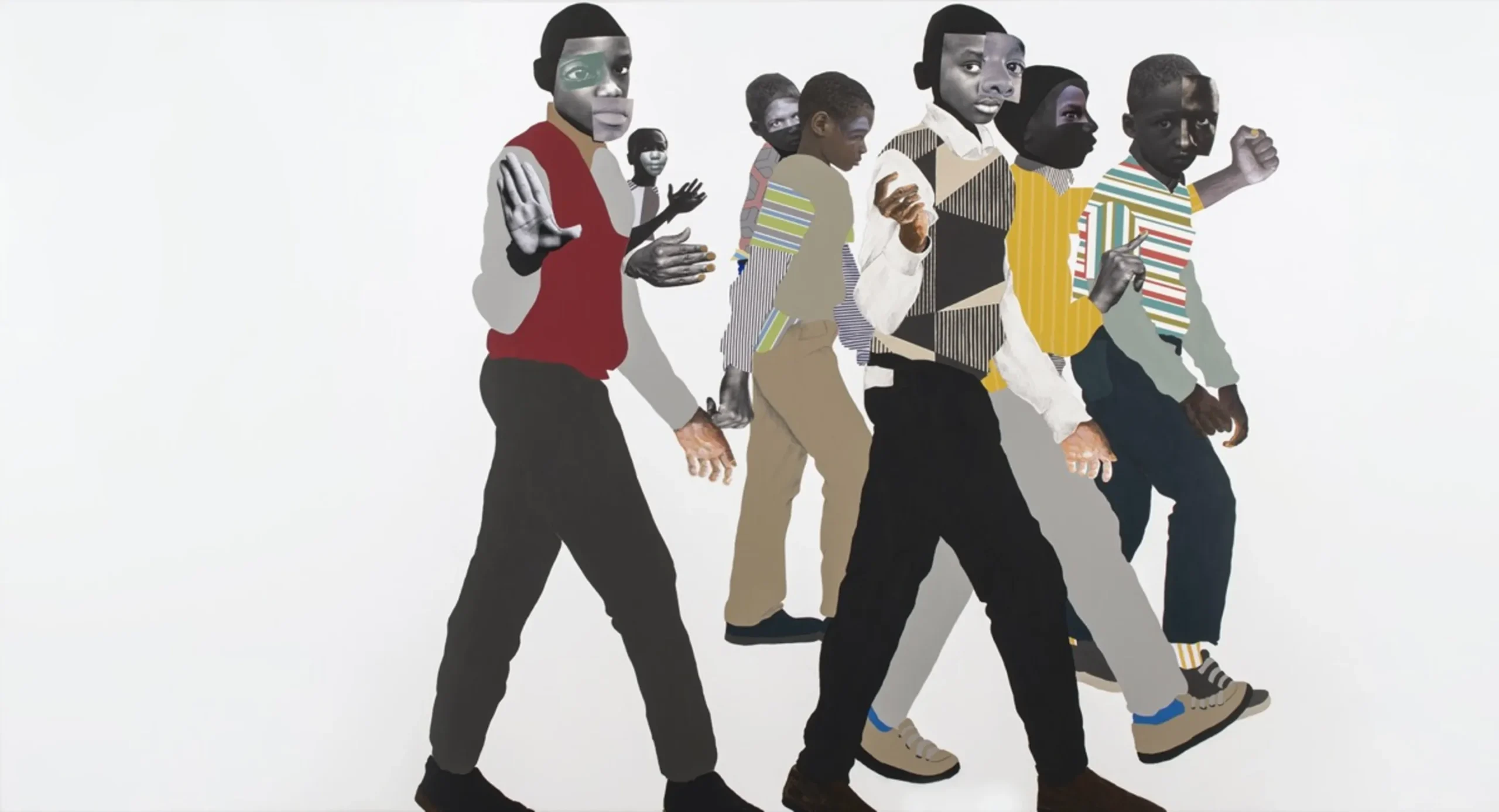 Deborah E. Roberts. When You See Me, 2019.
 There’s a very good reason not to support the Guardian’s independent journalism: not everyone can afford to pay for news. That is why our website is open to everyone. We don’t think that access to trustworthy, reliable news coverage should be a luxury. If you aren’t able to pay at the moment, please continue to turn to our work for free.