
by Laurie Sheck
1.
Years ago, when my daughter was five, we spent a day at the Barcelona Zoo. As I held her small hand in mine, we stood before a cage in which a large albino gorilla resolutely turned his face from us. If we moved to the right, he turned his face to the left, if we edged toward the left, he shifted to the right. He was determined to have no eye contact with us, and at that moment I felt ashamed. My very presence, my gaze, was a kind of violation. I was in the presence of a being, dignified and exposed, with whom I had no shared language apart from the mute language of gesture. His own stark language was deeply expressive, and his refusal said the most basic things about captivity, inequality, exposure, isolation.
In his 1977 essay Why Look At Animals? John Berger traced the increasing estrangement between animals and humans: “The 19th century, in western Europe and North America, saw the beginning of a process, today being completed by 20th century corporate capitalism, by which every tradition which has previously mediated between man and nature was broken. Before this rupture, animals… were with man at the center of his world.” Picture the early cave paintings, how sensitive they were to the curve of an animal’s back, its grace and power, its sense of movement.
Berger goes on to think about how in the intimate gaze exchanged between animals and humans, now so often lost, there is a sense of both recognition and mystery, knowing and unknowing. And how, within this relationship, “The animal has secrets which, unlike the secrets of caves, mountains, seas, are specifically addressed to man.” How it is hubris to forget this mixture of what can be grasped and what is secret and other. And now, in the 21st century, it is all too easy to experience animals as images in children’s picture books, cartoon characters, and commodities produced by factory farms. Yet it seems there still lingers a haunting feeling of intimacy and betrayal, a painful and also beautiful, almost sacred, sense of vulnerable, complex lives that are not confined to “owner” and “owned” or to commodity and consumer.
2.
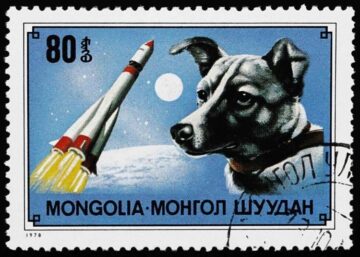
It is night, I am sitting in my study. My daughter is grown now, the pandemic has been raging for two years. There is a silence that is hard to name—isolate, almost wounded. And in this silence, in this dim light, I pick up a book about a dog I have only ever vaguely heard about, a dog known mostly as an image on a stamp or coffee cup or watch-face, reduced and cartoonish.
The dog is Laika, the first mammal to be sent into outer space.
And as I think of her, I think again of Berger’s essay. How he said that in our modern world, “Animals appear like fish seen through the plate glass of an aquarium…. The fact that they can observe us has lost all significance…. What we know about them is an index of our power.”
This dog sent into outer space— I want to know who she was, to have some sense of what her life was, what she felt. But I know I can never really know. All I have are a few facts.
3.
She was a Moscow street dog, a mongrel husky mix, small and wiry.
It is 1957 and the Soviet space program is looking for dogs to train for a mission into outer space. They decide street dogs are well-suited to withstand rigorous training; they are already “survivors of the hardships of hunger and bad weather.” By sending a dog into space, the program will collect needed data on the effects of space travel on a “complex biological organism.” After all, no human has ever been to outer space; who knows what might happen? The space program rounds up ten dogs, all female, and transports them to its canine training center. In the end, only one will be chosen.
4.
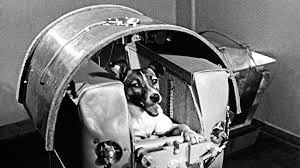
“The specimen is a five-kilogram mongrel female, white with brown markings, approximately three years old.”
She is “quiet and charming” with “outstanding levels of passivity and obedience.”
5.
During her first hours at the training center, Laika is implanted with sensors for monitoring her biological data. A small loop of her carotid artery is pulled through the flesh of her neck. This will serve as the attachment point for the biological monitors on Sputnik 2.
Over the next days she is fitted with a spacesuit equipped with attachment rings to chain her to the capsule floor.
In order to get her used to the space capsule’s confinement, over time she is locked inside progressively smaller pressurized chambers. Her first confinement lasts for a few hours, her final one for twenty days. As her isolation grows more prolonged, she learns not to cry.
At other times, she is placed inside a centrifuge that mimics the loud, violent accelerations of space flight. Her heart rate soars wildly, her blood pressure spikes, her respiration quickens.
She is secured to a mechanical arm and spun in circles.
In zero gravity, regular dog food flies out of the bowl, so she is fed a gelatinous mixture of agar, water, dried meat and beef fat. Though at first she repeatedly refuses it, with her regular food withheld, eventually she learns to eat it.
6.
What is known but kept from the public is that the technology to return to earth has not yet been invented. Whichever dog is chosen will die in outer space.
A few weeks into the training, three finalists are chosen. Muhlka is considered too homely to represent the state. Albina is beautiful, perfectly proportioned and with silky white hair, she has already served on several minor missions. The trainers love and know her best. As one trainer explains, “Albina was everyone’s darling. It was exceedingly painful to think of sending her to her death.”
Laika is chosen so Albina can live.
7.
A few days before Laika’s transfer to the launch site, Vladimir Yazdovsky, the canine program’s director, takes her home with him against all regulations to enjoy the outdoors and play with his children. “I wanted to do something nice for her. She had so little time left to live.”
The next week, Laika and her backups are flown by chartered jet to Tashkent, then transferred to a smaller prop plane to Toretum where Sputnik 2 is being assembled. In Toretum, Laika trains for another ten days.
On October 31, after being taken for one last walk, Laika is transferred to the Baikonur Medical Center where technicians wash her with streptocide and iodine water. As she lays still and quiet on the operating room’s metal table, Dr Yazdovsky carefully combs her hair away from the electrodes and wires emerging from beneath her shoulders. The final medical procedures take two hours. By afternoon she is taken to be sealed into the capsule.
8.
The mission’s instrument list reads: Dog (biological data), Geiger Counter (charged particles), Spectrophotometers (solar radiation, ultraviolet and x-rays transmissions, cosmic rays.). The capsule has a pressurized compartment just large enough for Lakia to stand or lie down in, but not to turn around.
What does wordless thinking feel like?
Laika’s sense of smell is 10,000 times stronger than a human’s. Whatever her perceptual system is doing, no one can know it.
9.
On the morning of November 3, Sputnik 2 fires its engines, leaving behind a glowing cloud of dust and smoke. Laika’s heart rate soars to 260 beats per minute, her respiration accelerates to five times its normal rate. 297 seconds after blast-off, Sputnik 2 is soaring through earth’s atmosphere at 7,945 miles per hour.
In earth orbit, Laika’s thorax which had compressed on blast off, begins to loosen. In microgravity she weighs almost nothing, her chains secure her to the capsule floor.
Does she understand that she is far from earth? Does she look out the capsule window? How can she understand what is happening? Whatever she feels, no living being has ever felt it before. No one has seen what she is seeing.
She is three years old and in a few days she is going to die.
Except it happens sooner. On the spacecraft’s second orbit, the cabin’s cooling system malfunctions. Laika’s temperature spikes to 104 degrees, her biological data indicate increasing agitation, a desperate animal trying to pull against its chains. Her paw pads are unable to sweat out such large amounts of heat. After a few agonizing hours, she dies a painful death from heatstroke.
Sputnik 2 continues orbiting for another 162 days until, on April 14, it falls from its decaying orbit and as it falls and burns, Laika’s body burns with it.
10.
According to the Dalai Lama, if an animal is sacrificed for the good of sentient beings, “you must feel the sacrifice in your heart.” And Peter Singer has written, “All the arguments to prove man’s superiority cannot shatter this hard fact: in suffering the animals are our equals.” And Jeremy Benthem: “The question is not, can they reason? Nor can they talk? But can they suffer?”
11.
Years after Lakia’s death, Dr. Oleg Gazenko, one of Laika’s trainers says, “The more time passes the more I am sorry about it. We shouldn’t have done it. We did not learn enough from the mission to justify the death of a dog.”
12.
Such a quiet night. I still see in my mind’s eye the small being in her capsule, her throat constricted from the pressure of blast-off, her heart wildly beating. How she is traveling where no one has ever traveled before. There is no language for this, for what happens. In my mind I still see her frightened eyes.