
by Steve Gimbel
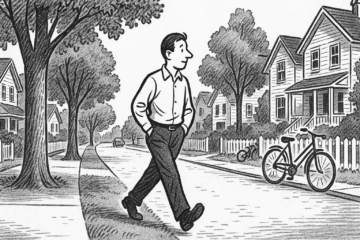 Every neighborhood seems to have at least one. You know him, the walking guy. No matter the time of day, you seem to see him out strolling through the neighborhood. You might not know his name or where exactly he lives, but all your neighbors know exactly who you mean when you say “that walking guy.” This summer, that became me.
I needed to drop serious weight, so I made up my mind and went all in. I cleaned up my diet, started intermittent fasting, and a resistance training regimen. I needed to add cardio and would initially alternate between the elliptical and taking long walks. Online experts and “experts” extolled the fat-burning power of brisk walks and as a philosopher, the walks were nice because I could get in my head and work through the arguments of whatever I was writing as I also expended calories.
I found myself walking more often and longer distances until my daily routine involved a seven mile path which I would trod first thing in the morning and then again in the evening, taking advantage of the late sunset. It certainly accomplished the intended goal, I’m down 59 pounds (my goal was 60 before the start of classes and with a week and a half left until the semester launches, this should be easily accomplished). But what surprised me was a secondary benefit, an interesting connection to those around me.
My walk takes about three hours to complete. Twice a day, that means that I am walking the same neighborhood streets for six hours each day. As a result, virtually everyone along that trail knows me by sight and an odd but interesting set of relationships have developed.
Some are with fellow walkers, but these depend on who they are. There are other walking guys, more or less committed, but regulars on the way. We are middle aged and overweight, but aspirational. We have all watched the same YouTube videos featuring muscled influencers or enthusiastic doctors discussing the difference between subcutaneous and visceral fat and explaining that walking is a fat-burning hack because by staying in “zone 2,” your body bypasses the need to exhaust its glucose stores and goes right into fat-burning mode. We see ourselves as having the firm bodies we want, bodies that just need to be allowed to emerge through this squishy coating utilizing the working smarter-not harder approach. We stride confident that we are just down the street from being back in shape.
And then we see each other. You would think there would be camaraderie amongst us as we are all in the same place on the same journey. And on the surface, there is. But just beneath there is a resentment of the other. We see them and know that they are a mirror. They are not in shape. They are getting older. And they are us. Seeing our compatriots only brings us back to reality that we are who we are, not who we had been able to fool ourselves into being. It could cause you to stop, or it could give you motivation to keep grinding it out, but ether way, it is a cold shower moment.
Except for Rick. Rick is the other hardcore walking guy and the extroverted party dude of the peripatetic set. No doubt having been a golden retriever in a past life, Rick enthusiastically greets everyone by name and both pulls energy from and gives it to all the other walkers. He is genuinely glad to see you and you cannot leave your encounter without a smile at the guileless joy Rick spreads.
Other walkers are suburban women. Like the majority of walking guys, too, our interactions are surface friendly, but again with an edge. In this case, however, you know it is not aimed at you. You can read in their face, as if they had a cartoon bubble over their head setting out their thoughts which are really about that lazy slug of a husband who is home on the couch and could very well be out walking with her. After all these walking guys are guys who walk. We could be a walking couple, they think.
And there are walking couples. Passing is a bit awkward because you feel the need to greet other walkers, but they are always mid-conversation. Sometimes, that means that the best you get is a brief half-wave or the raised eyebrows of acknowledgement. Other times, you get a full greeting, usually by the one who was not talking in order to create a respite from whatever story was being told so that they could grab a quick mental breather before rejoining the narrative.
There are the semi-walkers, those taking their dogs out to do their business or families with little ones on bikes or scooters. In either case, you get a minimal glance as they focus their attention on their charge.
You will get passed by runners and joggers. Runners tend to be a bro in his prime, with no shirt, cut arms, often with tattoos. They pass with an air of superiority. They are running, you old person are merely walking. But as their smooth, muscular back recedes into the distance in front of you, walking guys just smirk knowing that we too were once shirtless running bros and that they should take a good look because this hairy back and slower pace is not that distant in their future.
Joggers, on the other hand, are much more amiable. They are feeling insecure because they too were passed by shirtless running bro. They want to be a shirtless running bro, but they are not and it is not clear they will ever be. But in passing the walking guy, they are at least passing someone, and that fact gives their ego a little boost, especially if you say something pleasantly encouraging to them as they pass.
Then there are those who are not moving at all. The neighbors in their yard, getting mail, or going to their car. Often older, the fact that you are walking means that you are passing slowly enough to count as a visitor and seeing you regularly means that you are a friend come to check in on them. As such, a conversation is in order. “I see you often, how far do walk?” “You seem to do this every day, why?” “Is it working?” These are short, but fun chats.
But perhaps the most interesting interactions are the most superficial, those with those who are vehicularly-endowed. I live in a formerly rural exurb with a mixture of single family homes and McMansions. Because of the country setting, the vast majority of my route has no sidewalks forcing me to walk in the street. Cars out here drive recklessly fast and given that the roads have hills and curves, safety is always a concern.
As a result, I took to waving at passing cars and looking the driver in the eyes to gauge recognition, figuring that if I know they see me, they are less likely to hit me. A full wave would be awkward and possibly indicate the need for them to stop to assist me, so I give the cool guy half-wave which involves holding the hand at a 45 degree angle and extending only the thumb and first two fingers. The vast majority of drivers respond with a likewise languid gesture, sometimes opening the hand on the steering wheel or a point at me.
But what is fascinating is that having done this pretty much twice a day every day for the entire summer, the reactions are becoming quite different. A significant number are increasingly enthusiastic. I still give my three-fingered gesture, but am often rewarded with a full hand vigorous wave and oddly happy smile, the sort that clearly conveys “hi, old friend, I’m excited to see you and want you to know of my passion at our meeting again.” They are not just saying, “Don’t worry, walking guy, I won’t run you over,” but rather see me as a part of their social existence in the community and are expressing actual warmth in passing me, someone whose name they do not know.
Robert Putnam’s Bowling Alone captures the alienation of suburban life and the regular appearance of the walking guy on the drive to work or coming home provides a minimal, but real instance of human-to-human interaction that seems to serve some role in allowing neighbors to feel neighborly. Indeed, at this point, a number of them begin waving at me before I wave at them. They have come to expect the interaction and feel comfortable initiating it with me.
But there is also a different gesture I am starting to see with increased frequency. I look like the stereotypical philosophy professor: glasses, gray beard, balding with a ponytail. As I give my cool guy, three-fingered wave, a number of my neighbors—perhaps influenced by the ponytail when they drive up from behind—ignore the thumb and take the gesture to be the two extended fingers. As a result, I am getting a noticeable number of people throwing up the peace sign at me in return. Given that this is a somewhat conservative area, no doubt a few of them are ironic or mocking, but you can tell that many are genuine. Maybe these are those who feel isolated on a political island and relish the idea that walking guy is a member of their tribe. Perhaps, they are like Americans visiting another country trying to greet locals in their language, hoping that shows some intention to connect. Whatever the explanation, the passion of the digital response is heart-warming.
But the most memorable of my interactions occurred on my later walk one day when a neighbor stopped her car and rolled down her window, saying “I saw you walking this morning and now here you are again. Have you been walking all this time?” Feigning confusion, I simply said to her, “I forgot where I live.” I not only get a wave from her now, but always see her laughing as she passes, a cheap joke still landing. But that gag has formed a relationship between two people who have no idea what each other’s names are or where they reside, but see each other as dear neighbors—nice driving lady and that crazy walking guy.
Enjoying the content on 3QD? Help keep us going by donating now.