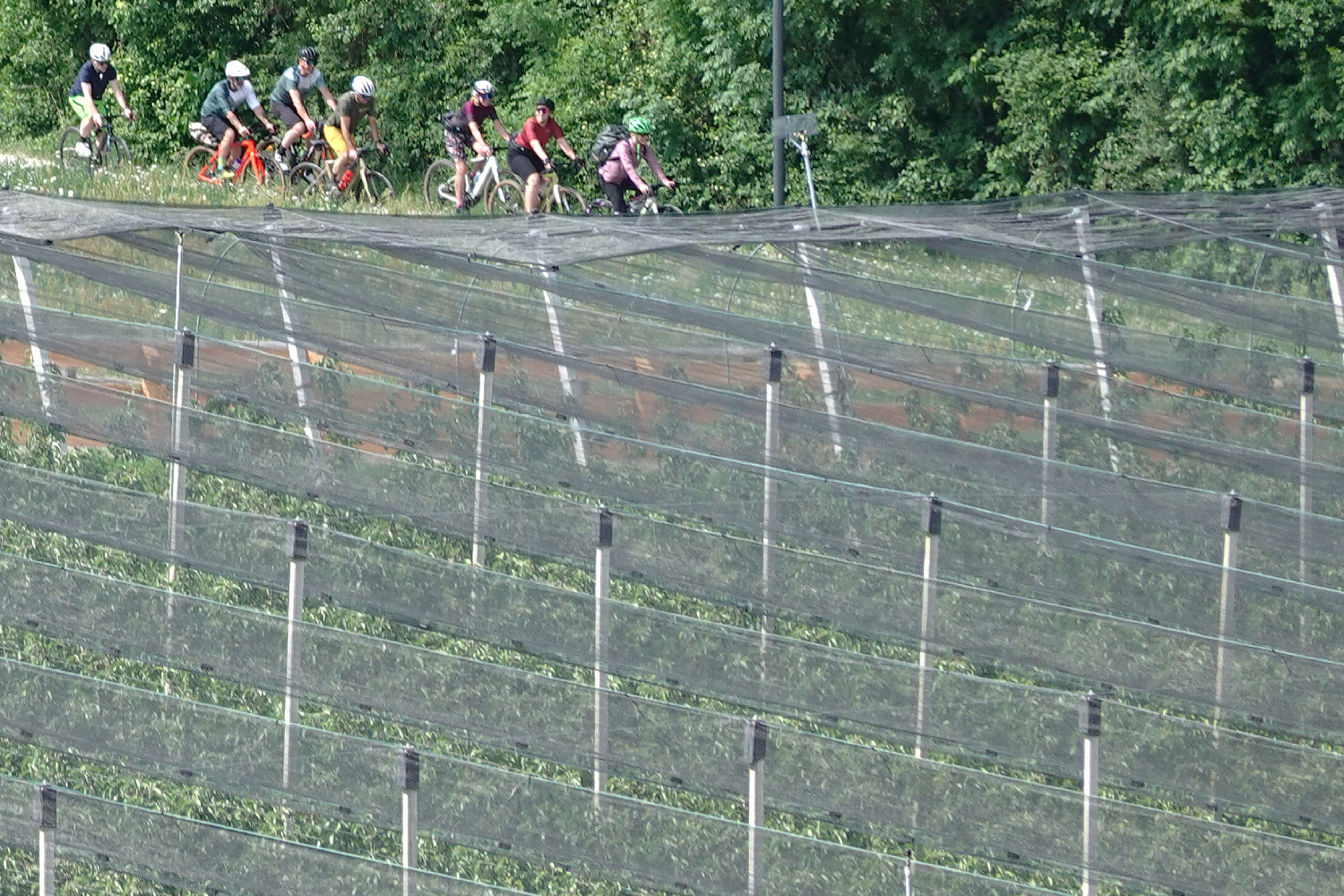
Seven cyclists passing from Brixen into Vahrn, on a bike path behind a vineyard in South Tyrol.
Enjoying the content on 3QD? Help keep us going by donating now.

Seven cyclists passing from Brixen into Vahrn, on a bike path behind a vineyard in South Tyrol.
Enjoying the content on 3QD? Help keep us going by donating now.
by Tim Sommers
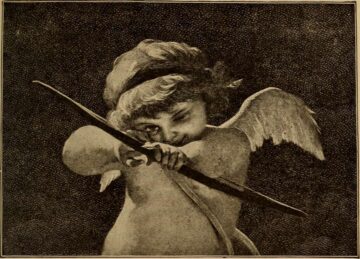
(1) Aristophanes. This is my favorite theory about the origin and nature of romantic love. Humans were once spherical, four-armed, four-legged, two-headed beings that rolled around everywhere confidently. They were cut in half by Zeus for trying to scale Olympus and attack the gods. Love is the search for your missing half and the ache to become whole again. Notable: Aristophanes says some of us were originally composed of two women, others of two men, and still others a man and a woman. In other words, your gender is not what determines whether your other half is male or female.
(2) Socrates/Plato. At the same dinner party as Aristophanes (aka The Symposium), Socrates offered this one. Love begins with desiring one beautiful body, then that body’s beautiful soul, then beauty as an idea, and finally the very form of beauty: love becomes the desire for the eternal. He lost me at loving beauty as an idea.
(3) Ovid. Despite being the author of some of the most famous love poetry in Latin literature, Ovid abandoned the philosophy and metaphysics of love for a practical, and not at all poetic, approach in Ars Amatoria (The Art of Love). Love is a craft. To succeed, master the moves. In other words, he wrote the first instruction manual for pick-up artists in recorded history. His advice? Take her to a gladiator match or a chariot race. Ask her who is fighting or riding. Pretend to care about her answer. If her dress drags at all, pick it up “for her” and get a good look at her ankles. Strategically brush a real, or imaginary, speck from her dress. Press against her whenever the crowd surges — whether you really must or not. Master stroke? Press against her at the height of the excitement in the ring and she will confuse her excitement at the gladiators (or chariot race) for excitement towards you. Apparently, there is empirical support for this move in contemporary social psychology. It’s called misattribution. Read more »
by Mike O’Brien
Read below or listen here:

In this interview, Angie Pepper and Richard Healey discuss their arguments for adopting an abolitionist approach to animal rights, focusing on a recent article in which they argue that the political and social power we wield over animals kept as pets is illegitimate.
In their article (linked below), Angie and Rich argue that pets have three moral complaints against the relations of power to which they are subject. First, they argue that our power over pets disrespects their moral independence: the fact that non-human animals are not simply available to be used to serve the interests or projects of others. Second, our power over pets systematically sets back their interests in exercising control over their own body, actions, and environment. Third, in subjecting pets to asymmetric relations of power in which they are heavily dependent on humans for the satisfaction of their interests, we subject them to objectionable risks of harm. Angie and Rich argue that, taken together, these complaints support the claim that the power relations central to the institution of pet keeping are illegitimate. Therefore, they conclude, we have a strong moral reason to abolish this institution.
In the interview we discussed how their thinking has been developing since writing the article, political and philosophical challenges to abolitionism, and what more just relations with animals might look like. To read their arguments in more detail, and in their own words, see their recent paper “Pets, Power & Legitimacy” here:
https://journals.publishing.umich.edu/phimp/article/id/6219/
To read more of their work, see here:
https://pure.roehampton.ac.uk/portal/en/persons/angie-pepper/publications/
https://richardhealeyphilosophy.wordpress.com/publications/
START OF TRANSCRIPT
MO: Welcome… Perhaps we can start by you introducing yourselves; what you do, where you’re at, and what sort of themes your work concentrates on.
RH: Up to you…
AP: Hi, my name is Angie Pepper, I am a senior lecturer in political theory at the University of Roehampton. I am principally interested in questions of what we owe to non-human animals, so I’m a moral and political philosopher, but I am primarily interested in questions of justice with regard to other animals. So, thinking about how we ought to treat them, what they are entitled to, thinking about the ways in which we might be wronging them… So I guess that kind of sums me up.
RH: I am Richard Healey, I’m an assistant professor at the University of Aarhus in Denmark, and I’m interested in all the topics that Angie just described, and often we’re working together on those questions, at least recently. I also do some work on… so, my primary work at the moment here at Aarhus is focused on informed consent, and requirements for informed consent, and we’re interested in a bunch of difficult questions around the nature of what informed consent looks like, disclosure and understanding. I guess more broadly I’m interested in, well… most of moral and political philosophy (laughs)… so, those are the things I’m working on at the moment, but yeah, I have fairly broad interests. Read more »
by Christopher Hall

I did something a little odd this past semester: I had my students write an assignment where I instructed them to use AI as much as they wanted. The assignment was to produce a cover letter and a resume to respond to a job ad I had given them; normally, for any given assignment, I’d give them parameters for how AI was to be used, either not at all or under guidance and supervision. But here, I took the reins off.
The reasoning was pretty simple: those reins, held by a communications professor hoping these Gen Z students might be directed to engage the engines of generative thinking that remain in their minds, wouldn’t be there at all when it came time to apply for their entry-level jobs in a few years’ time. So why not have them produce the very best product possible, which some of them could only do with the help of AI, and have their professor look over it to make it sure it wasn’t hallucinated garbage?
Not doing so, making them write what would likely be inferior documents just so I could criticize them, seemed backwards and a little cruel, like dragging a lot of abacuses into a math classroom and making the students do algebra just for the sake of, you know, doing it old school.
So that was my covering rationale; the real rationale is that I’ve been trying to convert all of my assignments over multiple courses to meet with the reality of AI, with marginal success, and I ran out of steam here. I had thought that, perhaps, I’d get them to produce something in class, have other students critique it in a kind of workshop atmosphere – I didn’t have a really clear idea of what I wanted to do at the beginning of the term, and predictably as time ran short I went for what was essentially the “default” option. And, seriously – writing a draft cover letter on the spot, in class, getting peer feedback, revising, getting more feedback, etc. – was I trying to replicate a process that is simply outdated? As I’m increasingly finding, the process of getting students to stop relying on artificial intelligence means, paradoxically, introducing a level of artificiality, a distance from practicality, into the classroom. Read more »
by Nils Peterson
On Water
Somewhere I have stowed my astrology reading so I could put my hands upon it when I wanted to see it again. I don’t remember where. So there is something about a water sign [Scorpio] — a certain muddiness and flow of memory. All is at the bottom of the sea. Why is it so important to remember the longitude and latitude of any one thing? That’s for earth people on their certain ways across the sea’s broad expanse. Whatever the shift in tide, the turn of the current, throws up interests the water person, though it is not what he or she set out to find in the morning.
Euripides says that “The parched earth loves the rain; and high heaven, rain-filled, loves to fall earthward.” So, water is this too, a messenger between longings, as anyone given a chemistry set as a kid knows — those dusts that sit desiccate in a test tube until water brings out the longing of each for the other and a third being is created. Yet there is something else. There is a poem of mine which ends with a walk by the sea after a great winter storm looking at the bits and pieces of washed up wreckage, then I look out at the ocean where:
The waves still roll fiercely from far out
breaking over a new sandbar then gathering up
again to break once more full upon the shore,
and I think of how on even the calmest day there
is a little shimmer against the solidness of land,
a little rolling againstness, and I feel the ancientness
of the anger hard and tight in her belly six miles
down in the dark fold of the Mindanao Deep.
So, water buoys, carries, flows, dissolves, beaches, creates, destroys. It sucks under. It throws up. It rains. It pours. Empedocles calls fire “destructive strife” and water “tenacious love,” and he saw that love and strife produced all change in their combinings and separatings. Read more »
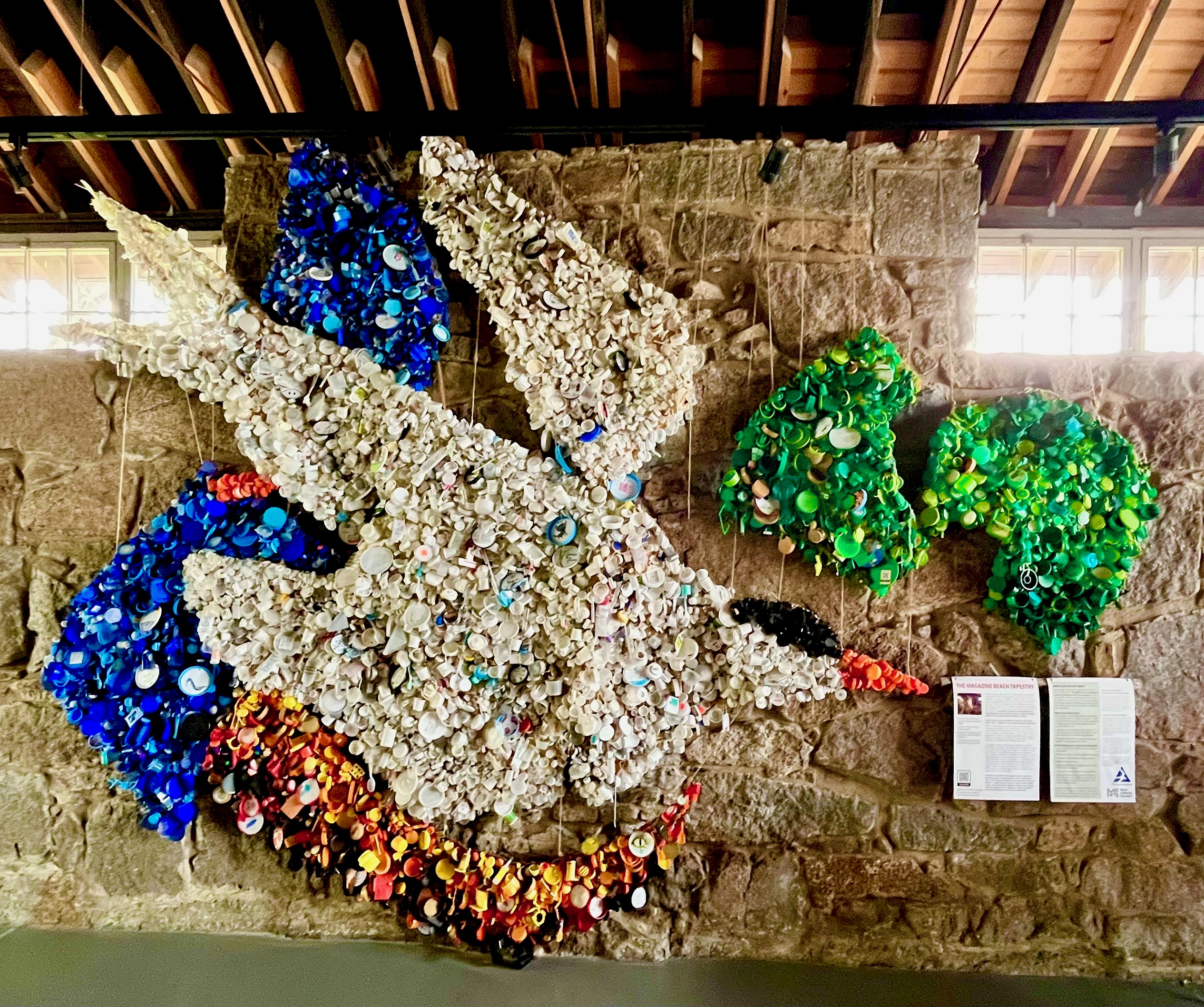 Michelle Lougee, Cecily Miller. Magazine Beach Tapestry, 2022.
” In 2022, Cecily Miller and Michelle Lougee teamed up to create a new project for Magazine Beach Park in Cambridge. Taking inspiration from FLOTSAM — Michelle’s 2021 mash-up of tapestry and mosaic made of post-consumer waste — we aimed to create a new community-based work warning of the environmental dangers of single-use plastic.”
Photograph by Sughra Raza, May 10, 2026.
Enjoying the content on 3QD? Help keep us going by donating now.
by Ken MacVey
 Justice Clarence Thomas recently gave a speech at the University of Texas on the Declaration of Independence in anticipation of its 250th anniversary this coming July. In giving his take on the Declaration and its ties to the Constitution, Thomas interspersed autobiographical details with commentary on what he perceives to be America’s moral failures to live up to the Declaration. Thomas attributed these failures to what he called “progressivism.”
The audience was enthusiastic and his presentation was acclaimed on Fox News. At the same time it was condemned in other circles. Renowned conservative and retired Judge Luttig described the speech as the most important speech on the Constitution that should never have been given. He condemned it as a manifesto for authoritarianism and for being anti-conservative to its core. Liberal constitutional scholar Erwin Cherminsky dismissed the speech as historically inaccurate and disturbing.
As will be shown, Thomas’ speech is largely incoherent, sometimes wildly so. What ties it together is not logic or historical fact — it is grievance. What is particularly concerning is that Justice Thomas is a powerful man; he is a justice on the Supreme Court. In fact, he has thus far served the second longest term of any Supreme Court justice and may end up serving the longest. He has played a key role in decisions that have re-shaped the United States, be it Bush v. Gore which guaranteed who would be president, the Shelby and Callais decisions which eviscerated the Voting Rights Act, the Dobbs decision which overturned Roe v. Wade, or US v. Trump, which granted Trump and other presidents sweeping immunity when it comes to committing crimes. What Justice Thomas succeeded in doing, by giving a speech while not wearing his judicial robes, was to reveal how he really thinks and what really motivates him. Read more »
by Priya Malhotra
 Before I launch into any critique of the phone, I should confess that I am not immune to its seductive qualities. I am not writing from a mountain, purified by silence, looking down at the scrolling masses. Like almost everyone else, I spend too much time on my phone. I reach for it when I am bored, when I am anxious, when I am tired, when I have two minutes between tasks, and the list goes on and on. I have checked it without wanting anything from it. I have opened one app, closed it, opened another, returned to the first, and emerged several minutes later with nothing gained but a vague sense of …something so amorphous that I can’t even begin to find the words to describe it.
So this is not a sermon. It is a confession disguised as cultural observation.
The phone is useful and has made life easier in so many ways. It lets us find our way home, call for help, send money, photograph our children, listen to music, read books, preserve friendships across continents, translate menus, summon taxis, record evidence, track medication, learn languages, and tell someone we love them from a hospital corridor or an airport gate. For many people, especially those who are isolated, disabled, elderly, far from family, or economically dependent on digital work, the phone is not a toy. It is essential.
And yet, precisely because the phone is so useful, it has become almost impossible to see it clearly. It has slipped past the category of object and become a world or many worlds. It is not something we merely use–it is something we inhabit. It is alarm clock, mirror, wallet, library, television, therapist, confessional, marketplace, map, camera, newspaper, babysitter, diary, and escape hatch. It is the first thing many of us touch in the morning and the last blue glow we see at night. It has become, in the most literal sense, an extension of the hand; and in some stranger sense, an extension of the mind.
But what kind of extension? Read more »

Who will herd the creatures of the constellations
across the prairies of the night sky
if we disappear like dinosaurs into the mists
of archaeology?
Who will name them? Who’ll call them
Crab and Bear, minor or major? Who’ll domesticate
The Lesser Dog, The Little Horse, The Wolf ?
Who would think to inscribe imaginary lines
between anonymous outposts of hydrogen
and helium exploding in the vast stillness
of galaxies where no thing breathes,
just to make something of nothing?
Who’ll nurture the illusion of them; The Hunter
and The Hunting Dogs roaming in fields
of sprouting nebulae pocked with ditches
of dark matter circled by clumps of cosmic dust?
Who’ll imagine The Lyre and The Painter’s Easel
placed to serenade the inhabitants of utter space,
and poised for the artist who’ll paint their portraits
in a vacuum?
Who’ll inscribe The Eagle on the crystal spheres?
And who will dare to sic The Lion on The Dove
against the wisdom of The Southern Cross?
Who’ll scan The Octant with an octant
to navigate chaos upon the back of The Phoenix
if we insist upon clutching The Scorpion
to our breast?
Who’ll project all the things of earth upon the heavens
if we continue to be seared by the blazing breath of
The Dragon?
……….
Jim Culleny, 2008
Enjoying the content on 3QD? Help keep us going by donating now.
by Peter Topolewski

When a certain earthly ruler, soaked in irony, recently lectured Pope Leo XIV about theology, one of the pope’s many charges, Monsignor Arthur Holquin, came to his defense, noting among other things that “Catholic Social Teaching from Rerum Novarum onward has always insisted that the Gospel is not a private spiritual comfort but a public moral claim.”
In other words, the Catholic Church isn’t the place you go to assemble an inner peace that jibes with the way you want to live your life. The Church makes claims on how you manifest your faith in society. You go into the Catholic Church as a guest to enjoy the full meal, not a buffet, and if you don’t want to eat every course, go pound sand.
We can assume a sizable crowd of Catholics would love to see this particular vice president fade from their ranks, or at least the spotlight. Whatever the nature of his call to the Church—even with the benefit of converting as an adult rather than being committed as a child—he’s bastardized that gift by hammering it into another tool of his ambition. Were he a regular Joe, hardly a person would notice his warped commitment to self. By the nature of his position, he’s granted exorbitant attention, making the parade of his faith especially abusive to other believers.
Should he walk away or not, his challenge to the pope leaves the rest of the flock to deal with an ongoing dilemma: How do you deal with the parts of your faith you don’t buy? Doubt is a real and necessary part of faith. For those who struggle, might we take another route forward to make our religion a private comfort so that we might better enact its moral claim? Read more »
by Anton Cebalo
In the first century AD, a passionate didactic poem was written in Latin and later bundled with Virgil’s work. However, the style is so drastically different from his that the author’s real name is likely permanently lost.

Aetna is a poem that revolves around explaining how Mount Etna (“Aetna” in Latin) on the island of Sicily erupts. Whoever wrote it must have made an altar in his mind devoted this volcano which was the most active in the region then. Mount Vesuvius had not destroyed the Roman city of Pompeii yet.
Aetna shall be my poetic theme and the fires that break from her hollow furnaces.
The poem is written romantically, as an ode to nature and to not underestimate the fiery infernos of Earth. It may be one of the few classical works that deals explicitly with the Earth as a victim and the consequences of taking from the land without paying it back in kind.
What’s also unique about the poem is that it is explicitly naturalistic. In a time of lyrical myth-making, the author spends the opening dismissing three leading myths about Aetna. No, he writes, Aetna is organic and has to be understood on her own terms. He speaks of Aetna as a body full of underground rivers, caves, and winds that carry the fire. He describes them in great detail to rationally understand how the volcano lives and moves.
This would be rare in classical poetry on its own, but the real emotional heart of the poem is what follows this naturalistic exploration. For it’s not really just about Aetna, but how by understanding Aetna, one lifts one’s head to the sky and grows closer to higher things. Read more »
by Dilip D’Souza
Some mornings, I wake up thinking of Ahmedabad. It’s a city I’ve visited a few times; for a few reasons, it’s a city I’ve never really warmed to. But I’ve roamed widely there, often by autorickshaw. And on those mornings I’m talking about, it’s two of those rides I remember.
The first: I’m going to see a friend. My rickshaw is operated by a burly man, greying and unshaven, I’d say in his mid-50s. We stop at a traffic signal. The little bump we feel as we wait, it doesn’t seem like anything to be concerned about. The white car behind has nudged us accidentally (we think) but gently. I mean, so gently that I’m certain there isn’t even a scratch registered. My driver must think the same – he waves his hand in what I can only describe as half-hearted irritation, doesn’t even get out to look. The light changes, we drive on.
Seconds later, the white car pulls alongside, then ahead, forcing us to the side, then to a stop. Man leaps out. Gleaming black shoes, spotless white shirt, creased trousers, looks 30 years old – must be an executive somewhere, I think. Right now, his face is twisted in fury. He bears down on us, yelling that he honked three times, wanting us to move over. (So maybe it wasn’t an accidental bump?) My driver steps out. He and executive-man go nose-to-nose, abusing each other loud enough for passing drivers to do a double-take.
I try to pacify them. I’m not even fully sure what the executive is really upset about, and there is no visible damage on either vehicle. For a moment, I think I have succeeded in calming him down. But only for a moment. Because he suddenly turns, lopes back to his car, reaches in and pulls out … absolutely the last thing I expect. It’s a long, sturdy stick.
He lopes back. Before I can react, or even comprehend what he’s doing, he swings at my driver’s forearm with a ferocity I would not have believed had I not seen it. The sound the stick makes, as it connects with flesh and the firmness of bone underneath, is nauseating. He has hit the driver so hard that the stick … it breaks in two. Read more »
by Mindy Clegg

Those who study history as a field of knowledge production (like myself) often differ in their understanding of what it is from the general public. Much of the public views history as entertainment or a boring list of names and dates, not anything critical to modern life. In some cases, its positioned as a mode of predicting what will most certainly come next. Historians tend to view history as more dynamic and in flux depending on the present. But where do perceptions of the past between the two groups diverge and is there a danger in that divergence?
I would argue that the difference is in how more popular perceptions understand the past as dead while those engaged in knowledge production view it as alive, speaking to us, demanding our attention to rethink the world around us. That disconnect is fed by popular historical narratives found in nationalist, teleological histories and by mass mediated narratives in film and television. For many, history is something back there, not something that informs us in the here and now. As such, the public is missing out on the power that understanding history in a more holistic way can hold. That does cause real problems as history for most isn’t something that is fully real nor something that can shape our understanding of what’s possible in the world.
Popular perceptions of the past rests in two ideas, that of inevitability of events of the past and the second is the objectification or flattening of the past. First, popular historical narratives tend to rest on the idea of a singular, teleological narrative, either progressive or sometimes cyclical, such as in Oswald Spengler’s Decline of the West. What happened, happened and that’s just fate. Nationalist historical narratives tend to embrace that framing along a continuum from liberal to fascist. The “nation” in these histories are an inevitable outcome of history or a body that has always existed in the past and will into the future. Messier aspects of the past are ignored or glossed over. Let’s take US history and the rise of modernity. Modern liberalism is seen as the inevitable outcome of the Enlightenment – a direct line from one to the other and the only real outcome that matters. The modern nation-state is an inevitable outcome of the historical process of the Enlightenment, in other words. Read more »
by Thomas Fernandes
High-acuity vision and depth perception give Portia a detailed and stable visual world. But vision alone does not explain why Portia is famous. What makes this genus remarkable is not just what it can see, but how it uses what it sees to manipulate the perceptual systems of other spiders.

Portia does not simply overpower its prey. It engineers situations in which prey behave in ways that make them vulnerable through careful behavioral manipulation.
Before examining Portia’s hunting strategies, we need to understand how it moves. Unlike almost all animals, spiders have no muscles dedicated to straightening their legs (extensor muscles). Instead, spiders evolved a hydraulic system that does this work for them by using hemolymph, the spider’s blood equivalent, as a hydraulic fluid.
To extend a leg, spiders pressurize hemolymph throughout the body, forcing fluid into each of their eight legs. Connections at the leg–body interface act as valves that open or close to adjust which legs extend. Pressure straightens the joints, while flexor muscles fine-tune movement. This is why dead spiders curl inward. When hydraulic pressure collapses, only the flexor muscles remain active, pulling the legs into the characteristic death curl.
This mechanism has several advantages. First, it reduces muscle mass at the extremities and concentrates it near the center of the body. More importantly, it makes holding an extended posture not just easier but nearly effortless, since legs are maintained by pressure rather than sustained muscle contraction. We say spiders “sit” in their webs, but they do not really sit; they hold their legs extended, waiting for information. Maintaining such stillness for hours would be nearly impossible using constantly tensed extensor muscles, especially in a web where immobility is essential. Read more »
by Herbert Lui
 By definition, in order to be prolific, you only need to produce and publish a lot of work.
When you set out to produce and publish a lot of creative work, you focus on what’s in your control. Your time will be limited, as will the size of each project, as well as your expectation for each one. There’s no time to get in your own head—for example, thinking about the prizes the work may earn—which means there’s no time for you to get blocked. Instead of getting too precious about a single piece of work, and falling into the trance of hesitation, you focus your energy on making a contribution to your body of work by finishing this one and starting on the next.
When you aim to produce a vast quantity of acceptable work, you also naturally find opportunities to improve along the way. Being prolific turns out to be a structure to improve your skills. Joseph Mallord William Turner’s practice of travel and painting led him to create and complete a vast quantity of work, including more than 550 oil paintings, 2,000 watercolors, and 30,000 works on paper. Ray Bradbury advice comes to mind, “If you can write one short story a week — it doesn’t matter what the quality is to start, but at least you’re practicing, and at the end of the year you have 52 short stories, and I defy you to write 52 bad ones.” Read more »

Reflection selfie in the window of a train I was about to catch at the station in Franznesfeste, South Tyrol.
Enjoying the content on 3QD? Help keep us going by donating now.
by Scott Samuelson
I’ve noticed something peculiar when I’m at an academic talk. While the paper is being read, I tend to become increasingly skeptical of it. Sometimes I dismiss it because I can’t track its jargon or follow its argument. But even when I do follow its every twist and turn, I often experience a strange resistance to it.
In the Q and A after the talk, the audience seems in a similar boat. They raise objections of their own and are rarely enthusiastic about the consequent rebuttals. When they’re not making objections, they end up asking one of two questions. How does this relate to my work? Or: why doesn’t this relate to my work?
In short, a paper that’s meant to win over its audience tends to have the exact opposite effect. This is especially true at philosophy talks.
Here’s the really curious thing. When I happen to have drinks or dinner afterwards with the speakers, they become way more fascinating, way more winning. They tell the story of how they got into their subject. They joke around. They confess their nagging doubts. They relate their ideas to their personal lives and to contemporary events. I see the value in the very points that had me dreaming up objections a short while ago. Now I’m enjoying myself and having new ideas of my own. When they stop trying to convince me they’re right, I start to come around to their ideas.
I’ve experienced a related phenomenon at poetry readings. A poet will recite a poem full of references to, say, up-to-date hospital equipment and mid-century European train commerce. After intoning the last bewildering line, the poet will start talking like a normal person and tell the backstory of writing the poem by a dying grandpa’s bedside, listening to the bleeping EKG and thinking about tales of his escape from Nazi Germany hidden among boxcar freight. I’ll go from being completely baffled to being immensely moved.
What I’ve long wondered is why thinkers and writers don’t think and write the interesting stuff, the stuff that actually convinces us and moves us. Read more »
by Mike Bendzela
I have mourned the fact my entire life that we, as a species, no longer have tails. —Robert Sapolsky
It’s too bad the most basic fact of our existence is overlooked, ignored, even denied, and railing against this state of affairs is largely pointless. I’m talking about our essential animal nature, written in our genes and imbued in our gray matter. I’ve scribbled on the topic before, working against a tide of careless language that swamps public discourse with confusion, particularly in politics. As a writer who is hardly a scientist, I sometimes resort to using the fable and the parable over the essay form for illustrative purposes, as I’m a better storyteller and analogy fabricator than an expository writer. I like these forms as they are instructive as well as entertaining.
As I’m a mere lay observer, my knowledge comes by way of books and lectures from writers whose knowledge exceeds my own by orders of magnitude. We all know the names: Darwin and Wallace themselves; Dawkins, Dennett, Gould, Sapolsky, Mr. Braterman of this very website, and so on. I’ve taken every evolution course I can find at the University where I am an adjunct instructor of writing, sections in both the Biology and Anthropology departments. I was privileged to be admitted into all of the courses taught by Harvard PhD Professor Kenneth Weber (1943-2023), some of which I audited, others I took for grades. I was flattered when he told the class that I, a university employee, was not an undergraduate biology student but an evolution “enthusiast.” Yes, that’s the right term for it. I am enthusiastic about what Darwin called “descent with modification.” This idea should be the centerpiece of all our lives, the same way evolutionary theory is the centerpiece of all the life sciences.
But if gifted writers and teachers such as those mentioned cannot make a dent in the consciousness of the American public, who am I to think I can? Read more »