
by Sauleha Kamal
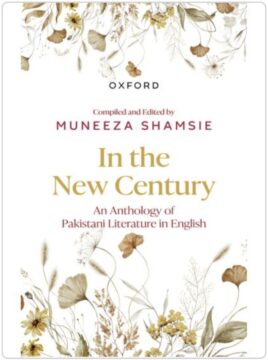 With In the New Century: An Anthology of Pakistani Literature in English, Muneeza Shamsie, the time‑tested chronicler of Pakistani writing in English, presents what is arguably the definitive anthology in this genre. Across her collections, criticism, and commentary, Shamsie has chronicled, championed, and clarified the growth of a literary tradition that is vast but, in many ways, still nascent. If there is one single volume to read in order to grasp the breadth, complexity, and sheer inventiveness of Pakistani Anglophone writing, it would be this one.
Comprehensive and weighty in the best sense, In the New Century is a tome, and unapologetically so. It almost asks readers to peruse it at a leisurely pace, giving the vastness of its subject matter, picking up and sitting with one writer at a time to uncover new dimensions to this genre. Spanning the work published between 1997-2017 by over eighty writers with least one full-length published collection in that period, the book, a follow up to her first anthology A Dragonfly in the Sun: An Anthology of Pakistani Writing in English (1997) proceeds in a loose chronological order according to the year of the author’s birth. This structure allows the reader to trace patterns across decades: the repetition of certain national traumas, the evolution of form and the confusing task of carving an identity. Each writer’s entry is prefaced by a concise biographical note which provides crucial context about their lives. This framing device is characteristic of Shamsie’s editorial approach: informed, unobtrusive, and generous. It also allows Shamsie to share priceless bits of trivia with readers, for example, that the Marxist writer Tariq Ali inspired Mick Jagger’s “Street Fighting Man.”
The first half of the anthology, in particular, feels like a trove of hidden gems, with stories, essays, and poems by a generation of writers who have shaped the tradition but are too often left out of mainstream discussions today. Only someone with Shamsie’s archival instinct and literary memory could have assembled such a list.
Recurring concerns of the Pakistani experience—displacement, migration, identity and inequality—echo across time. Some older pieces that capture the resilience that defines Pakistan are uncanny in that they feel as if they could have been written in the contemporary moment. Zulfikar Ghose’s “Silent Birds” is one such poem, masterfully capturing the contradictions of life in Lahore going on as normal amid extreme incidents like terrorist attacks. Taufiq Rafat’s poem “Karachi ‘79” captures the paradox of a city built for chaos (“My relatives here/ have had to be evacuated/ by a naval boat./ When they planned this city/ they forgot the sewers”). The city’s stubborn survival set against the ongoing human consequences of a lack of urban planning still rings true. Abdullah Hussein’s “Émigré Journeys,” which recounts the story of a modest villager making up his mind to migrate to England motivated for the promise of “bright prospects,” strikes a sad chord amid today’s headlines of ICE raids in the US and Afghan refugee expulsions in Pakistan.
Irshad Abdul Kadir’s meditation on relationships in “Two is an Odd Number” reminds readers that human beings remain, essentially, the same across time and culture. What starts as a promising match between an Urdu newspaper editor and a glamorous international academic is soon marked by a growing distance that has the protagonist Yasmin breaking down upon hearing Ahmed Faraz’s poem “Ranjish hi sahi, dil hi dukhane ke liye aa”. Here, and in other stories, gender and control surface repeatedly as tangled threads. In Abdul Kadir’s story Yasmin’s first marriage fails because her “ethereality” puts her husband on edge and her second, when her Swedish convert husband adopts a patriarchal, fundamentalist approach to marriage. Similarly, Nazneen Sheikh’s story reflects on how heterosexual relationships, especially within marriage, can become arenas of disguised subjugation, across cultures. Reeling from a betrayal and broken marriage in Marrakech, Sheikh’s protagonist asks: “Had I simply projected my vision fuelled by a powerful imagination of an unworthy ally whose utterances were simply a hashish dream?” Again, a husband’s latent desire to control his wife becomes a stumbling block. Later she reflects, “Lurking beneath his urbane and thinly lacquered French patina was the ferocity of a tribal code that confined women to locked homes, exercised a rapacious control over their personal assets and mobility, and then sought absolution through prayer” that is, in her eyes, rendered both “godless and suspect. These observations point to how the illusion of piety is often wielded as a weapon to police women.
There are pieces in this anthology that build their emotional impact stealthily. Saad Ashraf’s story is one such example as the tale of a postmaster’s routine transfer which unfolds against the extraordinary backdrop of Partition. In GF Riaz’s poem “Baramasa: Seasons of Rural Life” the last section Chayt, with its urgent imperative to “beware the rains” is strikingly prescient about climate change, especially its impact on crops like wheat and fruit that remain, against a ticking clock, the lifeblood of agrarian Pakistan.
Some stories work through sleight of hand. Syed Afzal Haider’s “Life of Ganesh,” a tale of childhood, class and caste is sharp and understated, allowing social hierarchies to unravel through the casual cruelty of children. Talat Abbasi’s exploration of shame and morality (there is a pointed mention of the grandmother’s disapproval of sleeveless clothing) quietly captures how deeply society internalizes sin, and how unkind piety can sometimes be. That a woman’s faith is measured by the coverage of her arms but not by her response to questions from children is a subtle, biting observation.
A clever inclusion is Bapsi Sidhwa’s essay about the film adaptation of her novel Cracking India (1991), Earth (1998), . By choosing an essay over fiction, Shamsie gives us not just what we would expect to see from Sidhwa in this volume but access to her interiority within the frame of her most recognizable work. The essay is both a window into the politics of adaptation and a meditation on voice, agency, and authorship. This pairs beautifully with Tahira Naqvi’s “Holi,” a story inspired by the filming of Earth. Naqvi’s young protagonist loses her husband to senseless violence when he stops to buy sugar at the market. The focus on violence, youth, and emotive descriptions of the bag of sugar echoes the image of sugar dissolving in milk, a powerful metaphor from Cracking India that reappears here with renewed force.
Interiority and domesticity are even more prominent themes in the second half of this anthology. Writer and physicist Tasneem Zehra Husain uses physics metaphors for the breakdown of communication in a relationship: “For a writer, the thought of words driving people apart is especially painful, and I have gone to major lengths to avoid arguments with those I love. But apparently distance can creep into a relationship through other means, far more dangerous than a war of words. […] Eventually, the Universe splits up into disjoint fragments, unable to exchange signals, doomed to stay ignorant of each other forevermore.”
Hima Raza’s Two Tones traverses this space with a bilingual flair, capturing the intimacy of distance with the switch to Urdu. In “In Translation,” translation and divisions evolve into silence: “‘New ethnicities’ Emerge from old divisions / To manoeuvre my tongue / Towards silence”. A poem that starts with a joining in English “Two tones become / a reluctant one” expresses a breakdown and departure in Urdu: “jahaan umeed mit gayi/ tau teri yaad ka faida kiya?” Meanwhile, other kinds of love emerge too. Bina Shah’s window into Sufi poet Shah Abdul Latif’s interiority sees a confrontation between romantic love and devotion to the divine as the ascetic considers his unspoken, undying love for his wife. Meanwhile, Fatima Bhutto’s fighter in The Disappearing foregoes earthly comforts and companionship declaring “I am married to my country […] I am wedded to the cause” before his cause consumes his life.
Rukhsana Ahmed’s reflections on playwriting offer another kind of insight. Here is another documentation of the artistic process but this one is charged with political solidarity. Ahmed’s trenchant observation that the inclusion of Black writers in UK theatres “pulled the door down for some of us” is a powerful reminder of the interconnected nature of BAME struggles. Wajahat Ali’s later piece portrays this shared struggle from a different perspective as he navigates the challenges of writing a Muslim‑American show for HBO without compromising his vision. He captures the very serious, shared POC struggle with his characteristic playful flair: “The current story of Islamophobia in America is simply a remake. In the past, the antagonists have been (and occasionally still are) Jews, Catholics, LGBT persons, Japanese Americans and African Americans. This time, Muslims got the part without auditioning.”
Other standouts include Imtiaz Dharker’s “The Right Word” which place terrorism and identity in the frame of childhood. This poem begins with a simple declaration, “Outside the door, lurking in the shadows, is a terrorist”, but with each new stanza, the word “terrorist” is transposed into another word: “a freedom fighter,” “hostile militant,” “guerrilla warrior,” “martyr” and “child,” until, finally, what’s left is “a boy who looks like your son.” These sharp, semantic switches are a succinct way to point towards the problem of defining the word “terrorist,” which academics such as Alex Houen have long debated. Qaisra Shahraz’s story “The Elopement” documents a different kind of struggle: the competing demands of two cultures for British‑Pakistanis as they are pushed into “social vacuum,” marked by shame and rejection from their community as well as country. Finally, Moni Mohsin’s fictional diaristic entry about September 2001 from her standout satire Diary of a Social Butterfly is rightly included here as a unique artefact that blends Sex and the City Style-levity with the horrors of the 9/11 era.
Sorayya Khan’s excerpt from her novel Noor (2003) wrestles with silence and forgetting as it fills in gaps about the horrors of 1971. In “What Do I Owe My Father’s Far-Flung Family,, Rosie Dastagir captures her inheritance of her father’s immigrant/survivor guilt with an anecdote about her self-made father’s attempts to help a less financially successful distant relative because he was “anxious that he had little to show for his hard‑won life” as well as haunted by generational trauma and the hope to “transmute his luck into theirs.” Encapsulating the recurring trauma of conflict in Pakistan over the past few decades, Rizwan Akhtar delivers a sobering line: “The world had one 9/11 and one 7/7, we live through them each moment.”
Excerpts from successful, as well as, widely acclaimed works from Mohsin Hamid, Kamila Shamsie, Nadeem Aslam, Daniyal Mueenuddin, Hanif Kureshi and HM Naqvi are reprinted here. These pieces are not only representative of the most prominent works in contemporary Pakistani fiction today but also allow readers to reencounter pivotal works in a new light, placed in conversation with a century of literary tradition. I will not say more about these pieces here simply because they have been discussed at length before, but this is not to suggest they are not essential, the very opposite indeed. Kamila Shamsie’s excerpt from Home Fire (2017), for example, exposes the deliberate cracks within immigration systems with an airport interrogation scene that illustrates how quickly suspicion becomes psychological violence.
There are Raja Changez Sultan’s historical reflections on Islamabad. The Islamabad native critiques such things as architectural violence, including the rejection of indigenous practices like high ventilation, and the hollowing out of spiritual institutions (for example, his verse “Bari Imam and Golra Sharif stuck to their task” comes as a quiet indictment of the clerical class). Salman Tarik Kureshi’s Vigil, a poem about growing older and becoming a caretaker for aging parents features one of the most affective lines in the book: “more parent than son now.” It distills the quiet reversals of familial love and duty into six aching words. Quieter pieces like these ones bring the anthology full circle in tying the personal and political. On the other hand, Tariq Ali’s gentle mockery of Harold Bloom’s myopic introduction to a volume on Andalusia with a simple tongue-in-cheek sentence—“The only spoiler in this book is Harold Bloom”—is a reminder that these writers have teeth.
This volume may be nationally defined but Shamsie’s editorial eye is certainly not geographically limited. Alamgir Hashmi takes readers to the moors of Yorkshire. Durdana Soomro and Ghazala Hameed capture the tension following Ayub Khan’s coup via a domestic scene as a civil servant’s family hosts a state dinner in East Pakistan for Ayub Khan that ends up being a men-only affair. The girls who help with the dinner preparations later see the event in photographs and notice Zulfiqar Ali Bhutto who is young and handsome in those pictures—an observation marred by the knowledge that he is, of course, to be later executed by the very country he led. Sara Suleri Goodyear’s excerpt from Boys Will Be Boys is a reminder of the trouble with translating selves and languages: “who can provide me with a better translation of goyah? […] Language. What a nuisance it is!” She later extends the metaphor in a reflection that captures the central tension in anglophone Pakistani writing, a genre that is often translating feelings that originated in Urdu, Punjabi, Sindhi, Pashto into English prose, all the while redolent with the colonial legacy of the English language: “Cultures are certainly translated things: moving from one to another requires a discursive equilibrium hard to acquire, hard to retain.”
In the New Century is a masterful achievement. It is a collective autobiography of a young country, a portrait of those who stayed and those who left, and all those who translated, doubted, witnessed and reimagined. It captures the essence of Pakistani writing in English: cosmopolitan, rooted, contradictory, unresolved and in a state of constant flux. Muneeza Shamsie has gifted fans of anglophone Pakistani writing a monumental anthology that is both an archive and a home.
***
Enjoying the content on 3QD? Help keep us going by donating now.