by Michael Abraham
I have been told it is a bad thing. I have been told this by doctors and friends and my parents and lovers. They worry over me, worry over me the way a Catholic worries over her rosary. They insist on the medication and the therapy and anything but this feeling, anything but this feeling you relish so intensely.
O, but to live without it is a waste, a wasteland, and not in the TS Eliot way: not a wasteland overbrimming with meaning, but a wasteland devoid of even the potential for meaning. Hypomania is summer thunder, is getting crushed by the rain. It is having sex with two men in one night, and learning their names, and learning their deepest fears because one is so open that deep fears tumble out. It is falling into Triangle Park, into the puff-puff warm feeling. It is taking ecstasy on the tongue and dancing all the night long. It is spending all your money and calling it good, for a good night out is only the sign of one who hopes. O, it is sex and drugs and money, but it is more than that, so much more than that. It is a deep thrum like a drum struck at the center of the being, an immaculate sound that emanates through the vibration of the whole body. It is an easy slide into Exactly Who He Wants To Be. The world is an oyster, and hypomania is the pearl: it is gorgeous; it is extravagant; it deserves to be worn at the neck as a sign of glamour and appeal. For one who has experienced it, there is nothing quite as quick as the slice of its blade upon the throat. It bleeds one out. It makes from one who is merely body, merely mind, something spectacular: a fountain of bright red conundrum, a spill of the holy stuff onto the ground. There is no living without it once you’ve had it. It is the best drug on the street. It is top-shelf liquor. It leaves nothing in its wake but wanting for it. Staying up to write all night, sweating profusely as you dance your aches out alone in front of the DJ booth, falling into the arms of any boy, falling into your own embrace, embracing yourself as a broken thing full of yearning: it is a true human condition. It is maybe the human condition laid bare. There is no proper way to say it, but to say that all the stars align for a moment, and in that moment, you are immortal; you are the absolute apotheosis of chance and luck. You take the world in your hands, and then you take the succor of the world in your mouth, and then you fill yourself until your greed for all the world has to offer is finally satiated. O, but it is never satiated!—not until the hypomania passes, and you pass with it, into the doldrums, into the never-ending blue of regret and depressive reconstruction of the self. You lose your ground in the hypomania, and then, in the depression, you get your ground back. And your ground is such a burden. To be free of oneself, to be an onslaught, to be a trick in the back pocket of a satyr prancing wild to a Madonna song: it is so very difficult to leave it. Read more »
 I know


 Some years after Carlos died, another friend and another noted development economist, Hans Binswanger, was diagnosed as HIV-positive. He initially took that as a death sentence and gave away much of the material things he had. But by then the new antiretroviral drugs were in use, and possibly because of them lived an active life for another quarter century, until he died in Pretoria, South Africa in 2017 at age 74. In 2002, shortly before he left his World Bank job, he founded and endowed an NGO in Zimbabwe, that supported about 100 mostly HIV-positive children and their families by providing education, supplemental health care, and counseling. In South Africa he married his boyfriend Victor in a traditional multi-day Zulu celebration. Since then he has always identified his last name as Binswanger-Mkhize.
 Carved in marble above the entrance to the Supreme Court Building is the motto: “Equal Justice Under The Law.”
 Napoleon Jones-Henderson. TCB, 1970.
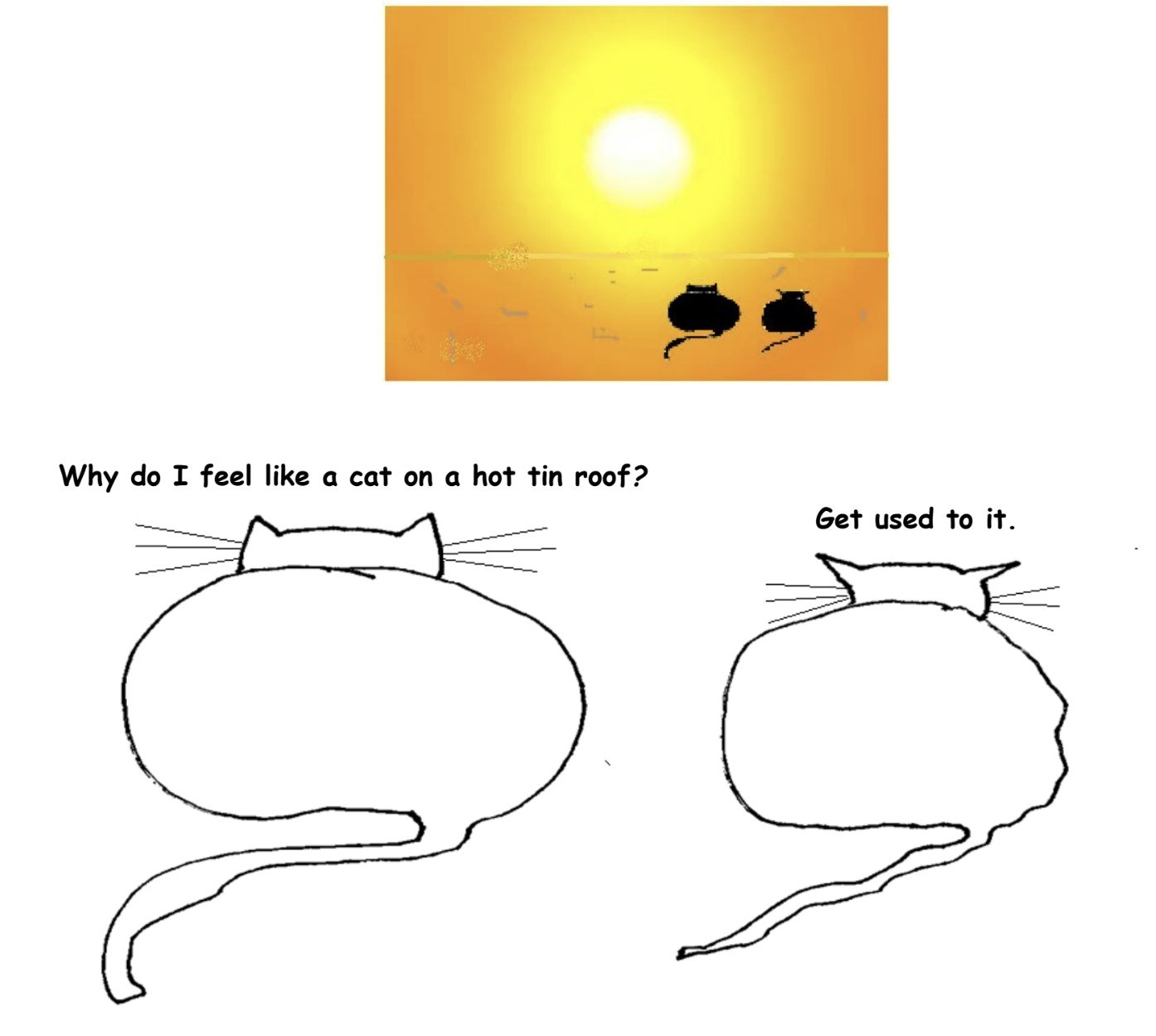
 Dreams are about questions.


 I had a colleague, a great reader, whose favorite material was mid-century Japanese short-form realism. Frequently epistolary and often featuring at least one frame narrative, these novellas typically have as their narrator someone captivated, not to say obsessed, by a memory; and that memory, it seemed to me when I read the works my colleague lent me, is almost inevitably fed by an erotic or romantic encounter, as well as by its often calamitous sequelae.