by John Allen Paulos
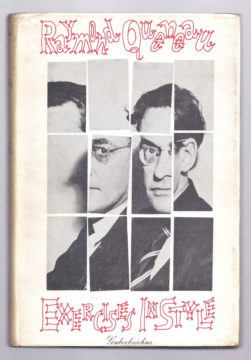 Raymond Queneau was a French novelist, poet, mathematician, and co-founder of the Oulipo group about which I wrote last year here. The group is primarily composed of French writers, mathematicians, and academics and explores the use of mathematical and quasi-mathematical techniques in literature. Their work is funny, experimental, weird, and thought-provoking.
A reader of my piece recently suggested I read Queneau’s 99 Exercises in Style. I’d read a lot of Oulipo’s writings, but never this collection of 99 retellings of the same simple anecdote. Each version is in a different style, if we interpret “style” loosely to encompass just about any variation in the telling. In almost all of the 99 variations the narrator gets on a bus in Paris, sees an argument between a long-necked man with an unusual hat and another passenger. Elsewhere and a while later the narrator sees the same man speaking with someone about button on his coat.
Queneau’s entries are clever, varied, and, taken in their entirety constitute a brilliant tour de force. The basic anecdote is banal, but that’s the point. Banality varied and repeated is far from banal. On a long overnight flight with nothing much to do, the entries inspired me to try my hand at writing a few of my own such short pieces rather than cite a sample of them from the book, many of which, incidentally, are only a half dozen sentences long. So here goes my comparatively feeble quota of stories a la Queneau, which are based on a different anecdote and set in Philadelphia. I hope other readers might be tempted to play with the idea as well, perhaps with the help of ChatGPT. Read more »





 Human minds run on stories, in which things happen at a human level scale and for human meaningful reasons. But the actual world runs on causal processes, largely indifferent to humans’ feelings about them. The great breakthrough in human enlightenment was to develop techniques – empirical science – to allow us to grasp the real complexity of the world and to understand it in terms of

 One of the amusing things about academic conferences – for a European – is to meet with American scholars. Five minutes into an amicable conversation with an American scholar and they will inevitably confide in a European one of two complaints: either how all their fellow American colleagues are ‘philistines’ (a favourite term) or (but sometimes and) how taxing it is to be always called out as an ‘erudite’ by said fellow countrymen. As Arthur Schnitzler demonstrated in his 1897 play Reigen (better known through Max Ophühls film version La Ronde from 1950), social circles are quickly closed in a confined space; and so, soon enough, by the end of day two of the conference, by pure mathematical calculation, as Justin Timberlake sings, ‘what goes around, comes around’, all the Americans in the room turn out to be both philistines and erudite.
 Sa’dia Rehman. Allegiance To The Flag on Picture Day, 2018.



 In the first round of this year’s NBA playoffs, Austin Reaves, an undrafted and little-known guard who plays for the Los Angeles Lakers, held the ball outside the three-point line. With under two minutes remaining, the score stood at 118-112 in the Lakers’ favor against the Memphis Grizzlies. Lebron James waited for the ball to his right. Instead of deferring to the star player, Reaves ignored James, drove into the lane, and hit a floating shot for his fifth field goal of the fourth quarter. He then turned around