by Eric Bies
 I think of Pearl S. Buck and end up thinking of William F. Buckley. I think of The Good Earth—of hovels unworthy of Frankenstein’s monster and a palace sacked in smoke, its shriveled matriarch glued to an opium pipe—and end up thinking of Firing Line. Clicking over to YouTube, typing, hitting enter, clicking, watching: after the FBI Warning about unauthorized reproduction and so forth, past the Hoover Institution’s little slide about same, through the twittery culture-conferring bit of Bach as theme, this is number 267, an interview with Jorge Luis Borges. I giggle a little as South America’s Titan, gazing literally blindly out past everyone in attendance that day in Buenos Aires, clips and interrupts Buckley’s stately introduction, an introduction that begins with Buckley reading off words about Borges, by Borges.
Buckley: About himself he said recently, “As for a message, well, I have no message. Some things—”
Borges: That’s right, there’s no message whatever.
Buckley [places a hand on Borges’ arm]: “Some things simply occur to me and I write them down with no aim to hurt anyone or to convert anyone. This is all I can say. I make this public confession of my poverty before everybody—”
Borges: Yes.
Buckley: “Besides, had I not done so, you would have known—”
Borges: But I think you may know.
Buckley: “—you would have known it was true,” yes that’s what I said.
Borges: Yes.
Buckley: I’m just going to finish this introduction, and then we’ll exchange—
Borges: That’s right, yes, that’s right.
Buckley: Uh, about him others—
Borges: [inarticulate]
Buckley: About him others have written that he is the greatest living writer. Still others, that he has influenced the literature of the world more than anyone alive. Jorges Luis Borges lives here in Buenos Aires, although he has traveled extensively, especially in the United States, and taught most recently at Harvard for a year. He is blind, since the late fifties. He does not mind it, he says [Buckley’s brows go up], because now he can live his dreams with less distraction—
Me: CLICK.
Video paused, I get up from my desk, traverse the kitchenette, use the toilet, and refill my glass with water from the tap. My apartment isn’t bugged or anything, but if it were, say, with a dozen little cameras, or even if the little man in my phone were to tune in for a peep to help pass the afternoon, dangling his eye from the eye of my phone which I carry from point to point before returning to my desk—nothing would appear awry. On the surface, I, the walls, even the water in this glass remain totally unperturbed. But, for seventy seconds or so, those last few pre-pause words, far from the conclusion of Buckley’s introduction, have been shimmering brightly inside of me. Read more »
 In late March the United Nations adopted a landmark
 The term “gastronomy” has no agreed-upon, definitive meaning. Its common meaning, captured in dictionary definitions, is that gastronomy is the art and science of good eating. But the term is often expanded to include food history, nutrition, and the ecological, political, and social ramifications of food production and consumption. For my purposes, I want to focus on the conventional meaning of gastronomy for which that dictionary definition will suffice.

 One of the most interesting debates within the larger discussion around large language models (LLMs) such as GPT-4 is whether they are just mindless generators of plausible text derived from their training – sometimes termed “

 Misha Japanwala. Breastplate, ca. 2018.
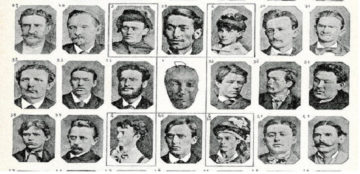 When they arrived in the U.S., Southern Italians brought with them the sense that they’d been branded as underdogs, that they belonged and would forever belong to a lower class, but the birth of the Italian-American gangster was rooted in attitudes toward the Mezzogiorno that dated back far earlier. After Italy was unified under Vittorio Emanuele II in 1861, a new national government imposed Piedmont’s centralized administrative system on the South, which led to violent rebellion against State authority. Politicians and intellectuals took pains to deflect responsibility for what they saw as the “barbarism” of the Mezzogiorno, and were particularly receptive to theories that placed the blame for the South’s many problems on Southern Italians’ own inborn brutishness. The decades following Unification saw the nascent fields of criminal anthropology and psychiatry establish themselves in the universities of Northern Italy; implementing the pseudosciences of phrenology and anthropometry in their search for evolutionary remnants of an arrested stage of human development manifested in the people of the Mezzogiorno, they used various instruments to measure human skulls, ears, foreheads, jaws, arms, and other body parts, catalogued these, and correlated them with undesirable behavioral characteristics, inventing in the process a Southern Italian race entirely separate from and unrelated to a superior Northern race and officially confirming the biological origins of Southern “savagery.”