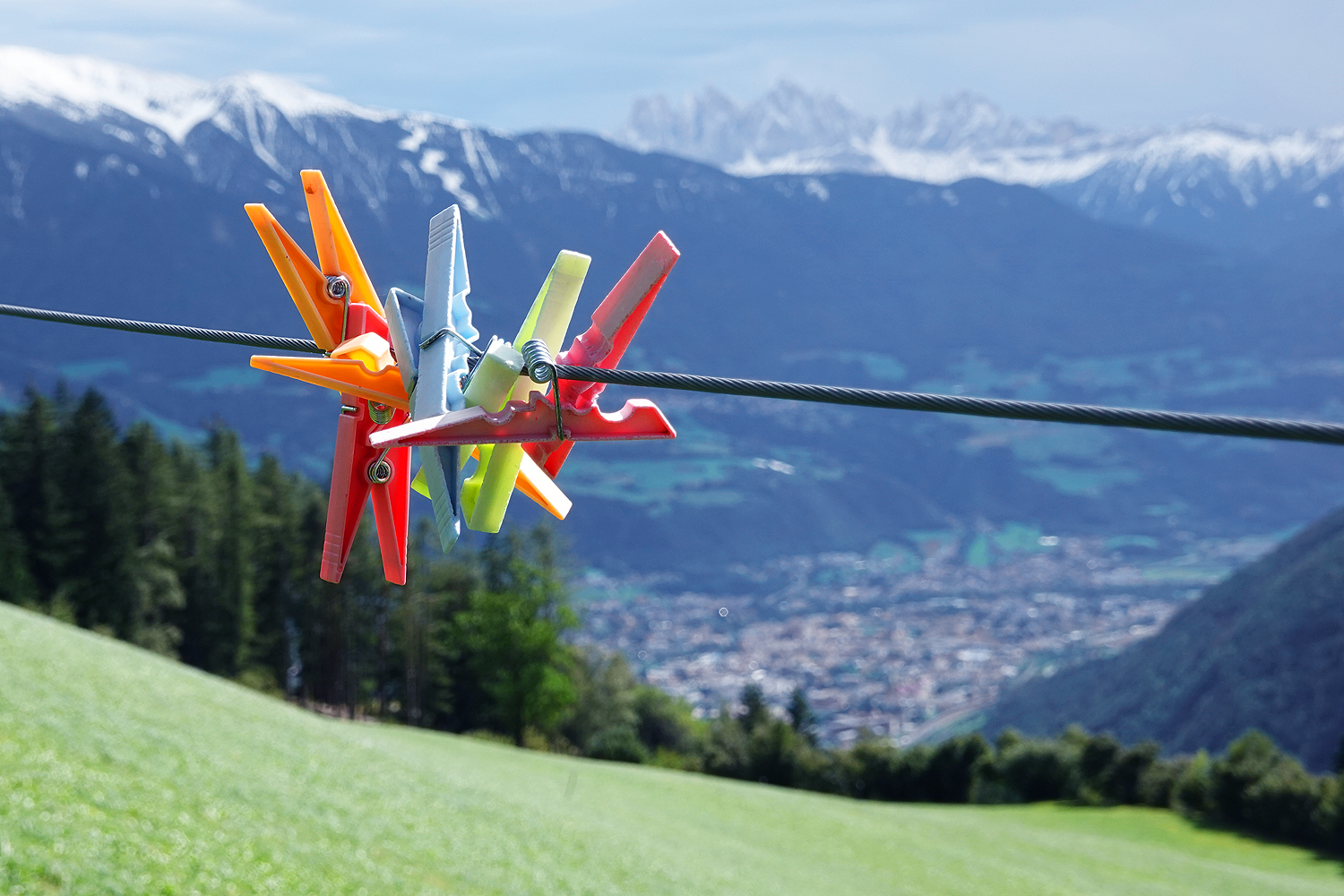
Clothespins in Spiluck, South Tyrol, with the Dolomites and Brixen in the background.
Enjoying the content on 3QD? Help keep us going by donating now.

Clothespins in Spiluck, South Tyrol, with the Dolomites and Brixen in the background.
Enjoying the content on 3QD? Help keep us going by donating now.
by Rachel Robison-Greene

When we look back on some of our most pleasant memories, they often share two things in common: people we love and food. We would be unlikely to describe the origin of our favorite meals as food production. We’d be more likely to describe it as cooking and the cooks we’d describe would, invariably be people. That might not always be true.
Mezli was the first fully robotic restaurant in San Francisco. If you stop by for a meal, you’ll find that your fully customizable order is taken by a machine and the food itself is delivered by robots. The creators of Mezli argue that producing food in this way is a moral good: it involves less space, less of a carbon footprint, and has the potential to make food cheaper because there are not employees to pay.
One need not be up for a night out in order for technology to do the cooking. For those who would like some assistance with cooking at home, there’s the Moley Robotic Kitchen. Those who purchase this technology will have a pair of robot arms installed in their kitchens that will prepare and cook food for them. The robot arms can even be trained to cook in the style of the owner’s favorite five-star chefs.
The process of creating food can be time consuming. It can be difficult to find the time and attention every day to craft three healthy and delicious meals for oneself and one’s family. This may be an area in which people could use a little help. On the other hand, we might think that cooking is an art; it’s an aesthetic experience. It is also a fundamental way in which we show love and care to the people in our lives.
AI is already being used to craft recipes; in the future we may not even need to be creative anymore—AI may provide us with more food combinations than we ever considered. It will be able to learn any food tradition and style and will be able to create beautiful and seamless fusions of ingredients. Read more »
by Mike O’Brien
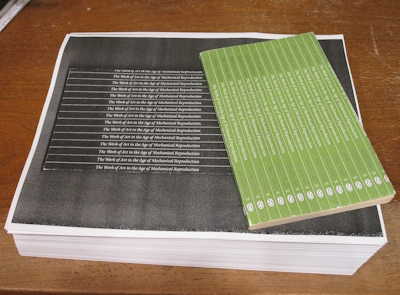
Once again, I found myself torn in several directions trying to choose a topic for this piece. I try not to be too current, but also not too esoteric. I considered writing about A.I. generated video games, end-of-life care for pets (unfortunately quite topical in our house), and the overly formal and stylistic definitions of fascism in the popular press. Overwhelmed, I reached to the bookshelf for something less ad hoc, something that could afford some comforting distance from the present moment, while also enhancing perception through a parallax view. (I have been partial to optical analogies ever since taking an exceptionally good course on pre-modern theories of optics by Dr. Stephen Menn at McGill. Holding MA and PhD degrees in both philosophy and mathematics, with a command of ancient languages and a gift for exegetical reading, I am still impressed by his teaching some twenty years later.)
I landed on Walter Benjamin’s “The Work of Art in the Era of Mechanical Reproduction”. It mostly recommended itself by its brevity; the titular essay runs only fifty pages in its slim Penguin Classics edition. I first became aware of Benjamin through Giorgio Agamben’s writing during my late 2000’s edgy political theory days, when theology, linguistics and theatrical criticism blended together in a haze of intriguingly oblique but often flatly ridiculous text (insert “Verso monograph ” joke here). The title of this work promised some strikingly prescient anticipations of the current debates over the role of generative A.I. in art and culture. It was not to be, insofar as Benjamin’s concern with art’s impact on audiences does not speak so readily to concerns about the impact of A.I. art on artists or its use for automated forgeries. It did, rather unexpectedly, lend itself more readily to questions about the differences between film and video games, and to the topic of aesthetic vs substantive critiques of fascism. (Benjamin, as a writer, a Marxist, and a Jew, found fascism inescapable in its ubiquity and in its enmity towards his identities. He killed himself in 1940, five years after the essay’s publication, when he was captured in Spain while trying to flee to America via Portugal, believing that he would be deported to France and handed over to the Nazis.) Read more »
by Derek Neal
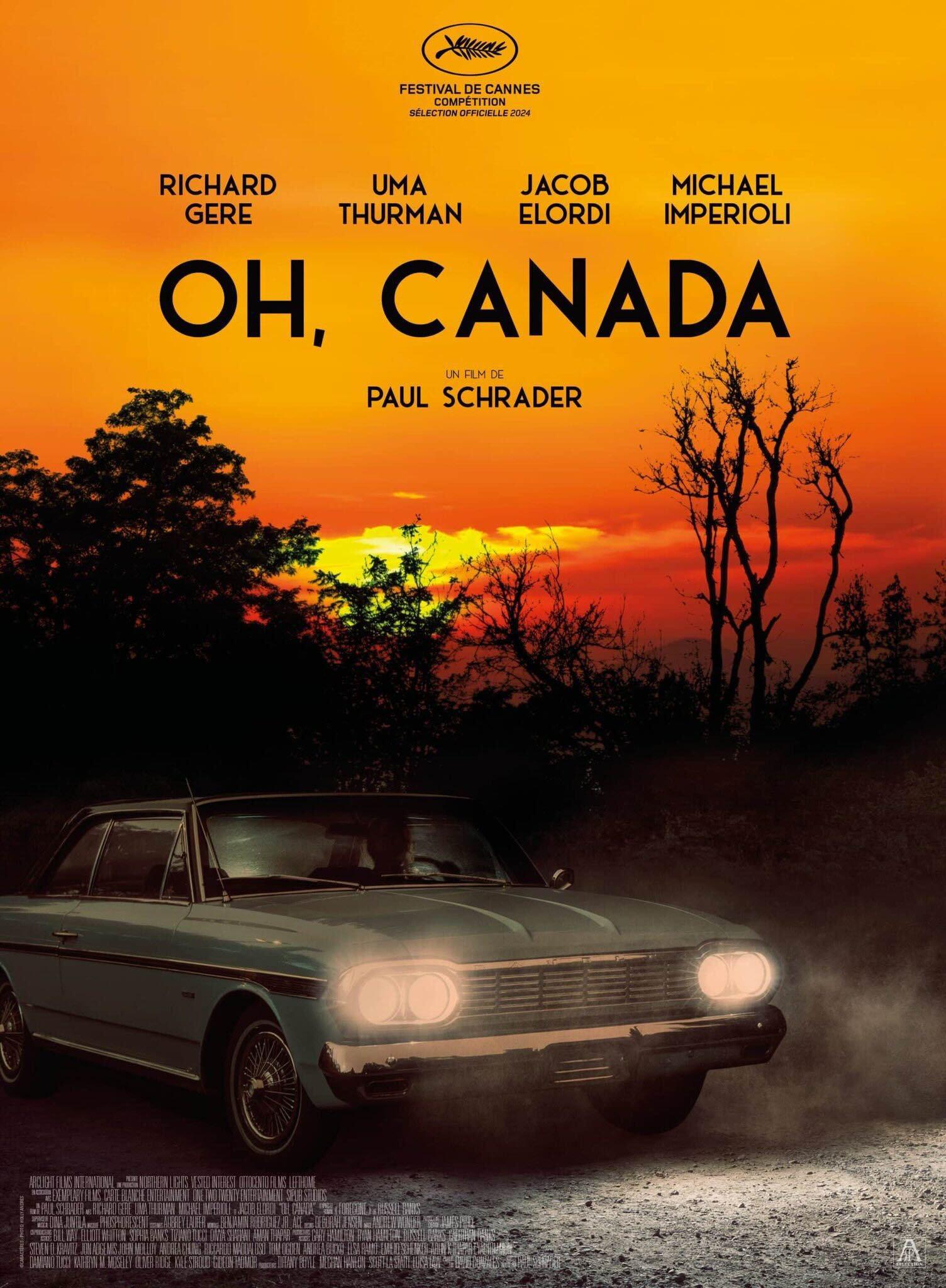 I was in Toronto the other day to see Paul Schrader’s newest film, Oh, Canada, which was screening at the Toronto International Film Festival (TIFF). This was my first time seeing a movie at a festival, and the experience was quite different from seeing a movie at a cinema: we had to line up in advance, the location was not a cinema but a theatre (in this case, the Princess of Wales Theater, a beautiful venue with orchestra seating, a balcony, and plush red carpeting), and there was a buzz in the air, as everyone in attendance had made a special effort to see a movie they wouldn’t be able to see elsewhere. As I stood in line with the other ticket holders, I noticed that there was a clear difference between the type of person in my line, for those with advance tickets, and the rush line, for those without tickets and who would be allowed in only in the case of no shows: in my line, the attendees were older, often in couples, and had the air of Money and Culture about them; in the rush line, the hopeful attendees were younger, often male, and solitary. In other words, those in the rush line, the ones who couldn’t get their shit together to buy a ticket in time, could have been typical Schrader protagonists: a man in a room, trying, yet frequently failing, to live a meaningful life, to keep it together, to be the type of person who buys a ticket in advance, and invites his wife, too. Yet there I was, in the advance ticket line: a man, relatively young, and someone who spends a good deal of time by himself. I’d invited my partner of 10 years, but she didn’t come because she doesn’t like Paul Schrader films, and who can blame her? They’re not for everyone. Perhaps my presence in the advance ticket line, but my understanding of and identification with those in the other line, helps explain my deep attraction to Schrader’s films: I know his characters, and in the right circumstances, I could become one of his characters.
We made our way into the theatre and found our seats. I’d put some thought into my choice of assigned seat. It was one of the cheapest seats, but it was also the final row of the dress circle, just below the balcony, and it was almost at the end of the aisle. I thought this would give me a good view of the screen while also allowing for easy entry to and exit from my seat, avoiding the need to stand up to let people pass while also removing the need for me to squeeze by people in my row. However, as the usher showed me to my seat, I realized I had not, in fact, made a good choice. Read more »
by Tamuira Reid
I asked 6th, 7th and 8th grade NYC public school students – ranging in age from 11-14 – if they had any thoughts on the upcoming Presidential election. Here is what they had to say.
Kamala for President. She cares more about poor people and mothers and Americans who are really struggling, you know, to buy food and stuff for their babies and to get money for their rent. My mom said hot dogs are almost $8 now and those aren’t even the natural kind. I don’t think hotdogs should cost that much and that means milk and other foods cost too much now, too. I eat breakfast at school and lunch at school and it’s really gross but it’s free and it helps my mom save money. Then we can maybe buy the hotdogs.
–Katarina, grade 8, Manhattan
Trump. He was making America great again and won the election. Biden stole the presidency.
–Joey, grade 7, Brooklyn
Someone who will protect all Americans regardless of what color skin they have and what god they worship and who they choose to love. Someone who will stand up for all the people sleeping on the streets and who don’t know how to get help.
–Naomi, grade 7, Brooklyn
My mom.
–Oliver, grade 6, Brooklyn
Nobody. The two party system is stupid if you think about it. Why only two options? Starbucks has more latte flavors than we have choices when it comes to who we want to run this country.
–Lauren, grade 8, Manhattan Read more »
by Tim Sommers
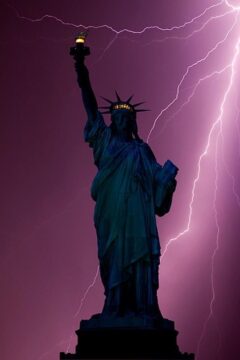
Imagine a slave in ancient Rome with a very generous master. A master so, generous, in fact, that this slave lives their entire life doing as they choose and their master never once interferes with them. The liberal view of liberty, enshrined, for example, in the U.S. Constitution, is that liberty, or at least the most fundamental kind of political liberty, is the right to not be interfered with, especially by the government. This freedom not to be prohibited from or impeded in doing what one will is often called “negative liberty” – as opposed to “positive” liberty which implies the will (autonomy/self-directedness) and the means (money, for example) – and not just the absence of interference.
The point of the generous master hypothetical is that the slave seems to be free, in the negative, liberal sense; that is, free from interference, specifically, from their master. Yet surely, as a slave, even as the slave of a very, very generous master, one is not free. There must be something wrong, then, with the liberal idea that freedom is simply freedom from certain kinds of outside interference.
Political philosopher Phillip Pettit, who formulated this hypothetical, says, and it is hard to argue with him, that the slave is not free since the master could have interfered at any point – even though they didn’t. This kind of unfreedom he calls “domination” and, so, his account of freedom he calls “liberty as non-domination” or the “republican” theory.
Over the last twenty years, Pettit has been attempting to resuscitate, he says, “the republican viewpoint as a political philosophy.” He’s been developing a “neorepublicanism” which he thinks is founded on a significant theoretical difference between the republican and liberal views of political freedom.
Pettit thinks that his hypothetical generous master shows that the master and slave have a hierarchical relation, even if the dominant party never exercises their power. Arguably, the master still oppresses the slave without ever interfering with them. Read more »
by Azadeh Amirsadri
 In 1977, I was a student at the University of Pennsylvania, majoring in French Literature. I was 19 years old and pregnant with my first child. I would dress in a long shapeless plaid green and black dress, tie my hair with an off-white headscarf, and wear Dr. Scholl’s slide sandals trying very hard to blend in and look cool and hippyish, but that look wasn’t really working well for me. The scarf at times became a long neck shawl and the ‘cool and I don’t care’ 70’s look became more of a loose colorless dress on top of my plaid dress, giving me the appearance of a field-working peasant. My sandals added absolutely nothing, except making me trip on the sidewalks.
I was an international student, in the process of learning English as I was enrolled in advanced French classes. I was overwhelmed by the size of the campus, all the city blocks it covered and getting to class on time during the 10 minutes I had between classes. I was also both fascinated and secretly envious of the female students who laid on the grass, wearing bikini tops and shorts and studying or just hanging out.
Most days for lunch, I would go to Houston Hall, a large campus cafeteria near Williams Hall, where my classes were held. I was in line one day, trying very hard to be cool and to fit in, and ordered one of the only few foods I could pronounce with ease: cheeseburger, hamburger, or soup. I would not veer into difficult sandwich names where I had to specify the type of bread, toasted or not, condiments, and other words I didn’t know nor could say. The lady behind the counter was working fast and after my burger order, she asked me what I wanted to drink. “Water” I said, or so I thought. It came out as a weak ‘watter’ and she didn’t have time for someone slowing her down. “What?” She yelled and I lost all courage and barely murmured ‘woutter’ trying to make it sound like the way Philadelphians pronounce that word, except it came out even worse than the first time. Terrified, I repeated it, hoping she could understand me. I wish I had thought of Coke or Pepsi or any other beverage I could pronounce. I really wanted milk since I was pregnant and believed drinking it would make my baby stronger, but saying “meelk” was out of the question for me, especially after my lame water request. Read more »
by Claire Chambers
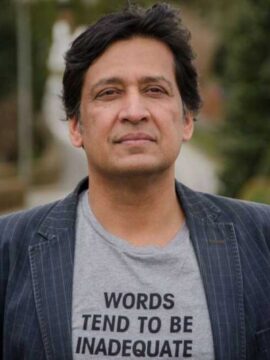 The writer Tabish Khair was born in 1966 and educated in Bihar before moving first to Delhi and then Denmark. He is the author of various acclaimed books, including novels The Thing About Thugs, How to Fight Islamist Terror from the Missionary Position, and Just Another Jihadi Jane. He has also published poetry collections such as Where Parallel Lines Meet and Man of Glass. Khair’s academic writing includes studies of alienation in contemporary Indian English novels, the postcolonial gothic, and the new xenophobia.
In addition is Quarantined Sonnets, a sequence about Covid-19 published soon after the virus went global. In this slim volume, Khair rewrites Shakespearean sonnets with humour as well as pathos in order to examine ageing, sexuality, and other subjects. Twenty-one Shakespearean sonnets are reinterpreted to reflect the changing face of love and mortality amid health disaster. Above all, the poetry collection examines how economies are impacted by the virus, and satirizes rampant capitalism against the backdrop of the Covid-19 pandemic. Khair does something similar in his most recent novel The Body by the Shore, for which I wrote a ‘Reader’s Guide’ and so I will not say too much about it here. In both his poetic and fictional works he sends shots across the bow against materialism, corporate greed, and social inequality.
Similarly, at least two stories from Khair’s 2023 collection Namaste Trump, ‘Shadow of a Story’ and, especially, ‘Namaste Trump’, have coronavirus as a fulcrum. The narrator of ‘Shadow of a Story’ is angered by India’s plight amid the 2021 catastrophe of ‘pyres burning, bodies floating down the Ganges during the pandemic’ (167).
The titular tale ‘Namaste Trump’ is set earlier on, around the time of the American president’s state visit to India in February 2020, and examines the onset of Covid. The story centres on a young servant with physical and mental disabilities, employed under near-feudal conditions by a wealthy Hindu Right family. As Prime Minister Narendra Modi’s migrant labour crisis escalates, the family sends the boy back to his village in Bihar. Disconnected from his supposed home and attached to the metropole, Chottu flees to live among marginalized city-dwellers. Eking out an existence in a nearby dump, he contracts the virus there and goes on to die from it. Read more »
by Eric Feigenbaum
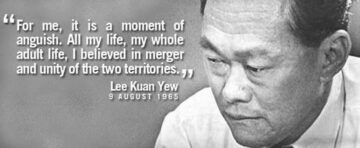
Singaporeans call it “The Moment of Anguish” – when their founding prime minister, Lee Kuan Yew broke down in tears announcing the independence of Singapore. There are relatively few surviving recordings of the actual event – a non-televised press conference on August 9, 1965 with international correspondents – but the still images of Singapore’s Founding Father with tears in his eyes, dabbing himself with a handkerchief is a key moment in the small island nation’s self-narrative.
Unlike most countries, Singapore’s independence was not greeted with celebration. It was not the result of a long-time struggle – at least not directly. At the time, Singaporeans – including Lee himself – saw independence as a failure and a moment of existential crisis.
You see, Singapore had navigated its anti-colonial struggle with Britain along with British Malaya, which in turn became the Malaysian Federation. Singapore, Sabah and Sarawak joined the federation – envisioning a single nation of related peoples. Only fractures emerged that caused the Malaysian Federation to cast out Singapore shortly before full Malaysian independence.
The issue: ethnic equality. Put simply, Singapore wanted all people to have the same rights, whereas Malaysia put the rights of ethnic Malays first – giving them extra privileges and status.
Before going further, it helps to understand what Malaysian and Singaporean even mean – and to do that it helps to rewind.
For at least 800 years, Singapore had been intermittently populated by different ethnic groups within its region and then lightly used by the Portuguese 1500’s. After 1613 when the Portuguese destroyed Malay settlements on Singapore, it was left essentially unpopulated for more than 200 years before Sir Stamford Raffles identified the island at the tip of the Malay Peninsula as his ideal for a British trading port and naval base – which came to full fruition in 1867 when Britian officially took Singapore by treaty. Read more »
 Sughra Raza. Rain. Hund Riverbank, Pakistan, November 2023.
Digital photograph.
“Standing on the banks of the River Indus in Hund village, Swabi, it is difficult to get an inkling of the magnificent past of this hamlet and how it dominated the history of the subcontinent once upon a time. An intriguing symbol in this village is a Corinthian column, standing in the courtyard of a domed red brick building. One has to travel about six kilometres through a mustard plantation and wheat fields before entering this village, which is nondescript and seems to be stuck in the winter of its past. Before walking the narrow muddy streets of Hund, you will likely pass oxen pulling out water from wells. Once on your way to the river through these streets, you will come across the building with the Greek column in front and spacious lawns. The building houses Hund Museum, which opened a few years back. This small village is said to be the capital of Gandhara civilisation under the Hindu Shahi dynasty in the 9th century CE.”
Enjoying the content on 3QD? Help keep us going by donating now.
by S. Abbas Raza

A few weeks ago I suffered a herniated cervical disc (a part of the upper spine) resulting in extreme pain in my neck, left shoulder, and left arm which has resulted in my having to be flat on my back in a supine position 24 hours a day for a couple of weeks. This was the position in which I had the least pain, even though it was sometimes quite a bit even like that. Several doctors have now told me that it is one of the most painful conditions they know of, and managing this pain is a major part of what they try to do with people who have this not uncommon problem.
Sitting or standing or any other position in which the weight of my head (around 10 pounds) was on my neck resulted in severe pain within 30 seconds at first but then fortunately this interval grew longer over the days and the pain would come more slowly. This meant that to urinate, for example, I had to quickly rush into the toilet and could only half go before the pain would hit hard and I had to stop and rush back to some horizontal surface and lie down. After a couple of days I lay down on the floor of our shower stall with my legs sticking outside and learned to take showers that way with my wife’s help. I also had to eat lying down which is difficult. Using a computer was also not easily possible, and that is why I was away from 3QD for some time for the first time in more than 20 years. My wife devoted herself completely to taking care of me and my needs and took time off work and my sister Sughra who is a doctor also came from Boston to help. So that’s what’s been happening, in case you were wondering why the magazine posts at 3QD were missing (as was I) for a couple of weeks.
But I want to tell you about a specific and unexpected experience that I had: A few days after this problem started I was still in a lot of pain and was taking some heavy prescription painkillers including opioids. I had an appointment a couple of days later to see a neurosurgeon who would determine if I needed surgery to correct the problem. (I do not, at least yet.) So on this particular day, the morning had been one of continuous pain but by afternoon, as I was lying flat on the sofa in our living room, I noticed the pain lessening significantly. For the first time, I felt that I might be getting better. And right then a fully-formed sentence gurgled up from the depths of my brain and surfaced in my consciousness with all the force of an urgent, desperate plea, and it was this: “My beautiful, beautiful pain, please don’t abandon me!” And I was immediately gripped by a panic that the pain might go away. Not that it wouldn’t go away but panic at the thought of no pain! I was not in any state to make sense of all this but there could not have been any more clarity in my acutely-felt desire that the pain remain with me, at least in that moment. The idea of the pain leaving me almost made me weep and I addressed the pain directly: “Pain, I love you,” I said. Read more »
by Malcolm Murray
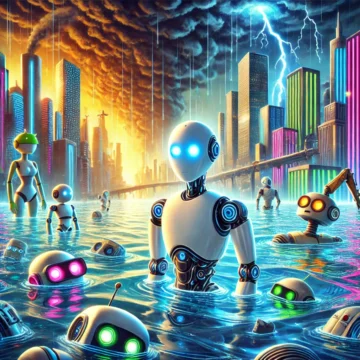 In the 21st century, only two risks matter – climate change and advanced AI. It is easy to lose sight of the bigger picture and get lost in the maelstrom of “news” hitting our screens. There is a plethora of low-level events constantly vying for our attention. As a risk consultant and superforecaster, I try to pay disproportionate attention to the bigger picture, in order to separate the signal from the noise. With that bigger picture in mind, I would argue that climate change and advanced AI are the only two risks where parts of their probability curve include singularities where change is so fundamental that we cannot forecast beyond it. All other risks are a continuation of the status quo, to a greater or lesser extent.
The interesting thing is that not only are these two risks joined together at the hip, towering over this century like the Norns in Norse mythology, they also share many similarities – both in terms of the nature of the risks and how they are mitigated against. It can therefore be instructive to study these similarities to see what we can learn and apply across the two risk areas. The risk equation – think Lady Justice with her two competing scales – has the nature of the risk on one side and the effectiveness of its mitigation on the other. No risk goes fully unmitigated (except perhaps in a Don’t Look Up scenario). Subtracting one from the other leaves us with residual risk. This is what matters at the end of the day. Starting with the nature of the risk, two similarities stand out. Read more »
by Martin Butler
We live in a rational age. Naturalism, the view that the fabric of the world can be – and should be – discovered and understood through the theories and methods of natural science, has dominated philosophy and contemporary thought for years. The theory of evolution and the big-bang theory of the origin of the universe are classic naturalistic explanations, and even those with a religious perspective for the most part concede the natural world to science. Oddly, those who pit their religious beliefs against accepted science, still often try to use scientific evidence to bolster their argument, inevitably resulting in bad science. Trying to ‘prove’ that the age of the earth accords with the biblical account is an example of this.
Many earlier philosophers produced non-naturalistic philosophies. Descartes’ dualism gave a central place to both natural and non-natural causes. The ghost in the machine account, while giving bodily functions a scientific explanation in terms of mechanical causes, understands mental capacities in terms of an immaterial, mental entity, something we might describe as spiritual. And even with the rise of the scientific world view, God could still be relied upon to fill in any gaps where science struggled – the so called ‘God of the gaps’. Newton, for example, despite his discovery of the laws of motion, believed that God intervened to ensure the proper movement of the planets within the solar system. Laplace, however, famously moved things towards full blooded naturalism when, in response to Napoleon’s question about the place of God in his philosophical system, he is supposed to have quipped that he had ‘no need for that hypothesis’. Here we have “a nature stripped of the divine” as Schiller put it. Or, according to the sociologist Max Weber, a disenchanted world
So where does this leave the spiritual, a term still widely used even by those who do not necessarily align themselves to any particular religious belief? Read more »
by Brooks Riley
I didn’t plan to write about Caspar David Friedrich for his 250th birthday. He belongs to a different time in my life and a different aesthetic pathology. But as the date edged closer, I found myself missing that impossible reach for the sublime that his work had once provoked in me.
I cannot not write about him.
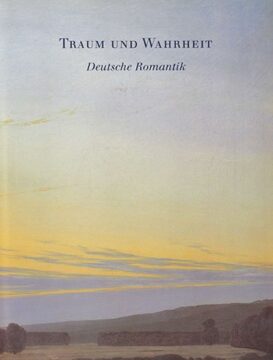 The first time I became aware of Friedrich, many years ago, I was in Zurich to meet an elderly Jungian psychoanalyst—my head stuffed with theoretical questions and eerie dreams with soundtracks by Scriabin. Walking down the Bahnhofstrasse, I passed a bookstore window displaying a stunning art book with the elegant title Traum und Wahrheit (Dream and Truth) and a simple subtitle: Deutsche Romantik. I didn’t yet speak German, but I knew enough to be interested. The book was too heavy for my luggage. I bought it anyway and had it shipped.
 What lured my eye to the cover as I passed by was a partial view from one of my now favorite Friedrich paintings, Das Große Gehege (The Great Enclosure)—a cool marshy landscape evoking real ones I would later see from train windows. How could just a corner of a painting have such power? It was the light, the late afternoon saturation of yellow, the black shadowed trees, and the hint of evening gloom already visible as gray on the horizon even though the sky above was still blue. I was captivated.
Later, it was the darkness that would keep me going back to his work.

Caspar David Friedrich loved the dark. He loved it so much that he got married at 6 am on a cold January morning, long before a Dresden sunrise. He often went out for walks along the Elbe at dawn or at dusk and lurked in the twilights or the moonlights, bringing home threads of illuminated thinking one can only have at night in the dark. I understand him. Darkness, with its tendency to distort as well as to obscure, is conducive to thinking in unlikely ways, offering a different kind of clarity that is difficult to achieve in daylight, when the light interferes demanding attention. Read more »
by John Allen Paulos
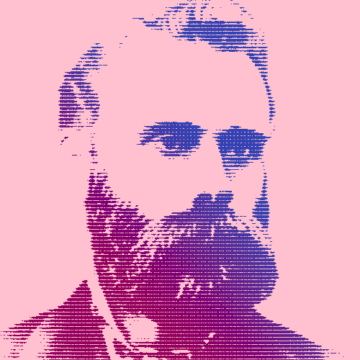
Election season has put an increased focus on the stock market, but little attention is ever paid to the Efficient Market Hypothesis (the EMH, for short). As I’ve written in A Mathematician Plays the Stock Market, it is a fundamental and important notion, but it is also a little weird. Its recent formulation derives from the work of Eugene Fama, economist Paul Samuelson, and others in the 1960s. The basic idea, however, dates back more than 100 years when Louis Bachelier, a student of the great French mathematician Henri Poincare, formulated an early version. Roughly, the hypothesis maintains that stock prices reflect all relevant information about the stock. As Fama put it, “In an efficient market, competition among the many intelligent participants leads to a situation where, at any point in time, actual prices of individual securities already reflect the effects of information based both on events that have already occurred and on events which, as of now, the market expects to take place in the future.”
The EMH depends crucially on what information is assumed to be reflected in the stock price. The weakest version maintains that all information about past market prices is already reflected in a stock price. A stronger version maintains that all publicly available information about a company is already reflected in its stock price. The strongest version states that information of all sorts, even inside information, is already reflected in the stock price.
It was probably this last rather implausible and all-encompassing version of the hypothesis that underlies the joke about the two efficient market theorists walking through town. They notice a hundred dollar bill on the sidewalk and simply ignore it. If it were real, they conclude, someone would have been picked it up already. Even more risible is the question: How many efficient market theorists does it take to change a light bulb? Answer: The answer is none. If the bulb needed changing, the wisdom of the market would have insured that it had already been changed.
So why do people think that the market efficiently, and more or less immediately, responds to changes in the conditions for a particular stock or even for the market as a whole? The answer is that investors are always seeking an edge to increase their gains or decrease their losses, and they try to do so in a multitude of ways. They’re on the lookout for new bits of information possibly relevant to a company’s stock price that may be enough to quickly raise or lower it. Because of this swarm of profit-hungry and loss-averse investors, the market rapidly responds to new information, and efficiently – there’s that word again – adjusts prices to reflect it. The changes take place so rapidly, or so the story goes, that even utilizing technical rules or fundamental analyses aren’t fast enough to be fully exploited, and investors who pursue them will see their excess profits shrink to zero. Read more »
maybe you think I do not know
maybe you think I could not be
surely I am not where I go
surely I am here with thee
but maybe moon is nothing old
maybe sun is never new
perhaps all stories have been one
maybe there’s no such thing as through
could be everything is here
could be everything is near
could be heaven is not far
could be now, just where we are
perhaps all maybes will be done
maybe all should-bes might be too
could be everything is one
within the shadow of we two
by Jim Culleny
3/241/12
Enjoying the content on 3QD? Help keep us going by donating now.
Hello Reader,
 Because I have taken some medical leave from 3QD in the past few weeks, we have not had magazine posts for a while, though we have continued to post curated articles in the “Recommended Reading” section. I am feeling better now, so we will resume all posts starting tomorrow, meaning Monday, the 16th of September. Just wanted to let you know. More details of what happened to me also coming tomorrow.
All the best,
Abbas
by David J. Lobina

For someone who sees himself as a person of the Left, at least in the sense in which the political right and left were conceptualised by Norberto Bobbio ages ago – that is to say, as moral and political stances towards equality (and inequality) – and more concretely, as a sort-of anarchist, at least in the sense, this time, of being suspicious of authority, top-down impositions and ideas, and much preferring a society composed of spheres of self-realisation instead from the bottom up,[i] the advent and prominence of so-called ‘identity politics’ in recent years, especially in the English-speaking world, and most clearly, in the US, has been surprising, bewildering, and rather frustrating.
Even though identity politics is usually associated with the Left, both by friends and foes, I agree with some thinkers from the Left I actually follow, such as the academic Brian Leiter, that this kind of politics may well be ‘the narcissism of the aspiring bourgeoisie, who want to get their share of the “capitalist pie”, including their share of “respect” as reflected in language and culture’ – and likewise for the concept of equity so common and so often defended these days, which is not really a liberal principle per se, but more of a neoliberal keyword: no universal social programs to be set up, but instead we shall have micro-interventions here and there that can only produce a more ethnically diverse elite. Under these conditions, inequality and capitalism remain untouched, class politics unmentioned, the result a Left without the economics or the socialism, and on we go with elite representation and such worries (seriously, whatever happened to class politics?).
Rather surprisingly, at least to me, the obsession with such diversity concerns is ubiquitous here in the UK too, including at my daughter’s primary school in London, one of the most diverse cities in Europe. In June each year there is a so-called Diversity Week, which according to the Head Teacher is about ‘taking pride in who you are and all of the things that make you ‘you’, especially your differences’ (you can strike out the word especially from that statement), the main point to be conveyed being that ‘one opinion, lifestyle, religion, family make up, or cultural heritage is not more important than another; we are all individuals and our differences are what make us stronger as a community’.[ii]
As a case in point, the school once entered a local flower cart competition, and the chosen message on the cart was: We are all different, and that’s fine.
All of course laudable, at least at first sight. My point in this column is to push back a little bit, and to do so from the point of view of universality and commonality, which I regard as a much more significant property of human thought and belief systems – indeed, of human nature tour court. Or as the La Fontaine Academy flower cart could also have advertised at the competition: We are all the same, and that’s fine too! Read more »
by Mary Hrovat
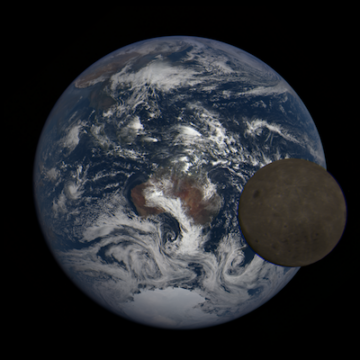
Mission to Earth: Landsat Views the World, Nicholas M. Short, Paul D. Lowman, Jr., Stanley C. Freden, William A. Finch, Jr. (published 1976)
I found this book in a library at Indiana University when I was a student in the mid-1980s. I spent hours fascinated by the beauty of the photographs and the quiet, precise poetry of the geographical and geological terminology in the accompanying text.
Satellite images were not as readily available back then, and this book provides a rich banquet of them. Maps in the front of the book show where to find images of each part of the planet. First I looked up places I knew or had visited, and then I looked up places I wanted to visit or was curious about, and finally I just browsed. I’d always been interested in maps, with their place names and the history behind them. This book expanded that experience by giving me the geological, ecological, and human context of each image. It was endlessly interesting.
The book also expanded my horizons in another way. I had no theological qualms about the age of Earth or the universe, but I’d been shown a narrow world, growing up—a world centered on sin and redemption, where Earth is ultimately a way station between two eternities. I’d been a homebody as a child, caught up in my parents’ religious scruples and anxiously examining my behavior for not only sinful tendencies but also insufficient devotion to the divine.
This book was one of the things that released me to a wider view of life; it nurtured an enchantment with Earth, its dynamic intricacy and complex history, its reality as a thing in itself rather than a divine stage set. It absorbed me in the features and processes of the living planet. I didn’t realize it at the time, but I can see now that it sowed the seeds of a view of Earth itself as sublime and holy, in a completely natural sense. Read more »