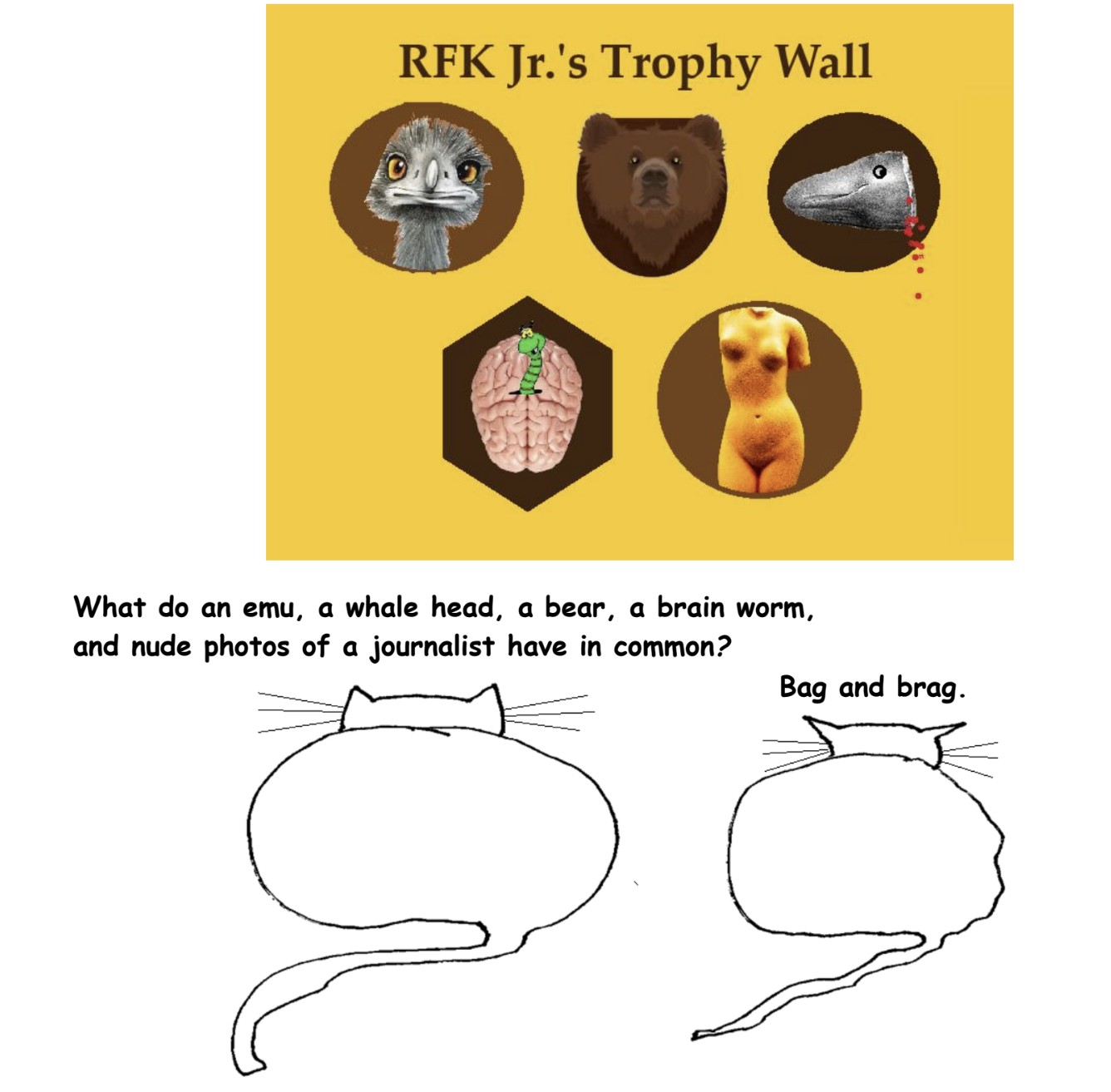
Rain on the Autobahn from Innsbruck to Munich.
Enjoying the content on 3QD? Help keep us going by donating now.

Rain on the Autobahn from Innsbruck to Munich.
Enjoying the content on 3QD? Help keep us going by donating now.
by Andrea Scrima
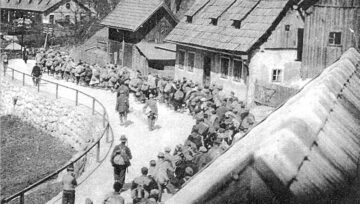
Sometimes it’s a single detail that hits home: a little girl’s pink shoe, for instance, with remnants of the delicate fabric still intact, unearthed among the hundreds of worn-down shoe soles and other objects found in the course of an archaeological excavation on the grounds of the former Liebenau camp in Graz, Austria. The site has since been paved over, covered in large part by housing settlements and a youth center, kindergarten, and sports field. The tour guides’ voices could barely be heard above the basketball game underway on a nearby court; in this vibrant residential neighborhood of Grünanger, the loud cries and laughter of everyday life suddenly seemed jarring and alien.
“Resettlement Camp V” was founded in 1940 for “Volksdeutsche” or ethnic Germans, who were relocated from the Baltic states and other parts of Europe and the Soviet Union, often involuntarily. It consisted of 190 barracks built to accommodate 5,000 inhabitants. A year later, as the war raged on, forced laborers and prisoners of war were brought here to toil under unimaginably harsh conditions in the nearby Steyr-Daimler-Puch works, which manufactured machine parts for the armaments industry. In April of 1945, the camp became a temporary stopover for Hungarian Jews on a two-hundred-mile-long death march to the Mauthausen concentration camp after the “Southeast Wall” they’d been building, Hitler’s defensive strategy of anti-tank trenches and fortifications intended to halt the advance of the Red Army along the Hungarian border, failed and they were “evacuated.” Over a period of several days, six to seven thousand exhausted and severely undernourished slave laborers arrived on foot. They had already been on the road for a week and had been given nearly nothing to eat; in Graz-Liebenau they were forced to sleep outside, on the bare ground. They received a bowl of watery soup and a single slice of bread. Those who were too sick or weak to continue were forced to lie face down in shallow trenches, where they were shot from behind, in the neck.
In May of 1947, the British occupying forces had the mass graves exhumed. A trial, verdicts, and executions followed. After that, the matter was repressed and forgotten. More than sixty years would pass before historians began investigating the site in earnest; some of the older locals still knew where the buildings once stood. A series of excavations undertaken during the construction of a power plant uncovered rubble and building foundations, personal belongings, and human remains bearing evidence of war crimes. Already a politically sensitive issue, the area became a point of contention; it was eventually declared an archaeological site requiring the oversight of specialists during any future construction projects or excavations.
The tour of the Liebenau camp was intended as a prelude to a theater performance, but the weather proved uncooperative: taking our seats on benches arranged around the open-air stage, there came a cloudburst so sudden and dramatic that it felt like a logical reaction to the devastation and destruction we had been contemplating moments before. We ran for cover; the rain was pelting down at angles that rendered our umbrellas superfluous. As I made my way home in the storm, I wondered if history is ever past, or if we’ve ever properly understood the factors that can lead to fascism and genocide. Read more »
by Carol A Westbrook
In our third year of medical school we began our clinical studies. After two full years of classroom work, it was time to apply what we learned to real patients. One can spend years in the library, reading all the books and journals that you can get your hands on, but there is no substitute for seeing a patient with disease. The stories I’m recounting here are all true, as I experienced at the University of Chicago Hospitals (then called Billings Hospital) while I was a medical student in 1977-78. I’ve changed the patients’ names, and I’ve made up some details I couldn’t recollect.
Billings hospital had a locked psychiatry ward, and it admitted patients for brief interventional stays, with a Medicare limit of two weeks. If a longer stay were required, the patient would have to be transferred to a chronic care facility. Patients could be either voluntary admissions or legally committed.
Psychiatry rotation for a third-year med student was 1 month long, of which 2 weeks were spent on the inpatient service. That was just long enough for the student to admit a patient and follow them through discharge; we each had our own individual patient. We had a four-member team (3 students and one resident) The resident took call every third night, which means they stayed overnight and answered the pager for problems on the ward or in the emergency room. We students were expected to come along. We did not carry our own pagers, but we took orders from our resident, who did carry a pager. Although call requires an overnight stay—with little sleep—it can be one of the most valuable experiences of med school, because that’s when you get to see the extreme cases, the ones you’ll never forget. Read more »
by Mark Harvey

On September 1, 2004, a middle-aged Russian journalist named Anna Politkovskaya boarded a plane in Moscow on her way to Ossetia to cover a hostage crisis in the town of Beslan. During the flight, she drank a cup of tea that almost killed her. After she drank the tea, she became disoriented, began to vomit, and ultimately lost consciousness. She was taken to a hospital in Rostov-on-Don, where doctors concluded she had been poisoned.
Politkovskaya had been reporting on the human rights abuses in Russia and Chechnya for some time and was a harsh critic of Vladimir Putin. In one of her books she had written, “If you live in Russia, you cannot help but notice that Putin’s Russia is a world of violence, lies, and injustice.”
Throughout her career, Politkovskaya received death threats and was heavily surveilled by the Russian government. But the intimidation didn’t stop her, and she wrote hundreds of articles for the independent newspaper Novaya Gazeta and several books highly critical of Putin. In her 2004 book, Putin’s Russia, she bravely wrote about the corruption, human rights abuses, and oligarchy in Russia with an unflinching style.
In short, she was a daring, hardworking investigative journalist who risked her life to write about the cruel and criminal aspects of Russia. She was assassinated in the elevator of her apartment building on October 7, 2006—Vladimir Putin’s birthday. Read more »
by Bill Murray
 It’s raining in Russia. Thunderheads boil up in the afternoon heat over there, behind the limestone block fortress on the other side of the river. Which is not a wide river. You can shout across it.
Here’s how close Russia is: on Victory Day, May ninth, commemorating the Nazi defeat in World War II, Russia points big screen TVs over here toward Narva, Estonia’s easternmost city, to explain the way things really are to all these misguided Estonians.
This year Estonia put on their own concert on the town hall square. This side of the Narva River, May ninth is called Europe Day. Estonia hung a poster on its own castle wall that read “Putin is a war criminal.”
Both riverbanks are park land, well kept, landscaped, trees trimmed as if by respectful neighbors. These dueling castles mark the spot where the Teutonic Order, Swedes, Danes, Poles, Lithuanians, Slavs and local Finno-Ugrics have bumped up against each other since medieval times. This point on the map has been the tip of somebody’s sword since the 13th century.
Everybody in the train spoke Russian, Russians and Estonians both. For the confluence of Vladimir Putin’s “greatest geopolitical catastrophe of the century” with Estonia’s triumph of independence, it’s far more Russophilic out here than I expected.
Thirty-three years after Estonian independence, that’s something to puzzle out. Part of the explanation, I think, is cultural. The other part is that it just takes time to start a new country. Read more »
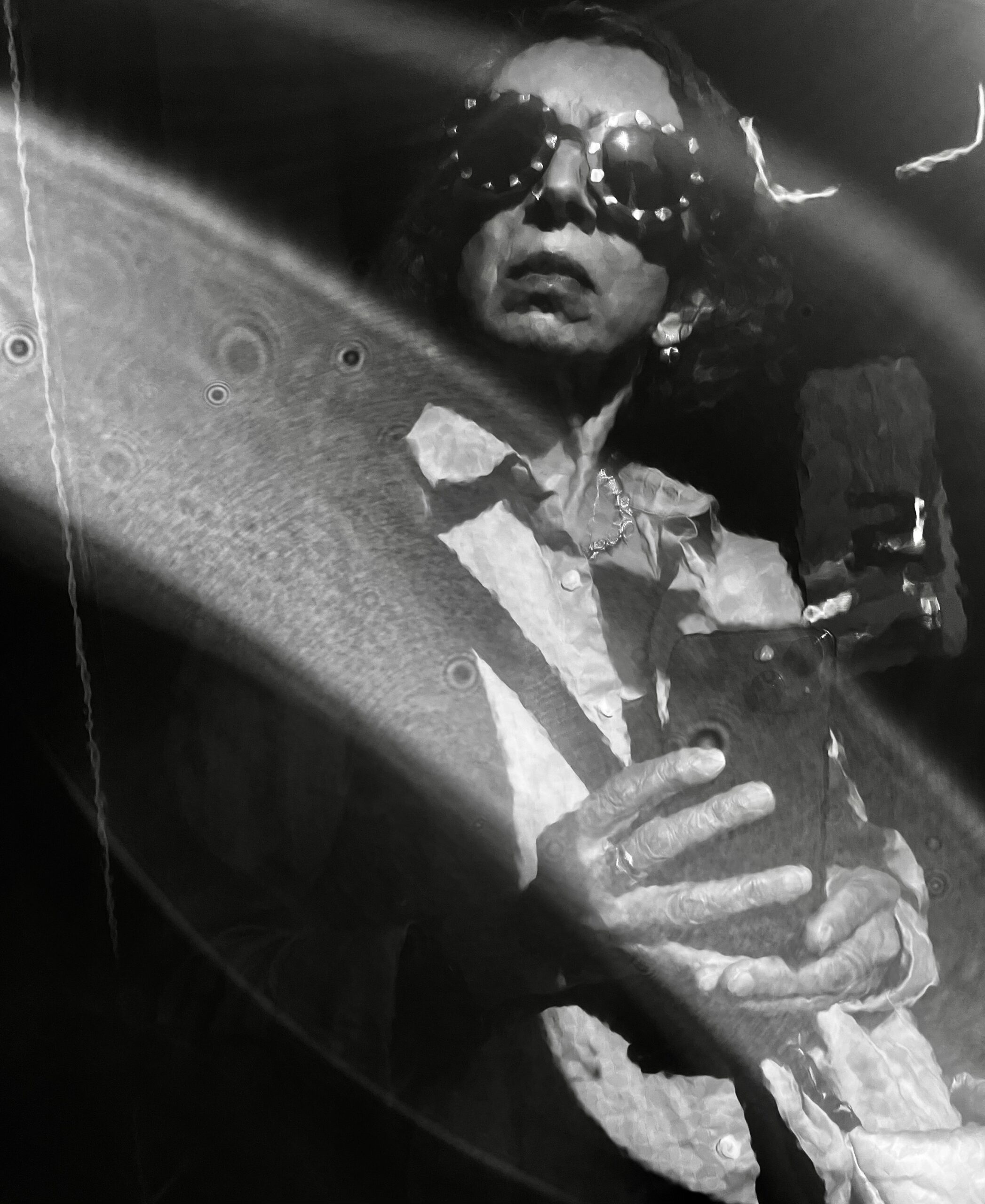 Sughra Raza. On the Train to Franzensfeste. September, 2024.
Digital photograph.
Enjoying the content on 3QD? Help keep us going by donating now.
by Richard Farr
 Even if you are sympathetic to Marx — even if, at any rate, you see him not as an ogre but as an original thinker worth taking seriously — you might be forgiven for feeling that the sign at the East entrance to Highgate Cemetery reflects an excessively narrow view of the political options facing us.
For years I had planned to come here, to his final resting place, and pay my genuine if heavily qualified respects. In the end the visit was almost accidental. My wife and I were walking off vast quantities of melted cheese sandwich that had accosted us in Camden Market, our destination was Hampstead Heath, and Google Maps suggested to us that the detour was slight.
The six quid you pay to get in helps the Cemetery Trust keep most of this beautiful sanctuary neat and trim, with broad main avenues and benches spaced at convenient intervals for rest and contemplation. But much of its appeal lies in a strange duality of character. Large sections are so crowded, so ivied, so root-heaved and broken that I was put in mind of Mayan temples in the Yucatan, reduced to fragments and being digested by the rainforest. Stones pristine and sundered. Inscriptions legible and illegible. Some Victorian pillars standing proud and straight but others leaning against one another like end-of-day commuters slumped shoulder to shoulder on the Northern Line.
Hopeful sentiment is engraved here over and over: Never Forgotten; Always in our Thoughts. But you look at relentless climbing nature and wonder how long any of this remembering can really last. Two generations? Three? A bit more, for the famous — but the truth is that they too will “fly forgotten as a dream,” as Isaac Watts has it. Even at George Eliot’s grave, tended lovingly by a woman with gloves and garden tools, the name itself has all but evaporated. Read more »
by Mike Bendzela

How happy to have discovered the history of other species, as well as our own. How fortunate to be alive during the time when the evolutionary puzzle has been so masterfully worked out, assembling a picture so stunning in its completeness, that mere school children now know more about Darwin’s great idea than even Darwin himself knew.
And yet, how mortifying to be stuck with natural selection as “the mother of beauty,” to crib from the poet Wallace Stevens. (“Death is the mother of beauty; hence from her,/ Alone, shall come fulfillment to our dreams/ And our desires.”) Accepting this brute fact of life is a tall order, and I still recoil whenever I contemplate what Darwin called the “sufferings of millions of the lower animals throughout almost endless time.”
The central tenet of life is directionless, indifferent, insensate, implacable natural selection. And yet . . . here we are.
*
We have — or had — five cats. Four are sibs, seven years old now, Girly, Rocky, Pinky, and Scooter. They showed up, mere kittens clustered near their scrawny mother, behind our barn, as my husband Don was recovering from a stroke that occurred the year before. The fifth, Maggie, showed up just last summer, barefoot and pregnant, on our back doorstep. She hated and still hates the others. She eventually gave birth to four kittens of her own, which we judiciously distributed, but we still have to keep her separate from the other cats.
While returning from teaching one day earlier this month, I saw Rocky, our black, tuxedo male, vaulting across the road, his skinny ass stretched out like a black snake as he made it safely to the other side.
“I just saw Rocky sprinting across the road in front of me,” I said to Don. “Prepare yourself. We’re going to lose that cat.” I sometimes actually believe that articulating a fear helps to diminish it . . . Read more »
‘tis the little things, for sure
‘tis a little thing the way the toast pops up
in the morning, ‘tis magic that took
billions of years to enter the picture
to brown two sides of bread at once
in the kitchen of a little castle
‘tis the little things, for sure
‘tis a little thing that we met one day
among the multitudes who dance upon
the surface of a sphere who ever chase
the big thing of why? the impossible thing
’tis the little thing of those last four lines above,
among all the unknown possibilities,
of all the little things, ‘tis the one
that changed my heart
‘tis the little things, for sure
Jim Culleny, 8/1/24
Enjoying the content on 3QD? Help keep us going by donating now.
by Gary Borjesson
Become who you are, having learned what that is. -Pindar
Become who you are. —Nietzsche
I want to be authentic and so probably do you. It’s a virtue fostered by philosophic and therapeutic inquiries. In popular culture, “authenticity” is broadly used to mean being true to oneself—often with an emphasis on not caring what others think. Thus its critics see authenticity as encouraging a culture of narcissism, since it appears to focus on self-actualization at the expense of other ideals, including healthy relationships and communities, and the social values such as honesty, fairness, and justice that support these. Here I offer a philosophically informed definition of authenticity, drawing attention to why, despite popular usage, it is a prosocial, ethical ideal.
Authenticity may indeed be the virtue of being true to oneself, but what does that mean? To some it means being the creator of one’s own truth and value, and living solely according to these. Imagine a bright, rebellious teenager who’s read a little Nietzsche. They decide that the first step to becoming authentic is to take up their philosophic hammer and use it to smash all external claims and constraints —those truths, values, and beliefs that come from family, religion, community, customs, traditions, even from nature herself. This apparently asocial or even antisocial tendency is partly how authenticity gets associated with nihilism and moral decline, rather than being the virtue I suggest it is.
As many have pointed out, including Allan Bloom in Closing of the American Mind, this narcissistic-fantasy version of authenticity stems from a philosophy of “cheerful nihilism,” a memorable phrase borrowed from Donald Barthelme. It’s cheerful because it’s about freedom from responsibility, rather than being freedom with responsibility. The roots of this nihilism can be traced to reductive materialism in the sciences and postmodernism in the humanities—ideologies that find fertile ground in individualistic capitalist societies, where everyone competes to get the most they can. These days one can see this “ethic” prominently displayed among politicians and tech billionaires, but this is not authenticity. (Philosopher Charles Taylor’s short book The Ethics of Authenticity offers a good account of the history and future of authenticity.)
The ethical definition of authenticity includes the observable fact that we own our lives and truth in the world. Specifically, becoming authentic concerns taking our place in the world—even if it’s the place of a rebel. For where else but in a world do we learn who we are, and actualize ourselves? Our very power of living, thinking, and speaking owes its development to others. Thus, a free spirit or rebel or Libertarian may imagine they are powered by their truth alone. But without a world, there’s nothing to rebel against, and nothing from which to liberate the spirit. Read more »
by Mark R. DeLong

Once a real irritant and frustration, the routine has become a slap-stick show staged in our living room. Today, it’s only slightly tinged with impatience. Someone wants to watch a movie, which is a challenge itself, since that means having to find one worth watching. But there are lists, online reviews, thumbs-up (and down) from friends, and Rotten Tomatoes flung (or not) and Metacritic. You make a guess. You land on a title, and that’s when you engage The Bureaucracy. From that point on, your smartphone’s glass screen no longer stays your own. The flat and wide display across the room becomes possessed by something else—just as you agreed would be the case back when you clicked “I agree” on the annoying “End User License Agreement.” You never read it. You’re in good company; no one reads the “EULA.” The run-up to the show is, well, a ping-pong of passwords, a inchoate suspicion or hope that the app you’re using will actually connect to … to … something that will “cast” your movie to the display.
“Cast” is a word loaded with magical innuendo, word of spells and the luck of fishing.
I like to think that the rituals of my devices somehow unite a community—in my case, I guess, a community of Android phone users who dangle Google-provided services through a Chromecast dongle that hangs limply from the edge of an ancient plasma flat-screen. But unlike ritual’s usual rigidity, the technological rituals mystify with nuance; they follow subtly different paths, so you never really learn the trail by heart. (And, it’s not just Google in the priestly robes waving the thurible.)
Half of the adventure of watching a movie at home is just getting to sound and picture. Read more »
by Chris Horner

Things we don’t want to know that we know.
Donald Rumsfeld’s famous distinctions between knowledge and ignorance:
[T]here are known knowns; there are things we know we know. We also know there are known unknowns; that is to say we know there are some things we do not know. But there are also unknown unknowns—the ones we don’t know we don’t know. [1]
It’s been suggested that we should add to that list another kind of ‘known’: unknown knowns. [2] these would be the kinds of things we actually do know, but somehow remain unaware that we know. The classic example would be repression: a painful memory is repressed from our consciousness, but continues to be present in the unconscious – where it may return to trouble us via dreams, symptoms and parapraxes (so-called ‘Freudian slips’). So we (unconsciously) know something, but do not (consciously) know that we know it.
But there is another variety of knowing that isn’t ‘unknown’, but inhabits a twilight zone between knowing and acknowledging: Fetishistic disavowal. This is where we do know something, but act on the basis that ‘I know this perfectly well, but nevertheless….’. To disavow something is to deny it; to fetishise something is to invest it with special powers. One knows that something is the case, but denies it to oneself. This is obviously paradoxical, for how can I know X is the case but at the same time deny it? How can I act a belief that I consciously deny, or deny something that my actions show that I believe? This is where the unconscious, fantasy, and the fetish, enter in. Read more »
by Barry Goldman
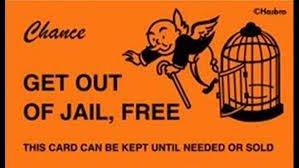
Rich and powerful people commit a vast amount of crime. According to Big Dirty Money: The Shocking Injustice and Unseen Cost of White Collar Crime, by law professor Jennifer Taub:
White collar crime in America, such as fraud and embezzlement, costs victims an estimated $300 billion to $800 billion per year. Yet street-level “property” crimes including burglary, larceny, and theft, cost us far less – around $16 billion annually, according to the FBI.
But rich and powerful people do not go to prison. There are 2.3 million people incarcerated in the United States. None of them are members of the Sackler family, despite Purdue Pharma being responsible for hundreds of thousands of deaths. The Sacklers have had to pay out billions of dollars for pushing OxyContin, but they have been able to keep billions more. And none of them has done any time.
This week Martin Winterkorn, formerly the head of Volkswagen and Germany’s highest-paid executive, went on trial. He led the company when it manufactured 9 million vehicles designed to cheat on emissions tests. Readers will recall that the cars and trucks were equipped with “defeat devices” that switched on pollution controls only when the vehicles were being tested. When they were out on the road the vehicles spewed many times the allowable amounts of pollutants and caused unknown damage to public health around the world. Winterkorn’s trial is starting nine years after he resigned from Volkswagen. He is not expected to serve any prison time.
None of the greedy bastards actually responsible for the 2008 financial crisis went to prison. According to the New York Times:
the largest man-made economic catastrophe since the Depression resulted in the jailing of a single investment banker — one who happened to be several rungs from the corporate suite at a second-tier financial institution.
If you pay any attention to the news you can supply your own examples of this pattern. Wells Fargo and ExxonMobil come immediately to mind, but the list is very long. Read more »
by Ed Simon
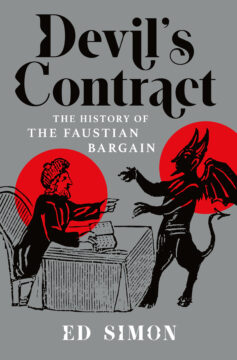
Doctor Faustus by Christopher Marlowe
Though there are stories about people trading their souls with the devil in exchange for power and knowledge before, it was the English playwright Christopher Marlowe’s 1592 play that firmly entrenched that variety of character in the literary imagination. Incidentally there was a real Johann Faust in the sixteenth century, a German wizard of whom little certain is known, but the similarly dissolute figure of Marlowe was who granted that mysterious figure a variety of immortality. Drawing inspiration from anonymous pamphlets about Faust, Marlowe crafted one of the most chilling tales about how the insatiable thirst for power can lead to damnation when we’re willing to trade our very soul. Notorious at the time, both for the author’s reputation for heresy and sodomy as well as for claims that the script itself was capable of conjuring demons, it was said that Satan himself was in attendance at the premier to evaluate how accurately he’d been depicted. “Hell hath no limits, nor is circumscrib’d,” said the play’s infamous demon Mephistopheles, “where we are is hell,/And where hell is, there must we ever be.” A despairing vision born in Marlowe’s own life, the second most celebrated Elizabethan playwright after Shakespeare who was rightly valorized for the genius of his “mighty line,” ultimately stabbed to death in a tavern fight at the age of 29.
Faust by Johann Wolfgang von Goethe
Marlowe may have been the one to make the diabolical contract a mainstay of European literature, but it was the nineteenth century German poet and polymath Johann Goethe who elevated the story into the canon of eternal works. A genius who dabbled in everything from botany to anatomy, Goethe is nonetheless most celebrated for his brilliant writings responsible for the inauguration of the passionate and emotional literary movement of Romanticism. His Faust, written in two voluminous parts respectively published in 1790 and 1808, was intended to be a “closet drama,” a type of verse play meant to be read rather than performed. Drawing from the same wellspring of German myth as Marlowe, Goethe nonetheless reinvents the details and purpose of the Faust legend. Fleshing out a love interest for the wizard, Goethe also more importantly reorients the focus of the devilish contract into a wildly expansive philosophical vision, having Faust sell his soul not for power or even knowledge, but rather a very Romantic zeal for unadulterated human experience. Most arrestingly, the Faust of Goethe’s poem finds a salvation denied the magician in Marlowe’s play, though the questions raised about human freedom and depravity along the way remain disturbing, this sense that “Man errs as long as he strives.” Read more »
by John Hartley
“Beauty is mysterious as well as terrible.” Noted the Russian novelist Fydor Dostoevsky, “God and the devil are fighting there, and the battlefield is the heart of man.”
When 18th century Scholars used anthropology, physiognomy, and phrenology to apportion value according to race and beauty, clearly something has gone terribly wrong. Yet what is now dismissed as pseudoscience was then seen as a perfectly legitimate means to qualify human ‘beauty’. What, then, can be learnt from examining the critical juncture, as the departure from objective standards of beauty upon which such pernicious conclusions where not merely possible, but actively promoted?
The Enlightenment’s quest for knowledge and reason carried a darker side—one that linked ‘beauty’ with superiority. This fusion of science and aesthetics shaped European thought, whereby the pursuit of an aesthetic ideal became a gateway to racial ideologies. Read more »
by Rebecca Baumgartner
Carpets…chairs…shoes…bricks…crockery…anything you like to mention – they’re all made by machinery now. The quality may be inferior, but that doesn’t matter. It’s the cost of production that counts. And stories – well – they’re just another product, like carpets and chairs, and no one cares how you produce them so long as you deliver the goods.
So goes one of the more biting sections in the delightfully mordant 1953 short story by Roald Dahl called The Great Automatic Grammatizator. The story focuses on a man who we’d refer to as a computer scientist today. He’s just finished developing a “great automatic computing engine,” at the request of the government, but he’s unsatisfied. You see, Adolph Knipe has always wanted to be a writer. The only problem is, he’s terrible at it. Publishers keep turning him down, and it’s no surprise when we read that his current novel begins with “The night was dark and stormy, the wind whistled in the trees, the rain poured down like cats and dogs…”
However, Knipe has an epiphany one night. He’s already successfully built a computing engine that can solve any calculation by reducing it down to the fundamental operations of addition, subtraction, multiplication, and division. Why couldn’t he do the same with stories? All he’d have to do is teach the machine English grammar, program the parameters of each major publication’s style, and the machine would write the stories for him!

Thus begins his invention of the Great Automatic Grammatizator, a machine that can produce a story in the style of all the best publications at the press of a button. Knipe works like a madman to build a prototype and goes back to work to show it to his boss. After hearing how the machine works, his boss (a Mr. Bohlen) says, “This is all very interesting, but what’s the point of it?” Knipe explains how it could be used as a money-making tool, but the boss still isn’t convinced, knowing how expensive it would be to make and run such a machine. Knipe spells it out: Read more »
by Laurence Peterson
It is said that money talks, but recent signals from markets, economic indicators, and utterances from monetary policy makers all over the world now display all the comprehensibility of an overly enthusiastic believer speaking in tongues. Things had been hyper-sensitive since the Federal Reserve started raising the key interest rate (Federal Funds rate) from an historic low of 0.25% in early 2022 to 5.5% in August of 2023, but the last several weeks have produced a series of gyrations and blowouts that have been quite unique. Perhaps it is only because of the extraordinary (usually regarding their absurdity) happenings in the world of domestic politics and nothing less than atrocities on the international scene that many have allowed these events to fade from view. But then these developments have their own complicating effects on the same markets.
The most prominent cause of tension in the markets has involved two major forces pulling against each other: a weakness in the US labor market, and signs of increasing or plateauing US inflation. Any significant indication of momentum in either direction induces market players to pile in, reinforcing the trend. If the movement becomes dramatic enough, pressure builds on the monetary authorities to stem the accelerating tide by altering interest rates.
Since early July, poor monthly unemployment reports have resulted in lopsided reactions that have provoked alarm amongst Federal Reserve board members and monetary policy officials worldwide. Officials dropped hints that the first Fed rate cut in 4 years became more or less imminent, slated for the September 18th, 2024 Fed meeting. At first, few expected more than the usual quarter-percentage point cut. But when the second consecutive subpar report for July came in early August, markets worldwide panicked. US and European markets took significant hits, but the real damage, as is so often the case, was in the Far East and the less-developed world, although four of the most adversely affected markets were powerhouses like Japan, South Korea, Taiwan and China. Read more »
by Jochen Szangolies
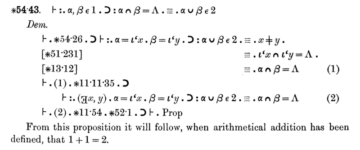
In the last column, I have argued against the idea that understanding in mathematics and physics is transmitted via genius leaps of insight into obscure texts rife with definitions and abstract symbols. Rather, it is more like learning to cook: even if you have memorized the cookbook, your first soufflé might well fall in on itself. You need to experiment a little, get a feel for ingredients, temperatures, resting times and the way they interact before you get things right. Or take learning to ride a bike: the best textbook instructions won’t keep you from skinning your knees on your first try.
Practical skills are acquired through practice, and doing maths is just such a skill. However, mathematics (and physics by extension) may be unique in that it likes to pretend otherwise: that understanding is gleaned from definitions; that the manipulation of symbols on a page according to fixed rules is all there is to it. But no: just as you need an internal, intuitive model of yourself on a bike, its reactions to shifts in weight and ways to counteract developing instabilities, the skilled mathematician has an intuition of the mathematical objects under their study, and only later is that intuition cast into definitions and theorems.
At the risk of digressing too far, this is a general feature of human thought: we always start with an intuitive conception, only to later dress it up in formal garb to parade it before the judgment of others. We are not logical, but ‘analogical’ beings, our thoughts progressing as a series of dimly-grasped associations rather than crisp step-by-step derivations. If we do find ourselves engaged in the latter, then as a laborious, explicit, and slow ‘System 2’-exercise, rather than the intuitive leaps of ‘System 1’.
Indeed, it couldn’t be otherwise: how should we know whether a definition is accurate, if we didn’t have a grasp on the concept beyond that definition? Read more »
by Eric Schenck
The first time I hear about couchsurfing is in a political science class. It’s 2013 and I’m a sophomore in college.
Our guest speaker is a guy in his 30’s that’s traveled the world. His secret to doing it on the cheap?
A website called Couchsurfing that lets you sleep in strangers’ homes.
He tells us about all the places he’s been, the people he’s met, and the adventures he’s had. He finishes his presentation and asks if there’s any questions. Nobody raises their hand. I take the bait.
“And all of this is safe?”
He nods his head and laughs.
“Well, I’m here, aren’t I?”
I go home that evening and look it up. Couchsurfing has over 14 million members around the world. Sounds legit to me.
Creating a profile can be stressful. You add some pictures, the countries you’ve been to, and a little bit about yourself. But what to say?
I spend a few hours thinking about it. How do I sound nice without trying too hard? Or trustworthy without being desperate?
The profiles I look up all sound so much cooler than me. I’m 20 years old and have never left the United States. What interesting things can I possibly offer?
I throw up a few random lines about languages and reading and call it a day. I don’t plan on using it anytime soon. But a few months later, after going back and forth in my head, my time comes.
It’s time to give couchsurfing a shot. Read more »