
 by David J. Lobina
Well, first post of the year, and a new-year-resolution unkept. Unsurprising, really.
In my last entry of 2023, I drew attention to the various series of posts I have written at 3 Quarks Daily since 2021, many of which did not proceed in order, creating a bit of confusion along the way. Indeed, the last post of the year was supposed to be the final section of a two-parter, but instead I wrote about how I intended to organise my writing better in 2024. What’s more, I promised I would start 2024 with the anticipated second part of my take on why Machine Learning (ML) does not model or exhibit human intelligence, and yet in my first post of 2024 I published a piece on the psychological study of inner speech (or the interior monologue, as is known in literature), a fascinating topic in its own right, though I am not sure it got much traction, but it really has little to do with ML.
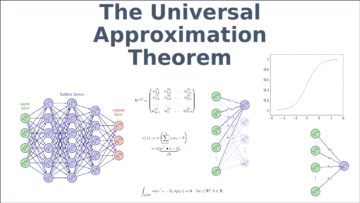
In my last substantial post of 2023, then, I set up an approach to discuss the supposedly human-like abilities of contemporary Artificial Intelligence (AI [sic]™, as I like to put it), and I now intend to follow up on it and complete the series. It is an approach I have employed when discussing AI before, and to good effect: first I provide a proper characterisation of a specific property of human cognition – in the past, I concentrated on natural language, given all the buzz around large language models; this time around was the turn of thought and thinking abilities – and then I show how AI – actually, ML models – don’t learn or exhibit mastery of such a property of cognition, in any shape or form. Read more »



 ew years, I keep getting stuck on the same question: Don’t these people have grandchildren? How can corporate decision-makers spend their days actively working to destroy the environment, pollute the water, kill off the animals, melt the glaciers, and incinerate the biosphere? Even if what they care about the most is making more money no matter how much money they already have, don’t they care at all about the world they’re leaving for their kids?


 In
In  Amar Kanwar. The Sovereign Forest, 2011- …
 The last time I see Sam she’s sitting at the vanity in her bedroom, carefully examining her 16 year-old face in its lighted mirror.


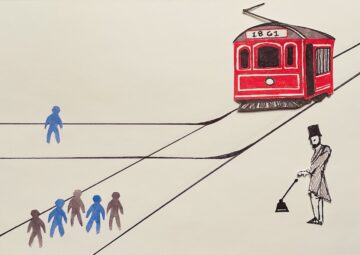 Did we need to have a Civil War? Couldn’t the two sides, geographically defined as they were, simply part before the shooting started? Did Lincoln intentionally choose war for any one of a variety of unworthy reasons that stopped short of necessity, including even something so mundane as a fear of losing face? Or was he faced with an intractable situation for which there was no simple, satisfactory answer—a type of political Trolley Problem?



 Ana Mendieta. Body Tracks, 1974.